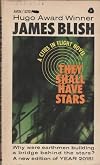
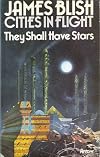
They Shall Have Stars
by James Blish
Villes Nomades (Collections and Selections — 01), Cities in Flight: Chronological order (1), Cities in Flight: Publication order (2)
On This Page
Description
"In Washington things looked serious. The big projects - the projects that meant survival - had become pawns in the game of power politics. When Colonel Paige Russell reported back with the specimens he had no idea of how quickly he was to become involved in the most dangerous adventure of all. In the great laboratory which was man's most stupendous engineering achievement - the Great Bridge on Jupiter - the last crucial experiments approached their crisis."--Publisher descriptionTags
Recommendations
















Member Reviews
To be honest, I thought the iconic Boston album cover was inspired by the Cities in Flight series, of which They Shall Have Stars is the first in the series. But I can find no evidence of that.
For old science fiction, this one had some elements to it that were surprisingly not dated. There were female characters—one major, one minor—that held technical jobs. Both were described as being rather plain instead of being made to uphold the era's standard of beauty. One woman's Latin name was just that, a name, as "such once-valid tickets no longer meant anything among the West's uniformly mixed-race population." Blish was apparently downright progressive for his time.
While paper is still a thing, robots can be operated remotely via VR show more gear. "Believer" terrorists spray gasses at people to induce feelings of euphoria or shame. Fireworks can be designed to bring sparkling messages to the sky.
Published in 1956, Blish was living in an America deep in the Cold War and infected by McCarthyism. So he took that fear and paranoia and ran with it. Domestic spying is rampant, and everyone, including Congressmen, has to watch what they say and do lest they be tossed in prison. But there's one senator that's determined to restore freedom to his fellow Americans.
But Big Science is still a thing. There's a "bridge to nowhere" down in the depths of Jupiter being used for scientific study and experiments. Remote workers on Jupiter's moons use VR to control robots on the bridge to affect repairs in the gas giant's tumultuous atmosphere. The experience can be off-putting and tends to stress out the workers.
And some astronaut has retrieved soil samples for a pharmaceutical company in hopes of discovering something useful to aid mankind. He's miffed that no one at the company is dropping everything to attend to him. While waiting he gets suspicious that there's something going on at the company. Impatient with waiting, he gets downright mean with a receptionist, and it takes a while for him to stop being an ass.
These three plotlines take nearly the entire length of this short novel (novella by today's standards) to bear fruit. I couldn't figure out where any of them were leading or how they were connected until the big reveal. The astronaut's work with the pharmaceutical company offered some clues, but the disgruntled bridge worker's story was just so much angst. If the individual storylines did more, then I would've liked it more. show less
For old science fiction, this one had some elements to it that were surprisingly not dated. There were female characters—one major, one minor—that held technical jobs. Both were described as being rather plain instead of being made to uphold the era's standard of beauty. One woman's Latin name was just that, a name, as "such once-valid tickets no longer meant anything among the West's uniformly mixed-race population." Blish was apparently downright progressive for his time.
While paper is still a thing, robots can be operated remotely via VR show more gear. "Believer" terrorists spray gasses at people to induce feelings of euphoria or shame. Fireworks can be designed to bring sparkling messages to the sky.
Published in 1956, Blish was living in an America deep in the Cold War and infected by McCarthyism. So he took that fear and paranoia and ran with it. Domestic spying is rampant, and everyone, including Congressmen, has to watch what they say and do lest they be tossed in prison. But there's one senator that's determined to restore freedom to his fellow Americans.
But Big Science is still a thing. There's a "bridge to nowhere" down in the depths of Jupiter being used for scientific study and experiments. Remote workers on Jupiter's moons use VR to control robots on the bridge to affect repairs in the gas giant's tumultuous atmosphere. The experience can be off-putting and tends to stress out the workers.
And some astronaut has retrieved soil samples for a pharmaceutical company in hopes of discovering something useful to aid mankind. He's miffed that no one at the company is dropping everything to attend to him. While waiting he gets suspicious that there's something going on at the company. Impatient with waiting, he gets downright mean with a receptionist, and it takes a while for him to stop being an ass.
These three plotlines take nearly the entire length of this short novel (novella by today's standards) to bear fruit. I couldn't figure out where any of them were leading or how they were connected until the big reveal. The astronaut's work with the pharmaceutical company offered some clues, but the disgruntled bridge worker's story was just so much angst. If the individual storylines did more, then I would've liked it more. show less
I recently got the urge to re-read James Blish's 'Cities in Flight', a sequence that I enjoyed greatly when I was first discovering science fiction in the 1970s and which I re-read fairly regularly up to my twenties. When I first came across the novels, I read them almost in reverse order; this time, I have started with the first novel in the sequence, 'They shall have stars'. (Note: the whole sequence has since been reissued bound together as one book; but I first read it as four separate novels, and my Arrow UK paperbacks, dating from the 1970s, are similarly separated; so it'll be four reviews in due course, and I shall bring all of them together on my separate reviews blog, 'Deep Waters Reading' show more [http://deepwatersreading.wordpress.com/].)
Anyway, I hope the rest of my re-read of 'Cities in Flight' comes up better than this. It wasn't just that the writing was so very 1950s; it wasn't just that the science - especially in light of what we now know about Jupiter - now comes up so very badly wrong. It wasn't even that the setting of the novel, which in 1954 was the impossibly distant year of 2018, had so very few matches with the reality of the early 21st century, either in technology, society or international politics (although interestingly, the two female characters in the novel are neither ciphers nor do they conform 100% to traditional male stereotypes of women) (more like about 45%, I'd reckon). It was the way in which so much of the novel - about 2/3rds - is characters sat in offices or restaurants doing the "Now tell me, Professor" thing. Most of the novel is just two big expository lumps. And whilst the science sounds plausible - Blish's day job was as a biologist for the Pfizer company, thinly disguised as 'Pfitzner' in the novel - it's only really good for what he knew. His planetary science was pretty shaky, even for the state of knowledge of the day. I can stand science fiction becoming out-of-date - after all, despite what a lot of people think, SF isn't prediction - but when the whole story hinges on a number of different scientific scenarios, all of which turned out to be wrong, it rather impacts the tale.
The political landscape of the book is interesting; the USA and the Soviet Union have become more like each other as the Cold War dragged on, to the extent that the USA is now an almost totalitarian state, in the interests of loyalty. Those with a bent for political commentary will smile a bit at this, because many believe that is rapidly coming true; but Blish's idea of how this might happen and what it could look like is pretty heavy-handed, and so really didn't work for me.
Having said that, the imagery of the Bridge on Jupiter is quite effective, even though even some of the characters recognise that it's one huge McGuffin; and one of the main character's surprise at encountering the first spindizzy-powered ship is effectively conveyed. But this only lasts for the duration of the (now short) voyage from Earth to Ganymede; then we're back to the talking heads. And the final message - abandon Earth to the Soviets and Take Freedom to the Stars - seems pretty clunky. I'd always thought Blish was more sophisticated than that.
And quite why Blish thought he needed to tell the story about how his future technology got invented in the first place is a bit beyond me. This novel, after all, was written second in the sequence, after the work that became (in its UK incarnation) 'Earthman, come home'. It's as if Frank Herbert had written a whole Dune novel about how someone first discovered the qualities of spice, and then told everyone exactly how they'd refined it, tested it in the laboratory, and then done clinical trials. All very interesting for biologists if it was a scientific paper, but it doesn't make for great reading. It's not even as if the story in the next novel, 'A Life for the Stars' then carries on from where this novel leaves off; there is, as far as I recollect, no narrative connection, even a slight one, between this and the next book in the sequence, not even a reference to the characters or events of the first book as history.
So, not a propitious start to my re-read. I'm hoping for better. show less
Anyway, I hope the rest of my re-read of 'Cities in Flight' comes up better than this. It wasn't just that the writing was so very 1950s; it wasn't just that the science - especially in light of what we now know about Jupiter - now comes up so very badly wrong. It wasn't even that the setting of the novel, which in 1954 was the impossibly distant year of 2018, had so very few matches with the reality of the early 21st century, either in technology, society or international politics (although interestingly, the two female characters in the novel are neither ciphers nor do they conform 100% to traditional male stereotypes of women) (more like about 45%, I'd reckon). It was the way in which so much of the novel - about 2/3rds - is characters sat in offices or restaurants doing the "Now tell me, Professor" thing. Most of the novel is just two big expository lumps. And whilst the science sounds plausible - Blish's day job was as a biologist for the Pfizer company, thinly disguised as 'Pfitzner' in the novel - it's only really good for what he knew. His planetary science was pretty shaky, even for the state of knowledge of the day. I can stand science fiction becoming out-of-date - after all, despite what a lot of people think, SF isn't prediction - but when the whole story hinges on a number of different scientific scenarios, all of which turned out to be wrong, it rather impacts the tale.
The political landscape of the book is interesting; the USA and the Soviet Union have become more like each other as the Cold War dragged on, to the extent that the USA is now an almost totalitarian state, in the interests of loyalty. Those with a bent for political commentary will smile a bit at this, because many believe that is rapidly coming true; but Blish's idea of how this might happen and what it could look like is pretty heavy-handed, and so really didn't work for me.
Having said that, the imagery of the Bridge on Jupiter is quite effective, even though even some of the characters recognise that it's one huge McGuffin; and one of the main character's surprise at encountering the first spindizzy-powered ship is effectively conveyed. But this only lasts for the duration of the (now short) voyage from Earth to Ganymede; then we're back to the talking heads. And the final message - abandon Earth to the Soviets and Take Freedom to the Stars - seems pretty clunky. I'd always thought Blish was more sophisticated than that.
And quite why Blish thought he needed to tell the story about how his future technology got invented in the first place is a bit beyond me. This novel, after all, was written second in the sequence, after the work that became (in its UK incarnation) 'Earthman, come home'. It's as if Frank Herbert had written a whole Dune novel about how someone first discovered the qualities of spice, and then told everyone exactly how they'd refined it, tested it in the laboratory, and then done clinical trials. All very interesting for biologists if it was a scientific paper, but it doesn't make for great reading. It's not even as if the story in the next novel, 'A Life for the Stars' then carries on from where this novel leaves off; there is, as far as I recollect, no narrative connection, even a slight one, between this and the next book in the sequence, not even a reference to the characters or events of the first book as history.
So, not a propitious start to my re-read. I'm hoping for better. show less
In an alternative present, the Cold War has gone the other way. The West has become more socialized to mirror the Soviets, and science has bogged down into stasis for lack of anyone's ability to share data and research. A few mavricks in the West decide to buck the system, funnelling government dollars into two related projects that will finally revolutionize Earth's future. The story is told largely from two perspectives: Col. Paige Russel, a Western astronaut whose curiosity gets the better of him as he discovers the nature of the research being done; and Robert Helmuth, an engineer working in Jupiter's orbit with the rest of his team on an enormous, mysterious construct. Both men come to terms with the enormity of what they're show more grappling with, amidst prying federal watchdogs and the pressures of their work.
As usual for sci-fi become this aged, the author's foresight was hit-and-miss regarding life in 2010, so I have to make allowances for that when reading about a scientific world far more advanced than ours that still believes itself critically sluggish. But the novel also lacks for tension and suspense. While the narration tells me the West has become rigidly security-tight, nothing I was shown supported that. It just seemed like the typical USA government to me; possibly more lax, if anything. This novel is a far cry from capturing the feel of a rigidly controlled socialist society as I'd imagine it. Meanwhile Helmuth's storyline, where he's supposedly in danger of becoming insane, doesn't convey that sense of danger. He's working in a pretty comfortable VR environment that presents no physical danger to anyone, with an understanding boss and the option of taking leave whenever he needs it. Air traffic controllers have it worse.
The novel compensates with some interesting science. How plausible it is I don't really know, as it travels well beyond my personal knowledge of medicine, chemistry, etc. The author certainly makes it sound good for a layperson. I also liked the characters. I found myself relating to the curiosity of the two leads and their yearnings to find answers. I also know this novel is the prelude to some books about floating cities, which is just, like, cool. It's a very short novel that sticks to the point and doesn't wear out its welcome, with a snappy ending. After reading the sequels I'll have a better sense of whether reading this prelude to the trilogy was necessary, but I can already say it wasn't painful. show less
As usual for sci-fi become this aged, the author's foresight was hit-and-miss regarding life in 2010, so I have to make allowances for that when reading about a scientific world far more advanced than ours that still believes itself critically sluggish. But the novel also lacks for tension and suspense. While the narration tells me the West has become rigidly security-tight, nothing I was shown supported that. It just seemed like the typical USA government to me; possibly more lax, if anything. This novel is a far cry from capturing the feel of a rigidly controlled socialist society as I'd imagine it. Meanwhile Helmuth's storyline, where he's supposedly in danger of becoming insane, doesn't convey that sense of danger. He's working in a pretty comfortable VR environment that presents no physical danger to anyone, with an understanding boss and the option of taking leave whenever he needs it. Air traffic controllers have it worse.
The novel compensates with some interesting science. How plausible it is I don't really know, as it travels well beyond my personal knowledge of medicine, chemistry, etc. The author certainly makes it sound good for a layperson. I also liked the characters. I found myself relating to the curiosity of the two leads and their yearnings to find answers. I also know this novel is the prelude to some books about floating cities, which is just, like, cool. It's a very short novel that sticks to the point and doesn't wear out its welcome, with a snappy ending. After reading the sequels I'll have a better sense of whether reading this prelude to the trilogy was necessary, but I can already say it wasn't painful. show less
I wanted to like this book, and I found things to like about it, but ultimately it left me a bit disappointed. I thought Blish's take on politics and science (and how they interact) was thought provoking, I found the direct story telling refreshing, and I liked just about everything about the gravity research on Jupiter storyline. On the other hand, the whole Paige/Anne/anti-death research storyline unconvincing on several levels, and the final climactic scene on and around one of Jupiter’s moons felt rather clunky.
They Shall Have Stars would certainly fall within the category of "hard" science fiction, coming with discussions about theories of gravity and magnetism, complete with mathematical formulae(!). The full complexity of the science went over my head, but I was able to grasp enough of it to be intrigued by the ideas.
The book begins with a couple of mysteries: a pharmaceutical company is consumed with some particularly hush-hush project, while on Jupiter a massive bridge is being built. What new drug is the company pursuing? And why build a bridge on uninhabitable Jupiter, of all places? And what links the two projects?
The novel is short, and these mysteries kept me turning the pages to figure it all out.
Along the way, the author raises show more other ideas, e.g. the future of Western culture when it is dominated by those obsessed with sniffing out unconventional thinkers on the one hand (a J. Edgar Hoover-type is a particular villain), and fanatical religionists on the other. (This book was originally written in 1957--what would the author think of things today?) Like much science fiction, characterizations were not very deep, but the content remained thoughtful throughout. show less
The book begins with a couple of mysteries: a pharmaceutical company is consumed with some particularly hush-hush project, while on Jupiter a massive bridge is being built. What new drug is the company pursuing? And why build a bridge on uninhabitable Jupiter, of all places? And what links the two projects?
The novel is short, and these mysteries kept me turning the pages to figure it all out.
Along the way, the author raises show more other ideas, e.g. the future of Western culture when it is dominated by those obsessed with sniffing out unconventional thinkers on the one hand (a J. Edgar Hoover-type is a particular villain), and fanatical religionists on the other. (This book was originally written in 1957--what would the author think of things today?) Like much science fiction, characterizations were not very deep, but the content remained thoughtful throughout. show less
This book has sat on my shelf for about 20 years before I actually got around to reading it. I had known Blish from his adaptations of the original Star Trek shows into short story form that were published in the 70s. I was a fan of reading his Star Trek books in grade school since I was a fan of all things Trek but due to those books I never thought his original stories worthy of reading.
The "Cities in Flight" series of stories is a vision of the future in which gravity has been mastered and almost any object can be transported at speeds greater than light and whole cities are now migrating across the galaxy in search of work. Blish makes many predictions about the future and almost all never came true. Blish makes predictions about show more the end result of the cold war, future of medicine, physics, and society and is far from correct in almost every respect. The characters and feel of the novels also seem hopelessly trapped in the 70s. (Did Blish honestly think we would still be using slide rules 1000 years in the future?). The only thing that rescues the stories is the rather neat technology of the "spindizzy" and its implications. The storytelling is uneven in places and mundane side stories go on for far too long. The characters also seem 2 dimensional even though they are supposed to be hundreds of years old. I'm not disappointed I finally read the book but it could have remained on my shelf for another 20 years. show less
The "Cities in Flight" series of stories is a vision of the future in which gravity has been mastered and almost any object can be transported at speeds greater than light and whole cities are now migrating across the galaxy in search of work. Blish makes many predictions about the future and almost all never came true. Blish makes predictions about show more the end result of the cold war, future of medicine, physics, and society and is far from correct in almost every respect. The characters and feel of the novels also seem hopelessly trapped in the 70s. (Did Blish honestly think we would still be using slide rules 1000 years in the future?). The only thing that rescues the stories is the rather neat technology of the "spindizzy" and its implications. The storytelling is uneven in places and mundane side stories go on for far too long. The characters also seem 2 dimensional even though they are supposed to be hundreds of years old. I'm not disappointed I finally read the book but it could have remained on my shelf for another 20 years. show less
Reapproaching the Cities in Flight stories, after first reading them in the late 1960's, I wondered if my memory of them would stand the test of time. This first book in the series (chronologically, but it was the second to be written) was a disappointment. It felt like a book the author had to write to fulfil a contractual commitment. Whilst covering the origins of the anti-agathic drugs and 'spindizzy', albeit in very general terms, the plot line was very contrived. There were long dialogue passages used instead of story development, and some of the characters barely sketches. I was disappointed.
Members
- Recently Added By
Lists

Books Read in 2020
4,379 works; 124 members

Les 100 principaux titres de la science-fiction (1981)
126 works; 3 members
Author Information

268+ Works 24,500 Members
James Benjamin Blish was born on May 23, 1921 in East Orange, N.J. Blish trained as a biologist at Rutgers and Columbia University, and spent 1942 - 1944 as a medical technician in the United States Army. After the war he became the science editor for the Pfizer pharmaceutical company. His first published story appeared in 1940, and his writing show more career progressed until he gave up his job to become a professional writer. From 1962 to 1968, he worked for the Tobacco Institute. Between 1967 and his death from lung cancer in 1975, Blish wrote authorized short story collections based upon the 1960s TV series Star Trek. He wrote 11 volumes adapting episodes of the series. He died midway through writing Star Trek 12. Perhaps Blish's most famous works were the "Okies" stories, known collectively as Cities in Flight, published in the science-fiction digest magazine Astounding Science Fiction. Some of James Blish's other works include The Vanished Jet, And All the Stars a Stage, The Quincunx of Time, and Flight of Eagles. (Bowker Author Biography) show less
Some Editions
Series

Villes Nomades
1 works (Collections and Selections — 01)

Cities in Flight: Chronological order
6 works (1)

Cities in Flight: Publication order
6 works (2)
Belongs to Publisher Series
Work Relationships
Is contained in
Common Knowledge
- Canonical title*
- Aux hommes les étoiles
- Original title
- They Shall Have Stars
- Alternate titles
- Year 2018!
- Original publication date
- 1956
- People/Characters
- Dr. Guiseppe Corsi; Senator Bliss Wagoner; Colonel Paige Russell; Anne Abbott; Truman Gunn; Frank MacHinery (show all 10); General Horsefield; Robert Helmuth; Charity Dillon; Eva Chavez
- Important places
- Okie Cities
- Dedication
- To Frederik Pohl
- First words
- The shadows flickered on the walls to his left and right, just inside the edges of his vision.
- Last words
- (Click to show. Warning: May contain spoilers.)After a while, the man and the woman went to the window, and looked past the discarded bulk of Jupiter at the near horizon, where there had always been visible a few stars.
- Original language
- English
*Some information comes from Common Knowledge in other languages. Click "Edit" for more information.
Classifications
Statistics
- Members
- 533
- Popularity
- 56,016
- Reviews
- 15
- Rating
- (3.24)
- Languages
- 7 — Danish, English, French, German, Portuguese, Spanish, Swedish
- Media
- Paper, Ebook
- ISBNs
- 8
- ASINs
- 27