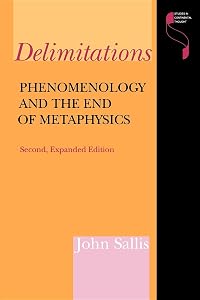
Delimitations: Phenomenology and the End of Metaphysics
by John Sallis
35 Members (3.00)
On This Page
Description
Since Hegel, philosophers have declared repeatedly that metaphysics is at an end, a pronouncement that has sparked much contemporary philosophical debate. What exactly does the end, or closure, of metaphysics mean, and what are the implications of this view? John Sallis characterizes the end of metaphysics as a limit, or horizon, both enclosing metaphysical thought and opening the field of thinking beyond it. He elaborates five areas in which the boundaries of thinking are extended: show more imagination as an opening power, the radicalizing of phenomenology's injunction to attend to the things themselves, Heidegger's shift of thinking toward an opening or clearing, archaic closure through a return to Plato and Heraclitus, and the nonidentity that takes place in the act of delimitation. This last question is developed in relation to Husserl's project of a pure phenomenology, to the debate between hermeneutics and deconstruction, and to the secluding of ground announced in Schelling's thought. show lessTags
Recommendations





























Member Reviews
Members
- Recently Added By
Author Information
John Sallis is Frederick J. Adelmann Professor of Philosophy at Boston College. He is the author of many books, including Klee's Mirror; The Gathering of Reason: Second Edition; and Platonic Legacies, all also published by SUNY Press.
Series
Belongs to Publisher Series
Common Knowledge
- Canonical title
- Delimitations: Phenomenology and the End of Metaphysics
- Original publication date
- 1986
Classifications
Statistics
- Members
- 35
- Popularity
- 820,529
- Rating
- (3.00)
- Languages
- English, French
- Media
- Paper, Ebook
- ISBNs
- 8
- ASINs
- 1