The Undertow: Scenes from a Slow Civil War
by Jeff Sharlet
On This Page
Description
An Instant New York Times Bestseller.One of America's finest reporters and essayists explores the powerful currents beneath the roiled waters of a nation coming apart.
An unmatched guide to the religious dimensions of American politics, Jeff Sharlet journeys into corners of our national psyche where others fear to tread. The Undertow is both inquiry and meditation, an attempt to understand how, over the last decade, reaction has morphed into delusion, social division into distrust, show more distrust into paranoia, and hatred into fantasies—sometimes realities—of violence.
Across the country, men "of God" glorify materialism, a gluttony of the soul, while citing Scripture and preparing for civil war—a firestorm they long for as an absolution and exaltation. Lies, greed, and glorification of war boom through microphones at hipster megachurches that once upon a time might have preached peace and understanding. Political rallies are as aflame with need and giddy expectation as religious revivals. At a conference for incels, lonely single men come together to rage against women. On the Far Right, everything is heightened—love into adulation, fear into vengeance, anger into white-hot rage. Here, in the undertow, our forty-fifth president, a vessel of conspiratorial fears and fantasies, continues to rise to sainthood, and the insurrectionist Ashli Babbitt, killed on January 6 at the Capitol, is beatified as a martyr of white womanhood.
Framing this dangerous vision, Sharlet remembers and celebrates the courage of those who sing a different song of community, and of an America long dreamt of and yet to be fully born, dedicated to justice and freedom for all.
Exploring a geography of grief and uncertainty in the midst of plague and rising fascism, The Undertow is a necessary reckoning with our precarious present that brings to light a decade of American failures as well as a vision for American possibility.
. show less
Tags
Recommendations






























Member Reviews
A remarkable travelogue of post-Trumpian America that explores vast differences of ideology across vast tracts of grief-stricken land. Sharlet is a wonderfully gifted journalist whose ornate prose flows through brooks and ravines of communities in perpetual mourning. He compassionately interrogates the stormy confluence of emotion and logic, a remote and fathomless delta poisoned by blind faith and cultish urges that are fomented by charismatic charlatans and righteous avengers for an imagined populace who have collectively been duped by the very junkyard messiah they worship. The Undertow is a modern take on Lesy's Wisconsin Death Trip that lays bare the circling eddy of white American exceptionalism and provides creative commentary show more about the overfracked streams of consciousness that have carried the nation to the brink of another civil war, and that continue to roil and bubble just upriver from the next roaring cataract. Bookended by transportive chapters that explore the legacies of Harry Belafonte and Lee Hays and their respective ordeals of social justice, Sharlet effectively reminds us that the past is all-too-obviously prologue. show less
Sharlet is such a beautiful writer that you almost forget he's telling a horror story. He interviews numerous people of all races across our country who believe that Trump is God, Ashli Babbitt (who was killed in the January 6 capitol riot) is a martyr, and only through armed insurrection will the country be set right. They're already busy preaching their unique take on the Gospels, amassing multitudes of firearms, and training militias.
The only reassurance that Sharlet can provide are bookend chapters about activists Harry Belafonte, and folksong legends The Weavers, who kept on singing even though their causes were virtually hopeless. He admits to having started his odyssey with heart problems, and one wonders if the process of show more researching and writing this book may have further eroded his health. It certainly raised my blood pressure. show less
The only reassurance that Sharlet can provide are bookend chapters about activists Harry Belafonte, and folksong legends The Weavers, who kept on singing even though their causes were virtually hopeless. He admits to having started his odyssey with heart problems, and one wonders if the process of show more researching and writing this book may have further eroded his health. It certainly raised my blood pressure. show less
This is such a strange trip of a book! The author's plan is to track down who and what constitutes belief in the ultimate "civil war" that is predicted by QAnon ("Storm is coming"). But the first and last chapters seem like they are from a different book, and they are the best, so achingly poignant. The recently deceased Harry Belafonte's origin story is the first chapter and now you will learn even more to admire about him. The last chapter is about Lee Hayes, a Black musician who, with Pete Seeger, was one of the founding members of The Weavers, who taught America Leadbelly's essential and immortal folk songs "Goodnight Irene", "Midnight Special", "Rock Island Line", "Stewball" and their own "Which Side Are You On". In between these show more gems are the author's fond reminiscence of Occupy Wall Street, followed by too many frightening tales of his meetups with members of what he terms "The Trumpocene", featuring a multitude of evangelical church leaders and gun enthusiasts. In sum, a confusing but compelling narrative.
Quotes: "Whiteness has always been a means of claiming the suffering it inflicts on others as its own."
"His red hat and the gun on his hip displayed a certain sense of American threat level. He looked as if he'd been left a long time in the deep fryer."
"Everybody seemed to know someone who'd participated in January 6, and yet nobody believed it'd really happened. Such cognitive dissonance is the awful genius of our ecstatically disinformed age." show less
Quotes: "Whiteness has always been a means of claiming the suffering it inflicts on others as its own."
"His red hat and the gun on his hip displayed a certain sense of American threat level. He looked as if he'd been left a long time in the deep fryer."
"Everybody seemed to know someone who'd participated in January 6, and yet nobody believed it'd really happened. Such cognitive dissonance is the awful genius of our ecstatically disinformed age." show less
Our present moment is haunted by its socio-cultural condition. Many would rather pretend otherwise or remain ensconced in their particular bubble. Jeff Sharlet went out exploring.
The result is The Undertow Scenes From a Slow Civil War. Sharlet uses the January 6 insurrection and the death of Ashli Babbit to frame his 12 year exploration into the socio-cultural movements at work in American society.
Sharlet does fantastic work in investigation and reporting and writes well. He visits Occupy Wall Street and gets a feel for why people are there. He visits Trump rallies in 2016 and 2020 and men’s rights conferences. He is present at a rally in remembrance of Ashli Babbit and then drives across the country, randomly visiting churches show more and/or interviewing people who express strong support for Trump. He hears the same fevered stories, heartfelt yet almost utterly devoid of reality. The same anxieties and fears pervade throughout. There is an expectation - almost a relishing - of the prospect of civil war, of "“us” against “them,” “red” against “blue,” “rural” vs. “urban.” Sharlet concludes with an account of The Weavers, the last moment of vitality in an American Left worthy of the name and its ultimate demise in the 1950s and 1960s.
This is definitely a work written more for understanding the condition of the reactionary right-wing in America than anything else, but all do well to grapple with the reality of the world Sharlet investigated. How much longer will comity prevail? What awful and terrible crisis will come to relieve all of this friction and tension? Only God knows; it probably won’t be good. show less
The result is The Undertow Scenes From a Slow Civil War. Sharlet uses the January 6 insurrection and the death of Ashli Babbit to frame his 12 year exploration into the socio-cultural movements at work in American society.
Sharlet does fantastic work in investigation and reporting and writes well. He visits Occupy Wall Street and gets a feel for why people are there. He visits Trump rallies in 2016 and 2020 and men’s rights conferences. He is present at a rally in remembrance of Ashli Babbit and then drives across the country, randomly visiting churches show more and/or interviewing people who express strong support for Trump. He hears the same fevered stories, heartfelt yet almost utterly devoid of reality. The same anxieties and fears pervade throughout. There is an expectation - almost a relishing - of the prospect of civil war, of "“us” against “them,” “red” against “blue,” “rural” vs. “urban.” Sharlet concludes with an account of The Weavers, the last moment of vitality in an American Left worthy of the name and its ultimate demise in the 1950s and 1960s.
This is definitely a work written more for understanding the condition of the reactionary right-wing in America than anything else, but all do well to grapple with the reality of the world Sharlet investigated. How much longer will comity prevail? What awful and terrible crisis will come to relieve all of this friction and tension? Only God knows; it probably won’t be good. show less
Reporter Jeff Sharlet is best known for The Family: The Secret Fundamentalism at the Heart of American Power. The current book, published in 2023, is mainly a tour of the world of Trump followers, plus some other chapters bearing on our predicament. I worry about the people who dwell in Trump world, drilling with their guns and trading insane stories about the evils of people not in their cult. Sharlet, a political progressive, goes and talks to them, bringing back what he's learned in ten chapters across three major sections, most with photo illustrations.
He starts the book with a section titled "Day-O:On Hope". There's a chapter on Harry Belafonte, singer and civil rights activist, whose smile hid his anger. Following is a piece on show more the Occupy Wall Street movement of 2011, through the lens of a Cynthia Ozick book that once was part of the Occupy library.
The next second major section, "Dream On:On Vanity", starts with portraits of a couple of preachers of the so-called Prosperity Gospel - the theory that Jesus wants his followers to be, not good so much as rich, which fortune they may attain by sending money to these preachers. Sharlet next explores the "manosphere", the online groupings of men who feel, deeply and personally, that the world owes them sexual access to women, and threaten or commit violence when the world doesn't make good on the debt.
In "The Trumpocene", Sharlet recounts his attendance at numerous rallies of the Trump 2020 presidential campaign. He talks to voters who believe in more secret knowledges and conspiracies than you could shake a demonic stick at, including that Bill and Hillary Clinton are serial murderers (they killed one of his interviewees' uncles!) who eat babies. There's a subpart on Gnosticism and its natural blend with right wing delusion.
The section ends with "Tick-Tock", on the Qanon conspiracy theorists, for whom every inconsistency, every Trump brain glitch, is a clue.
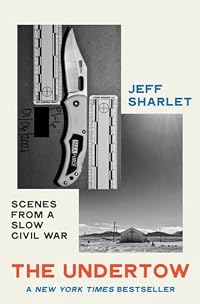
The third and last major section, "Goodnight, Irene:On Survival", begins with the 123 page heart of the book, "The Undertow", which follows the story of Ashli Babbit. That's her knife on the book's cover illustration; she was carrying it when she was shot to death while breaching the Capitol on January 6, 2021. Babbit has become a sort of saint on the right. The chapter is a road trip across America, starting at a "justice for Ashli" rally in California. There, a pastor wears a t-shirt featuring Joshua 1:9, which he takes as an exhortation to kill in Trump's righteous cause. Proud Boys trade punches with Antifa as the police look on. A French-speaking Native American Jew-for-Jesus January 6 rioter is interviewed. A jobless ex-TV host declares what Ashli would want today. Ashli's mother asks why Ashli is not proclaimed a hero. Kyle Rittenhouse's former lawyer says that Ashli "was all of us". An Ashli flag is flown. Sharlet is threatened by men calling themselves Saviors, and leaves for his next stop, Yuba City California, where he visits a church known for giving Michael Flynn a rifle, for holding mask-free services throughout the COVID years,and for a pulpit made from swords. A guest speaker, David Straight, talks about heading a secret team under Melania Trump which arrested many child traffickers, and notes that Hillary Clinton has already been executed.
Getting dizzy yet? But the reader must follow Sharlet farther as he travels east across Nevada, hearing talk-radio hosts make machine-gun noises over the air. He gives us more of what his subjects say about Ashli, in Rifle, Colorado and Omaha, Nebraska, among other places. In Wisconsin he meets the Brumms, who show him some of (the legal part of) their arsenal and boast that their adult daughter is the family's best shot and a rare natural killer; the dad opposes abortion because it makes for fewer soldiers when China will invade the US. And on: so many guns, so many weirdly decorated flags, so many characters whose self-defined individualities overlay political tendencies all pointed in the same direction.
Sharlet's last chapter, "The Good Fight is the One You Lose", is another musician's biography, that of Lee Hays, the bass voice of The Weavers, who fought fascists with song, sometimes in venues where that put his life at stake.
The Undertow is impressionistic, not analytical. There's not a thesis so much as a theme: we're all here together in America, distrusting one another, fed different streams of information. The main fault I find with the book is that it's hard to know what to do with what he gives us. But that's the main problem with contemporary politics; we know what's wrong, but what do we do? show less
He starts the book with a section titled "Day-O:On Hope". There's a chapter on Harry Belafonte, singer and civil rights activist, whose smile hid his anger. Following is a piece on show more the Occupy Wall Street movement of 2011, through the lens of a Cynthia Ozick book that once was part of the Occupy library.
The next second major section, "Dream On:On Vanity", starts with portraits of a couple of preachers of the so-called Prosperity Gospel - the theory that Jesus wants his followers to be, not good so much as rich, which fortune they may attain by sending money to these preachers. Sharlet next explores the "manosphere", the online groupings of men who feel, deeply and personally, that the world owes them sexual access to women, and threaten or commit violence when the world doesn't make good on the debt.
In "The Trumpocene", Sharlet recounts his attendance at numerous rallies of the Trump 2020 presidential campaign. He talks to voters who believe in more secret knowledges and conspiracies than you could shake a demonic stick at, including that Bill and Hillary Clinton are serial murderers (they killed one of his interviewees' uncles!) who eat babies. There's a subpart on Gnosticism and its natural blend with right wing delusion.
The section ends with "Tick-Tock", on the Qanon conspiracy theorists, for whom every inconsistency, every Trump brain glitch, is a clue.
The third and last major section, "Goodnight, Irene:On Survival", begins with the 123 page heart of the book, "The Undertow", which follows the story of Ashli Babbit. That's her knife on the book's cover illustration; she was carrying it when she was shot to death while breaching the Capitol on January 6, 2021. Babbit has become a sort of saint on the right. The chapter is a road trip across America, starting at a "justice for Ashli" rally in California. There, a pastor wears a t-shirt featuring Joshua 1:9, which he takes as an exhortation to kill in Trump's righteous cause. Proud Boys trade punches with Antifa as the police look on. A French-speaking Native American Jew-for-Jesus January 6 rioter is interviewed. A jobless ex-TV host declares what Ashli would want today. Ashli's mother asks why Ashli is not proclaimed a hero. Kyle Rittenhouse's former lawyer says that Ashli "was all of us". An Ashli flag is flown. Sharlet is threatened by men calling themselves Saviors, and leaves for his next stop, Yuba City California, where he visits a church known for giving Michael Flynn a rifle, for holding mask-free services throughout the COVID years,and for a pulpit made from swords. A guest speaker, David Straight, talks about heading a secret team under Melania Trump which arrested many child traffickers, and notes that Hillary Clinton has already been executed.
Getting dizzy yet? But the reader must follow Sharlet farther as he travels east across Nevada, hearing talk-radio hosts make machine-gun noises over the air. He gives us more of what his subjects say about Ashli, in Rifle, Colorado and Omaha, Nebraska, among other places. In Wisconsin he meets the Brumms, who show him some of (the legal part of) their arsenal and boast that their adult daughter is the family's best shot and a rare natural killer; the dad opposes abortion because it makes for fewer soldiers when China will invade the US. And on: so many guns, so many weirdly decorated flags, so many characters whose self-defined individualities overlay political tendencies all pointed in the same direction.
Sharlet's last chapter, "The Good Fight is the One You Lose", is another musician's biography, that of Lee Hays, the bass voice of The Weavers, who fought fascists with song, sometimes in venues where that put his life at stake.
The Undertow is impressionistic, not analytical. There's not a thesis so much as a theme: we're all here together in America, distrusting one another, fed different streams of information. The main fault I find with the book is that it's hard to know what to do with what he gives us. But that's the main problem with contemporary politics; we know what's wrong, but what do we do? show less
This was an excellently written book - one of the few non-fiction "page turners" that I've run across. The first three quarters is a tale of a cross country trip seeking the roots of our current political malaise, and it's filled with insights and horrors and intelligent musings, mostly tied together around the sad tale of Ashli Babbit. The last quarter is a second trip to Wisconsin, and it's here that the author pretty much loses it. It seems to me that here the author actively sought angst rather than recording and reporting it. For want of a better term, it's whiny. And the very last section tries to tie in the Old Left of the 50's to today's turmoil - for what reason I couldn't discern. This is a good book nonetheless, but it show more could've been a lot better - 5 stars easy if he hadn't lost his focus. show less
3.5
In the Undertow: Scenes from a Slow Civil War, journalist Jeff Sharlet embarks on a year-long road trip to chronicle what he calls " the theology" of the far right. In his journey, he meets and interviews evangelical pastors, members of militia groups, QAnon followers, and other adherents of the " Trumpecene."
Sharett is a skilled interviewer and writer, and the portraits he paints are chilling. I listened to the book on audio, and it frightened me. However, his analysis was limited as he sees the rise of the far right solely as an ideological and cultural phenomenon and does not examine the economic and structural factors that most likely come into play.
These limitations could be a consequence of the travelogue structure of the show more text. On a road trip, one must sacrifice depth for breadth. Yet, as I listened to different interviews, questions popped into my head. Is this person representative of the community in which they live? What percentage of the population believes as they do? What is the economic situation in the area? What kinds of jobs are available? What is the educational level? I wanted a fuller picture.
Despite these concerns, I recommend the book. Just don't read or listen to it before you go to sleep. show less
In the Undertow: Scenes from a Slow Civil War, journalist Jeff Sharlet embarks on a year-long road trip to chronicle what he calls " the theology" of the far right. In his journey, he meets and interviews evangelical pastors, members of militia groups, QAnon followers, and other adherents of the " Trumpecene."
Sharett is a skilled interviewer and writer, and the portraits he paints are chilling. I listened to the book on audio, and it frightened me. However, his analysis was limited as he sees the rise of the far right solely as an ideological and cultural phenomenon and does not examine the economic and structural factors that most likely come into play.
These limitations could be a consequence of the travelogue structure of the show more text. On a road trip, one must sacrifice depth for breadth. Yet, as I listened to different interviews, questions popped into my head. Is this person representative of the community in which they live? What percentage of the population believes as they do? What is the economic situation in the area? What kinds of jobs are available? What is the educational level? I wanted a fuller picture.
Despite these concerns, I recommend the book. Just don't read or listen to it before you go to sleep. show less
Members
- Recently Added By
Author Information

11+ Works 2,019 Members
Jeff Sharlet is a visiting research scholar at New York University's Center for Religion and Media. He is a contributing editor for Harper's and Rolling Stone, the coauthor, with Peter Manseau, of Killing the Buddha, and the editor of The Revealer.org. He lives in Brooklyn, New York.
Some Editions
Awards and Honors
Awards
Distinctions
Notable Lists
Common Knowledge
- First words
- Throat clearing such as this prelude usually accounts for a journey that ends with the book in your hands. But this book is written from the middle of something, a season of coming apart. -Prelude: Our Condition
Once, more than half a century ago, he was the handsomest man in the world. -Chapter 1, Voice and Hammer - Canonical DDC/MDS
- 320.973
- Canonical LCC
- BL2525.S532
Classifications
- Genres
- General Nonfiction, Nonfiction, History, Religion & Spirituality
- DDC/MDS
- 320.973 — Society, Government, and Culture Political science Types of Government Political situation and conditions North America United States
- LCC
- BL2525 .S532 — Philosophy, Psychology and Religion Religions. Mythology. Rationalism Religions. Mythology. Rationalism History and principles of religions American
- BISAC
Statistics
- Members
- 259
- Popularity
- 124,660
- Reviews
- 11
- Rating
- (3.72)
- Languages
- English
- Media
- Paper, Audiobook, Ebook
- ISBNs
- 3
- ASINs
- 3