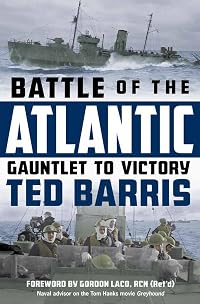
Battle of the Atlantic: Gauntlet to Victory
by Ted Barris
On This Page
Description
The Battle of the Atlantic, Canada's longest continuous military engagement of the Second World War, lasted 2,074 days, claiming the lives of more than 4,000 men and women in the Royal Canadian Navy, the Royal Canadian Air Force and the Canadian merchant navy The years 2019 to 2025 mark the eightieth anniversary of the longest battle of the Second World War, the Battle of the Atlantic. It also proved to be the war's most critical and dramatic battle of attrition. For five and a half years, show more German surface warships and submarines attempted to destroy Allied trans-Atlantic convoys, most of which were escorted by Royal Canadian destroyers and corvettes, as well as aircraft of the Royal Canadian Air Force. Throwing deadly U-boat "wolf packs" in the paths of the convoys, the German Kriegsmarine almost succeeded in cutting off this vital lifeline to a beleaguered Great Britain. In 1939, the Royal Canadian Navy went to war with exactly thirteen warships and about 3,500 regular servicemen and reservists. During the desperate days and nights of the Battle of the Atlantic, the RCN grew to 400 fighting ships and over 100,000 men and women in uniform. By V-E Day in 1945, it had become the fourth largest navy in the world. The story of Canada's naval awakening from the dark, bloody winters of 1939-1942, to be "ready, aye, ready" to challenge the U-boats and drive them to defeat, is a Canadian wartime saga for the ages. While Canadians think of the Great War battle of Vimy Ridge as the country's coming of age, it was the Battle of the Atlantic that proved Canada's gauntlet to victory and a nation-building milestone. show lessTags
Recommendations






















Member Reviews
Another Barris masterpiece using the method he has employed for so many of his books about Canada's history. As he title suggests, this is about Canada's contribution to the Allied victory in the Battle of the Atlantic. Starting the War with just thirteen warships and 3500 sailors, at the conclusion in May 1945 Canada's navy had grown to 400 fighting ships and 100,000 personnel to become the fourth largest navy in the world.
In these pages, Barris explains how that happened and who the men and women to make it happen were and he includes hundreds of their individual experiences manning ships in the violent, cold Atlantic while fighting off Hitler's submarines, aircraft and war ships.
In these pages, Barris explains how that happened and who the men and women to make it happen were and he includes hundreds of their individual experiences manning ships in the violent, cold Atlantic while fighting off Hitler's submarines, aircraft and war ships.
In fairness to the book itself, I have been listening to an audio version. Just dreadful. Surely a reader could learn to pronounce foreign words more nearly correctly. For instance, the ending 'e' in German is not like 'é' in French! It's painful to listen to this.
Ratings
Members
- Recently Added By
Lists

Globe and Mail | Canadian Non-Fiction: October 1, 2022
10 works; 1 member
Globe and Mail | Canadian Non-Fiction: October 15, 2022
10 works; 1 member

Globe and Mail | Canadian Non-Fiction: October 8, 2022
10 works; 1 member

Globe and Mail | Canadian Non-Fiction: November 19, 2022
10 works; 1 member
Author Information

14 Works 565 Members
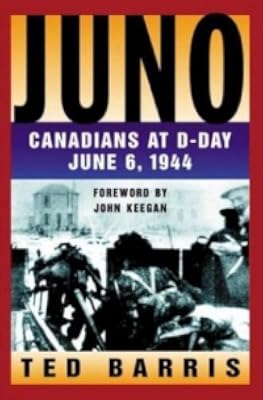
Ted Barris is an author, journalist and broadcaster. He is a full-time professor of journalism at Centennial College in Toronto. He has written more than fifteen non-fiction books including Victory at Vimy: Canada Comes of Age, April 9-12, 1917; Juno: Canadians at D-Day June 6, 1944; and The Great Escape: A Canadian Story. (Bowker Author Biography)
Classifications
Statistics
- Members
- 35
- Popularity
- 819,597
- Reviews
- 2
- Rating
- (3.80)
- Languages
- English
- Media
- Paper, Ebook
- ISBNs
- 4
- ASINs
- 1