Beasts in My Belfry
by Gerald Durrell, Edward Mortelmans
On This Page
Description
Beasts in My Belfry is the wonderfully funny memoir about Gerald Durrell's time at Whipsnade Zoo and his experiences as a young zookeeper. Following the Second World War, Durrell joined Whipsnade Zoo as a junior keeper - an opportunity that fulfilled a lifelong dream. Thanks to Rupert Degas's brilliant voicing, which captures all of Durrell's charm and wit, the listener can enjoy being taken behind the scenes of one of the world's very first zoos. This is a delightful portrait of the animals show more who lived there and those who looked after them. show lessTags
Recommendations



















Member Reviews
Gerry tells us that he regards himself as a lucky person. Since the age of two he made up his mind that he was going to study animals. Nothing else interested him.
He wanted to become a collector of animals and eventually have his own zoo. All this came to pass.
He tells us a lot about his life but never mentions his childhood in Greece, which is what we best know about him from the tv series.
The book’s main content is an account of Gerry’s first job, at Whipsnade Zoo.
Gerry’s talents are not only describing the various animals he cares for but also the people he encounters. He is at his most humorous when describing people.
Regarding the head of Whipsnade Zoo, Captain Beale, he imparts to us that he spoke “in a sort of muted show more roar”.
At the zoo, he is given various basic tasks, such as feeding the animals, clearing out the stalls, cages, and so forth.
Beale and the others working at the zoo tend to rather look down on Gerry: they have no idea that he is to become a world famous animal expert and best-selling author.
Though he is not given prestigious tasks at the zoo, he studies all the animals he’s assigned to take care of with his unsurpassable and meticulous powers of observation.
He is fortunate to get cheap lodging with a kind woman, Mrs Bailey, the wife of one of the zoo’s employees, who supplies him with delicious and sumptuous meals.
It was somewhat shocking for Gerry that his first job was taking care of the lions. He would rather have begun by looking after “a herd of dewy-eyed deer”.
The lion was called Albert and his two wives were Nan and Jill.
They didn’t look fierce and wild to him, in fact they looked overweight, lazy and slightly superior.
One of the keepers, Jesse, warns him that he shouldn’t try any tricks with the lions, or they’ll “have him”. They may look tame but they’re not.
He had to learn the routine work of feeding and cleaning and other daily chores, but when this was mastered he was able to watch the animals and try to learn something about them.
The keepers, Jesse and Joe, were vastly amused by the fact that Gerry carried an enormous notebook in his pocket and would at the slightest provocation whip it out and make an entry.
Gerry read up about lions but fund that what he read did not fit with reality.
In Pliny’s Natural History (1674) lions were said to be gentle but Gerry discovered that Albert did not possess an ounce of mercy.
Albert spent his time hiding behind bushes and leaping out at unsuspecting old ladies as they passed (though he couldn’t actually get at them, of course).
Albert and his wives had prodigious appetites and in spite of being so fat would squabble and snarl over their meat as though they had not been fed for weeks.
Gerry describes his interaction with the lions in a wonderful, satirical style.
After knowing Albert for some weeks, Gerry decided that he was “sulky, blustery and devoid of any finer feelings whatsoever”
His small golden eyes always had in them “an expression of baffled rage”.
He always had a “faintly puzzled look” about him.
Either he pranced about in a “filthy temper” or indulged in his joke of jumping out at unsuspecting passers-by and getting “a sardonic pleasure out of their panic”.
Gerry tried very hard but could not find “a single endearing quality” in Albert.
His next job was looking after the tigers. There were four tigers.
Ranee.and Paul were mother and son and lived in a pit. Gerry was permitted to scratch Paul’s ears. Jum and Maurena lived in a “great” cage.
Jum and his mate communicated by means of sniffs - “prodigious nose-quivering sniffs”.
Each sniff seemed to have its own meaning, and each sounded different from the other.
At one point Gerry met the owner’s son, Billy, though he didn’t know that was who he was.
He was a tall red-headed boy who waved his arms about like windmills and giggled. Gerry took Billy to be a sort of idiot since he, Billy, didn’t understand a word Gerry said.
Maurena, the tigress, had come into season and now Gerry observed and made copious notes about the tigers’ courtship.
Maurena had changed overnight from a “timid, servile creature” to a “slinking, dangerous animal” that dealt with Jum’s advances “speedily and ferociously”.
Gerry gives us a description of the whole procedure.
Another curious thing Gerry observed was that Jum used to lick his meat before devouring it. The meat was shredded off by the abrasive qualities of his tongue.
When Gerry was at Whipsnade, he was inundated with a multitude of what he considered to be inane questions about the animals. The public seemed to be totally ignorant of even the commonest facts of animal life.
And one little boy asked him “Mister, ‘ave you ever been ate by one of them buggers?”
Another little boy called to his mother, “Mum, come here quick and look at this zebra (one of the tigers).”
Gerry is invited to drinks by Billy’s father, Captain Beale. Later he’s regularly invited to dinner with the family.
This is a vastly entertaining, humorous and informative book, and you will enjoy it greatly if you have the slightest interest in animals and appreciate Gerrys’ wonderful humour. Highly recommended. show less
He wanted to become a collector of animals and eventually have his own zoo. All this came to pass.
He tells us a lot about his life but never mentions his childhood in Greece, which is what we best know about him from the tv series.
The book’s main content is an account of Gerry’s first job, at Whipsnade Zoo.
Gerry’s talents are not only describing the various animals he cares for but also the people he encounters. He is at his most humorous when describing people.
Regarding the head of Whipsnade Zoo, Captain Beale, he imparts to us that he spoke “in a sort of muted show more roar”.
At the zoo, he is given various basic tasks, such as feeding the animals, clearing out the stalls, cages, and so forth.
Beale and the others working at the zoo tend to rather look down on Gerry: they have no idea that he is to become a world famous animal expert and best-selling author.
Though he is not given prestigious tasks at the zoo, he studies all the animals he’s assigned to take care of with his unsurpassable and meticulous powers of observation.
He is fortunate to get cheap lodging with a kind woman, Mrs Bailey, the wife of one of the zoo’s employees, who supplies him with delicious and sumptuous meals.
It was somewhat shocking for Gerry that his first job was taking care of the lions. He would rather have begun by looking after “a herd of dewy-eyed deer”.
The lion was called Albert and his two wives were Nan and Jill.
They didn’t look fierce and wild to him, in fact they looked overweight, lazy and slightly superior.
One of the keepers, Jesse, warns him that he shouldn’t try any tricks with the lions, or they’ll “have him”. They may look tame but they’re not.
He had to learn the routine work of feeding and cleaning and other daily chores, but when this was mastered he was able to watch the animals and try to learn something about them.
The keepers, Jesse and Joe, were vastly amused by the fact that Gerry carried an enormous notebook in his pocket and would at the slightest provocation whip it out and make an entry.
Gerry read up about lions but fund that what he read did not fit with reality.
In Pliny’s Natural History (1674) lions were said to be gentle but Gerry discovered that Albert did not possess an ounce of mercy.
Albert spent his time hiding behind bushes and leaping out at unsuspecting old ladies as they passed (though he couldn’t actually get at them, of course).
Albert and his wives had prodigious appetites and in spite of being so fat would squabble and snarl over their meat as though they had not been fed for weeks.
Gerry describes his interaction with the lions in a wonderful, satirical style.
After knowing Albert for some weeks, Gerry decided that he was “sulky, blustery and devoid of any finer feelings whatsoever”
His small golden eyes always had in them “an expression of baffled rage”.
He always had a “faintly puzzled look” about him.
Either he pranced about in a “filthy temper” or indulged in his joke of jumping out at unsuspecting passers-by and getting “a sardonic pleasure out of their panic”.
Gerry tried very hard but could not find “a single endearing quality” in Albert.
His next job was looking after the tigers. There were four tigers.
Ranee.and Paul were mother and son and lived in a pit. Gerry was permitted to scratch Paul’s ears. Jum and Maurena lived in a “great” cage.
Jum and his mate communicated by means of sniffs - “prodigious nose-quivering sniffs”.
Each sniff seemed to have its own meaning, and each sounded different from the other.
At one point Gerry met the owner’s son, Billy, though he didn’t know that was who he was.
He was a tall red-headed boy who waved his arms about like windmills and giggled. Gerry took Billy to be a sort of idiot since he, Billy, didn’t understand a word Gerry said.
Maurena, the tigress, had come into season and now Gerry observed and made copious notes about the tigers’ courtship.
Maurena had changed overnight from a “timid, servile creature” to a “slinking, dangerous animal” that dealt with Jum’s advances “speedily and ferociously”.
Gerry gives us a description of the whole procedure.
Another curious thing Gerry observed was that Jum used to lick his meat before devouring it. The meat was shredded off by the abrasive qualities of his tongue.
When Gerry was at Whipsnade, he was inundated with a multitude of what he considered to be inane questions about the animals. The public seemed to be totally ignorant of even the commonest facts of animal life.
And one little boy asked him “Mister, ‘ave you ever been ate by one of them buggers?”
Another little boy called to his mother, “Mum, come here quick and look at this zebra (one of the tigers).”
Gerry is invited to drinks by Billy’s father, Captain Beale. Later he’s regularly invited to dinner with the family.
This is a vastly entertaining, humorous and informative book, and you will enjoy it greatly if you have the slightest interest in animals and appreciate Gerrys’ wonderful humour. Highly recommended. show less
After reading "My family and other animals" and determining it to be one of my favourite books of all time, I started searching for more of Durrell's reminiscing. This follow-up, which covers Durrell's time as a zookeeper at regional English zoo, doesn't have the same childhood wonder that "My family ..." had and while "Beasts ..." does have some amusing moments, including descriptions of some of the animals, mainly the book just makes one want to reread "My family ...".
One bone to pick with Durrell is his beliefs that animals should be locked up in smaller cages. Whipsnade zoo was an open zoo where animals had large areas to roam but Durrell believed that the animals wouldn't have minded being cooped up in less space and, anyway, they show more were so hard to catch when they had such a large distance to run around in. Hmm, I'm not sure if staff convenience is a good excuse for locking animals in small enclosures. show less
One bone to pick with Durrell is his beliefs that animals should be locked up in smaller cages. Whipsnade zoo was an open zoo where animals had large areas to roam but Durrell believed that the animals wouldn't have minded being cooped up in less space and, anyway, they show more were so hard to catch when they had such a large distance to run around in. Hmm, I'm not sure if staff convenience is a good excuse for locking animals in small enclosures. show less
This is Durrell's memoir of his year at Whipsnade Zoo in the 1940s. He was 19 or 20, and it was his first real job. He lived at the zoo and learned about keepering as it was in those days. This experience, while retold with Durrell's trademarked hilarity, helped to form the staunch conservationist he was to become as an adult. A lovely slice of life, well-written and wry. His reverence for the animals informs every word.
Gerald Durrell, animal collector and wildlife conservationist, began his career working in the Whipsnade Zoo during the 1940's. This books tells of his early apprenticeship there. It mostly describes his experiences working with the animals and amusing incidents which occurred. His fellow keepers were colorful characters to say the least. Most of them had little factual knowledge about the animals, but would make things up to impress the visitors. Some of the more interesting passages include Durrell quoting passages out of old books full of misconceptions about animals, then countering them with his own careful observations. While at Whipsnade the author realized the important role zoos take in conservation efforts, especially with show more captive breeding programs and education. The last chapter closes with Durrell realizing it is time to move on with his plans and leave the zoo so he can pursue his dream of collecting animals. I enjoyed reading this book, it has an easy style which is entertaining and moves quickly.
More at Dog Ear Diary show less
More at Dog Ear Diary show less
Autobigraphical writings on Durrell's first work in a zoo - as a 20 year-old at the end of WW2. Nice light reading about the animals at Whipsnade Zoo, but probably just as interesting in the light it shines on post-war England. Read August 2009.
Easy reading covering the year that Gerald Durrell spent working at Whipsnade animal park. As entertaining as I've come to expect from Durrell.
Amusing, but I don’t think I’ll ever like Durrell as much as he apparently likes himself.
Members
- Recently Added By
Author Information

107+ Works 21,792 Members
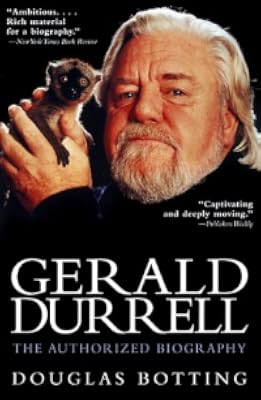
Gerald Durrell was born on January 7, 1925 in Jamshedpur, India to British parents. After the death of his father in 1928, the family lived in England and Europe before settling in Corfu, where he spent much of his childhood. Educated by private tutors, he became interested in natural history and amassed a private collection of dozens of creatures show more from scorpions to owls. He went on numerous wildlife expeditions and founded the Jersey Zoological Park and the Jersey Wildlife Preservation Trust with the purpose of breeding endangered species. His first book, The Overloaded Ark, was published in 1953. He wrote 37 books during his lifetime including My Family and Other Animals, The Bafut Beagles, A Zoo in My Luggage, Rosy Is My Relative, and The Mockery Bird. He received the Order of the British Empire in 1982 and was featured in the United Nations' Roll of Honor for Environmental Achievement in 1988. He died from complications related to a liver transplant on January 30, 1995 at the age of 70. (Bowker Author Biography) show less
1+ Work 510 Members
Some Editions
Series
Belongs to Publisher Series
Work Relationships
Common Knowledge
- Canonical title
- Beasts in My Belfry
- Original title
- A Bevy of Beasts
- Alternate titles
- Bevy of Beasts
- Original publication date
- 1973
- People/Characters
- Gerald Durrell
- Important places
- Whipsnade, Bedfordshire, England, UK
- Epigraph
- He prayeth well, who loveth well
Both man and bird and beast
Coleridge, "The Ancient Mariner" - Dedication
- For Bianca and Grandy,
in memory of three-quarters of a gorilla
and many other things - First words
- They say that a child who aspires to be an engine driver very rarely grows up to fill that role in life.
- Last words
- (Click to show. Warning: May contain spoilers.)I picked up my suitcase and made my way out of the park.
Classifications
Statistics
- Members
- 510
- Popularity
- 58,897
- Reviews
- 10
- Rating
- (3.76)
- Languages
- 7 — Danish, Dutch, English, Estonian, German, Hungarian, Latvian
- Media
- Paper, Audiobook, Ebook
- ISBNs
- 33
- ASINs
- 15