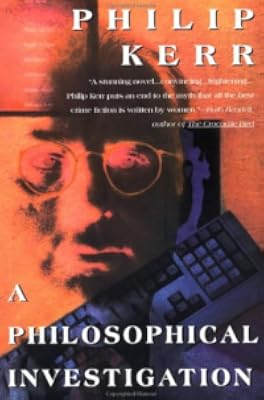
A Philosophical Investigation
by Philip Kerr
On This Page
Description
A terrifyingly prescient cult classic by the bestselling author of the Bernie Gunther series.“Chilling...absorbing...part techno-thriller, part futuristic detective story, part diary of a serial killer.”—The New York Times Book Review
LONDON, 2013. Serial killings have reached epidemic proportions—even with the widespread government use of DNA detection, brain-imaging, and the “punitive coma.” Beautiful, whip-smart, and driven by demons of her own, Detective Isadora show more “Jake” Jacowicz must stop a murderer, code-named “Wittgenstein,” who has taken it upon himself to eliminate any man who has tested positive for a tendency towards violent behavior—even if his victim has never committed a crime. He is a killer whose intellectual brilliance is matched only by his homicidal madness. show less
Tags
Recommendations


















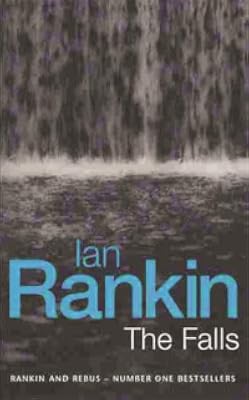

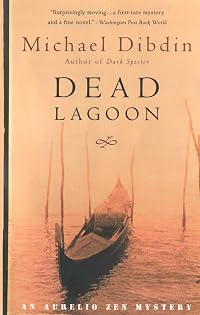



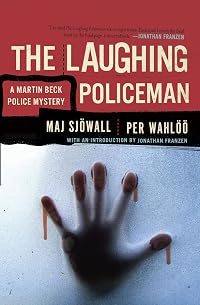

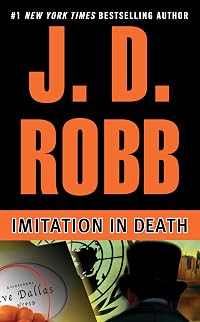








Member Recommendations
sek_smith another work of fiction based on an abstract theory
Member Reviews
Quite a refreshing read. This author is not afraid to try new things and changes around the trappings of the long established detective genre, with mixed results. We follow Jake, a protagonist we can freely call a militant lesbian since the author himself does exactly that. To my great relief this strong characterization doesn't get in the way of the plot or the story and shouldn't make anyone uncomfortable, in fact there are so many other politically incorrect situations described correctly that at some point the extreme descriptions feel quite natural and appropriate.
Police Detective Jake manages to place herself at the head of an investigation into the search for a serial killer who hunts other potential killers. Written in 1992 the show more novel postulates what society and criminal investigation might look like in our current age. Some is spot on some not so much. Both Jake and the killer use criminal profiling in their cat and mouse game but the core method of investigation is, or should have been, philosophy. The killer is obsessed with his idol the philosopher Wittgenstein and kills other killers who's assigned nickname by the criminal database also correspond to philosophers.
What should have been a battle of wits turns instead out to be a battle of wills. The author is so focused on trying to fit philosophy work in the context of crime that the entire endeavor feels forced to say the least. There is much to be enjoyed in this book and I would recommend anyone to read this if only to see the bravado of the author in breaking stereo types and trying out near future predictions. Describing this as a book thought of by Neal Stephenson and executed by William Gibson without directions doesn't feel far from the mark. If there are any gaping plot holes it would have to be things you would think the author knew something about. For example:
Schizophrenia is not the same as Multiple Personality Disorder (MPD).
A sociopath is not someone who suffers from schizophrenia.
There are also incredibly clumsy plot holes that have nothing to do with the technical details of mental illness or philosophy. Quite early on in the novel the police bureau comes up with a good description of the killer and even has a police sketch of his face. As a final touch Jake has an elaborate recording of the killer's voice. However Jake does not instantly recognize the killer after coming in close contact and even speaking with him. show less
Police Detective Jake manages to place herself at the head of an investigation into the search for a serial killer who hunts other potential killers. Written in 1992 the show more novel postulates what society and criminal investigation might look like in our current age. Some is spot on some not so much. Both Jake and the killer use criminal profiling in their cat and mouse game but the core method of investigation is, or should have been, philosophy. The killer is obsessed with his idol the philosopher Wittgenstein and kills other killers who's assigned nickname by the criminal database also correspond to philosophers.
What should have been a battle of wits turns instead out to be a battle of wills. The author is so focused on trying to fit philosophy work in the context of crime that the entire endeavor feels forced to say the least. There is much to be enjoyed in this book and I would recommend anyone to read this if only to see the bravado of the author in breaking stereo types and trying out near future predictions. Describing this as a book thought of by Neal Stephenson and executed by William Gibson without directions doesn't feel far from the mark. If there are any gaping plot holes it would have to be things you would think the author knew something about. For example:
Schizophrenia is not the same as Multiple Personality Disorder (MPD).
A sociopath is not someone who suffers from schizophrenia.
There are also incredibly clumsy plot holes that have nothing to do with the technical details of mental illness or philosophy. Quite early on in the novel the police bureau comes up with a good description of the killer and even has a police sketch of his face. As a final touch Jake has an elaborate recording of the killer's voice. However Jake does not instantly recognize the killer after coming in close contact and even speaking with him. show less
The problem for any author who writes about the future is attaching a date to that vision. 1984, 2001, etc. Here we are in 2014 and witness that the future is much more prosaic than the book or movie. The same is true here. The year is 2013. Chief Inspector “Jake” Jacowicz has been assigned to investigate the murders of several VMN-negative men. Research has revealed that men who are deficient in Ventro Medial Nucleus are more likely to commit violent antisocial acts. The Lombroso project was created to analyze men, to find those who are VMN deficit and to provide counseling and drug treatment in order to prevent their violent natures from committing crimes. Unfortunately, one of the VMN-negative men has found his way into the show more database and is killing off the men.
Each of the men has been given a code name to protect his privacy. The killer’s code is Ludwig Wittgenstein (obviously the title is a pun on Wittgenstein's most famous work), a twentieth century philosopher who speculated on the nature of language and its relationship to empirical reality. Oddly, the killer, in the eyes of the detectives begins to assume characteristics similar to the original philosopher whose diaries reveal interesting speculations on the nature of death and reality. Punishment in 2013 consists of punitive coma of varying lengths — often permanent. This was a way of defeating the anti-capital punishment groups. Obviously a person in a coma is not dead, they are being fed and cared for, and we know brain waves continue during coma, and its reversible nature at will (in 2013) provides control and saves money. Ironic given recent events in Oklahoma.
The book is quite interesting in some of the philosophical issues it raises. The discussion of murder is particularly interesting. “Because each time I kill one of my brothers, I am, of course, killing God. But just a minute, I hear you say: if someone kills God and God does not exist, then surely he’s killing nothing at all. It makes no sense to say ‘I am killing something’ when the something does not exist. I can imagine a god that is not there, in this forest, but not kill one that is not there. And ‘to imagine a god in this forest’ means to imagine a god is there. Burt to kill a god does not mean that. . . But if someone says ‘in order for me to be able to imagine God he must after all exist in some sense’, the answer is: no, he does not have to exist in any sense. Except one. Where God does exist is in the mind of man. Ergo, one kills a man, one kills God.” Fascinating.
There are other intriguing speculations on the nature of society and what is right and wrong. Society is simply a bias toward commonly held standards of what constitutes right and wrong. “That does not give us the truth about my acts. Only the appearance of truth. For thousands of years, when a man took another man's property it was called theft. But for almost a century, in certain parts of this world this sort of thing was legitimized by the name of Marxism. Tomorrow’s political philosophy might sanction murder, just as Marxism once sanctioned theft.
You talk about a standard of a decent society. . .. But what kind of society is it that regards a President of the United States who orders the use of nuclear weapons to kill thousands of people as a great man, and another man who assassinates a single President as a criminal?”
Very good detective story that speculates on numerous important issues, but he would have been better advised to leave the year ambiguous.. show less
Each of the men has been given a code name to protect his privacy. The killer’s code is Ludwig Wittgenstein (obviously the title is a pun on Wittgenstein's most famous work), a twentieth century philosopher who speculated on the nature of language and its relationship to empirical reality. Oddly, the killer, in the eyes of the detectives begins to assume characteristics similar to the original philosopher whose diaries reveal interesting speculations on the nature of death and reality. Punishment in 2013 consists of punitive coma of varying lengths — often permanent. This was a way of defeating the anti-capital punishment groups. Obviously a person in a coma is not dead, they are being fed and cared for, and we know brain waves continue during coma, and its reversible nature at will (in 2013) provides control and saves money. Ironic given recent events in Oklahoma.
The book is quite interesting in some of the philosophical issues it raises. The discussion of murder is particularly interesting. “Because each time I kill one of my brothers, I am, of course, killing God. But just a minute, I hear you say: if someone kills God and God does not exist, then surely he’s killing nothing at all. It makes no sense to say ‘I am killing something’ when the something does not exist. I can imagine a god that is not there, in this forest, but not kill one that is not there. And ‘to imagine a god in this forest’ means to imagine a god is there. Burt to kill a god does not mean that. . . But if someone says ‘in order for me to be able to imagine God he must after all exist in some sense’, the answer is: no, he does not have to exist in any sense. Except one. Where God does exist is in the mind of man. Ergo, one kills a man, one kills God.” Fascinating.
There are other intriguing speculations on the nature of society and what is right and wrong. Society is simply a bias toward commonly held standards of what constitutes right and wrong. “That does not give us the truth about my acts. Only the appearance of truth. For thousands of years, when a man took another man's property it was called theft. But for almost a century, in certain parts of this world this sort of thing was legitimized by the name of Marxism. Tomorrow’s political philosophy might sanction murder, just as Marxism once sanctioned theft.
You talk about a standard of a decent society. . .. But what kind of society is it that regards a President of the United States who orders the use of nuclear weapons to kill thousands of people as a great man, and another man who assassinates a single President as a criminal?”
Very good detective story that speculates on numerous important issues, but he would have been better advised to leave the year ambiguous.. show less
This mystery is set in a future world where science has discovered a genetic tendency toward violent crime and where a secret database lists these individuals. Now someone is killing them. The female police inspector on the case has her own issues, but gradually tightens the net until she finds him. Parts of the book are the diary of the killer, who waxes philosophical at times. Those were the times when my interest flagged and I became impatient with the story.
I liked Philip Kerr's Berlin Noir Trilogy very much, but cannot say the same about A Philosophical Investigation. The latter is set in London in 2013 with an engaging female officer from Scotland Yard who is an expert on chasing serial killers and she has a doozy on her hands in this novel: a man who is busy bumping off men, who have been identified through a secret government program as carrying a specific brain structure that predisposes them to violence; the killer is also one of these men and believes that he is doing a service by eliminating others who might–might–one day be violent. The point of view shifts between the policewoman and the killer with the latter justifying or at least exploring his actions in terms of show more philosophies of life, death, existence, etc; this then develops into a dialogue between the two, complicated by the policewoman's political superiors who want to twist all this philosophical musing into an argument, to the killer, that the only logical extension of his actions is suicide. I found the philosophical interventions sometimes interesting, but more often they seemed to detract from the flow of the novel. Sometimes it felt as if the murder mystery was just a vehicle for the author's musings.
(Feb/06) show less
(Feb/06) show less
The best of Kerr's non-Gunther novels, imo (noting that I've never been able to get very far with the Isaac Newton book). A combination serial killer/science fiction/philosophical novel. The philosophical part is a bit thin, but the rest holds together reasonably well, without the disasters-through-pandering or -imitation that seem common in many of Kerr's other 90s works.
Philosophical murder mystery set slightly in the future (2013) - supposedly there is a DNA test that reveals criminal tendencies and serial killers are rampant - one in particular is killing men before they commit crimes "just in case". A female detective is assigned to catch him. The story is ok, but the long break-ins of philosophical musings really detract from it.
Well written and generally enjoyable, particularly if you've read any Wittgenstein.
Members
- Recently Added By
Author Information

45+ Works 19,438 Members
Awards and Honors
Common Knowledge
- Original title
- A Philosophical Investigation
- Original publication date
- 1992
- People/Characters
- Isadora "Jake" Jacowicz; Wittgenstein; John Gilmore; Grace Miles; Norman Waring
- Epigraph
- The best I could write would never be more than philosophical remarks; my thoughts were soon crippled if I tried to force them on in any single direction against their natural inclination. - And this was, of course, connected... (show all) with the very nature of the investigation. For this compels us to travel over a wide field of thought criss-cross in every direction.
Ludwig Wittgenstein: Philosophical Investigations
There will be a time to murder and create,
And time for all the works and days of hands
That lift and drop a question on your plate;
T. S. Eliot: The Love song of J. Alfred Prufrock - Dedication
- For Jane
- First words
- 'The unfortunate victim, twenty-five-year-old Mary Woolnoth, was found naked in the basement of the offices of the Mylar Shipping Company in Jermyn Street, where she had worked for three years as a receptionist, her face beat... (show all)en in with a claw hammer.
- Last words
- (Click to show. Warning: May contain spoilers.)Jake wiped the tear from her eye, collected the hyacinth, and went out into the sunshine.
Classifications
Statistics
- Members
- 900
- Popularity
- 30,019
- Reviews
- 13
- Rating
- (3.48)
- Languages
- 13 — Czech, Danish, Dutch, English, Finnish, French, German, Greek, Italian, Japanese, Norwegian (Bokmål), Portuguese, Spanish
- Media
- Paper, Audiobook, Ebook
- ISBNs
- 50
- ASINs
- 14