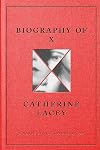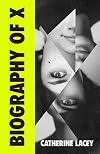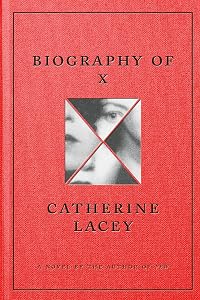
Biography of X
by Catherine Lacey
On This Page
Description
When X - an iconoclastic artist, writer, and polarizing shape-shifter - falls dead in her office, her widow, wild with grief and refusing everyone's good advice, hurls herself into writing a biography of the woman she deified. Though X was recognized as a crucial creative force of her era, she kept a tight grip on her life story. Not even CM, her wife, knew where X had been born, and in her quest to find out, she opens a Pandora's box of secrets, betrayals, and destruction. All the while, show more she immerses herself in the history of the Southern Territory, a fascist theocracy that split from the rest of the country after World War II, as it is finally, in the present day, forced into an uneasy reunification. show lessTags
Recommendations


Member Reviews
After her wife dies and a biography about her wife is published that CM feels is full of inaccuracies and lies, CM sets out to write the real biography of X. But the artist known most prominently as X has a past filled with obfuscations and deceptions, not all of them done in the name of art. As her widow dives deeper into her wife's life, what emerges is a conundrum. Was her wife a great and multi-talented artist who acted with her art in mind? Or was she a narcissistic grifter who hurt far too many people? Or does the truth lie somewhere in between?
Catherine Lacey has created a confounding novel; the subject is largely unsympathetic and the narrator is made unreliable by her motivations and loyalties. It's the kind of novel that show more needs an assured and talented author to pull it off, and Lacey does have the chops. Adding to the mix, Lacey has also set this biography in an alternate history of the United States, parts of which are described in detail, larger questions are hand-waved away or ignored. It was a lot to put in one book. X interacts with pretty much every famous person from the seventies to the late nineties, from Andy Warhol and Kathy Acker, to David Bowie, Warren Beatty and Susan Sontag. Lacey sticks to the format and there are amply endnotes, often referencing real people who accomplished different things in this alternative world, sometimes flipping details, like Rachel Cusk becoming Richard Cusk.
So does this audacious project work? Yes, mostly, almost? The alternate history that allows X to be in/famous and allows her a large role in the lives of many well-known people, lessens the stakes of the novel by constantly reminding the reader that this is fiction. The world Lacey has created has some large holes that are never addressed, while other issues are carefully laid out and it left me increasingly impatient, waiting for the information that never arrived. This is a book that looks at sexism, as it exists in the different countries the US has split into, in detail but ignores racism, which seems to have never existed in this version of the world. And many huge changes occur peacefully and largely off the page. The US split without war, women took over art without more than an occasional article wondering if men can even create real art, and despite the fact that the US is now three separate countries, no one wanted names more creative than the Northern Territory, the Southern Territory and the Western Territory (I really had trouble believing that we wouldn't have ended up with variations on the United Republic of America, the Democratic Republic of America and the Free Republic of Real American States.)
Lacey is a fantastic author and as CM learns new things about her wife, she reassessed their relationship, that was structured very much as a traditional marriage, where CM gave up her own career and aspirations to be X's support staff. These realizations come slowly, having to penetrate the gloss that grief has put on her memories of X and it's very well done. And the endnotes look like they were a lot of fun to write. show less
Catherine Lacey has created a confounding novel; the subject is largely unsympathetic and the narrator is made unreliable by her motivations and loyalties. It's the kind of novel that show more needs an assured and talented author to pull it off, and Lacey does have the chops. Adding to the mix, Lacey has also set this biography in an alternate history of the United States, parts of which are described in detail, larger questions are hand-waved away or ignored. It was a lot to put in one book. X interacts with pretty much every famous person from the seventies to the late nineties, from Andy Warhol and Kathy Acker, to David Bowie, Warren Beatty and Susan Sontag. Lacey sticks to the format and there are amply endnotes, often referencing real people who accomplished different things in this alternative world, sometimes flipping details, like Rachel Cusk becoming Richard Cusk.
So does this audacious project work? Yes, mostly, almost? The alternate history that allows X to be in/famous and allows her a large role in the lives of many well-known people, lessens the stakes of the novel by constantly reminding the reader that this is fiction. The world Lacey has created has some large holes that are never addressed, while other issues are carefully laid out and it left me increasingly impatient, waiting for the information that never arrived. This is a book that looks at sexism, as it exists in the different countries the US has split into, in detail but ignores racism, which seems to have never existed in this version of the world. And many huge changes occur peacefully and largely off the page. The US split without war, women took over art without more than an occasional article wondering if men can even create real art, and despite the fact that the US is now three separate countries, no one wanted names more creative than the Northern Territory, the Southern Territory and the Western Territory (I really had trouble believing that we wouldn't have ended up with variations on the United Republic of America, the Democratic Republic of America and the Free Republic of Real American States.)
Lacey is a fantastic author and as CM learns new things about her wife, she reassessed their relationship, that was structured very much as a traditional marriage, where CM gave up her own career and aspirations to be X's support staff. These realizations come slowly, having to penetrate the gloss that grief has put on her memories of X and it's very well done. And the endnotes look like they were a lot of fun to write. show less
X is a talented and controversial performance artist, musician, and writer. When she dies, her widow is angered by an inaccurate and unauthorized biography, and sets out to write her own biography to correct the record. The result is what we read here, although it is less a biography of X and more of an account of how the widow narrator researched her wife's secretive past. It becomes a decades-long obsession for the narrator, and in the process, she learns a lot of unpleasant things about X: throughout the book, her relationship to X and her memory of X shifts in complicated and uncomfortable ways, although she ultimately continues to be in thrall to her manipulative and controlling dead wife.
The book is set in an alternate history show more where the US split into a few different nations in the early 20th century, with the south becoming a Christian authoritarian state (scary to read about right after Trump was elected to a second term!) and the northeast becoming an extremely liberal socialist democracy. In places, this alternate history feels a bit too radical. For instance, men stop being artists and all of the famous and well-respected artists are women. As much as I love that idea, it would require a way more radical change in our culture than is depicted in the book. At the same time, sometimes this alternate history is too recognizable: David Bowie still writes the same songs, a lot of the same famous people are still famous. In some ways, the exposition of this alternate history is clunky and uneven. What we are reading is a book that is written in the alternate history, which means the narrator is writing for an audience that exists within the alternate history, which means she can't plausibly explain parts of it to her readers (that would be like someone writing a biography of a Kardashian and stopping to explain who Obama is). Sometimes she does this anyway, which feels a bit odd, but sometimes there are also some big gaps in the worldbuilding.
The purpose of this alternate universe is to explore extremes of sexism: the southern states are extremely oppressive for women, while the northern states sound almost like a feminist utopia. X exists in both of these worlds at different times in her life, and a lot of her art can be seen as a response to her experiences of oppression and liberation.
This is a complex book, and Lacey is a very skilled author to pull it off. It's one of those books that I didn't exactly enjoy reading: X is frankly a horrible person, and the narrator isn't much better, so it's a lot of time with some highly unlikable people. But I absolutely admire the skill it took to create this world, and to tell the reader so many things that the narrator isn't aware of. show less
The book is set in an alternate history show more where the US split into a few different nations in the early 20th century, with the south becoming a Christian authoritarian state (scary to read about right after Trump was elected to a second term!) and the northeast becoming an extremely liberal socialist democracy. In places, this alternate history feels a bit too radical. For instance, men stop being artists and all of the famous and well-respected artists are women. As much as I love that idea, it would require a way more radical change in our culture than is depicted in the book. At the same time, sometimes this alternate history is too recognizable: David Bowie still writes the same songs, a lot of the same famous people are still famous. In some ways, the exposition of this alternate history is clunky and uneven. What we are reading is a book that is written in the alternate history, which means the narrator is writing for an audience that exists within the alternate history, which means she can't plausibly explain parts of it to her readers (that would be like someone writing a biography of a Kardashian and stopping to explain who Obama is). Sometimes she does this anyway, which feels a bit odd, but sometimes there are also some big gaps in the worldbuilding.
The purpose of this alternate universe is to explore extremes of sexism: the southern states are extremely oppressive for women, while the northern states sound almost like a feminist utopia. X exists in both of these worlds at different times in her life, and a lot of her art can be seen as a response to her experiences of oppression and liberation.
This is a complex book, and Lacey is a very skilled author to pull it off. It's one of those books that I didn't exactly enjoy reading: X is frankly a horrible person, and the narrator isn't much better, so it's a lot of time with some highly unlikable people. But I absolutely admire the skill it took to create this world, and to tell the reader so many things that the narrator isn't aware of. show less
This is the third of Catherine Lacey’s books that I’ve read. I’m not sure I really understood any of them, but I’m good with that. She’s trying to do more than just entertain.
The style of the book isn’t simple. It’s the story of a biography. The narrator is the biography’s author, and the wife of the biography’s subject, X. It’s framed by the narrator’s experience with another biography of X, which bristles both her regard for truth and her somewhat proprietary attitude toward her former wife. It is her motivation for writing her own biography.
The fictional author is C.M. Lucca. She was married to X until X’s death. X was not always X. She had a long history prior to meeting Lucca, and much of the story is Lucca show more running down X’s story, visiting former friends and acquaintances, including X’s former husband.
X was born Carrie Lu in the Southern Territory of Lacey’s alternative history. What had been the United States divided itself after World War II into a Northern Territory, a Southern Territory, and a Western Territory. The Southern Territory (ST) was an authoritarian religious state, separated from the North and West by a mostly impassable wall. Emigration from the ST was all but impossible.
As Lucca traces X’s personal history, she discovers those facts — X has lived a life of numerous identities and personalities, abandoning her previous lives and personalities at every turn. She told Lucca, her wife, none of this.
Part of X’s secrecy, and her enigmatic name, stems from her escape from the ST. She was part of a rebellious group involved in the Revelation Rifle Affair, an attempted guerrilla style attack on the ST at one of the territory’s rifle factories (firearms were mandatory for citizens of the ST).
Of the seven involved in the Affair, three survived and made their way across the border from the ST. The other two were Kathy Boudin and Ted Gold — you may recognize the names as (real-life) fugitives from the Weather Underground involved in the Greenwich Village townhouse explosion, after which the Revelation Rifle Affair seems to have been modeled by Lacey.
Lacey scatters real-life figures throughout the story of X’s life as Lucca uncovers it. X is almost a Zelig type of character, present at and, in her case, participating in milestone events of a fictional history that overlaps with our own.
Events and persons, like those figures from the Weather Underground, are interestingly adapted to the circumstances of Lacey’s fictional history. Even Emma Goldman finds her place in this history, as a more or less conventional politician.
X has been an artist — a performance artist, a musician, a painter, . . . anything that provides a medium for self-expression. Her own portfolio of identities and personalities are themselves an artistic activity.
She has been a Zelig of the art world, mixing with and sometimes collaborating with (real-life) musicians Connie Converse, David Byrne, David Bowie, and Tom Waits, or taking her place in the New York gallery scene, not just one person in so many places like Zelig, but many persons in many places.
X isn’t so much a person as a variable, as becomes more and more evident in Lucca’s detective work.
Obviously this is no beach read. It will stir up thoughts about the permanence of identity, the relationship between art and life, and probably a lot more. I’m going to keep reading Lacey’s work. show less
The style of the book isn’t simple. It’s the story of a biography. The narrator is the biography’s author, and the wife of the biography’s subject, X. It’s framed by the narrator’s experience with another biography of X, which bristles both her regard for truth and her somewhat proprietary attitude toward her former wife. It is her motivation for writing her own biography.
The fictional author is C.M. Lucca. She was married to X until X’s death. X was not always X. She had a long history prior to meeting Lucca, and much of the story is Lucca show more running down X’s story, visiting former friends and acquaintances, including X’s former husband.
X was born Carrie Lu in the Southern Territory of Lacey’s alternative history. What had been the United States divided itself after World War II into a Northern Territory, a Southern Territory, and a Western Territory. The Southern Territory (ST) was an authoritarian religious state, separated from the North and West by a mostly impassable wall. Emigration from the ST was all but impossible.
As Lucca traces X’s personal history, she discovers those facts — X has lived a life of numerous identities and personalities, abandoning her previous lives and personalities at every turn. She told Lucca, her wife, none of this.
Part of X’s secrecy, and her enigmatic name, stems from her escape from the ST. She was part of a rebellious group involved in the Revelation Rifle Affair, an attempted guerrilla style attack on the ST at one of the territory’s rifle factories (firearms were mandatory for citizens of the ST).
Of the seven involved in the Affair, three survived and made their way across the border from the ST. The other two were Kathy Boudin and Ted Gold — you may recognize the names as (real-life) fugitives from the Weather Underground involved in the Greenwich Village townhouse explosion, after which the Revelation Rifle Affair seems to have been modeled by Lacey.
Lacey scatters real-life figures throughout the story of X’s life as Lucca uncovers it. X is almost a Zelig type of character, present at and, in her case, participating in milestone events of a fictional history that overlaps with our own.
Events and persons, like those figures from the Weather Underground, are interestingly adapted to the circumstances of Lacey’s fictional history. Even Emma Goldman finds her place in this history, as a more or less conventional politician.
X has been an artist — a performance artist, a musician, a painter, . . . anything that provides a medium for self-expression. Her own portfolio of identities and personalities are themselves an artistic activity.
She has been a Zelig of the art world, mixing with and sometimes collaborating with (real-life) musicians Connie Converse, David Byrne, David Bowie, and Tom Waits, or taking her place in the New York gallery scene, not just one person in so many places like Zelig, but many persons in many places.
X isn’t so much a person as a variable, as becomes more and more evident in Lucca’s detective work.
Obviously this is no beach read. It will stir up thoughts about the permanence of identity, the relationship between art and life, and probably a lot more. I’m going to keep reading Lacey’s work. show less
4.5 A musing on love, art and loss, set in a parallel world amidst a mash up of pop art, music and literature. Lacey's writing is amazingly good- she cuts around between side stories deftly bringing in new characters, dropping others as her narrator attempts to find the truth about what her life with the artist known as X meant. She is furious that an unauthorized biography failed to capture her love's life accurately, and while claiming she is embarking on the real biography is really exploring her grief. A handmaid's tale-like alternative present complements the above story, but could have been better developed- though then the novel might have been too long. The opening third was the stongest part of the book, the middle third a show more little soft (hence the 4.5) and the ending solid. Overall an exceptional read. show less
Can’t fault her writing, characterizations or the seductive bibliography to this novel. I just did not respond to the alternate U.S. history and associated constraints which form the basis of the story. I was more interested in the narrator than what she dug up on X.
‘Biography of X’ by Catherine Lacey was Sunnys Book Club pick for April. I was given a NetGalley audio ARC (big thanks to them and the publisher Recorded Books for this!) The narrator Cassandra Campbell does an incredible job and I so enjoyed her embodiment of CM as I listened along to the physical book. What a wonderful experience.
THIS BOOK — GOD! I loved it. Talk about ambitious, this faux biography is complete with photos, scraps of paper, footnotes and more. I loved it. X’s life unfolds in a way that feels organic and had me theorizing till the end. CM, X’s widow, was an incredible narrator because she has a very complicated history and unique perspective on X… and it bleeds into the work, as you might imagine. It is show more told against the backdrop of an alternate United States and unpacks themes of queerness, revolution and religion (Christianity specifically), in that severed US. It also leans heavily into the discussion of Art vs Artist and the idea of an eccentric artist who is a WOMAN as opposed to a man. How much suffering, cruelty, violence and deceit is afforded a genius? Should it be! But X is also just a fascinating figure, I’d watch the documentary in a heartbeat.
What an achievement! Highly recommend. show less
THIS BOOK — GOD! I loved it. Talk about ambitious, this faux biography is complete with photos, scraps of paper, footnotes and more. I loved it. X’s life unfolds in a way that feels organic and had me theorizing till the end. CM, X’s widow, was an incredible narrator because she has a very complicated history and unique perspective on X… and it bleeds into the work, as you might imagine. It is show more told against the backdrop of an alternate United States and unpacks themes of queerness, revolution and religion (Christianity specifically), in that severed US. It also leans heavily into the discussion of Art vs Artist and the idea of an eccentric artist who is a WOMAN as opposed to a man. How much suffering, cruelty, violence and deceit is afforded a genius? Should it be! But X is also just a fascinating figure, I’d watch the documentary in a heartbeat.
What an achievement! Highly recommend. show less
2023. An amazing book. X is a Downtown artist, writer, musician, producer, with a secret dark past and a talent for disguises. After she dies her wife sets out to find out who she really was, but finds way more than she bargained for. Is X gaslighting her from beyond the grave? A paranoia-inducing book of shifting realities that had me questioning everything. What is real? A corker. Great bang for your book-buying buck.
Members
- Recently Added By
Lists

Books Read in 2023
5,638 works; 147 members

Anticipated 2022 & Early 2023 Releases
209 works; 4 members

Netgalley Reads
468 works; 3 members

Top Five Books of 2023
767 works; 317 members

2024 Notable Books for Adults
26 works; 1 member

The Atlantic's The Great American Novel
136 works; 12 members

2024. Nuestro año literario (Faustino Sánchez)
20 works; 1 member
Author Information

10+ Works 2,349 Members
Awards and Honors
Common Knowledge
- Canonical title
- Biography of X
- Dedication
- This book is for my mother, Susan
- First words
- The first winter she was dead it seemed every day for months on end was damp and bright—it had always just rained, but I could never remember the rain—and I took the train down to the city, a few days a week, searching (i... (show all)t seemed) for a building I might enter and fall from, a task about which I could never quite determine my own sincerity, as it seemed to me the seriousness of anyone looking for such a thing could not be understood until a body needed to be scraped from the sidewalk.
- Last words
- (Click to show. Warning: May contain spoilers.)They gave me a document that described her body in the most discrete terms, as if we could ever say for certain where she ended and where the world began.
- Canonical DDC/MDS
- 813.6
- Canonical LCC
- PS3612.A335
Classifications
Statistics
- Members
- 652
- Popularity
- 44,432
- Reviews
- 19
- Rating
- (3.95)
- Languages
- English, Italian, Spanish
- Media
- Paper, Audiobook, Ebook
- ISBNs
- 11
- ASINs
- 4