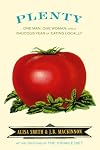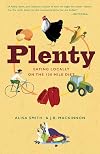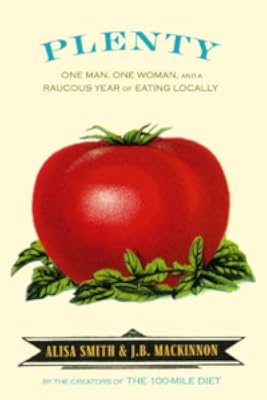
Plenty: One Man, One Woman, and a Raucous Year of Eating Locally
by Alisa Smith, J. B. MacKinnon
On This Page
Description
The remarkable, amusing and inspiring adventures of a Canadian couple who make a year-long attempt to eat foods grown and produced within a 100-mile radius of their apartment.When Alisa Smith and James MacKinnon learned that the average ingredient in a North American meal travels 1,500 miles from farm to plate, they decided to launch a simple experiment to reconnect with the people and places that produced what they ate. For one year, they would only consume food that came from within a show more 100-mile radius of their Vancouver apartment. The 100-Mile Diet was born.
The couple's discoveries sometimes shook their resolve. It would be a year without sugar, Cheerios, olive oil, rice, Pizza Pops, beer, and much, much more. Yet local eating has turned out to be a life lesson in pleasures that are always close at hand. They met the revolutionary farmers and modern-day hunter-gatherers who are changing the way we think about food. They got personal with issues ranging from global economics to biodiversity. They called on the wisdom of grandmothers, and immersed themselves in the seasons. They discovered a host of new flavours, from gooseberry wine to sunchokes to turnip sandwiches, foods that they never would have guessed were on their doorstep.
The 100-Mile Diet struck a deeper chord than anyone could have predicted, attracting media and grassroots interest that spanned the globe. The 100-Mile Diet: A Year of Local Eating tells the full story, from the insights to the kitchen disasters, as the authors transform from megamart shoppers to self-sufficient urban pioneers. The 100-Mile Diet is a pathway home for anybody, anywhere.
Call me naive, but I never knew that flour would be struck from our 100-Mile Diet. Wheat products are just so ubiquitous, "the staff of life," that I had hazily imagined the stuff must be grown everywhere. But of course: I had never seen a field of wheat anywhere close to Vancouver, and my mental images of late-afternoon light falling on golden fields of grain were all from my childhood on the Canadian prairies. What I was able to find was Anita's Organic Grain & Flour Mill, about 60 miles up the Fraser River valley. I called, and learned that Anita's nearest grain suppliers were at least 800 miles away by road. She sounded sorry for me. Would it be a year until I tasted a pie?
—From The 100-Mile Diet. show less
Tags
Recommendations








Member Reviews
I was intrigued by the title and the idea of eating locally for an entire year, and the book did bring home the principle that today food travels thousands of miles before reaching our plates and mouths. For one year the authors, a couple, ate food grown within 100 miles of their Vancouver, B.C. apartment. The authors alternated writing chapters and alternated between blending personal thoughts and experiences with eating locally and the politics of food. I most enjoyed the personal experiences and when they wrote about their food experiments such as learning how to can food for the winter, making cheese, and other food firsts for them. Another good book along this local food genre is Animal Vegetable Miracle.
One year, a couple was inspired to try to eat locally for a year. They defined locally based on their geographic surroundings and ended up drawing a boundary that allowed them to eat food withing 100 miles of their home in Vancouver, BC.
This book is the story of the challenges they faced and the lessons they learned. A year of trying to eat only locally grown and produced foods was difficult. Some of these difficulties were due to their geographic location; the area around Vancouver is just not fit for producing sugar or citrus. Other difficulties were more humorous; their 100 mile area included parts of northern Washington. They visited and found that the area produced a variety of wonderful foods, but then realized that they would be show more hampered by restrictions on taking food over the border (they decided it was worth the risk to smuggle home a wheel of cheese).
One of the most important lessons that the authors learned about food is that you can grow a lot more than you think in the climate of the Pacific Northwest. Our stereotypes about what can grow well are extremely warped by where things can be grown with the absolute highest yield. However, in reality most climates can support a much larger variety of food than they are known for, albeit at a smaller scale. Thus, even eating locally in Vancouver, BC, the authors were able to have a varied and interesting diet all year round (although it did take some preserving and finding wheat was a pain).
The other lesson the authors learned was to appreciate their food more. Spending a year eating locally caused Smith and Mackinnon to really think about the food they ate and helped them to appreciate the simple joys of fresh fruit or the first greens of the season. They learned, emotionally not just intellectually, that our food connects us to the earth and that holds true whether the food comes from your windowsill, a small farmer, or a giant farm.
The main thing I have taken from the book is to just think about my food, where it comes from, and what its production method may be denying me. I am not going to start only eating food that comes from within 100 miles, but I am going to take distance into account when given the choice. I am not going to stop buying lemons, but I am going to acknowledge that a strawberry shipped from California is less tasty than one picked fresh and ripe in Marysville. Mainly, I am going to acknowledge that our food production system is not without real social and environmental cost and try to take that cost into account when I am looking at price differences. show less
This book is the story of the challenges they faced and the lessons they learned. A year of trying to eat only locally grown and produced foods was difficult. Some of these difficulties were due to their geographic location; the area around Vancouver is just not fit for producing sugar or citrus. Other difficulties were more humorous; their 100 mile area included parts of northern Washington. They visited and found that the area produced a variety of wonderful foods, but then realized that they would be show more hampered by restrictions on taking food over the border (they decided it was worth the risk to smuggle home a wheel of cheese).
One of the most important lessons that the authors learned about food is that you can grow a lot more than you think in the climate of the Pacific Northwest. Our stereotypes about what can grow well are extremely warped by where things can be grown with the absolute highest yield. However, in reality most climates can support a much larger variety of food than they are known for, albeit at a smaller scale. Thus, even eating locally in Vancouver, BC, the authors were able to have a varied and interesting diet all year round (although it did take some preserving and finding wheat was a pain).
The other lesson the authors learned was to appreciate their food more. Spending a year eating locally caused Smith and Mackinnon to really think about the food they ate and helped them to appreciate the simple joys of fresh fruit or the first greens of the season. They learned, emotionally not just intellectually, that our food connects us to the earth and that holds true whether the food comes from your windowsill, a small farmer, or a giant farm.
The main thing I have taken from the book is to just think about my food, where it comes from, and what its production method may be denying me. I am not going to start only eating food that comes from within 100 miles, but I am going to take distance into account when given the choice. I am not going to stop buying lemons, but I am going to acknowledge that a strawberry shipped from California is less tasty than one picked fresh and ripe in Marysville. Mainly, I am going to acknowledge that our food production system is not without real social and environmental cost and try to take that cost into account when I am looking at price differences. show less
You know, I was ready to really like this book. I was receptive to the idea of eating local foods, and wanted to see how a couple on the other side of the continent could make it happen. Turns out, they do make it happen, and they are skilled writers, but I couldn't help feeling that their issue was a first world issue. That, as young, single people with flexible schedules, they were free to indulge their new hobby of eating food only produced within one hundred miles of their home. They spent a good bit of money (at first) on the project, but even more time was spent procuring their sources for food. I cannot imagine being able to do this as a working mom - it just seemed to take far too much effort. I don't mean to sound unsympathetic show more to their cause, because I am not, however, I will look elsewhere for ideas for working families to incorporate this kind of lifestyle into their own. The authors also point out several times that for all of human history communities and civilizations have prized exotic foods from strange locales over their own locally grown foods - from the extravagant meals from far flung locations in ancient Rome, to the trading ships of the 19th century bringing tea from China and spices from India. So, even though we have refrigerated trucks and a national highway system, our lives are not too different from people of earlier times. I think we should be eating less processed foods and more REAL foods, the more local, the better - that is the issue!
km show less
km show less
“It was the kind of meal that, when the plates were clean, led some to dark corners to sleep with the hushing of the wind, and others to drink mulled wine until our voices had climbed an octave and finally deepened, in the small hours, into whispers.” (pg. 3)
The 100-Mile Diet begins in a cottage with no light, fridge, car or hot water; the kind of place I dream of when too immersed in the hectic daily business of life. Most of us would starve out there, or so we believe. After an inspired meal gathered only from the wild, Alisa and James launched a year-long diet of food only found within 100 miles of their home. They found themselves returning from their cottage not starving, but with armfuls more food than they arrived with.
Why show more would anyone limit themselves to eating locally? How does that help anyone? Doesn’t it deprive third-world farmers and truckers of their livelihoods? There are a number of persuasive reasons. Local foods have fewer pesticides and more nutrition. Seasonal variety is good for developing immunity. Unprocessed foods represent a real solution to the obesity problem. Distant foods are only affordable through cheap oil, arguably enforced politically. Sparing the miles reduces the carbon emissions that cause global warming. And about those third-world farmers: when the 1994 free trade agreement was signed, subsidized corn from America overwhelmed Mexico’s two million small farmers and their 5000 varieties of corn. The collapse of a local industry due to economic deals (or a train derailment spilling ten thousand gallons of caustic soda into the river and killing half a million fish) is merely one disaster in a global economy in which we can always go elsewhere. In a local economy, we are reminded that such events are a catastrophe.
Works for me. But how does one go about eating locally? And can it be done without a “depression style diet of beets, cabbage and potatoes” (pg. 24)? Alisa and James started simply, eating seasonally from the farmer’s markets. It is not tough to find these in your area, e.g., Ontario. They sensibly used up supplies like salt that were already in their cupboards, but when they ran out they improvised, e.g., refining salt from the ocean. They used honey instead of sugar; I have got to get me some of that pumpkin honey. The great revelation from local eating is the immense variety of tastes that can be found. It reminds me of my half-dozen batches of home-brewing I did a couple years ago. I started with simple recipes but then discovered real flavour by adding freshly rolled grains and hops.
I went grocery shopping when I was reading their book. I read the source of each product on its label. Local apple juice replaced California grapefruit juice, and blueberries replaced my sultan raisins from Iran. I had no idea that carbonated water came all the way from Italy or Germany; dropped that. I have not replaced coffee yet but I am thinking about herbal tea. I am sure olive oil can be exchanged for a healthy local vegetable oil. And local vegetables frozen when fresh are always a good choice.
Turning over a local leaf can get quite philosophical. Their diet was not vegetarian, and this raised the question of whether the animals had been fed locally. They lived near the US border; should they break the law by taking local foods across it? Inevitably, you have to ask yourself if you are doing this because you believe the world is falling apart. When Alisa and James were shucking corn in their apartment they felt like part of some apocalyptic cult. While it is hard not to wonder at times if our fast global culture can sustain itself, I have to count myself with them among the non-believers. Instead, I see progress as something that is not always linear; sometimes we have to take a few steps back to pick up something we missed. A few weeks ago I read an objection to slow food on the grounds that women would likely have to do most of the work (see comments in this Metafilter post). Both Alisa and James worked hard, but James did most of the cooking. Perhaps we had to step away from slow food for awhile to advance women’s rights, but now may be a time to return to it for our health and that of the planet.
Alisa and James are journalists by trade but they sure know how to have fun with language; they “scuffed over to the farmer’s stand” (pg. 53) and ate strawberries “superlatively sun-sweetened to the brink of sweet booziness” (pg. 54). The edge in their relationship was of no more interest to me than it appeared to be to James as they alternated narration by chapter; I wondered if Alisa was simply missing some nutrient in her diet. I much preferred the drama of their quest for wheat: the disappointment at the ruined bag, the discovery that wheat had been grown locally in 1890, and Alisa’s delight when she declared, “I found a wheat farmer” (pg. 184). With a little effort, everything was possible.
http://johnmiedema.ca/2007/12/12/the-100-mile-diet-a-year-of-local-eating-by-ali... show less
The 100-Mile Diet begins in a cottage with no light, fridge, car or hot water; the kind of place I dream of when too immersed in the hectic daily business of life. Most of us would starve out there, or so we believe. After an inspired meal gathered only from the wild, Alisa and James launched a year-long diet of food only found within 100 miles of their home. They found themselves returning from their cottage not starving, but with armfuls more food than they arrived with.
Why show more would anyone limit themselves to eating locally? How does that help anyone? Doesn’t it deprive third-world farmers and truckers of their livelihoods? There are a number of persuasive reasons. Local foods have fewer pesticides and more nutrition. Seasonal variety is good for developing immunity. Unprocessed foods represent a real solution to the obesity problem. Distant foods are only affordable through cheap oil, arguably enforced politically. Sparing the miles reduces the carbon emissions that cause global warming. And about those third-world farmers: when the 1994 free trade agreement was signed, subsidized corn from America overwhelmed Mexico’s two million small farmers and their 5000 varieties of corn. The collapse of a local industry due to economic deals (or a train derailment spilling ten thousand gallons of caustic soda into the river and killing half a million fish) is merely one disaster in a global economy in which we can always go elsewhere. In a local economy, we are reminded that such events are a catastrophe.
Works for me. But how does one go about eating locally? And can it be done without a “depression style diet of beets, cabbage and potatoes” (pg. 24)? Alisa and James started simply, eating seasonally from the farmer’s markets. It is not tough to find these in your area, e.g., Ontario. They sensibly used up supplies like salt that were already in their cupboards, but when they ran out they improvised, e.g., refining salt from the ocean. They used honey instead of sugar; I have got to get me some of that pumpkin honey. The great revelation from local eating is the immense variety of tastes that can be found. It reminds me of my half-dozen batches of home-brewing I did a couple years ago. I started with simple recipes but then discovered real flavour by adding freshly rolled grains and hops.
I went grocery shopping when I was reading their book. I read the source of each product on its label. Local apple juice replaced California grapefruit juice, and blueberries replaced my sultan raisins from Iran. I had no idea that carbonated water came all the way from Italy or Germany; dropped that. I have not replaced coffee yet but I am thinking about herbal tea. I am sure olive oil can be exchanged for a healthy local vegetable oil. And local vegetables frozen when fresh are always a good choice.
Turning over a local leaf can get quite philosophical. Their diet was not vegetarian, and this raised the question of whether the animals had been fed locally. They lived near the US border; should they break the law by taking local foods across it? Inevitably, you have to ask yourself if you are doing this because you believe the world is falling apart. When Alisa and James were shucking corn in their apartment they felt like part of some apocalyptic cult. While it is hard not to wonder at times if our fast global culture can sustain itself, I have to count myself with them among the non-believers. Instead, I see progress as something that is not always linear; sometimes we have to take a few steps back to pick up something we missed. A few weeks ago I read an objection to slow food on the grounds that women would likely have to do most of the work (see comments in this Metafilter post). Both Alisa and James worked hard, but James did most of the cooking. Perhaps we had to step away from slow food for awhile to advance women’s rights, but now may be a time to return to it for our health and that of the planet.
Alisa and James are journalists by trade but they sure know how to have fun with language; they “scuffed over to the farmer’s stand” (pg. 53) and ate strawberries “superlatively sun-sweetened to the brink of sweet booziness” (pg. 54). The edge in their relationship was of no more interest to me than it appeared to be to James as they alternated narration by chapter; I wondered if Alisa was simply missing some nutrient in her diet. I much preferred the drama of their quest for wheat: the disappointment at the ruined bag, the discovery that wheat had been grown locally in 1890, and Alisa’s delight when she declared, “I found a wheat farmer” (pg. 184). With a little effort, everything was possible.
http://johnmiedema.ca/2007/12/12/the-100-mile-diet-a-year-of-local-eating-by-ali... show less
I really liked this book about a couple who decide not to eat anything unless it comes from within 100 miles from where they live. Granted they live in Vancouver, which makes it sound a lot easier to do than say, Chicago, but they do discover certain staples aren't attainable to them anymore, like wheat. Finding wheat in the Pacific Northwest becomes the ultimate Holy Grail. The experiment itself sounds a little pretentious, but the authors don't shy away from the downsides of local eating...they fight while canning tomatoes, lose too much weight from a lack of carbs, and drink a lot of wine from a local winery. In the end, their descriptions of delicious local produce makes me want to shop at farmer's markets a lot more.
Interesting he said/she said account of one Canadian couple's experiment to eat and drink only items grown/purchased/foraged within a 100-mile radius of their Vancouver home for an entire year. An effective yet surprisingly entertaining illustration of the inadequacies of our modern globalized food system. The brief segment on "double disappearance" was especially powerful. Recommend!
The idea was great and I think Alisa and James did a good job explaining and carrying out their experiment. It was well written and interesting, but the book was peppered with snide relationship comments that I could have done without. Regardless, I'm convinced that local eating is the way to go!
Members
- Recently Added By
Lists

Food Memoirs
97 works; 9 members

My Year Spent Doing Something Stupid so I Could Write This Book
34 works; 6 members

CBC's 100 True Stories
100 works; 6 members
Author Information

4+ Works 873 Members

7+ Works 1,360 Members
Some Editions
Awards and Honors
Common Knowledge
- Original title
- The 100-Mile Diet: A Year of Local Eating
- Alternate titles
- Plenty : Eating Locally on the 100-Mile Diet: A Cookbook (U.S. reprint edition, 2008) (U.S. reprint edition, 2008); Plenty : One Man, One Woman, and a Raucous Year of Eating Locally (U.S. hardcover edition, 2007) (U.S. hardcover edition, 2007)
- Original publication date
- 2007-03-12
- People/Characters
- Alisa Smith; James B. MacKinnon
- Important places
- Vancouver, British Columbia, Canada; Canada
- First words
- The year of eating locally began with one beautiful meal and one ugly statistic.
- Last words
- (Click to show. Warning: May contain spoilers.)James appears at her shoulder. He takes hold of the pan and tilts it, and with a wooden scraper Alisa carries the damp crystals to a waiting bowl. It is already nearly full. The salt is a dazzling white pile, enough to last through another year.
- Blurbers
- Madison, Deborah; Meyer, Danny; McKibben, Bill
- Disambiguation notice
- The 100-Mile Diet is the title in Canada, New Zealand, and Australia. Plenty is the U.S. title with a different subtitle between the hardcover and paperback editions. The two cannot be combined on the author pag... (show all)e because of limits on the numbers of copies involved.
Classifications
- Genres
- Nonfiction, General Nonfiction, Food & Cooking, Science & Nature, Biography & Memoir
- DDC/MDS
- 641.56309711 — Applied science & technology Home economics & family management Food, Cooking & Recipes / Meals, Picnics Cooking; cookbooks Cooking, Specialized Situations Healthy Cooking
- LCC
- TX360 .C32 .B78 — Technology Home economics Home economics Nutrition. Foods and food supply
- BISAC
Statistics
- Members
- 833
- Popularity
- 33,175
- Reviews
- 35
- Rating
- (3.66)
- Languages
- Chinese, English
- Media
- Paper, Ebook
- ISBNs
- 9
- ASINs
- 7