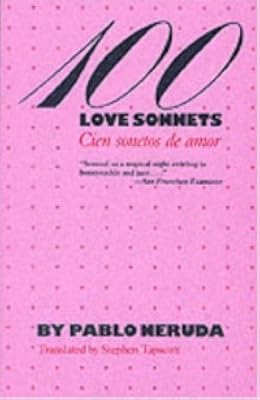
100 Love Sonnets
by Pablo Neruda
On This Page
Description
"The happiness I feel in offering these to you is vast as a savanna," Pablo Neruda wrote his adored wife, Matilde Urrutia de Neruda, in his dedication of One Hundred Love Sonnets. Set against the backdrop of his beloved Isla Negra, these joyfully sensual poems draw on the wind and tides, the white sand with its scattering of delicate wildflowers, and the hot sun and salty scent of the sea to celebrate their love. Generations of lovers since Pablo and Matilde have shared these poems with each show more other, making One Hundred Love Sonnets one of the most popular books of poetry of all time. This beautifully redesigned volume, perfect for gift-giving, presents both the original Spanish sonnets and graceful English translations. show lessTags
Recommendations

















Member Reviews
Achei essa edição argentina de 1960 por cinco reais num sebo, o que fatalmente me deixou feliz.
Voltando ao Neruda, o livro é um estouro, passando por quatro fases, cada uma delas instila fases da relação amorosa, seja num aspecto temporal (o tipo de relação que temos no decorrer da vida), seja num aspecto espacial (uma única relação passando pelas intempéries da manhã, meio-dia, tarde e noite). Enfim,é brilhante.
Voltando ao Neruda, o livro é um estouro, passando por quatro fases, cada uma delas instila fases da relação amorosa, seja num aspecto temporal (o tipo de relação que temos no decorrer da vida), seja num aspecto espacial (uma única relação passando pelas intempéries da manhã, meio-dia, tarde e noite). Enfim,é brilhante.
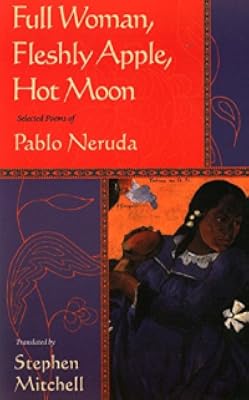
As my fourth Neruda poetry collection, 100 Love Sonnets is undoubtedly lacking compared to Twenty Love Poems and a Song of Despair, The Captain’s Verses, and Full Woman, Fleshly Apple, Hot Moon. Akin to intimacy and body landscapes among Gerard Schlosser’s paintings, Neruda paints love in a spectrum of emotions and shades; from devotion to inquisition to desolation, from red to mauve to blue. However the words that convey them can be sparse. With such limitation it is no wonder the sonnets can be wearisome and repetitive. But each time a sonnet successfully touches on a certain feeling or a certain memory, with words that seem to fit the only way Neruda limns them, it rollicks through romance and love-making in utmost splendour show more without forgetting its moments of neediness for reassurance and affirmation. Neruda wholeheartedly worships and adores his third wife, Matilde, in this collection. And for an affair to give birth to a hundred of sonnets is almost enough for love to infect your whole being; consumingly and blindly. Whilst this collection is divided by different times of the day (Morning, Afternoon, Evening, and Night), I can nearly describe the reading experience as sweet dew that slowly streams down among the blades of grass in the earliest of mornings as the sun takes it time to rise. Sometimes, it feels like it is all happening in a dream. But you don't always want to stay in one.
Overall, I bookmarked 15 sonnets in this collection. And as a passionate lover of bread, I was very amused by a particular sonnet that declares a beloved as made of bread. I don't think anything can be as sensual as this:
SONNET XIII
The light that rises from your feet to your hair,
the strength enfolding your delicate form,
are not mother of pearl, not chilly silver:
you are made of bread, a bread the fire adores.
The grain grew high in its harvest of you,
in good time the flour swelled;
as the dough rose, doubling your breasts,
my love was the coal waiting ready in the earth.
Oh, bread your forehead, your legs, your mouth,
bread I devour, born with the morning light,
my love, beacon-flag of the bakeries:
fire taught you a lesson of the blood;
you learned your holiness from flour,
from bread your language and aroma.
*
Two sonnets I dearly loved:
SONNET LXVI
I do not love you except because I love you;
I go from loving to not loving you,
From waiting to not waiting for you
My heart moves from cold to fire.
I love you only because it's you the one I love;
I hate you deeply, and hating you
Bend to you, and the measure of my changing love for you
Is that I do not see you but love you blindly.
Maybe January light will consume
My heart with its cruel
Ray, stealing my key to true calm.
In this part of the story I am the one who
Dies, the only one, and I will die of love because I love you,
Because I love you, Love, in fire and blood.
SONNET LXV
Matilde, where are you? Down here I noticed,
under my necktie and just above my heart,
a certain pang of grief between the ribs,
you were gone that quickly.
I needed the light of your energy,
I looked around, devouring hope.
I watched the void without you that is like a house,
nothing left but tragic windows.
Out of sheer taciturnity the ceiling listens
to the fall of the ancient leafless rain,
to feathers, to whatever the night imprisoned;
so I wait for you like a lonely house
till you will see me again and live in me.
Till then my windows ache.
*
Others sonnets worth mentioning:
Sonnet VIII
Sonnet XVI
Sonnet XVII
Sonnet XLIX
Sonnet LXXXI
Sonnet LXXXIX show less
Overall, I bookmarked 15 sonnets in this collection. And as a passionate lover of bread, I was very amused by a particular sonnet that declares a beloved as made of bread. I don't think anything can be as sensual as this:
SONNET XIII
The light that rises from your feet to your hair,
the strength enfolding your delicate form,
are not mother of pearl, not chilly silver:
you are made of bread, a bread the fire adores.
The grain grew high in its harvest of you,
in good time the flour swelled;
as the dough rose, doubling your breasts,
my love was the coal waiting ready in the earth.
Oh, bread your forehead, your legs, your mouth,
bread I devour, born with the morning light,
my love, beacon-flag of the bakeries:
fire taught you a lesson of the blood;
you learned your holiness from flour,
from bread your language and aroma.
*
Two sonnets I dearly loved:
SONNET LXVI
I do not love you except because I love you;
I go from loving to not loving you,
From waiting to not waiting for you
My heart moves from cold to fire.
I love you only because it's you the one I love;
I hate you deeply, and hating you
Bend to you, and the measure of my changing love for you
Is that I do not see you but love you blindly.
Maybe January light will consume
My heart with its cruel
Ray, stealing my key to true calm.
In this part of the story I am the one who
Dies, the only one, and I will die of love because I love you,
Because I love you, Love, in fire and blood.
SONNET LXV
Matilde, where are you? Down here I noticed,
under my necktie and just above my heart,
a certain pang of grief between the ribs,
you were gone that quickly.
I needed the light of your energy,
I looked around, devouring hope.
I watched the void without you that is like a house,
nothing left but tragic windows.
Out of sheer taciturnity the ceiling listens
to the fall of the ancient leafless rain,
to feathers, to whatever the night imprisoned;
so I wait for you like a lonely house
till you will see me again and live in me.
Till then my windows ache.
*
Others sonnets worth mentioning:
Sonnet VIII
Sonnet XVI
Sonnet XVII
Sonnet XLIX
Sonnet LXXXI
Sonnet LXXXIX show less
10/10
I have been consuming poetry in the last few months at an inordinate rate. I enter phases -- cycles in my life where it's easier to read poetry than prose; more importantly, where my life demands poetry more than it does prose. It's silly, in that context, to add long passages of my boring prose to describe what Neruda does perfectly in poems. All I can add is, if you haven't read Neruda, or haven't read him lately, do your soul a favour and pick up this little book, even if you borrow it from the library, and go sit quietly for an hour.
How many times, love, I loved you without seeing you
and maybe without recollection,
not recognizing your glance, not looking at you, a centaur,
in adverse regions, in a burning midday:
you were just show more the scent of grains I love.
Perhaps I saw you, I imagined you in passing lifting a glass
in Angol, by the light of the moon in June,
or you were the waist of that guitar
I played in the darkness, and it sounded like the excessive seas.
I loved you without knowing it, and I looked for your memory.
In the empty houses I entered with a lantern to steal your portrait.
But I already knew how you were. Suddenly
while you were there with me I touched you and my life stopped:
before my eyes you were, ruling me, and you reign.
Like a bonfire in the forests, fire is your kingdom.
````````````````
Cuántas veces, amor, te amé sin verte y tal vez sin recuerdo,
sin reconocer tu mirada, sin mirarte, centaura
en regiones contrarias, en un mediodía quemante:
eras sólo el aroma de los cereales que amo.
Tal vez te vi, te supuse al pasar levantando una copa
en Angol, a la luz de la luna de junio,
o eras tú la cintura de aquella guitarra
que toqué en las tinieblas y sonó como el mar desmedido.
Te amé sin que yo lo supiera, y busqué tu memoria.
En las casas vacías entré con linterna a robar tu retrato.
Pero yo ya sabía cómo era. De pronto
mientras ibas conmigo te toqué y se detuvo mi vida:
frente a mis ojos estabas, reinándome, y reinas.
Como hoguera en los bosques el fuego es tu reino.
````````````````````
PS This is a lovely edition which includes paintings by Gabriela Campos. show less
I have been consuming poetry in the last few months at an inordinate rate. I enter phases -- cycles in my life where it's easier to read poetry than prose; more importantly, where my life demands poetry more than it does prose. It's silly, in that context, to add long passages of my boring prose to describe what Neruda does perfectly in poems. All I can add is, if you haven't read Neruda, or haven't read him lately, do your soul a favour and pick up this little book, even if you borrow it from the library, and go sit quietly for an hour.
How many times, love, I loved you without seeing you
and maybe without recollection,
not recognizing your glance, not looking at you, a centaur,
in adverse regions, in a burning midday:
you were just show more the scent of grains I love.
Perhaps I saw you, I imagined you in passing lifting a glass
in Angol, by the light of the moon in June,
or you were the waist of that guitar
I played in the darkness, and it sounded like the excessive seas.
I loved you without knowing it, and I looked for your memory.
In the empty houses I entered with a lantern to steal your portrait.
But I already knew how you were. Suddenly
while you were there with me I touched you and my life stopped:
before my eyes you were, ruling me, and you reign.
Like a bonfire in the forests, fire is your kingdom.
````````````````
Cuántas veces, amor, te amé sin verte y tal vez sin recuerdo,
sin reconocer tu mirada, sin mirarte, centaura
en regiones contrarias, en un mediodía quemante:
eras sólo el aroma de los cereales que amo.
Tal vez te vi, te supuse al pasar levantando una copa
en Angol, a la luz de la luna de junio,
o eras tú la cintura de aquella guitarra
que toqué en las tinieblas y sonó como el mar desmedido.
Te amé sin que yo lo supiera, y busqué tu memoria.
En las casas vacías entré con linterna a robar tu retrato.
Pero yo ya sabía cómo era. De pronto
mientras ibas conmigo te toqué y se detuvo mi vida:
frente a mis ojos estabas, reinándome, y reinas.
Como hoguera en los bosques el fuego es tu reino.
````````````````````
PS This is a lovely edition which includes paintings by Gabriela Campos. show less
Neruda has had some of the strongest influence on how I think about language when I'm writing, and it all spawned from this bright pink book that I bought in Boulder, CO during an ill-fated ski trip during college. Turns out being somewhat "duck-footed" makes it difficult to ski. But despite the absolutely horrific cover design, I loved what I read...and I was doing a lot of reading while everyone else was skiing.
I have since read other translations that I liked better, but this is still the one that started it all for me, so it holds an oddly special place in my heart. I even used an equally bright pink highlighter to mark this book up, so I can tell you that, at the time of my initial readings of this book circa 2000, my favorites show more were numbers 11, 17, 27, 39, 40, 45, 78, 85, 89 (morbid as it is). I couldn't name as many favorites at this point, but I'd say half would remain the same and half would be something different. Which ones? I'll never tell.
Neruda uses words and phrases that always gave me the impression that I was momentarily understanding the way another person saw the world with their eyes. I always felt there is a deep empathy imbedded in the language. That is what I love about Neruda. show less
I have since read other translations that I liked better, but this is still the one that started it all for me, so it holds an oddly special place in my heart. I even used an equally bright pink highlighter to mark this book up, so I can tell you that, at the time of my initial readings of this book circa 2000, my favorites show more were numbers 11, 17, 27, 39, 40, 45, 78, 85, 89 (morbid as it is). I couldn't name as many favorites at this point, but I'd say half would remain the same and half would be something different. Which ones? I'll never tell.
Neruda uses words and phrases that always gave me the impression that I was momentarily understanding the way another person saw the world with their eyes. I always felt there is a deep empathy imbedded in the language. That is what I love about Neruda. show less
I came across a bookstore end-cap, beautifully set up and displayed for Valentines Day.
(read: lovey-dovey red and pink books, hearts, flowers, and time for your sugar coma)
It reminded me of this book because when it comes to romantic poetry, Pablo Neruda is the man...and well, this book was one of the items on display.
This was a reread but still as beautiful as the first time I read it. In Spanish and English bilingual presentation, this is a wonderful mix of sex on ink and paper, subtle, tender as a look, sweet as a first kiss. It's a blend of meanings and words: passionate, risk, feeling, deep-searing, timeless, a whisper, something wild. Something for everyone.
(read: lovey-dovey red and pink books, hearts, flowers, and time for your sugar coma)
It reminded me of this book because when it comes to romantic poetry, Pablo Neruda is the man...and well, this book was one of the items on display.
This was a reread but still as beautiful as the first time I read it. In Spanish and English bilingual presentation, this is a wonderful mix of sex on ink and paper, subtle, tender as a look, sweet as a first kiss. It's a blend of meanings and words: passionate, risk, feeling, deep-searing, timeless, a whisper, something wild. Something for everyone.
Poetry tends to be very hit or miss for me, but the ones that hit, hit hard. I liked all the poems in this collection, they are gorgeous and have such lush, sensual imagery. There were a few poems that really stood out to me, and I adored and keep going back too to read again. However, the rest of the poems were not as memorable and blurred together for me. Overall, I would highly recommend this.
Cien sonetos que no lo son, o que aspiran a serlo pero no alcanzan. Aquí algunas muestras de la genialidad del hombre infinito: Soneto XXIV: Eres hija del mar y prima del orégano; Soneto XLV: No estés lejos de mí un solo día, porque cómo, / porque, no sé decirlo, es largo el día; Soneto LXXXVII: Las tres aves del mar, tres rayos, tres tijeras / cruzaron por el cielo frío de Antofagasta, / por eso quedó el aire tembloroso, / todo tembló como bandera herida". A lo nerudiano, de la tortura pasé a la diversión, para marcar aquellos versos de tanto infinito, trigo y perejil. Quizás si lo hubiese leído en inglés la puntuación sería mayor. Quizás.
Members
- Recently Added By
Lists

Books translated from Romance Languages into English
102 works; 7 members

Best of World Literature
435 works; 52 members

1950s
340 works; 22 members

Tom's Bookstore
346 works; 2 members

Favorite Recent Poetry: 1980-2022
178 works; 70 members
Author Information

652+ Works 26,012 Members
Pablo Neruda was born Ricardo Eliecer Neftalí Reyes Basoalto in Ferral, Chile on July 12, 1904. In 1923 he sold all of his possessions to finance the publication of his first book, Crepusculario (Twilight), which he published under the pseudonym Pablo Neruda. Veinte Poemas de Amor y una Cancion Desesperada (Twenty Love Poems and a Song of show more Despair), which was published the following year, made him a celebrity and allowed him to stop his studies to devote himself to poetry. His other works include España en el Corazón, Canto General, Las Uvas y el Viento, and Para Nacer He Nacido. He received numerous awards including the World Peace Prize with Paul Robeson and Pablo Picasso in 1950, the Lenin Peace Prize and the Stalin Peace Prize in 1953, and the Nobel Prize for Literature for his poetry in 1971. He died of leukemia on September 23, 1973. (Bowker Author Biography) show less
Some Editions
Series
Belongs to Publisher Series
Work Relationships
Is contained in
Common Knowledge
- Canonical title
- 100 Love Sonnets
- Original title
- Cien sonetos de amor
- Original publication date
- 1959 (original Spanish) (original Spanish); 1986 (English translation) (English translation)
- Important places*
- Chili
- Dedication*
- À Mathilde Urrutia
- First words
- Matilde: the name of a plant, or a rock, or a wine, of things that begin in the earth, and last: word in whose growth the dawn first opens, in whose summer the light of the lemons bursts.
- Last words
- (Click to show. Warning: May contain spoilers.)There won't be anything but all the fresh air, apples carried on the wind, the succulent book in the woods: and there where the carnations breathe, we will begin to make ourselves a clothing, something to last through the eternity of a victorious kiss.
- Original language
- Spanish
- Disambiguation notice*
- Édition bilingue
*Some information comes from Common Knowledge in other languages. Click "Edit" for more information.
Classifications
Statistics
- Members
- 1,767
- Popularity
- 12,438
- Reviews
- 23
- Rating
- (4.38)
- Languages
- 10 — Arabic, Czech, Dutch, English, French, Greek, Italian, Multiple languages, Portuguese, Spanish
- Media
- Paper, Ebook
- ISBNs
- 49
- ASINs
- 7