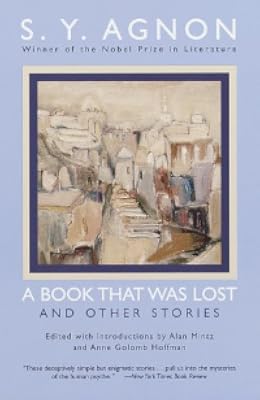
A Book that Was Lost: and Other Stories
by Shmuel Yosef Agnon
On This Page
Description
Stories depict the culture of traditional Jewish life in Poland, the lost world of Eastern European Jewry, and the emerging society of modern Israel.Tags
Recommendations




















Member Reviews
I read a few Agnon stories when I took a Modern Hebrew Literature class in college and was interested in reading more of his work (I loved and still love reading the literature of nobel prize for literature winners though this hasn't always panned out positively for me). And though i was interested i had a lingering doubt in my mind wondering whether or not agnon actually deserved the award, not that he would have been the first writer undeserving of the nobel -cough- t.s. eliot -cough- to receive it, nor are the nobels a hard and fast barometer of what is worthwhile reading and what isn't, still the doubt was planted due to my somewhat less than fantastically overwhelmed response to the few stories of his i had read.
Having finally show more completed this compilation I can say that he did deserve the nobel but maybe not for the reasons that have been stated. i'm not saying this to simply be contrary. when i read some of the praise of agnon and he's described as what is essentially the scribe/sage of the modern jewish experience, i roll my eyes because such a title is hyperbole to the point of being satirical, he might as well have been called the philosopher king of jews if we're following this line of praise to its not too illogical evolution. agnon, to my reading of his work and life, wasn't writing so much about the general jewish experience but rather was attempting to do so through depictions of the specific tinged with the ancient and traditional. the results of this approach vary decidedly almost with each individual story.
That is one of the two main problems i have with agnon: inconsistency. The other is his ego combined with his pretension to the role he set out to create and live for himself as 'the writer'. Agnon, maybe even more so than james joyce (which up until now i really didn't think was possible) was all too entangled in the mystique and grandeur of the writer as both lone wolf and erudite judge of his people and their history as well as their future. this is not to say that neither joyce nor agnon weren't these things, but maybe not to the extent that either one of them imagined. And, again like joyce, this wouldn't matter so much if this role playing and sometimes even holier than thou attitude didn't bleed into the work, but it does, with mixed to mostly good results.
Now, for brass tacks. Despite everything I just typed, i do firmly believe that agnon was, is, and forever shall be a great writer. The best of his stories presented in this collection such as agunot, the sign, on the road, the doctor's divorce, and others, are masterful works. Agnon weaves and interweaves the religious and the secular, the ancient and the modern, as well as the past, the present and the future, into fabulous tales depicting a single people sometimes chained to and sometimes joyful because of, a separateness from the rest of the world and a servitude to a god and a way of life that is at times wonderful and glorious but just as often degrading, antiquated, and simply kindling for the fires of the blast furnaces of not only persecution from the gentile/non-jewish world but as foreboding harbingers for division, judgment, isolation, and spiritual and even at times literal, death from within the jewish community as well.
Agnon never goes for the easy answers in what can only be described as a 'difficult' and 'complicated' history. The holocaust was and is a horrific event and agnon judges the viciousness of the nazis and their compatriots as they deserve to be judged, as inhuman monsters and the absolute most disgusting detritus that this world has produced. But, and this is a huge but, agnon doesn't spare the victims either. He realizes that while the fires were being lit and the jackboots were being fitted, many, too many jews and other future victims sat idly by in ignorance, or worse, denial, relying either on their god or their rituals or really on nothing much at all excepting possibly their own ignorance to save them.
Neither is the state of israel given a clean slate. Agnon gives tacit agreement to the sins of the state, namely that whilst many jews were being marched to their hells on earth constructed by cultured hands and condoning nods, the state was lost in many of the same asinine ritual and cultural wastes of time and energy as their apparent brothers and sisters had before the 'troubles' began. Agnon does of course view israel as a modern miracle but not without more than its fair share of human, and dare i say, divine error. Israel is not the period to the jewish story, the holocaust and jewish conflict with the world and with each other does not and has not gone away since the establishment of the state, it cannot, such a thing is almost beyond impossibility, agnon is aware and doesn't hide this truth.
Overall this is a wonderful but often long winded and exhausting collection of tales. But all hold a magnificent level of depth regarding not only a very specific jewish experience but, when done well, can be easily extrapolated to encompass many factors of the totality of the human experience no matter the culture or the history, but all another set of incidents within the grand and not so grand paradigm of human kind's continuity.
PS 'Pisces' is one of the most boring short stories ever put to the page, this is agnon at his worst and is most of the reason why this collection didn't get five stars from me, read that one with peril and a hell of a lot of patience with very little expectation. show less
Having finally show more completed this compilation I can say that he did deserve the nobel but maybe not for the reasons that have been stated. i'm not saying this to simply be contrary. when i read some of the praise of agnon and he's described as what is essentially the scribe/sage of the modern jewish experience, i roll my eyes because such a title is hyperbole to the point of being satirical, he might as well have been called the philosopher king of jews if we're following this line of praise to its not too illogical evolution. agnon, to my reading of his work and life, wasn't writing so much about the general jewish experience but rather was attempting to do so through depictions of the specific tinged with the ancient and traditional. the results of this approach vary decidedly almost with each individual story.
That is one of the two main problems i have with agnon: inconsistency. The other is his ego combined with his pretension to the role he set out to create and live for himself as 'the writer'. Agnon, maybe even more so than james joyce (which up until now i really didn't think was possible) was all too entangled in the mystique and grandeur of the writer as both lone wolf and erudite judge of his people and their history as well as their future. this is not to say that neither joyce nor agnon weren't these things, but maybe not to the extent that either one of them imagined. And, again like joyce, this wouldn't matter so much if this role playing and sometimes even holier than thou attitude didn't bleed into the work, but it does, with mixed to mostly good results.
Now, for brass tacks. Despite everything I just typed, i do firmly believe that agnon was, is, and forever shall be a great writer. The best of his stories presented in this collection such as agunot, the sign, on the road, the doctor's divorce, and others, are masterful works. Agnon weaves and interweaves the religious and the secular, the ancient and the modern, as well as the past, the present and the future, into fabulous tales depicting a single people sometimes chained to and sometimes joyful because of, a separateness from the rest of the world and a servitude to a god and a way of life that is at times wonderful and glorious but just as often degrading, antiquated, and simply kindling for the fires of the blast furnaces of not only persecution from the gentile/non-jewish world but as foreboding harbingers for division, judgment, isolation, and spiritual and even at times literal, death from within the jewish community as well.
Agnon never goes for the easy answers in what can only be described as a 'difficult' and 'complicated' history. The holocaust was and is a horrific event and agnon judges the viciousness of the nazis and their compatriots as they deserve to be judged, as inhuman monsters and the absolute most disgusting detritus that this world has produced. But, and this is a huge but, agnon doesn't spare the victims either. He realizes that while the fires were being lit and the jackboots were being fitted, many, too many jews and other future victims sat idly by in ignorance, or worse, denial, relying either on their god or their rituals or really on nothing much at all excepting possibly their own ignorance to save them.
Neither is the state of israel given a clean slate. Agnon gives tacit agreement to the sins of the state, namely that whilst many jews were being marched to their hells on earth constructed by cultured hands and condoning nods, the state was lost in many of the same asinine ritual and cultural wastes of time and energy as their apparent brothers and sisters had before the 'troubles' began. Agnon does of course view israel as a modern miracle but not without more than its fair share of human, and dare i say, divine error. Israel is not the period to the jewish story, the holocaust and jewish conflict with the world and with each other does not and has not gone away since the establishment of the state, it cannot, such a thing is almost beyond impossibility, agnon is aware and doesn't hide this truth.
Overall this is a wonderful but often long winded and exhausting collection of tales. But all hold a magnificent level of depth regarding not only a very specific jewish experience but, when done well, can be easily extrapolated to encompass many factors of the totality of the human experience no matter the culture or the history, but all another set of incidents within the grand and not so grand paradigm of human kind's continuity.
PS 'Pisces' is one of the most boring short stories ever put to the page, this is agnon at his worst and is most of the reason why this collection didn't get five stars from me, read that one with peril and a hell of a lot of patience with very little expectation. show less
A Book That Was Lost delivers many short tales of Jewish devotion - to Torah, to the Land of Israel, to the author's birthplace in Buczacz,
to love, family, and the end of wars.
Shmuel Agnon gradually weaves in the horror and massacres of World War II.
For World War I, many Jewish men fought on the side of Germany.
This adds to the horror of the massacres and extermination in World War II.
S.Y. Agnon seeks to unite divine reason with classical and modern Jewish thinking.
His beliefs are inspired by his devotion to religious tradition.
My favorite of his stories of variable quality and interest was "The Tale of the Menorah,"
while I deep-pearled "Pisces" for animal cruelty.
The Glossary was excellent reading.
to love, family, and the end of wars.
Shmuel Agnon gradually weaves in the horror and massacres of World War II.
For World War I, many Jewish men fought on the side of Germany.
This adds to the horror of the massacres and extermination in World War II.
S.Y. Agnon seeks to unite divine reason with classical and modern Jewish thinking.
His beliefs are inspired by his devotion to religious tradition.
My favorite of his stories of variable quality and interest was "The Tale of the Menorah,"
while I deep-pearled "Pisces" for animal cruelty.
The Glossary was excellent reading.
The stories are touching and the language is exquisite (I had the privilege to read it in Hebrew).
Ratings
Members
- Recently Added By
Author Information

131+ Works 2,615 Members
Shmuel Yosef Agnon was born Shmuel Yosef Halevi Czaczkes in 1888 in Galicia, Austria-Hungary (now Poland). He received training in Yiddish, Hebrew and the Talmud from his father, and was introduced to German literature by his mother. When he was fifteen, his first poems, written in Yiddish and Hebrew, were published in the newspaper. He took his show more pen name, later his legal name, S.Y. Agnon, from the title of his first story Agunot, published in 1909. He lived and worked in Palestine from 1907 until his death in 1970, except for an eleven year stay in Germany. He was buried on the Mount of Olives. Agnon was a prolific novelist and short-story writer. After his move to Jerusalem from Germany, Agnon began writing about the decline of Jewry in Galicia. His first major publication was a two-volume novel, Hakhnasat Kalah (The Bridal Canopy), 1932, which recreates the golden age of Hassidism. Ore'ah Nata' Lalun (A Guest for the Night), 1939, is an apocalyptic novel depicting the ruin of Galicia after World War I. 'Tmol Shilshom (Only Yesterday), published in 1946, is considered his greatest novel, portraying the early pioneer immigrants to Palestine. A great many of his later books are set in his adopted Palestine and deal with the replacement of early Jewish settlements after World War II. Agnon received the Nobel Prize for Literature in 1966, boosting interest in his work outside of Israel. About 85 of Agnon's works have been translated into at least 18 languages. Agnon was made an honorary citizen of Jerusalem in 1962. His portrait appears on the Israeli Fifty New Sheqalim banknote. Other works include Sefer Hamaasim (The Book of Deeds ), published in 1932, Pat Shlema (A Whole Loaf ), from 1933, Shevuat Emunim (Two Tales), 1943, and Kol Sipurav Shel Sh. Y. Agnon ( The Collected Works in 11 volumes), 1931-62. (Bowker Author Biography) Agnon was born in Galicia, the former Austrian crown land in east central Europe. In his home he was influenced by rabbinical and Hasidic traditions and the reviving spirit of European culture, Agnon began writing Hebrew and Yiddish at the age of eight. He contributed poetry and prose to periodicals, such as Ha-Mizpeh and Der Juedische Wecker. After he immigrated to Palestine in 1907, he no longer wrote in Yiddish. He chose the pen name "Agnon" from the title of his first novel, Agunot (Forsaken Wives); its meaning is "cut off" in Hebrew. From 1912 to 1914 Agnon lived in Germany, where he met Salman Schocken and convinced him that someone should undertake the publishing of Hebrew books. In 1931 Berlin Schocken Verlag published four volumes of Agnon's collected works in Hebrew. Agnon was awarded the Bialik Prize for literature in 1934, and in 1936 the Jewish Theological Seminary of America made him an honorary Doctor of Hebrew Letters. Other honors followed, including the Israel Prize in 1954 and 1958. In 1966 he became the first Israeli to receive the Nobel Prize for literature, which was awarded jointly to the Swedish writer Nelly Sachs. Agnon often deals with philosophical and psychological problems in a miraculous or supernatural manner. Reality is colored in a dreamlike atmosphere. Agnon is concerned with contemporary problems of a spiritual nature-the disintegration of traditional life, loss of faith and identity, and loneliness. At the center of his work is the Jew in various manifestations: a person of faith, a nihilist, a victim of pogroms and the Holocaust, a pioneer, and a saint. Creating a unique Hebrew prose style, his works link historic Jewish piety and martyrdom with longing for Israel. Yet they have universal appeal to the modern reader. Agnon himself has said: "I am not a modern writer. I am astounded that I even have one reader. I don't see the reader before me... No, I see before me only the Hebrew letter saying 'write me thus and not thus.' I, to my regret, am like the wicked Balaam. It is written of him that "the word that God putteth in my mouth, that shall I speak"' (The New York Times). (Bowker Author Biography) show less
Some Editions
Common Knowledge
- Original title
- A Book That Was Lost & Other Stories
- Alternate titles
- A Book That Was Lost: Thirty-five Stories
- Original language
- Hebrew
Classifications
- Genres
- Fiction and Literature, General Fiction
- DDC/MDS
- 892.4 — Literature & rhetoric Asian Literature Afro-Asiatic literatures Jewish, Israeli, and Hebrew
- LCC
- PJ5053 .A4 .A26 — Language and Literature Oriental languages and literatures Oriental philology and literature Hebrew Literature Individual authors and works
- BISAC
Statistics
- Members
- 210
- Popularity
- 155,141
- Reviews
- 3
- Rating
- (4.11)
- Languages
- English
- Media
- Paper
- ISBNs
- 4
- ASINs
- 1