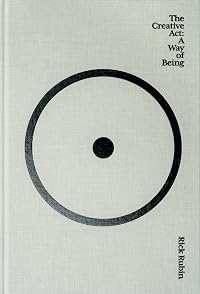
The Creative Act: A Way of Being
by Rick Rubin (Author), Neil Strauss (Author)
On This Page
Description
The #1 New York Times bestseller. From the legendary music producer, a master at helping people connect with the wellsprings of their creativity, comes a beautifully crafted book many years in the making that offers that same deep wisdom to all of us. "A gorgeous and inspiring work of art on creation, creativity, the work of the artist. It will gladden the hearts of writers and artists everywhere, and get them working again with a new sense of meaning and direction. A stunning show more accomplishment." --Anne Lamott "I set out to write a book about what to do to make a great work of art. Instead, it revealed itself to be a book on how to be." --Rick Rubin Many famed music producers are known for a particular sound that has its day. Rick Rubin is known for something else: creating a space where artists of all different genres and traditions can home in on who they really are and what they really offer. He has made a practice of helping people transcend their self-imposed expectations in order to reconnect with a state of innocence from which the surprising becomes inevitable. Over the years, as he has thought deeply about where creativity comes from and where it doesn't, he has learned that being an artist isn't about your specific output, it's about your relationship to the world. Creativity has a place in everyone's life, and everyone can make that place larger. In fact, there are few more important responsibilities. The Creative Act is a beautiful and generous course of study that illuminates the path of the artist as a road we all can follow. It distills the wisdom gleaned from a lifetime's work into a luminous reading experience that puts the power to create moments--and lifetimes--of exhilaration and transcendence within closer reach for all of us. show lessTags
Recommendations
Member Reviews
Most books on creativity try to teach you how to produce.
Rick Rubin’s The Creative Act does something far more interesting—it reframes creativity as a way of existing.
Rubin, known for shaping the sound of artists across genres, doesn’t write like a producer here. He writes like a quiet observer of the human condition. The book reads less like instruction and more like a series of meditations—short, distilled reflections on awareness, attention, and the unseen forces behind making anything meaningful.
One of the central ideas is disarmingly simple: creativity isn’t reserved for artists. It’s available to anyone willing to pay attention. The work, then, is not forcing output—but refining perception.
What stood out most is show more Rubin’s emphasis on receptivity over control. In a culture obsessed with optimization and productivity, he suggests that the best ideas arrive when we create the conditions to notice them. Not when we chase them.
This isn’t a tactical playbook. You won’t find step-by-step frameworks or productivity hacks. Instead, you’ll find reminders:
• To slow down
• To notice more
• To trust your taste
• To make things because you must, not because you should
At times, the book borders on the abstract. Readers looking for concrete systems may find it elusive. But that’s also its strength—it resists commodifying creativity.
The Creative Act is less about doing creative work, and more about becoming the kind of person through whom creative work can pass.
A book to return to—not for answers, but for alignment. show less
Rick Rubin’s The Creative Act does something far more interesting—it reframes creativity as a way of existing.
Rubin, known for shaping the sound of artists across genres, doesn’t write like a producer here. He writes like a quiet observer of the human condition. The book reads less like instruction and more like a series of meditations—short, distilled reflections on awareness, attention, and the unseen forces behind making anything meaningful.
One of the central ideas is disarmingly simple: creativity isn’t reserved for artists. It’s available to anyone willing to pay attention. The work, then, is not forcing output—but refining perception.
What stood out most is show more Rubin’s emphasis on receptivity over control. In a culture obsessed with optimization and productivity, he suggests that the best ideas arrive when we create the conditions to notice them. Not when we chase them.
This isn’t a tactical playbook. You won’t find step-by-step frameworks or productivity hacks. Instead, you’ll find reminders:
• To slow down
• To notice more
• To trust your taste
• To make things because you must, not because you should
At times, the book borders on the abstract. Readers looking for concrete systems may find it elusive. But that’s also its strength—it resists commodifying creativity.
The Creative Act is less about doing creative work, and more about becoming the kind of person through whom creative work can pass.
A book to return to—not for answers, but for alignment. show less
Wow.
I know a lot of reviewers are slagging the hell out of this book, but here's what I'll say...
This book, while thick, has very brief slices of all aspects of the creative process and, to me, no one has ever better captured precisely how I work when I create. Honestly, at times it felt as though Rubin was in my head and had observed the stages and aspects of my creative process, then translated it into this book.
As well, I can say that I had a fairly severe crisis of creativity, literally questioning whether I should keep going, about a month ago.
And this book, Rubin's observations and illustrations and explanations? Yeah, it went a long way in bringing me back to faith in myself and how I do things.
Does he hit a couple of sour notes show more along the way? Yes. But is that also part of the creative process too. I choose to ignore those, and focus on the other 99% of this book, because what he offers is wonderful. show less
I know a lot of reviewers are slagging the hell out of this book, but here's what I'll say...
This book, while thick, has very brief slices of all aspects of the creative process and, to me, no one has ever better captured precisely how I work when I create. Honestly, at times it felt as though Rubin was in my head and had observed the stages and aspects of my creative process, then translated it into this book.
As well, I can say that I had a fairly severe crisis of creativity, literally questioning whether I should keep going, about a month ago.
And this book, Rubin's observations and illustrations and explanations? Yeah, it went a long way in bringing me back to faith in myself and how I do things.
Does he hit a couple of sour notes show more along the way? Yes. But is that also part of the creative process too. I choose to ignore those, and focus on the other 99% of this book, because what he offers is wonderful. show less
Got to the anecdote about his appendix, and I'm done with this fool.
I was already kinda irked, and trying to overcome that -- his use of Source is just seemingly relabeling the Tao. Like okay... You're allowed to reframe when trying to get an idea across to people who might be put off or unfamiliar, buuuuut this is a seemingly woo philosophical term, and now that bit of paraphrase coupled with the spiritual mummery is increasingly reading like a bit of erasure or anti-Asian bias. Maybe he references something other than his own ass as precedent, but so far, he seems firmly up there.
And then home slice claims he was walking around in a bookstore with a burst appendix and just no-sold the concept of surgical intervention as optional show more because --seeking inspiration-- he opened a random book & read a doctor saying 'no u'
Nope!
To sum up: the vibes are rancid.
Whatever creativity he brings out in others, his advice is tainted by straight up quackery and some insidious-feeling interpretation of established philosophies based in a narrow, subjective understanding (rather than expansive.) Read this with salt at the ready, or better yet, instead seek primary sources and books of creative exercises. show less
I was already kinda irked, and trying to overcome that -- his use of Source is just seemingly relabeling the Tao. Like okay... You're allowed to reframe when trying to get an idea across to people who might be put off or unfamiliar, buuuuut this is a seemingly woo philosophical term, and now that bit of paraphrase coupled with the spiritual mummery is increasingly reading like a bit of erasure or anti-Asian bias. Maybe he references something other than his own ass as precedent, but so far, he seems firmly up there.
And then home slice claims he was walking around in a bookstore with a burst appendix and just no-sold the concept of surgical intervention as optional show more because --seeking inspiration-- he opened a random book & read a doctor saying 'no u'
Nope!
To sum up: the vibes are rancid.
Whatever creativity he brings out in others, his advice is tainted by straight up quackery and some insidious-feeling interpretation of established philosophies based in a narrow, subjective understanding (rather than expansive.) Read this with salt at the ready, or better yet, instead seek primary sources and books of creative exercises. show less
I didn't review this on my first read, but I remember enjoying this book - hence the five star review. Upon a re-read, I was initially a bit less enthusiastic as many of Rubin's hippyish aphorisms seemed a little trite and superficial. Eventually it dawned on me that the reality was that I had internalised many of his points after the initial reading and applied them to my own creative endeavours.
Definitely a five starts, probably next re-read should be the hardcopy to allow me to make notes.
Definitely a five starts, probably next re-read should be the hardcopy to allow me to make notes.
Some portions of this book were good, mostly in the last half. I'm taken, for instance, with Rubin's attention to the stages of creation (which I might call ideation, editing, incorporating feedback, and sharing) and the absolute necessity of respecting the stage you're in so that you can get to the next stage. I'm really taken with his metaphor that every experience in our lives acts as a "prism" which cast unique patterns based on the input of neutral events, and that art is about exploring those different patterns, choosing which to focus on or how to combine them. He also applies this metaphor to our collaborators.
The first half, unfortunately, struck me as frequently surface-level, ranging from the obvious to the uninvestigated. show more Rubin is correct, of course, that there's not a one-size-fits-all creativity solution, and I don't much mind the fact that every suggestion seemed to be paired with "or the opposite... whatever works." But *some* specific techniques to try would have been more my speed.
I should also say I think this is not a good text for audiobook, which is how I encountered it. Rubin's voice is so peaceful, and the topics and language so warm and fuzzy, that I frankly found it hard to stay engaged. I did appreciate the chimes at the end of each chapter, as an invitation to hit pause and think or meditate for a moment. But I think I would have gotten more out of Rubin's aphorisms if I'd been focused on a paper book. show less
The first half, unfortunately, struck me as frequently surface-level, ranging from the obvious to the uninvestigated. show more Rubin is correct, of course, that there's not a one-size-fits-all creativity solution, and I don't much mind the fact that every suggestion seemed to be paired with "or the opposite... whatever works." But *some* specific techniques to try would have been more my speed.
I should also say I think this is not a good text for audiobook, which is how I encountered it. Rubin's voice is so peaceful, and the topics and language so warm and fuzzy, that I frankly found it hard to stay engaged. I did appreciate the chimes at the end of each chapter, as an invitation to hit pause and think or meditate for a moment. But I think I would have gotten more out of Rubin's aphorisms if I'd been focused on a paper book. show less
Started this. Got about a few pages in and decided it wasn't for me.
Right at the beginning of the second chapter, he lists twelve pieces of great art from "humanity." Only the Sphinx couldn't be found in Europe or America. And not one piece of art done by a woman. Unless, maybe, you count that some of the people involved in creating the iPad were (probably) women.
And it's not that it's bad. It's his book, about his perspective. And he's a dude living in the Western World. And he's made a success of it.
But that narrow vision of what art is, and who does it, displayed in those first few pages, told me a lot. He didn't put in the effort to make his vision more expansive. To think about his audience. And if his editor did, he ignored show more that person. And if that's the book he was gonna write, I wasn't gonna be the person to read it.
But I wanted to be sure. Give this a proper chance. I read a little further out.
A handful of (thankfully short) chapters later I see he's quoting renowned quack Dr. Andrew Weil. I'm not bothering to reread it all to get it right here, so I'll just say yadda, yadda, yadda, Mr. Rubin still has his appendix because of a book he randomly opened to read a passage from for "inspiration."
And I guess those both point to the problem I have with this book: it's all "first thought best thought." Both in how it seems he lives his life and how he wrote this book. And sure, that slogan is great for thinking on your feet and acting extemporaneously. Social media posts and comment threads. But this is a book, goddammit. Not an interview or magazine article. There's probably a good book in here. Somehwere. But unfortunately it's probably about 100 pages of good stuff spread over 300 pages of text and another 100 of empty space.
Lol am I annoyed with this book because of *bad editing*? Yeah. I guess maybe I am. show less
Right at the beginning of the second chapter, he lists twelve pieces of great art from "humanity." Only the Sphinx couldn't be found in Europe or America. And not one piece of art done by a woman. Unless, maybe, you count that some of the people involved in creating the iPad were (probably) women.
And it's not that it's bad. It's his book, about his perspective. And he's a dude living in the Western World. And he's made a success of it.
But that narrow vision of what art is, and who does it, displayed in those first few pages, told me a lot. He didn't put in the effort to make his vision more expansive. To think about his audience. And if his editor did, he ignored show more that person. And if that's the book he was gonna write, I wasn't gonna be the person to read it.
But I wanted to be sure. Give this a proper chance. I read a little further out.
A handful of (thankfully short) chapters later I see he's quoting renowned quack Dr. Andrew Weil. I'm not bothering to reread it all to get it right here, so I'll just say yadda, yadda, yadda, Mr. Rubin still has his appendix because of a book he randomly opened to read a passage from for "inspiration."
And I guess those both point to the problem I have with this book: it's all "first thought best thought." Both in how it seems he lives his life and how he wrote this book. And sure, that slogan is great for thinking on your feet and acting extemporaneously. Social media posts and comment threads. But this is a book, goddammit. Not an interview or magazine article. There's probably a good book in here. Somehwere. But unfortunately it's probably about 100 pages of good stuff spread over 300 pages of text and another 100 of empty space.
Lol am I annoyed with this book because of *bad editing*? Yeah. I guess maybe I am. show less
In reading this book there were no aha moments, a few head-nodding moments, and a whole slew of head-shaking, frowny moments.
Too much ‘go without it how it feels.’
Not near enough ‘sit down, get over yourself, and work.’
Both yin and yang are of course necessary, but it would be hard to overemphasize the importance of unassuming grit, that simple, clear-minded work which actually gets it done. As this book proves, though, it is very easy to overemphasize the touchy-feely.
Creating is more akin to what the stonemason does. As artists we're less interested in what the forest spirit does, dancing about in flowing, sheer robes.
Too much ‘go without it how it feels.’
Not near enough ‘sit down, get over yourself, and work.’
Both yin and yang are of course necessary, but it would be hard to overemphasize the importance of unassuming grit, that simple, clear-minded work which actually gets it done. As this book proves, though, it is very easy to overemphasize the touchy-feely.
Creating is more akin to what the stonemason does. As artists we're less interested in what the forest spirit does, dancing about in flowing, sheer robes.
Members
- Recently Added By
Published Reviews
ThingScore 75
So when I read Rick Rubin's book, The Creative Act: A Way of Being, I saw [my mom] in those pages. And it made me think in a new way about the role creativity plays in my own life.
added by elenchus
Lists

Books Read in 2024
4,623 works; 126 members

Books Read in 2025
4,091 works; 97 members

Men's healing resources
747 works; 1 member

el
1,139 works; 1 member
Author Information

Neil Strauss is the author of The Game and Rules of the Game. He is also the coauthor of several celebrity memoirs including The Long Hard Road Out of Hell with Marilyn Manson, The Dirt with Mötley Crüe, How to Make Love Like a Porn Star: A Cautionary Tale with Jenna Jameson, and Don't Try This at Home with Dave Navarro. He also writes for show more Rolling Stone and The New York Times. He won the ASCAP Deems Taylor Award for his coverage of Kurt Cobain's suicide for Rolling Stone and his profile of Eric Clapton in The New York Times Arts and Leisure section. (Bowker Author Biography) show less
Some Editions
Awards and Honors
Awards
Distinctions
Common Knowledge
- Original publication date
- 2023
- Related movies
- https://www.bbc.co.uk/sounds/play/w3ct... (favourite aunt)
- Epigraph
- The object isn't to make art,
it's to be in that wonderful state
which makes art inevitable.
--Robert Henri - First words
- Nothing in this book
is known to be true. - Canonical DDC/MDS
- 153.3/5-dc23
- Canonical LCC
- BF408.R7368 2023
Classifications
Statistics
- Members
- 1,861
- Popularity
- 11,565
- Reviews
- 21
- Rating
- (3.90)
- Languages
- 9 — Dutch, English, French, Italian, Polish, Portuguese, Spanish, Swedish, Turkish
- Media
- Paper, Audiobook, Ebook
- ISBNs
- 22
- ASINs
- 9
