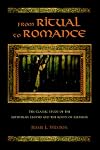
From Ritual to Romance
by Jessie L. Weston
On This Page
Description
Acknowledged by T. S. Eliot as crucial to understanding "The Waste Land," Jessie Weston's book has continued to attract readers interested in ancient religion, myth, and especially Arthurian legend. Weston examines the saga of the Grail, which, in many versions, begins when the wounded king of a famished land sees a procession of objects including a bleeding lance and a bejewelled cup. She maintains that all versions defy uniform applications of Celtic and Christian interpretations, and show more explores the legend's Gnostic roots. Drawing from J. G. Frazer, who studied ancient nature cults that associated the physical condition of the king with the productivity of the land, Weston considers how the legend of the Grail related to fertility rites--with the lance and the cup serving as sexual symbols. She traces its origins to a Gnostic text that served as a link between ancient vegetation cults and the Celts and Christians who embellished the story. Conceiving of the Grail saga as a literary outgrowth of ancient ritual, she seeks a Gnostic Christian interpretation that unites the quest for fertility with the striving for mystical oneness with God. show lessTags
Recommendations











Member Reviews
This book belongs on the bookshelf of anyone seriously interested in the evolution of religion. It is well-documented with plenty of footnotes. The book includes an index that any researcher could find useful.
Although well written, as some readers have commented on different reviews, the book uses a style of English that is no longer common on either side of the Atlantic. I imagine it was the norm when Jessie L. Weston (1850–1928) wrote this book (1920). I typed one of Weston’s long sentences (from page 62) in Grammarly.com. I selected “General Academic” as the style to correct. It received a score of 5 out of 100. Most likely, that would have been the standard for her time.
Other readers commented on Weston’s frequent use of show more Latin and French words without any translation. There is also German. For example, on page 114 there is a paragraph with 179 words in four sentences. Out of the 179 words, four are Latin or French words. Although most are recognizable to a monolingual readership, words such as “Manqué,” might require a dictionary. And let me not forget "gar keinem Verhältniss" (of all proportion). I would assume that when she wrote this book, many English-speaking book lovers could also read French and Latin, and possibly Ancient Greek and German, without much difficulty.
"In Indian cosmogony Manu finds a little fish in the water in which he would wash his hands; it asks, and received, his protection, asserting that when grown to full size it will save Manu from the universal deluge. This is Lhasa, the greatest of all fish.” (Pg. 126) Now, that story from the ancient Mahabharata, which Weston quotes, reminds me of more than one Bible story. Notwithstanding the limitations that Weston’s style may present to today’s audience, I would stress that this little book is a jewel for the serious researcher. show less
Although well written, as some readers have commented on different reviews, the book uses a style of English that is no longer common on either side of the Atlantic. I imagine it was the norm when Jessie L. Weston (1850–1928) wrote this book (1920). I typed one of Weston’s long sentences (from page 62) in Grammarly.com. I selected “General Academic” as the style to correct. It received a score of 5 out of 100. Most likely, that would have been the standard for her time.
Other readers commented on Weston’s frequent use of show more Latin and French words without any translation. There is also German. For example, on page 114 there is a paragraph with 179 words in four sentences. Out of the 179 words, four are Latin or French words. Although most are recognizable to a monolingual readership, words such as “Manqué,” might require a dictionary. And let me not forget "gar keinem Verhältniss" (of all proportion). I would assume that when she wrote this book, many English-speaking book lovers could also read French and Latin, and possibly Ancient Greek and German, without much difficulty.
"In Indian cosmogony Manu finds a little fish in the water in which he would wash his hands; it asks, and received, his protection, asserting that when grown to full size it will save Manu from the universal deluge. This is Lhasa, the greatest of all fish.” (Pg. 126) Now, that story from the ancient Mahabharata, which Weston quotes, reminds me of more than one Bible story. Notwithstanding the limitations that Weston’s style may present to today’s audience, I would stress that this little book is a jewel for the serious researcher. show less
I read this book because I wanted to understand better "The Waste Land," and to that extent at least the book was certainly successful. I have no idea how reliable the author's theories are--Segal's introduction was pretty useful in weighing the argument for both strengths and weaknesses. Also, the book had a pleasing amount of the conspiracy-ism that makes a lot of grail literature fairly exciting.
This little book is Jessie Weston's argument that the Grail quest is an ancient vegetation ritual told in story form. She goes into a lot of detail about elements and symbols found in the story, how they relate to the Adonis/Attis/Osiris rituals, which versions were probably earliest, and how the story changed and was adapted to its later form as a romance.
I thought the book was interesting and that she made a good case for her theory. Her focus was the Grail story, so she didn't deal with Arthurian legends except as they related to it, though she wrote about other aspects and legends in other articles. Parts of the book were quite clear, but other passages contained some of the most complex and convoluted sentences that I have ever seen.
I thought the book was interesting and that she made a good case for her theory. Her focus was the Grail story, so she didn't deal with Arthurian legends except as they related to it, though she wrote about other aspects and legends in other articles. Parts of the book were quite clear, but other passages contained some of the most complex and convoluted sentences that I have ever seen.
As for other reviews: the limitations are not in Weston's language; they are in the contemporary reader.
To assert otherwise is akin to blaming a language one doesn't understand for one's lack of understanding of the language, instead of taking responsibility for the fact one doesn't understand the language because of one's illiteracy in the language.
To assert otherwise is akin to blaming a language one doesn't understand for one's lack of understanding of the language, instead of taking responsibility for the fact one doesn't understand the language because of one's illiteracy in the language.
The book that influenced T. S. Eliot in structure and content of The Wasteland
Ratings
Members
- Recently Added By
Published Reviews
ThingScore 50
added by booksaplenty1949
Lists

thought provoking
15 works; 1 member

religion, myth, folktales
13 works; 1 member
Author Information

28+ Works 910 Members
Some Editions
Awards and Honors
Awards
Notable Lists
Series
Belongs to Publisher Series
Work Relationships
Inspired
Common Knowledge
- Original publication date
- 1920
- Epigraph
- Many literary critics seem to think that an hypothesis about obscure and remote questions of history can be refuted by a simple demand for the production of more evidence than in fact exists, --But the true test of an hypothe... (show all)sis, if it cannot be shewn to conflict with know truths, is the number facts that it correlates, and explains. - (Cornford, Origins of Attic Comedy.)
- First words
- In view of the extensive literature to which the Grail legend has already given birth it may seem that the addition of another volume to the already existing corpus calls for some words of apology and explanation.
- Last words
- (Click to show. Warning: May contain spoilers.)The study and the criticism of the Grail literature will possess an even deeper interest, a more absorbing fascination, when it is definitely recognized that we possess in that literature a unique example of the restatement of an ancient and august Ritual in terms of imperishable Romance.
- Original language
- English
Classifications
- Genres
- Nonfiction, Literature Studies and Criticism, Religion & Spirituality
- DDC/MDS
- 809.915 — Literature & rhetoric Literature, rhetoric & criticism History, description, critical appraisal of more than two literatures Literature displaying specific features, miscellaneous writings Literature displaying specific qualities of style, mood, viewpoint Symbolism, allegory, fantasy, myth
- LCC
- PN686 .G7 .W45 — Language and Literature Literature (General) Literature (General) Literary history By period Medieval (to 1500) Legends
- BISAC
Statistics
- Members
- 696
- Popularity
- 41,181
- Reviews
- 5
- Rating
- (3.56)
- Languages
- English, Polish, Portuguese
- Media
- Paper, Ebook
- ISBNs
- 38
- UPCs
- 1
- ASINs
- 12