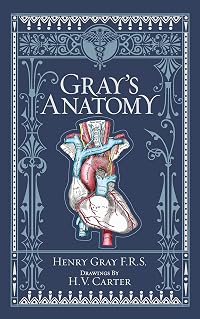
Gray's Anatomy
by Henry Gray
On This Page
Description
Written in the 1850s when its author was a young doctor, Gray's Anatomy was the most comprehensive and accessible medical textbook of its time. This compact volume comprises an abridged version of the classic 1860 edition - the last to be published during Gray's lifetime - and the masterly wood-block illustrations that ensured the runaway success of the original book. A national and international treasure, Gray's Anatomy is essential reading for anyone with an interest in the history of show more medicine or in the amazingly complex machine that is the human body. show lessTags
Recommendations














Member Recommendations
Member Reviews
A wonderful and fascinating atlas of the workings of the human body. It has some quaint anachronisms and other interesting things.
Starting off with the overall structure of cells in the body and covering the different tissues and glands and membranes, the book follows up with embryology and talks about the development of the human fetus from conception. The book has many general chapters and systematically goes through all of the body systems. After this section of the book, Gray's Anatomy restarts it's page count on the subject of the bones, or Osteology.
This section starts with the spine, goes to the skull, then the thorax and upper extremities, and the pelvis and lower extremities. Each muscle attachment is listed and all of the show more articulations are as well. Each bone has a corresponding picture to go with it, and it is beautifully rendered in black and white. That would be my only complaint overall actually, but not enough to take away a star from this book.
Next up is the subject of the joints or the Articulations as the book calls them. It goes through the types of joints and what they are made of and all of that. Then it goes to the articulations of the Trunk, followed by the upper extremities and the lower extremities.
The next major chunk of the book deals with muscles and other deep tissues or fascia. It starts at the head and goes down. All throughout the book we also get surgical advice, so that makes for some gruesome imagery. One wonders how they did it back then without anesthetic. Ah well. Each part of the muscles and fascia section contain information on dissection of the area in question.
The Blood-Vascular system follows. This section starts with the heart and goes to the arteries and then the veins. The lymphatic system gets it own section following the section on the vascular system.
Following that is the nervous system, the organs and then it covers specific situations like an Inguinal Hernia.
All in all this book is amazing, but very involved. It contains over 600 illustrations of cells and body parts so if you have the time, a look is certainly worthwhile. show less
Starting off with the overall structure of cells in the body and covering the different tissues and glands and membranes, the book follows up with embryology and talks about the development of the human fetus from conception. The book has many general chapters and systematically goes through all of the body systems. After this section of the book, Gray's Anatomy restarts it's page count on the subject of the bones, or Osteology.
This section starts with the spine, goes to the skull, then the thorax and upper extremities, and the pelvis and lower extremities. Each muscle attachment is listed and all of the show more articulations are as well. Each bone has a corresponding picture to go with it, and it is beautifully rendered in black and white. That would be my only complaint overall actually, but not enough to take away a star from this book.
Next up is the subject of the joints or the Articulations as the book calls them. It goes through the types of joints and what they are made of and all of that. Then it goes to the articulations of the Trunk, followed by the upper extremities and the lower extremities.
The next major chunk of the book deals with muscles and other deep tissues or fascia. It starts at the head and goes down. All throughout the book we also get surgical advice, so that makes for some gruesome imagery. One wonders how they did it back then without anesthetic. Ah well. Each part of the muscles and fascia section contain information on dissection of the area in question.
The Blood-Vascular system follows. This section starts with the heart and goes to the arteries and then the veins. The lymphatic system gets it own section following the section on the vascular system.
Following that is the nervous system, the organs and then it covers specific situations like an Inguinal Hernia.
All in all this book is amazing, but very involved. It contains over 600 illustrations of cells and body parts so if you have the time, a look is certainly worthwhile. show less
Originally published in 1858, Gray's Anatomy, which serves as the standard medical textbook of the modern age, is now into its 40th edition. Curiously if one takes the time to peruse the detailed sections, especially the internal organs and circulatory system, one discovers surprisingly in the first American edition of 1908 how much scientists knew near the turn of the 20th century. The side notes and drawn diagrams would certainly make Leonardo Da Vinci proud. For anyone going into the medical profession, this unabridged early American edition is a great pick for one's bookshelf. Most often copies can be found reprinted in the bargain bins of chain-bookstores or located in used bookshops reasonably priced.
Human bodies vary more than I had imagined.
Page 1444: Psoras Minor is absent in about 40% of subjects. This was very meaningful to
me, not because of that specific muscle, but because it lets me know that not all human bodies have the same structure. (39th edition)
A friend's knee muscles, someone else has an extra vertebrae, I seem to be missing a foot muscle.
I read the 39th edition.
Page 1444: Psoras Minor is absent in about 40% of subjects. This was very meaningful to
me, not because of that specific muscle, but because it lets me know that not all human bodies have the same structure. (39th edition)
A friend's knee muscles, someone else has an extra vertebrae, I seem to be missing a foot muscle.
I read the 39th edition.
When I started Medical School I didn't realise I would need a better anatomy textbook than this paper back version of a very early editon of Greys anatomy.
It would have been nice to actually get to see more bodies, but unfortunly I went to one of those progressive medical schools that didn't teach do dissection.
It would have been nice to actually get to see more bodies, but unfortunly I went to one of those progressive medical schools that didn't teach do dissection.
Tough read, but if you are interested in learning anatomy in great detail, it is without a doubt worth it.
This is a reprint of an earlier edition of Gray's Anatomy, a book which has since become the classic reference on human anatomy. Enormous detail throughout, illustrated with beautiful drawings.
A very small print version of Gray's Anatomy. I have to say it's not a very useful textbook, too small to be of any use really.
Members
- Recently Added By
Lists

Best Reference Books
53 works; 34 members

Books that changed the world
67 works; 63 members

A Rainbow of Books: Colors in the Title
570 works; 24 members
Author Information

10 Works 4,794 Members
Henry Gray was a British physician who wrote a general anatomy textbook at the age of 33; his work is still regarded as a standard after more than 100 years. Considering the fame of his modest textbook, relatively little is known about Gray. He was trained at St. George's Hospital, London, where he demonstrated an early interest in anatomical show more studies by writing a prize-winning essay comparing the structure of the human eye to the eyes of other vertebrates. Gray maintained his connection to St. George's and taught anatomy to medical students until his death from smallpox. In his short career, he wrote a book on the spleen, The Structure and Use of the Spleen (London, 1854) and published Anatomy, Descriptive and Surgical (1858), which assured him a place in medical history. Although there were other anatomy textbooks available at the time, Gray's approach was much clearer than all of the others. He was described by a contemporary as a "lucid teacher of anatomy" because of his organization of materials and the effective use of illustrations, drawn by Henry Vandyke Carter. Gray also hired a professional editor to work with his prose to make it less technical and more comprehensible to the student. "This accessibility has been one of the great factors in the Anatomy's success and has influenced other writers of anatomy textbooks" (Dictionary of Scientific Biography). (Bowker Author Biography) show less
Some Editions
Series
Belongs to Publisher Series
Common Knowledge
- Canonical title
- Gray's Anatomy
- Original title
- Anatomy- Descriptive and Surgical
- Original publication date
- 1858
- Dedication
- Sir Benjamin Collins Brodie, Bart.
F.R.S., D.C.I,
Serjeant-surgeon to Queen Victoria
Corresponding member of the Institute of France - First words
- All the tissues and organs of which the body is composed were originally developed from a microscopic body (the ovum), consisting of a soft gelatinous granular material enclosed in a membrane, and containing a ... (show all)vesicle, or small spherical body, inside which are one or more solid spots.
- Last words
- (Click to show. Warning: May contain spoilers.)In the female, the vagina perforates the recto-vesical fascia, and receives a prolongation from it.
- Disambiguation notice
- Do not confuse with similar title "Gray's Anatomy" by Spalding Gray
Classifications
Statistics
- Members
- 3,627
- Popularity
- 4,485
- Reviews
- 14
- Rating
- (4.00)
- Languages
- English, Italian, Norwegian, Spanish
- Media
- Paper, Ebook
- ISBNs
- 98
- UPCs
- 2
- ASINs
- 78