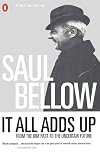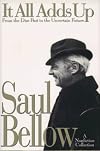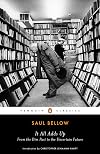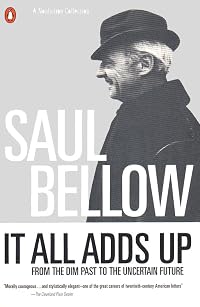
It All Adds Up: From the Dim Past to the Uncertain Future
by Saul Bellow
On This Page
Description
"Saul Bellow's fiction, honored by a Nobel Prize and a Pulitzer, among other awards, has made him a literary giant. Now, in his first nonfiction collection, Bellow's learned and original mind shines through over four decades of reflections on literature, on the state of the artist in the "violent uproar" of contemporary life, and on life itself, "the mysteries of our common human nature."" "Beginning with "Mozart: An Overture," a personal bicentennial tribute to the composer who means so show more much to Bellow, these carefully selected pieces, illuminated by Bellow's absolute clarity of language, range from his Nobel Prize lecture of 1976 to ruminations about his beloved city of Chicago, a city, Bellow writes, that "builds itself up, knocks itself down again, scrapes away the rubble, and starts over"; to remembrances of passing friends - John Cheever, Allan Bloom, Isaac Rosenfeld, John Berryman; to the state of the novel in our time. Along the way, he invokes Tolstoy, Dostoyevsky, Flaubert, Proust, Conrad, and other masters of the novel to bear the testament of his own life, his conviction of what the novel as a work of art can do for a society benumbed by technology." "Also included in this rich collection are pastoral, provocative travel pieces on Spain, Israel, Paris, Tuscany, and other special haunts. And finally, as the chef d'oeuvre, the revealing question-and-answer piece comprising "A Half Life," and "A Second Half Life," which is as close as we will come to an autobiography from this contemporary master of American fiction."--Jacket. show lessTags
Recommendations

















Member Reviews
By the mid-90s you were a real anachronism to even suggest interest in Marxism, let alone say that you were a Marxist. Nonetheless, that's more or less exactly what Bellow does.
In a succinct introduction of just over two pages he declares that he thinks this collection of non-fiction is superfluous, but he gives in to the wish of the publisher. He also sums up where, retrospectively and summatively, his main interest lies, namely with attention and distraction.
The essays are difficult to read because the author obviously doesn't service the reader more than necessary. To get all references to, for instance people who influenced Bellow, you would have to look those people up in external sources.
Bellow states that Marxism was the main show more formative influence during his life, and he cannot simply abandon it. However, he does conclude that Marxism has lost the power to explain reality because wordwide society is now dominated by urbanization and technology. These essays were written in the early 90s, obviously these trends come later to China, but may likewise undermine the power of Marxist theory to predict and guide societal development.
Bellow has a lot more to say, and his tenets about misinformation and disinformation are very apt. In fact, his essays can only be understand through very attentive and repeated reading.
The essays I like most are the essays in Part 3, and the two interviews with Saul Bellow at the end of the book. Clearly, Bellow is a bit of a maverick, but very clever. Incidentally, he was awarded the Nobel Prize for Literature in 1976. show less
In a succinct introduction of just over two pages he declares that he thinks this collection of non-fiction is superfluous, but he gives in to the wish of the publisher. He also sums up where, retrospectively and summatively, his main interest lies, namely with attention and distraction.
The essays are difficult to read because the author obviously doesn't service the reader more than necessary. To get all references to, for instance people who influenced Bellow, you would have to look those people up in external sources.
Bellow states that Marxism was the main show more formative influence during his life, and he cannot simply abandon it. However, he does conclude that Marxism has lost the power to explain reality because wordwide society is now dominated by urbanization and technology. These essays were written in the early 90s, obviously these trends come later to China, but may likewise undermine the power of Marxist theory to predict and guide societal development.
Bellow has a lot more to say, and his tenets about misinformation and disinformation are very apt. In fact, his essays can only be understand through very attentive and repeated reading.
The essays I like most are the essays in Part 3, and the two interviews with Saul Bellow at the end of the book. Clearly, Bellow is a bit of a maverick, but very clever. Incidentally, he was awarded the Nobel Prize for Literature in 1976. show less
H1.1.4
Jan 17, 2022Catalan
Ratings
Members
- Recently Added By
Lists

Literary Theory and Criticism: What Happens and Why
37 works; 5 members

Reading LIst
648 works; 1 member
Author Information

143+ Works 33,869 Members
Saul Bellow was born in Lachine, Quebec, Canada on June 10, 1915. He attended the University of Chicago, received a Bachelor's degree in sociology and anthropology from Northwestern University in 1937, and did graduate work at the University of Wisconsin. He taught at several universities including the University of Minnesota, Princeton show more University, the University of Chicago, New York University, and Boston University. His first novel, Dangling Man, was published in 1944. His other works include The Victim, Seize the Day, Henderson the Rain King, Mosby's Memoirs and Other Stories, To Jerusalem and Back: A Personal Account, Him with His Foot in His Mouth and Other Stories, More Die of Heartbreak, and Something to Remember Me By. He received numerous awards including the 1975 Pulitzer Prize for Humboldt's Gift, the 1976 Nobel Prize in Literature, and three National Book Awards for fiction for The Adventures of Augie March in 1954, Herzog in 1964, and Mr. Sammler's Planet in 1970. Also a playwright, he wrote The Last Analysis and three short plays, collectively entitled Under the Weather, which were produced on Broadway in 1966. He died on April 5, 2005. (Bowker Author Biography) show less
Series
Belongs to Publisher Series
Common Knowledge
- Canonical title
- It All Adds Up: From the Dim Past to the Uncertain Future
- Alternate titles
- Van een vaag verleden naar een onzekere toekomst {selections from It All Adds Up}
- Original publication date
- 1994
- First words*
- Non è mai del tutto piacevole leggere ciò che si è scritto decenni prima.
Prefazione - Quotations*
- Rileggendo questi scritti ho continuato a pensare alla poesia di Robert Frost, giacché anche nel mio caso c'erano state promesse da mantenere e miglia da percorrere prima di poter dormire. Ma non è stato così. Io ero già ... (show all)quasi addormentato e per tornare a casa ho dovuto fidarmi del cavallino. Lui si che conosceva la strada (piu o meno).
Prefazione
Molti anni fa, leggendo il saggio di Tolstoj su Maupassant, rimasi colpito dal breve elenco delle qualità che Tolstoj considerava indispensabili per scrivere bene. Esse erano: uno stile trasparente, un fondamento morale - ci... (show all)oè una ferma posizione sulla questione del bene e del male - e infine l'attenzione. Applicandosi diligentemente, lo scrittore sarebbe riuscito a inculcare il dono dell'attenzione nei suoi lettori, sostituendo al mondo il suo mondo. qui determinazione e passione sono interscambiabili. Sull'argomento possiamo solo aggiungere che uno scrittore viene educato soprattutto dai suoi errori. E come severamente suggerisce Herny James nel suo romanzo breve Mezza età, nel momento in cui hai completato la tua educazione e appreso un lavoro, è probabile che tu ti accorga di non avere più tempo a disposizione. - Last words*
- (Click to show. Warning: May contain spoilers.)Con tutta probabilità non ho raggiunto gli scopi che mi ero prefisso, ma la soddisfazione più grande è quella di essermi liberato dei tenaci errori del passato. Di entrare in un'epoca di errori migliori.
Prefazione - Disambiguation notice
- Please distinguish between Saul Bellow's It All Adds Up (1994) and the Dutch edition, Van een vaag verleden naar een onzekere toekomst, which contains only selections from the complete Work. Thank you.
Please distinguish between this Dutch edition of Van een vaag verleden naar een onzekere toekomst, which contains only selections from Saul Bellow's It All Adds Up (1994), and complete editions of that Work. Th... (show all)ank you.
*Some information comes from Common Knowledge in other languages. Click "Edit" for more information.
Classifications
- Genres
- Nonfiction, Literature Studies and Criticism, Fiction and Literature, Biography & Memoir
- DDC/MDS
- 814.52 — Literature & rhetoric American literature in English American essays in English 20th Century 1901-1945
- LCC
- PS3503 .E4488 .O23 — Language and Literature American literature American literature Individual authors 1900-1960
- BISAC
Statistics
- Members
- 346
- Popularity
- 91,533
- Reviews
- 3
- Rating
- (3.61)
- Languages
- 5 — Dutch, English, Italian, Portuguese (Portugal), Spanish
- Media
- Paper, Audiobook, Ebook
- ISBNs
- 19
- ASINs
- 6