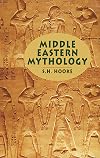
Middle Eastern Mythology
by S. H. Hooke
On This Page
Description
The role of mythology in ritual and its place in the origins of customs, cults, and hero worship are the fascinating subjects of this comparative survey. Based on firsthand sources, it recounts legends of the Egyptians, Babylonians, Assyrians, Hittites, and Canaanites, in addition to discussing the mythological elements of Jewish apocalyptic literature and the New Testament.S. H. Hooke, a distinguished scholar who taught at the University of London and served as Speaker's Lecturer at Oxford show more University, presents a well-documented commentary. Accessible and informative, his text highlights the similarities between a variety of Middle Eastern legends and offers revealing citations from documents, tablets, and inscriptions recovered by archaeological excavations. Familiar stories such as the events described in Genesis and those surrounding Noah's flood and Christ's nativity and resurrection -- whatever their basis in fact -- have parallels in other cultures. Professor Hooke provides a broad perspective on these and other tales, encompassing the roots of Greek, Roman, and even Celtic mythology. show lessTags
Recommendations















Member Reviews
An excellent introduction to the subject. More than an introduction really, due to the detail. He covers Mesopotamia and Egypt as well as the more obscure Hittite and Ugaritic mythologies. He follows the texts closely, either quoting or summarising, and keeps his commentary to a minimum allowing you to draw you own conclusions about the common fertility myths of these similar religions. The flower of the book is his treatment of Hebrew mythology. This is the area of Hooke's expertise and a lot of what he has to say is gob-smacking. Much of this part is either quoted or closely adapted from his earlier book In the Beginning. He closes the book with a brief discussion of Christian myth. He is very careful what he says here because it show more would be very easy to draw the conclusion that Christianity was another local agrarian religion founded entirely on myth. Hooke of course cannot say this, not only because of his own beliefs but because, while this is not a religious book, due to his fame as a Protestant OT scholar, much of his readership will be Christian and he doesn't want to become a pariah. show less
A learned, erudite, compact account of the mythologies of a number of civilizations in the ancient Middle East. The final chapter impinges on Christian ritual, by relating mythic elements in sich narratives as the Last Supper and the Eucharist. I have found it helpful in my investigations into the relationship between early Christian thought and that of its mythical, intellectual and spiritual context.
"The criterion used in this study is [...] functional. [...] The myth is a product of human imagination arising out a definite situation and intended to do something."
The functional approach seems the best way to discuss myths. Yet the links between the mythical elements of the civilizations could have been more clearly drawn.
The functional approach seems the best way to discuss myths. Yet the links between the mythical elements of the civilizations could have been more clearly drawn.
MIDDLE-EASTERN MYTHOLOGY:FROM THE ASSYRIANS TO THE HEBREWS
This book is a fascinating, very high-level description of the interrelationship of the mythology of the ancient Middle East, concentrating on the Sumerians, Assyrians, Canaanites, Egyptians, Hebrews, and Christians. I particularly enjoyed the brief descriptions of the myths themselves, and how these myths appear to have been made a part of the people's lives. The interconnection of mythology in the area was carefully related, although in places the Hebrew myths didn't seem to line up as well as the others. I also found it fascinating that the author labors to show how all these different myths influenced each other, but still feels the need to acknowledge his own, as well as his show more reader's unshakeable belief in Christianity. show less
This book is a fascinating, very high-level description of the interrelationship of the mythology of the ancient Middle East, concentrating on the Sumerians, Assyrians, Canaanites, Egyptians, Hebrews, and Christians. I particularly enjoyed the brief descriptions of the myths themselves, and how these myths appear to have been made a part of the people's lives. The interconnection of mythology in the area was carefully related, although in places the Hebrew myths didn't seem to line up as well as the others. I also found it fascinating that the author labors to show how all these different myths influenced each other, but still feels the need to acknowledge his own, as well as his show more reader's unshakeable belief in Christianity. show less
Jan 4, 2018Spanish
MIDDLE EASTERN MYTHOLOGY
The role of mythology in ritual and its place in the origins of customs, cults, and hero worship are the fascinating subjects of this comparative survey. Based on firsthand sources, it recounts legends of the Egyptians, Babylonians, Assyrians, Hittites, and Canaanites, in addition to discussing the mythological elements of Jewish apocalyptic literature and the New Testament.
S. H. Hooke, a distinguished scholar who taught at the University of London and served as Speaker's Lecturer at Oxford University, presents a well-documented commentary. Accessible and informative, his text highlights the similarities between a variety of Middle Eastern legends and offers revealing citations from documents, tablets, and show more inscriptions recovered by archaeological excavations. Familiar stories such as the events described in Genesis and those surrounding Noah's flood and Christ's nativity and resurrection — whatever their basis in fact — have parallels in other cultures. Professor Hooke provides a broad perspective on these and other tales, encompassing the roots of Greek, Roman, and even Celtic mythology. show less
The role of mythology in ritual and its place in the origins of customs, cults, and hero worship are the fascinating subjects of this comparative survey. Based on firsthand sources, it recounts legends of the Egyptians, Babylonians, Assyrians, Hittites, and Canaanites, in addition to discussing the mythological elements of Jewish apocalyptic literature and the New Testament.
S. H. Hooke, a distinguished scholar who taught at the University of London and served as Speaker's Lecturer at Oxford University, presents a well-documented commentary. Accessible and informative, his text highlights the similarities between a variety of Middle Eastern legends and offers revealing citations from documents, tablets, and show more inscriptions recovered by archaeological excavations. Familiar stories such as the events described in Genesis and those surrounding Noah's flood and Christ's nativity and resurrection — whatever their basis in fact — have parallels in other cultures. Professor Hooke provides a broad perspective on these and other tales, encompassing the roots of Greek, Roman, and even Celtic mythology. show less
Jan 11, 2018Spanish
Ratings
Members
- Recently Added By
Lists

Books in the Bibliography of The History of Hell by Alice K. Turner
155 works; 1 member
Author Information
19+ Works 620 Members
Series
Belongs to Publisher Series
Common Knowledge
- Canonical title
- Middle Eastern Mythology
- Original title
- Middle Eastern Mythology
- Original publication date
- 1963
- Important places
- Middle East
Classifications
- Genres
- Nonfiction, Religion & Spirituality, History, General Nonfiction
- DDC/MDS
- 398 — Society, government, & culture Customs, etiquette & folklore Folklore & Folktales
- LCC
- BL311 .H6 — Philosophy, Psychology and Religion Religions. Mythology. Rationalism Religions. Mythology. Rationalism The myth. Comparative mythology
- BISAC
Statistics
- Members
- 417
- Popularity
- 74,276
- Reviews
- 5
- Rating
- (3.40)
- Languages
- English, Turkish
- Media
- Paper
- ISBNs
- 5
- ASINs
- 14