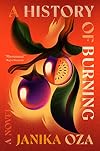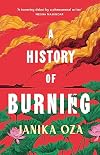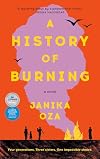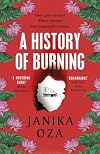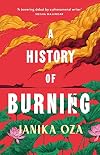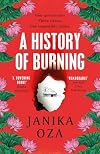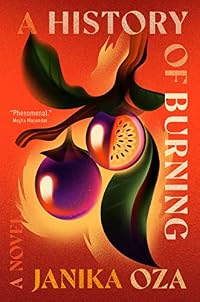
A History of Burning
by Janika Oza
On This Page
Description
"At the turn of the twentieth century, Pirbhai, a teenage boy looking for work, is taken from his village in India to labor on the East African Railway for the British. One day Pirbhai commits an act to ensure his survival that will haunt him forever and reverberate across his family's future for years to come. Pirbhai's children are born and raised under the jacaranda trees and searing sun of Kampala during the waning days of British colonial rule. As Uganda moves towards independence and show more military dictatorship, Pirbhai's granddaughters, Latika, Mayuri, and Kiya, are three sisters coming of age in a divided nation. As they each forge their own path for a future, they must carry the silence of the history they've inherited. In 1972, under Idi Amin's brutal regime and the South Asian expulsion, the family has no choice but to flee, and in the chaos, they leave something devastating behind. As Pirbhai's grandchildren, scattered across the world, find their way back to each other in exile in Toronto, a letter arrives that stokes the flames of the fire that haunts the family. It makes each generation question how far they are willing to go, and who they are willing to defy to secure their own place in the world. A History of Burning is an unforgettable tour de force, an intimate family saga of complicity and resistance, about the stories we share, the ones that remain unspoken, and the eternal search for home"-- show lessTags
Recommendations





















Member Reviews
In India, in 1898, Pirbhai is the 13 year old bread winner for his family. He is tricked into working for the British, labouring on The East Indian Railway. Looking for work , he signs a piece of paper that he cannot read, and uses his thumbprint for a signature. His children go on to do well enough in Uganda. Vinod, his son, marries Rajna, an arranged marriage. Their three daughters, Latika, Mayuri and Kiya , come of age as Idi Amin begins his brutal dictatorship.
I found the part about Idi Amin's Uganda to be most fascinating. I had never read much about his brutal reign, and the eventual expulsion of South Asians. Each of the daughters lead interesting lives. Latika is determined and bold, and works as a journalist. Mayuri wishes to show more become a physician , and moves from Uganda to Bombay to study. Kiya hopes to become a teacher. From there, most of the family is forced to flee to Toronto , following a traumatic event. In Toronto , they struggle as a family and as immigrants.
This story grabbed me from the start. It's an epic generational saga, covering family, racism, activism, colonialism, immigration and secrets kept and revealed. It is intimately told from the many points of view of the characters. A quote from the book that resonates throughout the story : "What was love but one long act of forgiveness, of choosing to return, over and over again."
A deeply moving story, beautifully written.
Highly recommended. show less
I found the part about Idi Amin's Uganda to be most fascinating. I had never read much about his brutal reign, and the eventual expulsion of South Asians. Each of the daughters lead interesting lives. Latika is determined and bold, and works as a journalist. Mayuri wishes to show more become a physician , and moves from Uganda to Bombay to study. Kiya hopes to become a teacher. From there, most of the family is forced to flee to Toronto , following a traumatic event. In Toronto , they struggle as a family and as immigrants.
This story grabbed me from the start. It's an epic generational saga, covering family, racism, activism, colonialism, immigration and secrets kept and revealed. It is intimately told from the many points of view of the characters. A quote from the book that resonates throughout the story : "What was love but one long act of forgiveness, of choosing to return, over and over again."
A deeply moving story, beautifully written.
Highly recommended. show less
I liked this multigenerational story that begins in India in 1898 and ends in Toronto in 1992. The characters were well drawn and nuanced. The time span included the rise of the dictatorship of Idi Amin and the expulsion of Asians from Uganda....people who had lived there for generations. The book deals with racism, colonialism, activism, immigration and -- most of all -- family connections, traditions and secrets.
What I especially reflected on were the multigenerational effects of a single decision, such as Pirbhai's decision to work in Africa or Latika's decision to remain in Uganda. The author showed the often unimagined impacts of such decisions and how they shape a family.
Very well written with a lot of depth.
What I especially reflected on were the multigenerational effects of a single decision, such as Pirbhai's decision to work in Africa or Latika's decision to remain in Uganda. The author showed the often unimagined impacts of such decisions and how they shape a family.
Very well written with a lot of depth.
Multigenerational family saga that covers almost one hundred years. It starts with Pirbhai in 1898 in Gujarat, India. He needs work and is fooled into signing up for a grueling project in British East Africa (now Kenya), where he builds railroads for the colonial powers. He commits an act that will reverberate through the family for generations. The storyline follows his descendants after a move to Uganda, the family’s successful business, and the expulsion of Asians by Idi Amin in 1972. The family is scattered, with some ending up in Toronto, Canada.
It is organized chronologically, occasionally leaping forward in time. For me, the heart of the novel is in the experience of the family living in Uganda under the dictatorship of Idi show more Amin. It sheds light on a part of world history that may not be widely known. Once expelled, the family must adapt to a new way of life, facing the many challenges experienced by those seeking refuge in other countries, who are often misunderstood or stereotyped.
It explores intergenerational family trauma, and the manner in which family members must face the same issues and concerns though separated by time and place. It spans three continents, with segments set in India, Kenya, Uganda, England, and Canada. Themes include colonialism, the plight of refugees, the impact of family secret-keeping, belonging, and memory. This is quite an accomplished debut and I look forward to reading more from Janika Oza. show less
It is organized chronologically, occasionally leaping forward in time. For me, the heart of the novel is in the experience of the family living in Uganda under the dictatorship of Idi show more Amin. It sheds light on a part of world history that may not be widely known. Once expelled, the family must adapt to a new way of life, facing the many challenges experienced by those seeking refuge in other countries, who are often misunderstood or stereotyped.
It explores intergenerational family trauma, and the manner in which family members must face the same issues and concerns though separated by time and place. It spans three continents, with segments set in India, Kenya, Uganda, England, and Canada. Themes include colonialism, the plight of refugees, the impact of family secret-keeping, belonging, and memory. This is quite an accomplished debut and I look forward to reading more from Janika Oza. show less
Beginning in 1898 with a young boy, Pirbhai, being tricked into traveling from India to Africa to help build the East African Railway, this sweeping saga traces the story of four generations told in snapshots through the years. This family is representative of Asians settling in Uganda during British Colonial Rule and, following the country’s independence and ascendence of Idi Amin, their expulsion in 1972 and worldwide resettlement.
I wasn’t sure about this book. It did take me a few chapters to settle in, but once I did, I couldn’t put it down; I was totally captivated by it. Beautifully written, I learned a lot of history of which I was only vaguely aware. There is so much here, but it is not overwhelming. Well written, there show more is warmth, love, benevolence, brutality, resilience.
Whenever I read books that tell stories like this one, I am left aghast about how helpless the world is when confronting dictators, the inhumanity of mankind in how it often treats others and how unwilling some are to assist refugees. This book will stay in my head for a while.
This is an incredible work from a debut author.
Thanks to #netgalley and #Grandcentralpublishing for the ARC. show less
I wasn’t sure about this book. It did take me a few chapters to settle in, but once I did, I couldn’t put it down; I was totally captivated by it. Beautifully written, I learned a lot of history of which I was only vaguely aware. There is so much here, but it is not overwhelming. Well written, there show more is warmth, love, benevolence, brutality, resilience.
Whenever I read books that tell stories like this one, I am left aghast about how helpless the world is when confronting dictators, the inhumanity of mankind in how it often treats others and how unwilling some are to assist refugees. This book will stay in my head for a while.
This is an incredible work from a debut author.
Thanks to #netgalley and #Grandcentralpublishing for the ARC. show less
Reason read: BB from Deborah, a book about Uganda. A book about an Indian family's, multigenerational, journey from India to Uganda to Canada. It is about intergeneration trauma. The title reflects the difficult experiences of the family. It is told in 10 perspectives, one of which is an unnamed narrator. I found the story compelling but the different family members (and probably holiday distractions) made it sometimes to keep it all straight. But it is a good book, which also historical fiction covering the rise of Idi Amin.
This is a well written and interesting family story of four generations that starts in India and ends in Toronto in 1992. It is a story of survival through hard work, resettlement, family traditions, love and will power.
It starts in 1898 when Pirbhai in Gujarat, India is lured to a menial, back breaking job in Kenya working on the British Railroad. He escapes this slavery and ends up working for a family. He and Sonal the daughter marry and they begin the family that populates the story. The descendants move from Kenya to Uganda u til 1972 when the South Asians are expelled by Idi Amin, the President for life. The branch of the family that lands in Toronto have trouble being accepted but re establish themselves into jobs, school and show more community and find a sense of happiness through third family ties.
I enjoyed the book and its characters but often got lost in who was who. A list of characters at the beginning would help. show less
It starts in 1898 when Pirbhai in Gujarat, India is lured to a menial, back breaking job in Kenya working on the British Railroad. He escapes this slavery and ends up working for a family. He and Sonal the daughter marry and they begin the family that populates the story. The descendants move from Kenya to Uganda u til 1972 when the South Asians are expelled by Idi Amin, the President for life. The branch of the family that lands in Toronto have trouble being accepted but re establish themselves into jobs, school and show more community and find a sense of happiness through third family ties.
I enjoyed the book and its characters but often got lost in who was who. A list of characters at the beginning would help. show less
A very good read. Historical fiction done well. Set among the Indian diaspora in colonial Uganda, and their later scattering due to Idi Amin.
And it seemed like the first novel I've read in a decade that was told in a strictly linear time sequence. I had started to think it was compulsory for authors to begin in the middle, go back in time, and then shuffle about.
And it seemed like the first novel I've read in a decade that was told in a strictly linear time sequence. I had started to think it was compulsory for authors to begin in the middle, go back in time, and then shuffle about.
Members
- Recently Added By
Published Reviews
ThingScore 75
In her debut novel, “A History of Burning,” Janika Oza creates an ambitious conflagration of characters, languages and continents....this epic novel about an extended Indo-Ugandan family that is displaced, settled and displaced again. With each disruption of movement, the author skillfully interrogates sweeping themes of survival, inheritance, immigration, colonialism and racism. By any show more standards, it’s a daunting undertaking: Oza’s narrative traverses almost a century of time, four generations of family, five continents and multiple languages, with the story moving between the perspectives of 10 characters (largely told in the third-person voice with a few detours into the first person during the last quarter of the novel). The result is a haunting, symphonic tale that speaks to the nuanced complexities of class and trauma for this particular family.....This engaging novel is interrupted by only a few missteps....The author opens things up for her readers. More life, more joy and more love amid a shifting and layered landscape of unspeakable loss. It’s all there — the complicated humanity and grief of Oza’s family of characters — for the reader to consider and behold. show less
added by vancouverdeb
Lists

Unread books
1,063 works; 87 members

Globe and Mail | Canadian Fiction: May 13, 2023
10 works; 1 member

Fiction: Asia
85 works; 2 members
Author Information
1+ Work 276 Members
Some Editions
Awards and Honors
Awards
Distinctions
Notable Lists
Common Knowledge
- Original publication date
- 2023
- People/Characters
- Pirbhai; Vinod; Rajna; Latika; Mayuri; Kiya (show all 8); Hari; Sonal
- Important places
- India; Uganda, Africa; Toronto, Ontario, Canada
- Important events
- 1972 invasion of Uganda
- Dedication
- For Manu-dada and Bhagwati-baa
- First words
- The last day Pirbhai spent in Gujarat was ignited by a sun the could not last.
- Quotations
- What was love but one long act of forgiveness, of choosing to return, over and over again.
- Last words
- (Click to show. Warning: May contain spoilers.)A reminder, as they stand together, that what the water takes, it returns.
- Blurbers
- Majumdar, Megha; Bala, Sharon; El Akkad, Omar; Ko,Lisa; Swamy,Shruti; Khong, Rachel (show all 7); Selvadurai, Shyam
- Original language
- English Canada
Classifications
Statistics
- Members
- 276
- Popularity
- 116,454
- Reviews
- 12
- Rating
- (4.11)
- Languages
- English
- Media
- Paper, Audiobook, Ebook
- ISBNs
- 14
- ASINs
- 3