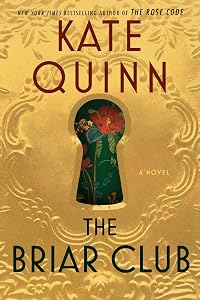
The Briar Club
by Kate Quinn
On This Page
Description
The New York Times bestselling author of The Diamond Eye and The Rose Code returns with a haunting and powerful story of female friendships and secrets in a Washington, DC, boardinghouse during the McCarthy era.Washington, DC, 1950. Everyone keeps to themselves at Briarwood House, a down-at-the-heels all-female boardinghouse in the heart of the nation's capital where secrets hide behind white picket fences. But when the lovely, mysterious widow Grace March moves into the attic room, she show more draws her oddball collection of neighbors into unlikely friendship: poised English beauty Fliss, whose facade of perfect wife and mother covers gaping inner wounds; policeman's daughter Nora, who finds herself entangled with a shadowy gangster; frustrated baseball star Beatrice, whose career has come to an end along with the women's baseball league of WWII; and poisonous, gung-ho Arlene, who has thrown herself into McCarthy's Red Scare.
Grace's weekly attic-room dinner parties and window-brewed sun tea become a healing balm on all their lives, but she hides a terrible secret of her own. When a shocking act of violence tears the house apart, the Briar Club women must decide once and for all: who is the true enemy in their midst?
Capturing the paranoia of the McCarthy era and evoking the changing roles for women in postwar America, The Briar Club is an intimate and thrilling novel of secrets and loyalty put to the test.
Includes a bonus conversation with Kate Quinn, Saskia Maarleveld, and Tessa Woodward, editor of The Briar Club.
. show less
Tags
Recommendations


Member Reviews
The Briar Club by Kate Quinn is a slow-burn historical mystery thriller that ultimately delivers a powerful and rewarding climax. Ideal for readers who enjoy Kristin Hannah and women-centered historical fiction, the novel weaves together themes of friendship, resilience, and quiet rebellion. Quinn takes her time developing each character, offering detailed backstories that deepen the emotional impact of the unfolding mystery. While the pacing feels gradual at first, this deliberate buildup strengthens the tension and makes the explosive final act all the more satisfying. The story thoughtfully explores how women have historically been judged, limited, and confined to domestic roles, highlighting the strength required to push against show more those expectations. The boardinghouse setting becomes a symbol of both restriction and solidarity, where bonds between women grow in meaningful ways. Though patient readers are required early on, the gripping, fast-paced climax transforms the narrative into a true page-turner, leaving a lasting impression about courage, identity, and the power of female friendship. show less
Briarwood House is a boarding house for women in Washington. Run by the fussy and awkward Mrs Nilsson, most of the work is done by her put-upon son, Pete, alongside his neglected sister, Lina. When a new tenant arrives the house begins to change and the women for a solid group where their secrets gain support. However, tragedy is around the corner and when it happens Briarwood House needs to decide where the priorities are.
This is an amazingly complex book about post-War America and the lives of women masquerading as a female-orientated novel! Each character takes on a persona that is believable and which also reflects on different strata of society, each is completely sympathetically drawn and, reading the author notes, expertly show more researched. I absolutely loved the different tales and the complexity of the ending. show less
This is an amazingly complex book about post-War America and the lives of women masquerading as a female-orientated novel! Each character takes on a persona that is believable and which also reflects on different strata of society, each is completely sympathetically drawn and, reading the author notes, expertly show more researched. I absolutely loved the different tales and the complexity of the ending. show less
I will not stop thinking about the characters in this novel for a long time. Set in the early 1950s during the Cold War and the heightened Red Scare era, the women and men who met at a boarding house in Washington DC discover friendship and conflict in equal measure. Through them Quinn tells the stories of the times revealing each person’s past as it relates to their present circumstances. She skillfully brings the reader to a vision of their future. There is a great plot twist which I anticipated in theory, but did not see how it was going to play out until the end. Good job KQ! I had to ding a half star because there were two attributes to the book that I thought should have been edited out. First, the house did not need to be a show more character…it added nothing to the narrative. Second, we really didn’t need the recipes to appreciate the variety of meals they shared. YMMV. Highly recommend this solid historical fiction to those who remember the 50s or want to learn more about it. show less
⭐️⭐️⭐️⭐️✨ 4.25 stars
Finally!! This was really good.
Kate Quinn’s storytelling feels effortless, the way she weaves everything together is honestly genius.
I loved the multiple POVs and how clearly they were structured. Each woman brought something different to the story, and together they painted such a vivid picture of the 1950s, the prejudices, the Korean War, the limitations placed on women, the quiet rebellion, and the conversations around birth control.
The mystery element was this overarching theme, although it wasn’t necessarily the primary plot of the book, if that makes sense. It was fun though and made you wonder what was going to happen and who dies at the end of the book.
From the very beginning, you’re show more given this glimpse of a murder, and there’s this underlying question of identity and truth that just keeps building until everything clicks into place at the end. It’s more character-driven than fast-paced, but I was completely invested.
I’ll say the chapters are on the longer side, but honestly, it works for this story. Also, total sidenote, I loved that the house had its own POV, so to speak. Not traditional magical realism, but like the house had thoughts about the people in it and what was happening, which was really fun.
Listening to the author’s note at the end is a must. It adds so much depth to the characters and really shows the thought and care behind the structure. It genuinely enhanced the whole experience for me.
This was actually my first Kate Quinn book (which feels wild because I own several of her others 😅), and I listened to this one on audio. The narration was fantastic and really helped distinguish the different characters, though I imagine it’s just as strong on the page. I’ll definitely be picking up a physical copy to add to my shelves.
Also, I loved the creative touches like the recipes and how they were paired with little notes about when or how to enjoy them. It added this cozy, personal layer that fit the story so well. It’s hard to pick my favorite character, but Grace, Nora, and Bea were definitely standouts for me.
Small critique, some of the male characters were not as easy for me to keep straight, especially the various men connected to Grace. So that got a little convoluted for me, but maybe that’s just because I was listening.
Also, I wish she would’ve delved a little bit deeper into some of the historical events, like more details about the Korean War, I don’t feel like I know as much about that. Listening to the author’s note did give me a better glimpse into some of the things I wasn’t sure about (like women in baseball and why they were in the major leagues during the war), so there were definitely historical elements she explained well. But there were also a few that felt a little confusing to me since I wasn’t as familiar with them, and I didn’t feel like I got quite enough information, so I ended up doing a little of my own homework. show less
Finally!! This was really good.
Kate Quinn’s storytelling feels effortless, the way she weaves everything together is honestly genius.
I loved the multiple POVs and how clearly they were structured. Each woman brought something different to the story, and together they painted such a vivid picture of the 1950s, the prejudices, the Korean War, the limitations placed on women, the quiet rebellion, and the conversations around birth control.
The mystery element was this overarching theme, although it wasn’t necessarily the primary plot of the book, if that makes sense. It was fun though and made you wonder what was going to happen and who dies at the end of the book.
From the very beginning, you’re show more given this glimpse of a murder, and there’s this underlying question of identity and truth that just keeps building until everything clicks into place at the end. It’s more character-driven than fast-paced, but I was completely invested.
I’ll say the chapters are on the longer side, but honestly, it works for this story. Also, total sidenote, I loved that the house had its own POV, so to speak. Not traditional magical realism, but like the house had thoughts about the people in it and what was happening, which was really fun.
Listening to the author’s note at the end is a must. It adds so much depth to the characters and really shows the thought and care behind the structure. It genuinely enhanced the whole experience for me.
This was actually my first Kate Quinn book (which feels wild because I own several of her others 😅), and I listened to this one on audio. The narration was fantastic and really helped distinguish the different characters, though I imagine it’s just as strong on the page. I’ll definitely be picking up a physical copy to add to my shelves.
Also, I loved the creative touches like the recipes and how they were paired with little notes about when or how to enjoy them. It added this cozy, personal layer that fit the story so well. It’s hard to pick my favorite character, but Grace, Nora, and Bea were definitely standouts for me.
Small critique, some of the male characters were not as easy for me to keep straight, especially the various men connected to Grace. So that got a little convoluted for me, but maybe that’s just because I was listening.
Also, I wish she would’ve delved a little bit deeper into some of the historical events, like more details about the Korean War, I don’t feel like I know as much about that. Listening to the author’s note did give me a better glimpse into some of the things I wasn’t sure about (like women in baseball and why they were in the major leagues during the war), so there were definitely historical elements she explained well. But there were also a few that felt a little confusing to me since I wasn’t as familiar with them, and I didn’t feel like I got quite enough information, so I ended up doing a little of my own homework. show less
4.25 Stars. After being captivated by the stirring narrative in her recent collaboration with Janie Chang, The Phoenix Crown, I was ready to dive into whatever novel Kate Quinn published next. And, like the former title, The Briar Club centres on a fascinatingly diverse and strong-willed female ensemble cast in a particularly evocative time period in US history.
The residents of the Briarwood boarding house and their guests come and go over the 5-year story timespan, so this is not a locked-room mystery. However, Quinn very successfully evokes a similar feeling of mystery, mistrust and dread within this microcosm by starting with a shocking crime scene, and then moving back in time to judiciously reveal the myriad influences that led up show more to that day.
The Briar Club‘s time-jumping narrative featuring different character perspectives may not be everyone’s cup of tea, but I enjoyed the puzzling mental stimulation. Quinn employs this structure well to develop characters with depth, authentic baggage and emotions while gradually ramping up the tension and suspense.
My favourite element, and a surprise for me, was how the Briarwood house itself is a sentient, all-seeing character with a perspective of its own, which we are introduced to in the prologue. Continue reading: https://www.bookloverbookreviews.com/2024/07/kate-quinn-the-briar-club.html show less
The residents of the Briarwood boarding house and their guests come and go over the 5-year story timespan, so this is not a locked-room mystery. However, Quinn very successfully evokes a similar feeling of mystery, mistrust and dread within this microcosm by starting with a shocking crime scene, and then moving back in time to judiciously reveal the myriad influences that led up show more to that day.
The Briar Club‘s time-jumping narrative featuring different character perspectives may not be everyone’s cup of tea, but I enjoyed the puzzling mental stimulation. Quinn employs this structure well to develop characters with depth, authentic baggage and emotions while gradually ramping up the tension and suspense.
My favourite element, and a surprise for me, was how the Briarwood house itself is a sentient, all-seeing character with a perspective of its own, which we are introduced to in the prologue. Continue reading: https://www.bookloverbookreviews.com/2024/07/kate-quinn-the-briar-club.html show less
The Briar Club is no literary fiction, but I thoroughly enjoyed this many-charactered historical fiction set in Washington D.C. in the the 1950s against the backdrop of McCarthyism and the Cold War. Even the boarding house, the Briarwood, is a character in the story, and the story is told one chapter to each character in the house. There is Pete, the teenaged son of the owner, a very bitter and stingy single Mom. Grace, the main character, a former Soviet spy in hiding, lives on the top floor and brings all of the boarders together with her Thursday night supper club, cooked on a hotplate, no less. We learn snippets of 1950s history through each of the character's lives: Nora, the Irish girl who left behind a stifling life across town show more of free babysitting and sharing her earnings with her crooked cop of a brother; Fliss, a British born wife of a doctor serving in Japan during the Korean War who is outwardly cheerful but inwardly going crazy as a single Mom who'd really like to go back to nursing, but is not allowed to work after marriage; Reka, a Hungarian artist who escaped Hitler's Germany only to have her valuables stolen by her sponsor; Bea, a former baseball player, during WWII, when women's leagues subbed for absent men's baseball; Claire, a closeted lesbian in a time when homosexuality was considered illegal and perverted; and Arlene, who works for Joe McCarthy's HUAC, and can't seem to make a friend or keep a boyfriend. How these women's lives mesh together to create a truly surprising climax kept me entertained for hours.
There were some aspects of the book that didn't work for me: the owner of the house, Mrs. Nilsson, is truly awful. She did not have a soft side, even for her two children, whom she either disparaged or forced to drop out of school to help support the family. I found her to be unbelievable as a character; she fit the needs of the plot, but I couldn't buy a mother so totally without a redeeming quality.
Secondly, the recipes that accompanied each character's story were unnecessary. Maybe readers who love to cook enjoyed them. I just skipped them.
All in all, an enjoyable read with a sprinkling of 1950s history that reminded me that life wasn't necessarily less dangerous than it is today show less
There were some aspects of the book that didn't work for me: the owner of the house, Mrs. Nilsson, is truly awful. She did not have a soft side, even for her two children, whom she either disparaged or forced to drop out of school to help support the family. I found her to be unbelievable as a character; she fit the needs of the plot, but I couldn't buy a mother so totally without a redeeming quality.
Secondly, the recipes that accompanied each character's story were unnecessary. Maybe readers who love to cook enjoyed them. I just skipped them.
All in all, an enjoyable read with a sprinkling of 1950s history that reminded me that life wasn't necessarily less dangerous than it is today show less
I really enjoyed The Briar Club and will recommend it to my book club here in Charlottesville. It had all the elements I like -- colorful and well-written characters, a historical setting that the characters fit neatly into and interact with, and a mystery to be solved. The writing reminded me very much of Amor Towle's A Gentleman in Moscow, another favorite. I thought the chapters written with the house itself as the narrator were a unique and interesting perspective. I loved getting to know each character in depth, and I thought the author deftly wove in social issues like racism, sexism, Communism, violence, abuse, etc. In the midst of that, we had the enigma of Grace who brought all the disparate characters together in a sort of show more family but never shared her own identity. Grace's use of food as the vehicle that drew everyone seemed believable, though I wondered how they all fit in her tiny apartment and managed to cook those meals. The embedded recipes added a little sparkle to the narrative, too. Then there were the murders and the reveal of their perpetrators that made absolute sense after reading everyone's story. It was a thoroughly entertaining and satisfying read, and I'll be looking for some more of Kate Quinn's books.
We all liked the book A LOT!! Some, incl myself, had never heard of the author, much less this book. We all want to read more of her books, incl. putting "The Rose Code" on our list for June. Historical Fiction can be a learning tool as well as a good read, which this certainly was. Grace seldom spoke of her background, so when she did, it came as quite a surprise. Someone in the house was going to turn out to be the spy, but Grace? Mama was hated, a real disgrace. Pete was liked by all; we wondered how he became such a fine young man with such an awful mother. Enjoyed the recipes, esp. the banana candle . . . and the inclusion of the appropriate music with each one. I could go on and on but you get the idea that the story was well-received. Oh, we were glad she filled us in on the characters at the end and included actual history, too. show less
We all liked the book A LOT!! Some, incl myself, had never heard of the author, much less this book. We all want to read more of her books, incl. putting "The Rose Code" on our list for June. Historical Fiction can be a learning tool as well as a good read, which this certainly was. Grace seldom spoke of her background, so when she did, it came as quite a surprise. Someone in the house was going to turn out to be the spy, but Grace? Mama was hated, a real disgrace. Pete was liked by all; we wondered how he became such a fine young man with such an awful mother. Enjoyed the recipes, esp. the banana candle . . . and the inclusion of the appropriate music with each one. I could go on and on but you get the idea that the story was well-received. Oh, we were glad she filled us in on the characters at the end and included actual history, too. show less
Members
- Recently Added By
Lists

Boarding House and Hotel Fiction
73 works; 25 members

ALA Reading List: Historical Fiction 2021-2026
30 works; 4 members

Houses and Buildings as Characters in Fiction
182 works; 29 members

Fiction: Historical
288 works; 3 members

Books I have Recommended
207 works; 1 member

LoanStars | Adult List: July 2024
10 works; 1 member

Fiction: Crime, Detective, Mystery
350 works; 3 members

Books Read in 2025
4,091 works; 97 members

Top Five Books of 2025
954 works; 303 members
Author Information

25+ Works 19,167 Members
Kate Quinn was born and raised in southern California. She attended Boston University, where she earned a Bachelor¿s and later a Master¿s degree in Classical Voice. She has always been a lifelong history buff. She put that love of history to work when she wrote four novels in the Empress of Rome Saga, and two books in the Italian Renaissance. show more She then moved on to the 20th century with "The Alice Network". (Bowker Author Biography) show less
Some Editions
Awards and Honors
Awards
Distinctions
Notable Lists
Common Knowledge
- Canonical title
- The Briar Club
- Original publication date
- 2024-07-09
- People/Characters
- Grace March aka Galina Pavlova Stepanova; Felicity “Fliss” Orten; Nora Walsh; Beatrice “Bea” Maria Verretti; Arlene Hupp; Pete Nilsson (show all 22); Claire Hallett aka Clara Halecki; Reka Takás Muller; Lina Nilsson; “Doilies” Nilsson; Joe Reiss; Xavier Warring Byrne; Angela Orton; Daniel “Dan” Orten; Harland Custis Adams; Sydney Zuill Sutherland; Barrett Landry Sutherland; Dr. John Rock; Claude Cormier; Timothy Walsh; Yekaterina “Kitty” Stepanova; Kirill Lensky aka Bob McDowell
- Important places
- Washington, D.C., USA
- Important events
- McCarthy Era
- Dedication
- For all the women in my life who make up my Briar Club, the ones who bring each other food and wine and counsel whenever it's needed. The ones who wouldn't bat an eyelash at a corpse on the floor. You know who you are.
- First words
- If these walls could talk.
- Last words
- (Click to show. Warning: May contain spoilers.)I wish you were here!
- Blurbers
- Kristin Harmel; Fiona Davis
- Original language
- English
- Canonical DDC/MDS
- 813.6
- Canonical LCC
- PS3617.U578
Classifications
Statistics
- Members
- 1,405
- Popularity
- 16,841
- Reviews
- 59
- Rating
- (4.09)
- Languages
- 5 — Dutch, English, Italian, Spanish, Swedish
- Media
- Paper, Audiobook, Ebook
- ISBNs
- 25
- ASINs
- 6