Soldiers' Pay
by William Faulkner
On This Page
Description
A wounded aviator returns home after his time in World War One. Escorted to his small hometown in Georgia by another wounded veteran of the war and a widow, he faces the many realities that come with his return: his anything-but-loyal fiancée, the silence he lives in because of his head injury, and the widow who plans to marry him herself.Tags
Recommendations


















Member Reviews
1. Soldiers' Pay by William Faulkner
OPD: 1926
format: 350 pages within an ebook anthology: William Faulkner: Novels 1926-1929: Soldiers' Pay / Mosquitoes / Flags in the Dust / The Sound and the Fury
acquired: January 1 read: Jan 1-7 time reading: 10:12, 1.7 mpp
rating: 4
genre/style: 1920’s Fiction theme: Faulkner
locations: mainly Charleston, Georgia, 1919
about the author: 1897-1962. American Noble Laureate who was born in New Albany, MS, and lived most of his life in Oxford, MS.
Faulkner's first published novel, one that no one read. 1200 copies sold before he became famous and this wasn't the first one anyone read once he got famous either. It's also a little unusual in that the setting is small town Georgia, not Mississippi (and that he show more wrote it while living in New Orleans, not in Oxford, MS). It's an interesting and complex novel, doing lots of things. It's also drawn out a bit and Faulkner clearly had trouble letting his characters go.
He's working within post-war America. WWI soldiers are returning home to wives, fiancés, and widows, and not everyone has been true, or wants to be. The soldiers are wild and girls have are working through a lot. The plot is a love-tangled story. A hot-headed veteran, Joe Giligan, takes to a seriously wounded air force veteran who is dying, and also going blind, and who has a nasty facial scar. The pilot has a fiancé waiting at home. Joe decides to help the pilot home, and gets help from a war widow he falls for; but feelings are kind but not mutual and she might have more interest in the dying man. Once they reach Charleston, GA, where the pilot was reported dead, we meet the wounded soldier's father, a rector who can't see that his son is dying, and his fiancé, who is young, gorgeous, and runs around in thin white silk dresses attracting and toying with a number of men, some pushing to uncomfortable lengths. It's a sexually charged novel throughout until it wraps itself up in a different way. It's also a southern culture charged novel, with "negroes" filling various roles, including as servants, drivers and musicians. They are always something foreign, other and mysterious, but never threatening. Faulkner seems to like African Americans in their second-class citizen roles.
But it's not simply a sex-charged and uncomfortably racist novel. Faulkner is doing a lot of different things. Most obvious is that he is straining normal prose styles, but not breaking them. He's itchy to jump around, become impressionistic, sketchy, curious. He spends many pages on various micro-dramas at a dance. But he also holds mostly to normal prose and always clearly designated speakers. His characters live and breathe and they grew on me and will hang around for me. I liked them. They are often funny, men literally fist-fighting over women, jealousy oozing, but often talking about it politely, before and after, and sometimes with a lot of humor.
I feel this is a novel that will reward rereading. There is a lot built it. A lot of subtext and richness that I'm sure I went right over, not knowing what he was doing. This is an interesting if forgotten and overshadowed immature work. (An OK first read of my year.)
2024
https://www.librarything.com/topic/356616#8348434 show less
OPD: 1926
format: 350 pages within an ebook anthology: William Faulkner: Novels 1926-1929: Soldiers' Pay / Mosquitoes / Flags in the Dust / The Sound and the Fury
acquired: January 1 read: Jan 1-7 time reading: 10:12, 1.7 mpp
rating: 4
genre/style: 1920’s Fiction theme: Faulkner
locations: mainly Charleston, Georgia, 1919
about the author: 1897-1962. American Noble Laureate who was born in New Albany, MS, and lived most of his life in Oxford, MS.
Faulkner's first published novel, one that no one read. 1200 copies sold before he became famous and this wasn't the first one anyone read once he got famous either. It's also a little unusual in that the setting is small town Georgia, not Mississippi (and that he show more wrote it while living in New Orleans, not in Oxford, MS). It's an interesting and complex novel, doing lots of things. It's also drawn out a bit and Faulkner clearly had trouble letting his characters go.
He's working within post-war America. WWI soldiers are returning home to wives, fiancés, and widows, and not everyone has been true, or wants to be. The soldiers are wild and girls have are working through a lot. The plot is a love-tangled story. A hot-headed veteran, Joe Giligan, takes to a seriously wounded air force veteran who is dying, and also going blind, and who has a nasty facial scar. The pilot has a fiancé waiting at home. Joe decides to help the pilot home, and gets help from a war widow he falls for; but feelings are kind but not mutual and she might have more interest in the dying man. Once they reach Charleston, GA, where the pilot was reported dead, we meet the wounded soldier's father, a rector who can't see that his son is dying, and his fiancé, who is young, gorgeous, and runs around in thin white silk dresses attracting and toying with a number of men, some pushing to uncomfortable lengths. It's a sexually charged novel throughout until it wraps itself up in a different way. It's also a southern culture charged novel, with "negroes" filling various roles, including as servants, drivers and musicians. They are always something foreign, other and mysterious, but never threatening. Faulkner seems to like African Americans in their second-class citizen roles.
But it's not simply a sex-charged and uncomfortably racist novel. Faulkner is doing a lot of different things. Most obvious is that he is straining normal prose styles, but not breaking them. He's itchy to jump around, become impressionistic, sketchy, curious. He spends many pages on various micro-dramas at a dance. But he also holds mostly to normal prose and always clearly designated speakers. His characters live and breathe and they grew on me and will hang around for me. I liked them. They are often funny, men literally fist-fighting over women, jealousy oozing, but often talking about it politely, before and after, and sometimes with a lot of humor.
I feel this is a novel that will reward rereading. There is a lot built it. A lot of subtext and richness that I'm sure I went right over, not knowing what he was doing. This is an interesting if forgotten and overshadowed immature work. (An OK first read of my year.)
2024
https://www.librarything.com/topic/356616#8348434 show less
I certainly didn’t expect this.
Who knew that Faulkner could screw up so completely? that the brilliant author of Absalom, Absalom! and As I Lay Dying could start his career off with such a fucking mess of scrambled ideas and no clear vision? Being his first novel, and a novel nearly forgotten by time at that, with even the back-page summary warning the potential buyer it’s no good, should be avoided by all but the Faulkner scholar, I didn’t of course go in expecting a masterpiece, but I was hoping for it to be at least decent, at least a slight bit readable, you know, not this pile of fucking dogshit. I enjoyed the kick-off, the beginning train ride (wreck?) that promised a funny and quirky slapstick war disillusionment story show more with some slick and prophetic commentary that would be right at home in any contemporary fiction knocking consumerism and suburbiatic post-WWII living, but this ended up being so absurdly out of place—and really, positively unnecessary: you could skip it and lose nothing at all from the experience, much as you could erase the inclusion of 3 or 4 characters and still miss nothing—for once we hit page 50 it’s a soap opera to the end, and a clumsy one at that.
Faulkner seemed to have no idea what sort of novel he was writing—comedy? melodrama?—and if he even cared, I don’t know; Sherwood Anderson told him one day in 1925, Hey, write a book and I’ll get it published, and that’s exactly what he did. Anderson refused to proofread or sample even a line of Soldiers’ Pay for Faulkner before he turned it over to his publishers with the highest of recommendations once the finished manuscript reached his hands (and I assume it was the same way with Faulkner’s second ‘lost’ novel, Mosquitoes). When the book was published in 1926, hardly a soul had anything good to say about it, just another derivative post-war novel, they claimed, and it quickly vanished from print (or so I like to imagine). I’ll give it to Faulkner that, like all his novels, at least as far as I know, the most basic story outline for Soldiers’ Pay sounds terrific: Donald Mahon is declared dead, shot down from the sky in WWI, and as his family deals with the tragedy back home, he stumbles off the local train to surprise his parents and former fiancée, not dead—and yet not exactly alive, neither. More of a shell than anything: his face a grotesque mess of stitches and old gore, brains not altogether there—literally.
(Faulkner himself pretended throughout his life to have been shot down (twice) in the war ‘observing’ for the RAF, although in actuality he joined the RAF at the war’s end because America’s Signal Corps said he was just too dumb to fly for them, and he didn’t get his Toronto wings until after World War I was already over and done with, at which time he went home to New Orleans and refused to take off his uniform for the next six months, showing it off around town and letting all the returning soldiers know he was one of them, with them on the field or in the air over Europe, even when that was simply what he wished he could have been.)
Before he was a novelist, Faulkner was a crummy poet, and it shows. Most of the book, particularly any scenes featuring Donald Mahon’s fiancée Cecily are painfully purple—but not all of it. As with the story, Faulkner didn’t seem to know how the hell to approach writing of whatever the hell he was writing, with the quality and style inconsistently going back and forth, all over the place, the most painful of which is the overly poetic bullshit that takes up the page(s) whenever Cecily is around, and we’re questioning What’s she gonna do? She gonna suffer her altruistic calling and marry this broken and more than likely dying war hero or not?—and that question, unfortunately, is the major focus of Soldiers’ Pay. Sometimes, not often but two or three times, we get a hint of the inimitable style Faulkner would skillfully employ in his future novels and stories, and that’s always a pleasure, a seriously wonderful diversion of the purple melodrama between Cecily and Cecily’s feelings regarding the zombie hero. In total, there are between 10 and 15 pages’ worth of quality in Faulkner’s 221-page debut, but no more.
Donald dies, to spoil it for you, and Cecily marries her second lover, crying out to everyone she’s no longer the good person she once was. You should never, ever read this book, even if your childhood dream was to become a scholar of all things Faulkner, fuck it: this sucks. Stay far away. I’m hoping that by writing this review, I can block Soldiers’ Pay from memory entirely and never again get the curious itch to pick it up for a re-read, that I can refer just to this and be satisfied, reminded of the utter awfulness of Faulkner’s first foray into prose fiction.
Mosquitoes—sigh—here I come....
30%
[210]
------------
”Carry on, Joe.” show less
Who knew that Faulkner could screw up so completely? that the brilliant author of Absalom, Absalom! and As I Lay Dying could start his career off with such a fucking mess of scrambled ideas and no clear vision? Being his first novel, and a novel nearly forgotten by time at that, with even the back-page summary warning the potential buyer it’s no good, should be avoided by all but the Faulkner scholar, I didn’t of course go in expecting a masterpiece, but I was hoping for it to be at least decent, at least a slight bit readable, you know, not this pile of fucking dogshit. I enjoyed the kick-off, the beginning train ride (wreck?) that promised a funny and quirky slapstick war disillusionment story show more with some slick and prophetic commentary that would be right at home in any contemporary fiction knocking consumerism and suburbiatic post-WWII living, but this ended up being so absurdly out of place—and really, positively unnecessary: you could skip it and lose nothing at all from the experience, much as you could erase the inclusion of 3 or 4 characters and still miss nothing—for once we hit page 50 it’s a soap opera to the end, and a clumsy one at that.
Faulkner seemed to have no idea what sort of novel he was writing—comedy? melodrama?—and if he even cared, I don’t know; Sherwood Anderson told him one day in 1925, Hey, write a book and I’ll get it published, and that’s exactly what he did. Anderson refused to proofread or sample even a line of Soldiers’ Pay for Faulkner before he turned it over to his publishers with the highest of recommendations once the finished manuscript reached his hands (and I assume it was the same way with Faulkner’s second ‘lost’ novel, Mosquitoes). When the book was published in 1926, hardly a soul had anything good to say about it, just another derivative post-war novel, they claimed, and it quickly vanished from print (or so I like to imagine). I’ll give it to Faulkner that, like all his novels, at least as far as I know, the most basic story outline for Soldiers’ Pay sounds terrific: Donald Mahon is declared dead, shot down from the sky in WWI, and as his family deals with the tragedy back home, he stumbles off the local train to surprise his parents and former fiancée, not dead—and yet not exactly alive, neither. More of a shell than anything: his face a grotesque mess of stitches and old gore, brains not altogether there—literally.
(Faulkner himself pretended throughout his life to have been shot down (twice) in the war ‘observing’ for the RAF, although in actuality he joined the RAF at the war’s end because America’s Signal Corps said he was just too dumb to fly for them, and he didn’t get his Toronto wings until after World War I was already over and done with, at which time he went home to New Orleans and refused to take off his uniform for the next six months, showing it off around town and letting all the returning soldiers know he was one of them, with them on the field or in the air over Europe, even when that was simply what he wished he could have been.)
Before he was a novelist, Faulkner was a crummy poet, and it shows. Most of the book, particularly any scenes featuring Donald Mahon’s fiancée Cecily are painfully purple—but not all of it. As with the story, Faulkner didn’t seem to know how the hell to approach writing of whatever the hell he was writing, with the quality and style inconsistently going back and forth, all over the place, the most painful of which is the overly poetic bullshit that takes up the page(s) whenever Cecily is around, and we’re questioning What’s she gonna do? She gonna suffer her altruistic calling and marry this broken and more than likely dying war hero or not?—and that question, unfortunately, is the major focus of Soldiers’ Pay. Sometimes, not often but two or three times, we get a hint of the inimitable style Faulkner would skillfully employ in his future novels and stories, and that’s always a pleasure, a seriously wonderful diversion of the purple melodrama between Cecily and Cecily’s feelings regarding the zombie hero. In total, there are between 10 and 15 pages’ worth of quality in Faulkner’s 221-page debut, but no more.
Donald dies, to spoil it for you, and Cecily marries her second lover, crying out to everyone she’s no longer the good person she once was. You should never, ever read this book, even if your childhood dream was to become a scholar of all things Faulkner, fuck it: this sucks. Stay far away. I’m hoping that by writing this review, I can block Soldiers’ Pay from memory entirely and never again get the curious itch to pick it up for a re-read, that I can refer just to this and be satisfied, reminded of the utter awfulness of Faulkner’s first foray into prose fiction.
Mosquitoes—sigh—here I come....
30%
[210]
------------
”Carry on, Joe.” show less
Soldier's Pay is William Faulkner's first novel. He wrote it in New Orleans, in a house that is now home to Faulkner House Books, where I bought my copy of Soldier's Pay. That alone predisposed me to enjoy this book.
Previously, the only Faulkner I had read was As I Lay Dying, which I enjoyed for its stream of consciousness and unique narrative voices. It felt groundbreaking - I had never read anything quite like it before. Soldier's Pay also incorporates this unique voice and rarely used devices to tell the story and involve the readers in the minds and emotions of the characters. For example, Faulkner often uses parentheses throughout the novel to express a character's unspoken thoughts:
"Jones, having to an extent eased his feelings, show more though he saw a recurring interest in her expression. (I was right, he gloated.)" (pg. 73).
He also employs a play-like construction that juxtaposes the inner-workings of several characters in rapid succession:
Sergeant Madden:
Powers. Powers... A man's face spitted like a moth on a lance of flame. Powers... Rotten luck for her.
Mrs. Burney:
Dewey, my boy...
Sergeant Madden:
No, ma'am. He was all right. We did all we could...
Cecily Saunders:
Yes, yes, Donald. I will, I will! I will get used to your poor face, Donald! George, my dear love, take me away, George!
Sergeant Madden:
Yes, yes, he was all right... A man on a fire-step, screaming with fear.
George Farr:
Cecily, how could you? How could you?
Because of Faulkner's unique voice, I wouldn't be surprised if many people had attempted this novel and gave it up within the first twenty pages. These pages are chaotic, slurred, and blurry. The reader is never quite sure what is going on, who is who, or whether anything is actually happening as depicted. It's actually brilliant because within these first pages, the main characters are all disgustingly drunk. The writing style reflects this drunkenness, making the reader feel almost drunk herself. By page 30, everyone has mostly sobered up, and the writing makes more sense. After that point, the plot and characters are easy to follow. I admire Faulkner for this peculiar strategy, but question his wisdom in beginning the novel with it.
The strongest aspect of Soldier's Pay is definitely the writing - the experimentation and amalgamation of various styles keeps the reader on her toes and makes the characters more accessible. That said, the content of the novel is less impressive. These characters all "fall in love" at the drop of a hat. Mrs. Powers, who marries her deceased husband just weeks after meeting him and three days before he is to leave to fight in World War I, somehow falls in love with Donald Mahon a few hours after meeting him. Somewhat understandable except for the fact that Mahon is sleeping or barely conscious for most of that time and has a horrible head wound from the war that both mars his face with a horrendous scar and reduces his intelligence and external awareness to almost nil. I can understand pitying him, taking compassion on him, wanting to mother him, but romantic love? The questions remain throughout most of the rest of the novel: What are Margaret's true feelings for Donald? Is she "in love" with him, or simply looking out for a wounded soldier?
Julian Lowe, a nineteen-year-old soldier returning to the States without seeing any action, is just as bad. He "falls in love" with Margaret after seeing her across the room. He's jealous of Donald's wound, of his surely inevitable early death, because he feels that those qualities draw Margaret to him. He wants the wound and the death if it means Margaret will love him. Joe Gilligan also falls in love with Margaret quickly, but his character is more complex and in him, the bond doesn't seem as silly.
In all, Soldier's Pay is clearly a first novel, but it is a first novel that foreshadows the great writing to come from William Faulkner. Faulkner does an excellent job depicting the feelings of soldiers returning from war - they are out-of-step, don't quite fit in, and need to reacclimate themselves to their homes, families, and lives, knowing that the only thing that has changed is themselves. show less
Previously, the only Faulkner I had read was As I Lay Dying, which I enjoyed for its stream of consciousness and unique narrative voices. It felt groundbreaking - I had never read anything quite like it before. Soldier's Pay also incorporates this unique voice and rarely used devices to tell the story and involve the readers in the minds and emotions of the characters. For example, Faulkner often uses parentheses throughout the novel to express a character's unspoken thoughts:
"Jones, having to an extent eased his feelings, show more though he saw a recurring interest in her expression. (I was right, he gloated.)" (pg. 73).
He also employs a play-like construction that juxtaposes the inner-workings of several characters in rapid succession:
Sergeant Madden:
Powers. Powers... A man's face spitted like a moth on a lance of flame. Powers... Rotten luck for her.
Mrs. Burney:
Dewey, my boy...
Sergeant Madden:
No, ma'am. He was all right. We did all we could...
Cecily Saunders:
Yes, yes, Donald. I will, I will! I will get used to your poor face, Donald! George, my dear love, take me away, George!
Sergeant Madden:
Yes, yes, he was all right... A man on a fire-step, screaming with fear.
George Farr:
Cecily, how could you? How could you?
Because of Faulkner's unique voice, I wouldn't be surprised if many people had attempted this novel and gave it up within the first twenty pages. These pages are chaotic, slurred, and blurry. The reader is never quite sure what is going on, who is who, or whether anything is actually happening as depicted. It's actually brilliant because within these first pages, the main characters are all disgustingly drunk. The writing style reflects this drunkenness, making the reader feel almost drunk herself. By page 30, everyone has mostly sobered up, and the writing makes more sense. After that point, the plot and characters are easy to follow. I admire Faulkner for this peculiar strategy, but question his wisdom in beginning the novel with it.
The strongest aspect of Soldier's Pay is definitely the writing - the experimentation and amalgamation of various styles keeps the reader on her toes and makes the characters more accessible. That said, the content of the novel is less impressive. These characters all "fall in love" at the drop of a hat. Mrs. Powers, who marries her deceased husband just weeks after meeting him and three days before he is to leave to fight in World War I, somehow falls in love with Donald Mahon a few hours after meeting him. Somewhat understandable except for the fact that Mahon is sleeping or barely conscious for most of that time and has a horrible head wound from the war that both mars his face with a horrendous scar and reduces his intelligence and external awareness to almost nil. I can understand pitying him, taking compassion on him, wanting to mother him, but romantic love? The questions remain throughout most of the rest of the novel: What are Margaret's true feelings for Donald? Is she "in love" with him, or simply looking out for a wounded soldier?
Julian Lowe, a nineteen-year-old soldier returning to the States without seeing any action, is just as bad. He "falls in love" with Margaret after seeing her across the room. He's jealous of Donald's wound, of his surely inevitable early death, because he feels that those qualities draw Margaret to him. He wants the wound and the death if it means Margaret will love him. Joe Gilligan also falls in love with Margaret quickly, but his character is more complex and in him, the bond doesn't seem as silly.
In all, Soldier's Pay is clearly a first novel, but it is a first novel that foreshadows the great writing to come from William Faulkner. Faulkner does an excellent job depicting the feelings of soldiers returning from war - they are out-of-step, don't quite fit in, and need to reacclimate themselves to their homes, families, and lives, knowing that the only thing that has changed is themselves. show less
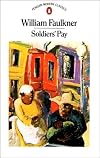
I've never been a big fan of William Faulkner, and this book, SOLDIER'S PAY, didn't change that. It seemed overly pretentious, verbose and pompous to the point of being boring. Faulkner's language has always been dense and ornate, but it simply did not work with this subject - a damaged and scarred veteran returning home to Georgia from the war. I'm always interested in reading books about the World Wars, but this one was just too tedious and did not work at all for me. I gave up on it after about 100 pages. My apologies to the late great Mr. Faulkner, but I cannot, in good conscience, recommend this book. (Although I did like the retro cover of this old paperback version.) P.S. I kept reading SOLDIER'S PAY, but it didn't get any better show more - too many characters, mostly unbelievable. Just a muddy mess of a novel, really. But it was his first one, and I know he got better, so ... show less
Though not as accomplished as his later novels, Soldiers' Pay still has moments of revelation, which reveal Faulkner willing to bend language to get at a feeling.
"They greeted him with the effusiveness of people who are brought together by invitation yet are not quite certain of themselves and of the spirit of the invitation; in this case the eternal country boys of one national mental state, lost in the comparative metropolitan atmosphere of one diametrically opposed to it. To feel provincial: finding that a certain conventional state of behavior has become inexplicably obsolete over night."
Like a rough house Proust. The vocabulary he pulls from doesn't suck either. At times, I couldn't tell if I wasn't getting a phrase because I was show more intellectually inferior or just not Southern. At other times, his stylistic daring worked better than others. He seems to be going along with the whole "make it new" dictum of the postwar period yet not fully buying into it.
There are amateur moments in the book as well. A lot of gorgeous descriptions of sunset... but like, a LOT of them. Many characters who don't fully flesh out and so become intellectual exercises, instead of insights into the human experience. The more moments like this I read, however, the better I felt. He's human, this Faulkner, and perhaps writing a novel can be learned after all.
I only recommend this book to Faulkner fans and those horrified at how paltry their first novel has turned out. show less
"They greeted him with the effusiveness of people who are brought together by invitation yet are not quite certain of themselves and of the spirit of the invitation; in this case the eternal country boys of one national mental state, lost in the comparative metropolitan atmosphere of one diametrically opposed to it. To feel provincial: finding that a certain conventional state of behavior has become inexplicably obsolete over night."
Like a rough house Proust. The vocabulary he pulls from doesn't suck either. At times, I couldn't tell if I wasn't getting a phrase because I was show more intellectually inferior or just not Southern. At other times, his stylistic daring worked better than others. He seems to be going along with the whole "make it new" dictum of the postwar period yet not fully buying into it.
There are amateur moments in the book as well. A lot of gorgeous descriptions of sunset... but like, a LOT of them. Many characters who don't fully flesh out and so become intellectual exercises, instead of insights into the human experience. The more moments like this I read, however, the better I felt. He's human, this Faulkner, and perhaps writing a novel can be learned after all.
I only recommend this book to Faulkner fans and those horrified at how paltry their first novel has turned out. show less
Though not as accomplished as his later novels, Soldiers' Pay still has moments of revelation, which reveal Faulkner willing to bend language to get at a feeling.
"They greeted him with the effusiveness of people who are brought together by invitation yet are not quite certain of themselves and of the spirit of the invitation; in this case the eternal country boys of one national mental state, lost in the comparative metropolitan atmosphere of one diametrically opposed to it. To feel provincial: finding that a certain conventional state of behavior has become inexplicably obsolete over night."
Like a rough house Proust. The vocabulary he pulls from doesn't suck either. At times, I couldn't tell if I wasn't getting a phrase because I was show more intellectually inferior or just not Southern. At other times, his stylistic daring worked better than others. He seems to be going along with the whole "make it new" dictum of the postwar period yet not fully buying into it.
There are amateur moments in the book as well. A lot of gorgeous descriptions of sunset... but like, a LOT of them. Many characters who don't fully flesh out and so become intellectual exercises, instead of insights into the human experience. The more moments like this I read, however, the better I felt. He's human, this Faulkner, and perhaps writing a novel can be learned after all.
I only recommend this book to Faulkner fans and those horrified at how paltry their first novel has turned out. show less
"They greeted him with the effusiveness of people who are brought together by invitation yet are not quite certain of themselves and of the spirit of the invitation; in this case the eternal country boys of one national mental state, lost in the comparative metropolitan atmosphere of one diametrically opposed to it. To feel provincial: finding that a certain conventional state of behavior has become inexplicably obsolete over night."
Like a rough house Proust. The vocabulary he pulls from doesn't suck either. At times, I couldn't tell if I wasn't getting a phrase because I was show more intellectually inferior or just not Southern. At other times, his stylistic daring worked better than others. He seems to be going along with the whole "make it new" dictum of the postwar period yet not fully buying into it.
There are amateur moments in the book as well. A lot of gorgeous descriptions of sunset... but like, a LOT of them. Many characters who don't fully flesh out and so become intellectual exercises, instead of insights into the human experience. The more moments like this I read, however, the better I felt. He's human, this Faulkner, and perhaps writing a novel can be learned after all.
I only recommend this book to Faulkner fans and those horrified at how paltry their first novel has turned out. show less
World War I and recovery is as hopeless as time for severely wounded Lieutenant Donald Mahon and the people bound to him by circumstances. He is brought back home by his fellow soldiers to mend and resume his civilian life. It is difficult for any war veteran to come home and adjust to the life he left behind. But Donald also endures the negative reactions of friends and loved ones to his disfigured and scarred face. As his eyesight fades steadily, his fiancé Cicely and his former girlfriend and lover Emmy must decide who will care for and marry the physically challenged pilot. Donald’s military friends help him physically But they also help themselves to flirtations with Cecily and Emmy. The RAF World War I motto applies to show more Donald’s post war circumstances, “Through Struggle to the stars.” show less
Members
- Recently Added By
Lists

20th Century Literature
1,161 works; 55 members

Fiction: Historical
288 works; 3 members
Author Information

468+ Works 99,727 Members
Born in an old Mississippi family, William Faulkner made his home in Oxford, seat of the University of Mississippi. After the fifth grade he went to school only off and on-lived, read, and wrote much as he pleased. In 1918, refusing to enlist with the "Yankees," he joined the Canadian Air Force, and was transferred to the British Royal Air Force. show more After the war he studied a little at the University, did house painting, worked as a night superintendent at a power plant, went to New Orleans and became a friend of Sherwood Anderson, then to Europe and back home to Oxford. By this time he had written two novels. The Sound and the Fury followed in 1929. Financial success came with Sanctuary in 1931, which he assisted in filming. Faulkner 's novels are intense in their character portrayals of disintegrating Southern aristocrats, poor whites, and African Americans. A complex stream-of-consciousness rhetoric often involves Faulkner in lengthy sentences of anguished power. Most of his tales are set in the mythical Yoknapatawpha County, Mississippi, and are characterized by the use of many recurring characters from families of different social levels spanning more than a century. His best subjects are the old, dying South and the newer materialistic South. As I Lay Dying (1930), is a grotesquely tragicomic story about a family of poor southern whites. With Absalom, Absalom! (1936); the difficult parts of his famous short novel "The Bear" (published in Go Down, Moses, 1942); and the allegorical A Fable (1954), a non-Yoknapatawpha novel set in France during World War I; Faulkner returned to an innovative and difficult style that most readers have trouble with. Yet, interspersed among such works are collections of easily read stories originally published in popular magazines. There seems to be a growing sentiment among critics that the Snopes trilogy-The Hamlet (1940), The Town (1957), and The Mansion (1959)-for the most part an example of Faulkner's "moderate" style, could well be among his most important works. Faulkner was awarded the 1949 Nobel Prize for literature "for his powerful and artistically independent contribution to the new American novel," but it would appear now that he also deserved to win that honor for his contribution to world literature. When reporting his death, the Boston Globe quoted Faulkner's having once told an interviewer: "Since man is mortal, the only immortality for him is to leave something behind him that is immortal since it will always move. That is the artist's way of scribbling "Kilroy was here" on the wall of the final and irrevocable oblivion through which he must some day pass." In addition to the Nobel Prize, Faulkner received the Howells Medal of the American Academy of Arts and Letters in 1950, and in 1951 he was given the National Book Award for his Collected Stories Collected Stories. For his novel A Fable he received the National Book Award for the second time, as well as the Pulitzer Prize in 1955. The Reivers (1962) was awarded the Pulitzer Prize in 1963. In 1957 and 1958, he was the University of Virginia's first writer-in-residence, and in January 1959 he accepted an appointment as consultant on contemporary literature to the Alderman Library of that university. Although Faulkner was not without honors in his lifetime and has received world recognition since then, it is surprising to learn that, when Malcolm Cowley edited The Portable Faulkner in 1946, he found that almost all of Faulkner's books were out of print. By arranging selections from the works to form a continuous chronicle, Cowley deserves much of the credit for making readers aware of the way in which Faulkner was creating a fictive world on a scale grander than that of any novelist since Balzac. William Faulkner died in Oxford, Mississippi, in 1962. (Bowker Author Biography) show less
Some Editions
Series
Belongs to Publisher Series
Work Relationships
Common Knowledge
- Canonical title
- Soldiers' Pay
- Original title
- Soldier’s pay
- Original publication date
- 1926
- People/Characters
- Donald Mahon; Joe Gilligan; Margaret Powers; Reverend Joseph Mahon; Cecily Saunders; George Farr (show all 9); Emmy; Januarius Jones; Julian Lowe
- Important places
- Charlestown, Georgia, USA
- Original language
- English
Classifications
Statistics
- Members
- 816
- Popularity
- 33,872
- Reviews
- 17
- Rating
- (3.34)
- Languages
- 9 — Arabic, English, French, German, Italian, Norwegian, Portuguese, Spanish, Swedish
- Media
- Paper, Audiobook, Ebook
- ISBNs
- 48
- ASINs
- 59