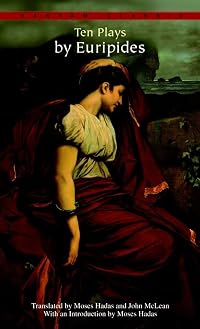
Ten plays by Euripides
by Euripides
On This Page
Description
The first playwright of democracy, Euripides wrote with enduring insight and biting satire about social and political problems of Athenian life.nbsp;nbsp;In contrast to his contemporaries, he brought an exciting--and, to the Greeks, a stunning--realism to the "pure and noble form" of tragedy.nbsp;nbsp;For the first time in history, heroes and heroines on the stage were not idealized:nbsp;nbsp;as Sophocles himself said, Euripides shows people not as they ought to be, but as they actually are.Tags
Recommendations



















Member Reviews
Some of the plays featured in this collection are the best Euripides ever wrote, namely Medea and Hippolytus which are just as emotionally devastating today as they were 2500 years ago. Some other plays are strong ones as well, like the wonderfully morbid The Bacchants. Unfortunately a large number of these plays are rather unremarkable. Euripides' play Electra is substantially inferior to Aeschylus' interpretation of the same events presented in The Libation Bearers, and Iphigenia at Aulis has an ending that undercuts one of the most poignant moments of The Iliad (though note, the authenticity of the final line giving this play a happy ending is highly disputed).
It's probably better to read a few of these plays at a time, instead of show more reading all ten straight through, since the style and progression of the plays is so uniform that the works might begin to blend together for you as they did for me. It's this experience that makes me rate the collection as I do, but I would also urge you to read Medea and Hippolytus, as they are among the best works that survive from the ancient Athenian dramatists. show less
It's probably better to read a few of these plays at a time, instead of show more reading all ten straight through, since the style and progression of the plays is so uniform that the works might begin to blend together for you as they did for me. It's this experience that makes me rate the collection as I do, but I would also urge you to read Medea and Hippolytus, as they are among the best works that survive from the ancient Athenian dramatists. show less
Medea Review - If one could enjoy reading a tragic story, then I could be counted as enjoying this book. Medea is the woman slighted by Jason, and whether you believe Jason is doing the right thing, especially for a Greek of the time the story is written, is the bigger question as to how tragic or to what degree this is a tragedy.
Euripides uses some great writing to make the audience feel the emotional despair Medea has and her further descent into it, resulting in the actions she takes. There are a few times that Medea becomes a bit too introspective with her pointing out that she has reached such a point of madness that she shouldn't do what she is about to do and it's a bit much even for her - although that may lend to believing her show more madness more.
Euipides does a good job of staying with his female character and while he doesn't write her to excuse her actions, you understand most of what she does. Once again, the early Greeks as a people seeing what type of story plays out when you let revenge overtake the person. Final Grade - A-
The Trojan Women Reivew - Whereas Medea is the story after Jason and the Argonauts, The Trojan Women is the story right after The Iliad but before Agamemnon. Euripides focuses on the tragic outcomes of what's going to happen to the captured women of Troy following the sacking of the city by the Greeks. Euripides once again focuses on the plight of women ,which is an interesting perspective for his time and nature. There is a mix of some anti-war teachings, or at the very least, some introspection about the outcomes of war, and again, with the focus of it affecting women.
While Euripides does write about the tragedy well, the story bounces to too many characters too often and includes a semi-trial of Helen. While it's nice to finally see someone call out Helen for causing about 75% of all Greek literature of the time to be written because of Troy, she's an odd inclusion and takes the focus of all the stories about the women as tragedies. Andromache and her child's story completes the woeful plot point that I enjoyed in The Iliad and that was devastating to read about. Overall, I didn't think the play did as much as it could have although I'd be willing to be convinced that I'm wrong. Final Grade - C+ show less
Euripides uses some great writing to make the audience feel the emotional despair Medea has and her further descent into it, resulting in the actions she takes. There are a few times that Medea becomes a bit too introspective with her pointing out that she has reached such a point of madness that she shouldn't do what she is about to do and it's a bit much even for her - although that may lend to believing her show more madness more.
Euipides does a good job of staying with his female character and while he doesn't write her to excuse her actions, you understand most of what she does. Once again, the early Greeks as a people seeing what type of story plays out when you let revenge overtake the person. Final Grade - A-
The Trojan Women Reivew - Whereas Medea is the story after Jason and the Argonauts, The Trojan Women is the story right after The Iliad but before Agamemnon. Euripides focuses on the tragic outcomes of what's going to happen to the captured women of Troy following the sacking of the city by the Greeks. Euripides once again focuses on the plight of women ,which is an interesting perspective for his time and nature. There is a mix of some anti-war teachings, or at the very least, some introspection about the outcomes of war, and again, with the focus of it affecting women.
While Euripides does write about the tragedy well, the story bounces to too many characters too often and includes a semi-trial of Helen. While it's nice to finally see someone call out Helen for causing about 75% of all Greek literature of the time to be written because of Troy, she's an odd inclusion and takes the focus of all the stories about the women as tragedies. Andromache and her child's story completes the woeful plot point that I enjoyed in The Iliad and that was devastating to read about. Overall, I didn't think the play did as much as it could have although I'd be willing to be convinced that I'm wrong. Final Grade - C+ show less
Ratings
Members
- Recently Added By
Lists

Books I've Read More Than Once
602 works; 49 members

Greatest Books, allegedly
484 works; 9 members

Books talked about in Pamela Dean's Tam Lin
74 works; 1 member
Author Information

1,348+ Works 34,256 Members
Euripides was born in Attica, Greece probably in 480 B.C. He was the youngest of the three principal fifth-century tragic poets. In his youth he cultivated gymnastic pursuits and studied philosophy and rhetoric. Soon after he received recognition for a play that he had written, Euripides left Athens for the court of Archelaus, king of Macedonia. show more Fragments of about fifty-five plays survive. Among his best-known plays are Alcestis, Medea and Philoctetes, Electra, Iphigenia in Tauris, The Trojan Women, and Iphigenia in Aulis Iphigenia. He died in Athens in 406 B.C. (Bowker Author Biography) show less
All Editions
Some Editions
Series
Belongs to Publisher Series
Work Relationships
Common Knowledge
- Canonical title
- Ten plays by Euripides
- Original title
- Ten Plays by Euripides
- Alternate titles
- Euripides Ten Plays
- Original publication date
- 1960
- First words
- Euripides (approximately 485–406 ʙ.ᴄ.) was the youngest of the great triad of Greek tragic poets; but so rapid was the efflorescence of tragedy that he was adult when Aeschylus was producing his greatest ploys, and was h... (show all)imself survived by the nonagenarian Sophocles.
- Original language
- Ancient Greek
- Disambiguation notice
- Do not combine Ten Plays by Euripides with Ten Plays; they are different works with a different selection of plays.
Classifications
- Genre
- Fiction and Literature
- DDC/MDS
- 882.01 — Literature & rhetoric Classical & modern Greek literatures Classical Greek dramatic poetry and drama standard subdivisions; collections; history, description, critical appraisal; Specific periods Ancient period to ca. 499
- LCC
- PA3975 .A2 — Language and Literature Greek language and literature. Latin language and literature Greek literature Individual authors Euripedes
- BISAC
Statistics
- Members
- 1,169
- Popularity
- 21,515
- Reviews
- 3
- Rating
- (3.97)
- Languages
- English, Greek (Ancient)
- Media
- Paper, Ebook
- ISBNs
- 8
- ASINs
- 22