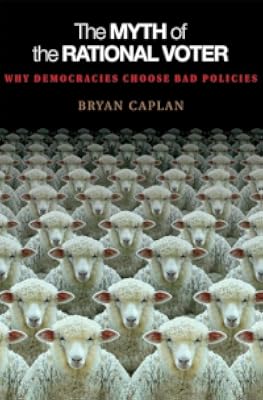
The Myth of the Rational Voter: Why Democracies Choose Bad Policies
by Bryan Caplan
On This Page
Description
"Caplan argues that voters continually elect politicians who either share their biases or else pretend to, resulting in bad policies winning again and again by popular demand. Calling into question our most basic assumptions about American politics, Caplan contends that democracy fails precisely because it does what voters want. Through an analysis of American's voting behavior and opinions on a range of economic issues, he makes the case that noneconomists suffer from four prevailing show more biases: they underestimate the wisdom of the market mechanism, distrust foreigners, undervalue the benefits of conserving labor, and pessimistically believe the economy is going from bad to worse. Caplan lays out several ways to make democratic government work better. show lessTags
Recommendations


Member Reviews
This is without a doubt the best book I've read this year, if not ever.
Caplan delivers spectacularly on the title. Not only is it a rebuttal of the common view of economists that everyone always acts rationally, but it also strongly argues that humans are _particularly bad_ in the political arena. The book persuasively challenges many common criticisms of democracy: that most voters are stupid and only vote in self-interest, that bureaucratic inefficiencies are a bad thing, that politicians are mostly crooked, that low-voter turnout is a bad thing, and that democracies aren't very good at giving the people what they ask for.
MY GOOD IS THIS BOOK GOOD.
If you accept Caplan's premise, and evidently I do, the consequences he points out are show more staggering. "Get out and vote" campaigns are actively harmful to society. If you're running for office, you should in fact not keep your campaign promises. It's a delightfully different lens for looking at the world, and one which puts a lot more into perspective than I realized beforehand. show less
Caplan delivers spectacularly on the title. Not only is it a rebuttal of the common view of economists that everyone always acts rationally, but it also strongly argues that humans are _particularly bad_ in the political arena. The book persuasively challenges many common criticisms of democracy: that most voters are stupid and only vote in self-interest, that bureaucratic inefficiencies are a bad thing, that politicians are mostly crooked, that low-voter turnout is a bad thing, and that democracies aren't very good at giving the people what they ask for.
MY GOOD IS THIS BOOK GOOD.
If you accept Caplan's premise, and evidently I do, the consequences he points out are show more staggering. "Get out and vote" campaigns are actively harmful to society. If you're running for office, you should in fact not keep your campaign promises. It's a delightfully different lens for looking at the world, and one which puts a lot more into perspective than I realized beforehand. show less
It's amusing that this book has been denounced as product of economic fundamentalism. Caplan is denouncing the very assumption of rationality that underpins so much of economic theory - which is pretty heterodox of him. And he's making the discussion accessible to general public, which is what one would expect political scientists to have done long ago. But political scientists have generally endorsed the idea of "one person, one vote" because they see it as more conducive to redistributive/welfare policies. Hence for the most part political scientists have confined their discussions of voter behavior to academic papers that journalists (or median voters; or entrepreneurial politicians) are unlikely to read. It took a Bryan Caplan to show more familiarize the general public with the notion of rational ignorance and to fully explore its most important implication, i.e., that perhaps we should consider restricting the franchise. That probably sounded like lunacy when the book first came out, back in 2007, but my guess is that now, after Trump's election, even political scientists might be a bit more open to the idea. show less
The freakonomics of democratic choice
My acquaintance Arnold is a successful independent treasury consultant with an income to match. Arnold even thinks he makes money too easily, and sometimes votes for the Socialist Party, a fringe party with old-fashioned ideas about taking money from “the rich” to distribute it among “the common men”. Still, Arnold uses every trick available to reduce his income tax bill.
The coming national elections here in the Netherlands are all going to be about the latest economic crisis and the sustainability of the welfare state. The event seemed good enough a reason for an upgrade of my knowledge of political economy, and this book delivers. It answers questions about voters’ understanding of show more economics, how it affects their choices in the voting booth, and how politicians deal with the outcome.
Starting point of the book is that people with PhD’s in economics know best what works for macro-economic management. This seems like a rather bold statement given the current state of the economy, which followed the adoption of classical policies by institutions like the Federal Reserve. Mr. Caplan sees this in broad terms however. He takes efficiency as the sole basis for choice, and then looks at certain biases like an anti-market bias, a pessimistic bias, an anti-foreign bias, and an overvaluation of hard work by the American public (somewhat unfortunately, Mr. Caplan’s book mainly uses examples from the United States, making his book less applicable to the other 94% of us on the globe). Most of these issues are indeed generally accepted and covered in most under-graduate courses in economics. The book also quotes research that people who are generally better informed about society think more like these PhD’s, as are highly educated people, people with high income growth or job security, and males.
Mr. Caplan then uses classical micro-economic reasoning to explain that not only ignorance but also irrationality about what is best for the economy are perfectly rational approaches for voters. The reason is simple: given how little importance an individual vote has in the outcome of elections, the choices of people like Arnold go without costs. Empirical studies have found that people do not vote with their wallet in mind. Voters choose parties that they think have the best policies for the nation. They may also vote for emotional reasons, or to belong to a certain group. There is little need to adjust the mental security blanket offered by an ineffective world view in this matter. People can be irrational as long as the consequences are limited.
The author also looks on how this affects the supply side of policy. Although most issues of public policy have a strong economic component, economists only play a secondary role in determining government politics:
to get ahead in politics, leaders need a blend of naïve populism and realistic cynicism. No wonder the modal politician has a law degree. (…) The electoral process selects people who are professionally trained to plead cases persuasively and sincerely regardless of merit.
And even if a politician knows “the best policy”, they will have to strike a balance between the irrational preferences of the masses and his own ideas. He cannot however fully ignore efficient policies, as the electorate can vote him out of office in the next elections. Vague solutions, with the tough part delegated to agencies can be a solution in this case. show less
My acquaintance Arnold is a successful independent treasury consultant with an income to match. Arnold even thinks he makes money too easily, and sometimes votes for the Socialist Party, a fringe party with old-fashioned ideas about taking money from “the rich” to distribute it among “the common men”. Still, Arnold uses every trick available to reduce his income tax bill.
The coming national elections here in the Netherlands are all going to be about the latest economic crisis and the sustainability of the welfare state. The event seemed good enough a reason for an upgrade of my knowledge of political economy, and this book delivers. It answers questions about voters’ understanding of show more economics, how it affects their choices in the voting booth, and how politicians deal with the outcome.
Starting point of the book is that people with PhD’s in economics know best what works for macro-economic management. This seems like a rather bold statement given the current state of the economy, which followed the adoption of classical policies by institutions like the Federal Reserve. Mr. Caplan sees this in broad terms however. He takes efficiency as the sole basis for choice, and then looks at certain biases like an anti-market bias, a pessimistic bias, an anti-foreign bias, and an overvaluation of hard work by the American public (somewhat unfortunately, Mr. Caplan’s book mainly uses examples from the United States, making his book less applicable to the other 94% of us on the globe). Most of these issues are indeed generally accepted and covered in most under-graduate courses in economics. The book also quotes research that people who are generally better informed about society think more like these PhD’s, as are highly educated people, people with high income growth or job security, and males.
Mr. Caplan then uses classical micro-economic reasoning to explain that not only ignorance but also irrationality about what is best for the economy are perfectly rational approaches for voters. The reason is simple: given how little importance an individual vote has in the outcome of elections, the choices of people like Arnold go without costs. Empirical studies have found that people do not vote with their wallet in mind. Voters choose parties that they think have the best policies for the nation. They may also vote for emotional reasons, or to belong to a certain group. There is little need to adjust the mental security blanket offered by an ineffective world view in this matter. People can be irrational as long as the consequences are limited.
The author also looks on how this affects the supply side of policy. Although most issues of public policy have a strong economic component, economists only play a secondary role in determining government politics:
to get ahead in politics, leaders need a blend of naïve populism and realistic cynicism. No wonder the modal politician has a law degree. (…) The electoral process selects people who are professionally trained to plead cases persuasively and sincerely regardless of merit.
And even if a politician knows “the best policy”, they will have to strike a balance between the irrational preferences of the masses and his own ideas. He cannot however fully ignore efficient policies, as the electorate can vote him out of office in the next elections. Vague solutions, with the tough part delegated to agencies can be a solution in this case. show less
"Altrusim and morality have a consumption cost like any other..."
There are two ways to look at Kaplan's work:
1. That this is a cynical work on political game theory that predicts the rise of Trump like figures.
2. That politcal economy, however unseemly, is a fascinating result of the electorate, politicians, media and so on attempting to navigate the fundamental irrational forces at work in democracy.
Ultimately, Kaplan's point is often that markets, both economic and behavioural, trump idealogy in terms of what motivates policies.
There are two ways to look at Kaplan's work:
1. That this is a cynical work on political game theory that predicts the rise of Trump like figures.
2. That politcal economy, however unseemly, is a fascinating result of the electorate, politicians, media and so on attempting to navigate the fundamental irrational forces at work in democracy.
Ultimately, Kaplan's point is often that markets, both economic and behavioural, trump idealogy in terms of what motivates policies.
The Myth of the Rational Voter is partially a book explaining economist Bryan Caplan’s economic model for voting, and partially it’s a polemic arguing for elitist views regarding the intelligence of the average U.S. citizen. As a super-smart citizen with just enough information to be dangerous, I’m partial to the argument. Caplan’s model and argument are internally consistent, but I don’t think he’s founded his erector set theory on as firm a ground as he describes. Whether it’s all true or not can only be seen by further research or events.
(Full review at my blog)
(Full review at my blog)
The uneducated voter has an anti-market bias inasmuch as he is less pro market than the educated and the economists are (even when discounting those rabidly pro-market fellows over at the Mises Institute!); this the author can prove with facts and figures and lots of diagrams, covering all possible exits. What to do about it? Well, the author has to ask the reader whether Britain, who until the Representation of the People Act of 1948 let people affiliated with universities vote double, was not a democracy? He has to ask, but he leaves it to the perhaps more freely elitist reader to answer, and somewhat timidly only suggests as redress to the empty-skulled anti-market bias that professors of economics when lecturing should leave the show more details until later, so at least the economically educated gets the basics right.
The first half of the book is interesting, detailing as it does just what the irrationality of the unread produces of strange economic ideas, this largely with the help of a 1996 Harvard University Survey Project, but it sort of peters out after that, and I cannot help thinking that this is a bit due to cowardice. I did all the way to the last page expect the author to step forward with some workable reworking of the election process, but he never did. And one fact that is well known should have been given some consideration in the context of the book I think, namely that not only the uneducated have a clear anti-market bias, so does typically the average English literature professor. (We could get rid of those with a market oriented school system!) show less
The first half of the book is interesting, detailing as it does just what the irrationality of the unread produces of strange economic ideas, this largely with the help of a 1996 Harvard University Survey Project, but it sort of peters out after that, and I cannot help thinking that this is a bit due to cowardice. I did all the way to the last page expect the author to step forward with some workable reworking of the election process, but he never did. And one fact that is well known should have been given some consideration in the context of the book I think, namely that not only the uneducated have a clear anti-market bias, so does typically the average English literature professor. (We could get rid of those with a market oriented school system!) show less
Caplan begins by outlining current theories of voter behavior that emphasize voter rationality + voter ignorance, and lays out persuasive objections to this view. First, he describes and provides empirical evidence for four systematic biases of the general public. He refers to these as antimarket bias, antiforeign bias, make-work bias, and pessimistic bias. He explains that once you take into account the fact that voting is unlike shopping and more like a commons, it makes perfect economic sense for voters to be irrational. In this case, citizens get a feel-good benefit voting according to these biases and only pay a tiny price for choosing poor economic policy (because their individual vote is so unlikely to decide things).
Caplan does show more a good job of laying out the facts and the theory behind his argument, to which I am sympathetic. My only regret is that he doesn't make more recommendations in the conclusion to the book, but there is a clear need for further work in this area. show less
Caplan does show more a good job of laying out the facts and the theory behind his argument, to which I am sympathetic. My only regret is that he doesn't make more recommendations in the conclusion to the book, but there is a clear need for further work in this area. show less
Members
- Recently Added By
Lists

Ancap Part 3 - Proficient 1
12 works; 1 member

KayStJ's to-read list
1,616 works; 11 members

Mind Expanding Books by hackerkid
581 works; 8 members
Author Information

13+ Works 1,358 Members
Bryan Caplan is professor of economics at George Mason University. His books include Selfish Reasons to Have More Kids: Why Being a Great Parent Is Less Work and More Fun Than You Think. Twitter @bryan_caplan
Awards and Honors
Awards
Common Knowledge
- Original publication date
- 2007
- People/Characters
- Niccolò Machiavelli; Frederic Bastiat
- Epigraph
- A supporter once called out, "Governor Stevenson, all thinking people are for you!" And Adlai Stevenson answered, "That's not enough, I need a majority." --Scott Simon, "Music Cues, Adlai Stevenson"
- First words
- In a dictatorship, government policy is often appalling, but rarely baffling.
- Last words
- (Click to show. Warning: May contain spoilers.)Economists have created and popularized many of the most socially beneficial in human history, and combated many of the most virulent. If they were self-conscious of their role in the world, they could do much more.
- Blurbers
- Mankiw, N. Gregory; Blinder, Alan; Kuran, Timur; Keeter, Scott
Classifications
- Genres
- Economics, Politics and Government, Nonfiction, General Nonfiction, Philosophy
- DDC/MDS
- 320.6 — Society, government, & culture Political science Types of Government Policy formulation
- LCC
- HD87 .C36 — Social sciences Industries. Land use. Labor Industries. Land use. Labor Economic growth, development, planning
- BISAC
Statistics
- Members
- 532
- Popularity
- 56,025
- Reviews
- 17
- Rating
- (3.88)
- Languages
- Chinese, Czech, English, Spanish
- Media
- Paper, Audiobook, Ebook
- ISBNs
- 9
- ASINs
- 3