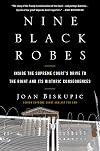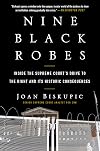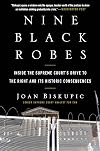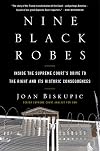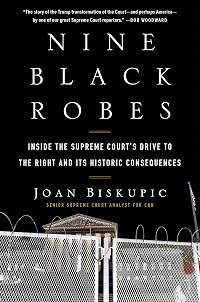
Nine Black Robes: Inside the Supreme Court's Drive to the Right and Its Historic Consequences
by Joan Biskupic
On This Page
Description
With unparalleled access to key players, a CNN senior legal analyst and Supreme Court expert provides an urgent and inside look at the history-making era of the Supreme Court during the Trump and post-Trump years, including its reversal of Roe v. Wade. "Nine Black Robes displays the inner maneuverings among the Supreme Court justices that led to the seismic reversal of Roe v. Wade and a half century of women's abortion rights. Biskupic details how rights are stripped away or, alternatively show more as in the case of gun owners, how rights are expanded. Today's bench--with its conservative majority--is desperately ideological. The Court has been headed rightward and ensnared by its own intrigues for years, but the Trump appointments hastened the modern transformation. With unparalleled access to key players, Biskupic shows the tactics of each justice and reveals switched votes and internal pacts that typically never make the light of day, yet will have repercussions for generations to come"-- show lessTags
Recommendations




Member Reviews
This is a history of the Supreme Court from 2016, shortly before Trump was elected, until shortly before the book was published in 2023, a time of great consequence for the country and the court. The history is told chronologically, primarily though a discussion of the court's many consequential decisions during this period. Through the decisions, we can see during the earlier years an incremental move to the right, but more recent decisions illustrate the court's move by leaps and bounds to the right, as it abandoned many of its earlier decisions with barely a nod to the doctrine of stare decisis. Along the way, the author includes a lot of anecdotal information about the various justices and the inner workings of the court.
As we all show more remember, Trump was able to appoint a justice almost immediately after he was elected due to Mitch McConnell's unprecedented actions in blocking Obama from appointing a successor to Justice Scalia after his death nearly a year before Obama's term ended. While Trump's first appointee, Neil Gorsusch, was a far-right ideologue, so was Scalia, and his appointment did not much shift the direction of the court. And, at that time, Chief Justice Roberts seemed very conscious of his role in history, and behind the scenes was working hard to prevent the Court from issuing radical decisions, seeking ways to decide cases on the most narrow grounds, constantly stressing stare decisis, and himself casting a deciding vote preventing the radical right-wingers on the court from going too far. This trend continued even after Trump was able to appoint a second right-wing ideologue, Brett Kavenaugh, after the retirement of the more moderate Justice Kennedy.
It was the appointment of Amy Coney Barrett after the death of Ruth Bader Ginsburg that emboldened the radicals on the court to refuse to compromise, to refuse to rule narrowly, to throw out stare decisis, all in favor of an extreme political agenda. The 5 right-wing conservatives on the court seemed to rally around Clarence Thomas, who is one of the most radical of the group, and Chief Justice Roberts seemed no longer in control of the group.
The book takes us up through the Dobbs decision (striking down Roe v. Wade) and to the appointment of Kitanji Brown to the court. As I was reading this book in early July, the court ended its term with decisions striking down affirmative action in education (a policy first upheld by the court when I was in law school in the early 1970's), overruling Biden's program to forgive student loans (a decision that many legal scholars see as overreaching and an entirely erroneous interpretation of the law on which Biden's forgiveness program was based), and expanding the ability of a business to discriminate against gays. As the dissent in Dobbs stated, " No one should be confident that this majority is done with its work." This was a compelling and highly readable book, even if you are not a recovering attorney, like me.
And I will note that this book ended before the revelations about the ethics violations and conflicts of interests of several of these justices (and in particular Clarence Thomas and his wife Ginni). In case you are unaware all lawyers and every federal judge is bound by a code of ethics, EXCEPT for Supreme Court justices. They have no code of ethics, just whatever they decide. And Chief Justice Roberts has indicated he has no interest in pursuing anything along these lines.
4 stars show less
As we all show more remember, Trump was able to appoint a justice almost immediately after he was elected due to Mitch McConnell's unprecedented actions in blocking Obama from appointing a successor to Justice Scalia after his death nearly a year before Obama's term ended. While Trump's first appointee, Neil Gorsusch, was a far-right ideologue, so was Scalia, and his appointment did not much shift the direction of the court. And, at that time, Chief Justice Roberts seemed very conscious of his role in history, and behind the scenes was working hard to prevent the Court from issuing radical decisions, seeking ways to decide cases on the most narrow grounds, constantly stressing stare decisis, and himself casting a deciding vote preventing the radical right-wingers on the court from going too far. This trend continued even after Trump was able to appoint a second right-wing ideologue, Brett Kavenaugh, after the retirement of the more moderate Justice Kennedy.
It was the appointment of Amy Coney Barrett after the death of Ruth Bader Ginsburg that emboldened the radicals on the court to refuse to compromise, to refuse to rule narrowly, to throw out stare decisis, all in favor of an extreme political agenda. The 5 right-wing conservatives on the court seemed to rally around Clarence Thomas, who is one of the most radical of the group, and Chief Justice Roberts seemed no longer in control of the group.
The book takes us up through the Dobbs decision (striking down Roe v. Wade) and to the appointment of Kitanji Brown to the court. As I was reading this book in early July, the court ended its term with decisions striking down affirmative action in education (a policy first upheld by the court when I was in law school in the early 1970's), overruling Biden's program to forgive student loans (a decision that many legal scholars see as overreaching and an entirely erroneous interpretation of the law on which Biden's forgiveness program was based), and expanding the ability of a business to discriminate against gays. As the dissent in Dobbs stated, " No one should be confident that this majority is done with its work." This was a compelling and highly readable book, even if you are not a recovering attorney, like me.
And I will note that this book ended before the revelations about the ethics violations and conflicts of interests of several of these justices (and in particular Clarence Thomas and his wife Ginni). In case you are unaware all lawyers and every federal judge is bound by a code of ethics, EXCEPT for Supreme Court justices. They have no code of ethics, just whatever they decide. And Chief Justice Roberts has indicated he has no interest in pursuing anything along these lines.
4 stars show less
As the title suggests, this book explores both the Supreme Court justices and the cases they've decided over the past decade or so. Biskupic is a journalist and long-time Supreme Court reporter for the Washington Post, and her writing is succinct and easy to follow. She weaves in brief bios, working styles, and approaches to judging for most of the current Justices. At the same time, she explores the most impactful cases decided in the past few years. It's a very current book, with analysis focused on 2016 to the present.
I follow the Court pretty religiously, so none of this was new to me, but it was really interesting to read about it all at once and see the complete picture of what is happening. It's disturbing, maddening, and sad show more for me to read about. I'm not sure if the author would agree, but I think this book really is written for the liberal audience. I can't imagine any conservatives even picking it up. If you want a summary of the impact the Court has had on society and law over the past decade, this is an excellent place to begin. show less
I follow the Court pretty religiously, so none of this was new to me, but it was really interesting to read about it all at once and see the complete picture of what is happening. It's disturbing, maddening, and sad show more for me to read about. I'm not sure if the author would agree, but I think this book really is written for the liberal audience. I can't imagine any conservatives even picking it up. If you want a summary of the impact the Court has had on society and law over the past decade, this is an excellent place to begin. show less
TW/CW: Politics, violence, sexual assault, teen pregnancy
RATING: 4/5
REVIEW: Nine Black Robes is Biskupic’s polemic on the Supreme Court during (and after) the Trump Era. She examines the composition of the court as well as the decisions, giving short biographies on each justice.
I found this to be a very depressing book. While most non-fiction books that look at our current society have some speck of hope at the end, this one did not. It left me feeling kind of gross having read it and having been brought down into the hopelessness that Biskupic clearly feels.
Nonetheless, this is a well-researched, well written, and educational book for anyone who is interest in the Supreme Court, or even just the law in modern day America. It is also show more written for the lay person who might not have any background in constitutional law.
I’m glad I read it, but I do wish it had been less doom-and-gloom at the end. show less
RATING: 4/5
REVIEW: Nine Black Robes is Biskupic’s polemic on the Supreme Court during (and after) the Trump Era. She examines the composition of the court as well as the decisions, giving short biographies on each justice.
I found this to be a very depressing book. While most non-fiction books that look at our current society have some speck of hope at the end, this one did not. It left me feeling kind of gross having read it and having been brought down into the hopelessness that Biskupic clearly feels.
Nonetheless, this is a well-researched, well written, and educational book for anyone who is interest in the Supreme Court, or even just the law in modern day America. It is also show more written for the lay person who might not have any background in constitutional law.
I’m glad I read it, but I do wish it had been less doom-and-gloom at the end. show less
Ratings
Members
- Recently Added By
Lists

Club Read's Recommended Nonfiction Written by Women
618 works; 30 members
Author Information
14 Works 596 Members
Joan Biskupic has covered the U.S. Supreme Court for more than twenty years and is the author of several books, including American Original: The Life and Constitution of Supreme Court justice Antonin Scalia and Sandra Day O'Connor: How the first Woman on the Supreme Court Became Its Most influential Justice. Biskupic is an editor in charge for show more legal affairs at Reuters News. Before joining Reuters in 2012, she was the Supreme Court correspondent for The Washington Post and for USA Today. A graduate of Georgetown Law, she is a regular panelist on PBS's Washington Week with Gwen Hill. She lives in Washington, D.C., and was a finalist for a Pulitzer Prize in 2015. show less
Awards and Honors
Common Knowledge
- Canonical DDC/MDS
- 347.7326
Classifications
- Genres
- Politics and Government, Nonfiction, General Nonfiction, History, Biography & Memoir
- DDC/MDS
- 347.7326 — Society, government, & culture Law U.S. Supreme Court - Judicial Decisions North America Civil procedure and courts of the United States Federal courts Supreme Court
- LCC
- KF8742 .B54 — Law Law of the United States Law of the United States (Federal) Courts. Procedure Court organization and procedure
- BISAC
Statistics
- Members
- 117
- Popularity
- 278,583
- Reviews
- 3
- Rating
- (4.09)
- Languages
- English
- Media
- Paper, Audiobook, Ebook
- ISBNs
- 5
- ASINs
- 2