On This Page
Description
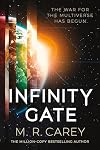
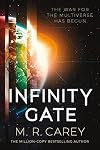
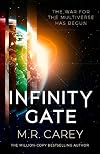
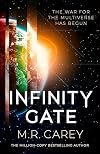
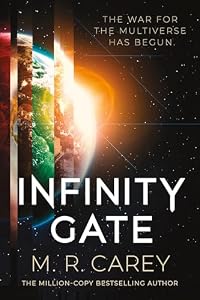
"The Pandominion: a political and trading alliance of a million worlds. Except that they're really just one world, Earth, in many different realities. And when an A.I. threat arises that could destroy everything the Pandominion has built, they'll eradicate it by whatever means necessary. Scientist Hadiz Tambuwal is looking for a solution to her own Earth's environmental collapse when she stumbles across the secret of inter-dimensional travel, a secret that could save everyone on her dying show more planet. It leads her into the middle of a war on a scale she never dreamed of. And she needs to choose a side before every reality pays the price."--Provided by publisher. show lessTags
Recommendations

















Member Reviews
I read [b:Infinity Gate|61237044|Infinity Gate (Pandominion, #1)|M.R. Carey|https://i.gr-assets.com/images/S/compressed.photo.goodreads.com/books/1665587330l/61237044._SX50_.jpg|96545712] over a lazy day while not feeling well and found it to be an excellent distraction. It had been nearly a month since I'd read such a fun and exciting novel. [b:Infinity Gate|61237044|Infinity Gate (Pandominion, #1)|M.R. Carey|https://i.gr-assets.com/images/S/compressed.photo.goodreads.com/books/1665587330l/61237044._SX50_.jpg|96545712] is an ambitious sci-fi thriller extrapolating endless parallel worlds and several empires that span them, including the catchily-named Pandominion. The point of view characters include a scientist from the near future of show more our own world (I think?) as well as a soldier, a civil servant, and a school child from the Pandominion. All are pulled into danger by the Pandominion's attempts to suppress perceived threats to its rule. The characters are an appealing and interesting bunch, whose experiences build up a picture of exploitation under the Pandominion as well as advancing the overall plot. It's an ingenious yet terrifying conceit: an empire that rapaciously conquers infinite alternate universes to use up their resources. I also appreciated that the main location of events was the city of Lagos, in various parallel iterations.
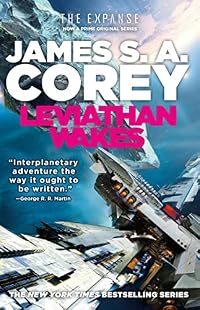
The narrative is well-paced and exciting and the world-building highly intriguing. I found the structure and general vibes similar to The Expanse series, so if you enjoyed that then this may also be to your taste. As [b:Infinity Gate|61237044|Infinity Gate (Pandominion, #1)|M.R. Carey|https://i.gr-assets.com/images/S/compressed.photo.goodreads.com/books/1665587330l/61237044._SX50_.jpg|96545712] concludes with an unresolved situation, it is clearly the first in a series. I look forward to seeing where Carey takes things. It is also another entry on the long list of recent sci-fi (and some literary fiction) dealing with disembodied hive minds and collective consciousness. Here these concepts are played with in an original and clever way. The final noteworthy aspect is that goodreads recommended me this book, one of a tiny handful of useful recommendations its algorithm has spat out over more than ten years. Machine learning doesn't deserve much credit for this feat, though, given I'd already read Carey's [b:The Book of Koli|51285749|The Book of Koli (Rampart Trilogy, #1)|M.R. Carey|https://i.gr-assets.com/images/S/compressed.photo.goodreads.com/books/1570049059l/51285749._SX50_.jpg|72759249] and sequels. show less
The narrative is well-paced and exciting and the world-building highly intriguing. I found the structure and general vibes similar to The Expanse series, so if you enjoyed that then this may also be to your taste. As [b:Infinity Gate|61237044|Infinity Gate (Pandominion, #1)|M.R. Carey|https://i.gr-assets.com/images/S/compressed.photo.goodreads.com/books/1665587330l/61237044._SX50_.jpg|96545712] concludes with an unresolved situation, it is clearly the first in a series. I look forward to seeing where Carey takes things. It is also another entry on the long list of recent sci-fi (and some literary fiction) dealing with disembodied hive minds and collective consciousness. Here these concepts are played with in an original and clever way. The final noteworthy aspect is that goodreads recommended me this book, one of a tiny handful of useful recommendations its algorithm has spat out over more than ten years. Machine learning doesn't deserve much credit for this feat, though, given I'd already read Carey's [b:The Book of Koli|51285749|The Book of Koli (Rampart Trilogy, #1)|M.R. Carey|https://i.gr-assets.com/images/S/compressed.photo.goodreads.com/books/1570049059l/51285749._SX50_.jpg|72759249] and sequels. show less
I have come to realise that I have a strange relationship with books of this nature- you know the start of a big SF series of mind-blowing complexity. I see them in the shop and think ‘ooh, that looks good’ and buy them. Then they sit in the unread pile for ages as I look at the cover and think ‘ohh, that looks complicated and challenging’ and I develop the fear that it will turn out to be as awful as say “The Three Body Problem’. Eventually I crack and decide I have to read the damn thing.
So I did, and after the first chapter I was thinking ‘ooh, this is rather fun’, Because it was. Infinity Gate begins with a Nigerian physicist (Hadiz) caught in the middle of the end of the world (nukes going off all over the place) show more accidentally creating a machine that acts as a gateway to an infinite number of universes. All she wants is to find somewhere similar to the Lagos she knew, but without the catastrophic climate change, pollution and Armageddon. Instead she falls foul of the Pandominion- a society which spans the infinite number of worlds that occupy the multiverse. An awesome supercomputer (deliberately held at the intelligence level of a three year old) supervises all movement between universes, and Hadiz has broken a huge number of regulations with her experiments. The Registry is not pleased. Meanwhile the Pandominion starts a war against a machine society which also dominates thousands of words across the multiverse. Trouble ensues.
This is a well-written novel- high quality SF. There are some really good characters- the downtrodden Watchmaster Vemmet, the persecuted trooper Moon and Hadiz herself are a lot of fun. This is clever and engaging stuff.
Normally the concept of a multiverse bores me as writers take the idea along a path of lives lived in parallel so character A has a bunch of other versions of themselves (Characters A1, A2, A3, An) who somehow come to interact with each other in worlds which diverge. Carey doesn’t fall into that trap and instead presents the idea that the infinite versions of reality are able to trade with each other and interact within a framework of controlling regulations. This is far more interesting. I look forward to reading the subsequent volumes. show less
So I did, and after the first chapter I was thinking ‘ooh, this is rather fun’, Because it was. Infinity Gate begins with a Nigerian physicist (Hadiz) caught in the middle of the end of the world (nukes going off all over the place) show more accidentally creating a machine that acts as a gateway to an infinite number of universes. All she wants is to find somewhere similar to the Lagos she knew, but without the catastrophic climate change, pollution and Armageddon. Instead she falls foul of the Pandominion- a society which spans the infinite number of worlds that occupy the multiverse. An awesome supercomputer (deliberately held at the intelligence level of a three year old) supervises all movement between universes, and Hadiz has broken a huge number of regulations with her experiments. The Registry is not pleased. Meanwhile the Pandominion starts a war against a machine society which also dominates thousands of words across the multiverse. Trouble ensues.
This is a well-written novel- high quality SF. There are some really good characters- the downtrodden Watchmaster Vemmet, the persecuted trooper Moon and Hadiz herself are a lot of fun. This is clever and engaging stuff.
Normally the concept of a multiverse bores me as writers take the idea along a path of lives lived in parallel so character A has a bunch of other versions of themselves (Characters A1, A2, A3, An) who somehow come to interact with each other in worlds which diverge. Carey doesn’t fall into that trap and instead presents the idea that the infinite versions of reality are able to trade with each other and interact within a framework of controlling regulations. This is far more interesting. I look forward to reading the subsequent volumes. show less
I received this novel from Orbit Books through NetGalley, in exchange for an honest review: my thanks to both of them for this opportunity.
Every book I read, so far, from M.R. Carey proved to be an intriguing, engrossing journey, so when I saw Infinity Gate showcased on the monthly Orbit newsletter I requested it without even taking a look at the synopsis. Once again I found myself totally immersed in a story whose only downside was that it ended too soon.
Infinity Gate starts from the premise of the existence of an uncounted number of Earths, a multiverse where each iteration can be either quite close to the reality we’re familiar with, or so wildly different as to be unrecognizable. Scientist Hadiz Tambuwal lives in what we might show more consider as our primary Earth, but one where resources are almost depleted and wars are being fought for whatever’s left. Finding herself practically alone in the university complex near Lagos, in Nigeria, she spends her time perfecting her studies and one day stumbles on an amazing discovery: the possibility to jump from one reality to another - and therefore a chance for a better life, even for a way to save her own dying planet.
With the help of Rupshe, a self-aware A.I. residing on the university grounds, Hadiz starts exploring the almost infinite versions of Earth, but in so doing she catches the attention of the Pandominion, a coalition of Earth-like worlds linked by the discovery of the Step plates, the means of jumping from one reality to another. The Pandominion is at war with another aggregation of worlds, the Ansurrection: these are planets ruled by machine intelligence and so far the war has claimed many victims and many worlds; fearing that Hadiz’s jumps might be related to the Ansurrection’s encroaching, the Pandominion sets its armed force, called the Cielo, on her tracks.
Hadiz’s storyline runs parallel to that of Essien Nkanika, living in a world not much different from hers, and the meeting between them will change Essien’s life - one that has already seen much suffering and deprivation - in a very dramatic way. The third main character in the novel is that of Topaz Tourmaline FiveHills, a young girl living on Ut, an Earth-like planet where the dominant life form descends from rabbits: Topaz - or Paz as she likes to be called - will see her life upturned by a devastating event and will have to make some hard choices she was not prepared for.
Curiously enough, for a story told through multiple POVs, Infinity Gate chooses the unusual way of following these three characters in a linear way instead of alternating chapters between them: at first this choice felt weird, because each time the reader must start anew with a different perspective that seems to have no connection with the previous one, but in the end it was revealed as a very clever way of making the reader invested in each character’s journey and at the same time of exploring the Pandominion in its many facets without need for long and distracting info-dumps.
The Pandominion looks, on the surface, as a conglomeration of advanced worlds graced by an utopian life-style, but as soon as the focus moves on its inner workings it’s easy to see that it’s not like Star Trek’s Federation at all: some of the people at the top are quite ruthless and the existence of the Cielo, the inter-planetary army whose armor-clad soldiers elicit apprehension with their sole presence, points toward a rule that’s quite far from benevolent. The Ansurrection, on the other hand, seems driven by an apparently unthinking drive to replicate its machines and the discovery of several worlds where any form of life has been obliterated does not bode well for their intentions.
The characters who move on this intriguing - if slightly unsettling - background are wonderfully depicted and fully fleshed: Hadiz Tambuwal looks like a single-focus-driven scientist who is more at ease among the instruments of her laboratory than among people, and yet there is a poignant streak of vulnerability in her that comes across in the course of her meeting with Essien Nkanika, a young man who has learned to stop at nothing to ensure his own survival, like accepting to join the Cielo where his humanity risks to be taken away from him piece by piece. My favorite character, however, remains Paz, a young girl (rabbit-shaped, granted, but still a girl) who finds herself dealing with exceptional events she was not prepared for: the way she finds a well of courage and resiliency she did not know she possesses, while still remaining true to herself, gives way to a character journey I found both compelling and heart-wrenching.
It’s not going to be a spoiler when I say that these three are destined to meet: the greater attraction in this novel stands in the expectation of that encounter and in the different, often difficult paths they travel before that can happen. This first book in the series merely lays the ground for what will develop into the main story, and yet it does not feel like a simple setting of the playing field because you can almost hear the various pieces clicking into place, each new addition boosting the tension level to new heights, particularly where Paz’s experiences are concerned: there is a long, tense segment dealing with them, toward the final part of the novel, where I was literally unable to put the book down because the various moving parts were in such a state of flux that anything could happen and failure seemed like a chilling possibility. It’s difficult to describe this book without giving away precious - and spoilery! - details, but trust me when I tell you that reading it without any prior knowledge is indeed the best way to go.
Infinity Gate closes with the equivalent of a “…to be continued” but at the same time it ends this part of the story neatly: previous experience with M.R. Carey’s other series tells me that the next books will come along with infallible cadence, and I already look forward to seeing where the story will take us next. show less
Every book I read, so far, from M.R. Carey proved to be an intriguing, engrossing journey, so when I saw Infinity Gate showcased on the monthly Orbit newsletter I requested it without even taking a look at the synopsis. Once again I found myself totally immersed in a story whose only downside was that it ended too soon.
Infinity Gate starts from the premise of the existence of an uncounted number of Earths, a multiverse where each iteration can be either quite close to the reality we’re familiar with, or so wildly different as to be unrecognizable. Scientist Hadiz Tambuwal lives in what we might show more consider as our primary Earth, but one where resources are almost depleted and wars are being fought for whatever’s left. Finding herself practically alone in the university complex near Lagos, in Nigeria, she spends her time perfecting her studies and one day stumbles on an amazing discovery: the possibility to jump from one reality to another - and therefore a chance for a better life, even for a way to save her own dying planet.
With the help of Rupshe, a self-aware A.I. residing on the university grounds, Hadiz starts exploring the almost infinite versions of Earth, but in so doing she catches the attention of the Pandominion, a coalition of Earth-like worlds linked by the discovery of the Step plates, the means of jumping from one reality to another. The Pandominion is at war with another aggregation of worlds, the Ansurrection: these are planets ruled by machine intelligence and so far the war has claimed many victims and many worlds; fearing that Hadiz’s jumps might be related to the Ansurrection’s encroaching, the Pandominion sets its armed force, called the Cielo, on her tracks.
Hadiz’s storyline runs parallel to that of Essien Nkanika, living in a world not much different from hers, and the meeting between them will change Essien’s life - one that has already seen much suffering and deprivation - in a very dramatic way. The third main character in the novel is that of Topaz Tourmaline FiveHills, a young girl living on Ut, an Earth-like planet where the dominant life form descends from rabbits: Topaz - or Paz as she likes to be called - will see her life upturned by a devastating event and will have to make some hard choices she was not prepared for.
Curiously enough, for a story told through multiple POVs, Infinity Gate chooses the unusual way of following these three characters in a linear way instead of alternating chapters between them: at first this choice felt weird, because each time the reader must start anew with a different perspective that seems to have no connection with the previous one, but in the end it was revealed as a very clever way of making the reader invested in each character’s journey and at the same time of exploring the Pandominion in its many facets without need for long and distracting info-dumps.
The Pandominion looks, on the surface, as a conglomeration of advanced worlds graced by an utopian life-style, but as soon as the focus moves on its inner workings it’s easy to see that it’s not like Star Trek’s Federation at all: some of the people at the top are quite ruthless and the existence of the Cielo, the inter-planetary army whose armor-clad soldiers elicit apprehension with their sole presence, points toward a rule that’s quite far from benevolent. The Ansurrection, on the other hand, seems driven by an apparently unthinking drive to replicate its machines and the discovery of several worlds where any form of life has been obliterated does not bode well for their intentions.
The characters who move on this intriguing - if slightly unsettling - background are wonderfully depicted and fully fleshed: Hadiz Tambuwal looks like a single-focus-driven scientist who is more at ease among the instruments of her laboratory than among people, and yet there is a poignant streak of vulnerability in her that comes across in the course of her meeting with Essien Nkanika, a young man who has learned to stop at nothing to ensure his own survival, like accepting to join the Cielo where his humanity risks to be taken away from him piece by piece. My favorite character, however, remains Paz, a young girl (rabbit-shaped, granted, but still a girl) who finds herself dealing with exceptional events she was not prepared for: the way she finds a well of courage and resiliency she did not know she possesses, while still remaining true to herself, gives way to a character journey I found both compelling and heart-wrenching.
It’s not going to be a spoiler when I say that these three are destined to meet: the greater attraction in this novel stands in the expectation of that encounter and in the different, often difficult paths they travel before that can happen. This first book in the series merely lays the ground for what will develop into the main story, and yet it does not feel like a simple setting of the playing field because you can almost hear the various pieces clicking into place, each new addition boosting the tension level to new heights, particularly where Paz’s experiences are concerned: there is a long, tense segment dealing with them, toward the final part of the novel, where I was literally unable to put the book down because the various moving parts were in such a state of flux that anything could happen and failure seemed like a chilling possibility. It’s difficult to describe this book without giving away precious - and spoilery! - details, but trust me when I tell you that reading it without any prior knowledge is indeed the best way to go.
Infinity Gate closes with the equivalent of a “…to be continued” but at the same time it ends this part of the story neatly: previous experience with M.R. Carey’s other series tells me that the next books will come along with infallible cadence, and I already look forward to seeing where the story will take us next. show less
This reads as it is, the first book in a trilogy. I enjoyed it immensely, but have given it only 4 of 5 stars due to its incompleteness. Some opening volumes for trilogies end on a more definite point, the immediate threat ended, or the main isue resolved, with hints of trouble ahead. This ends more like a first chapter in a very long novel, its main function being to gather together the main characters for the story to come.
The premise is deceptively simple. Scientist Hadiz Tambuwal, in trying to find a way to save her dying Earth from out-of-control climate change, stumbles upon the discovery of the multiverse, and the Step technology that can take her to and from any of the millions of alternate Earths. Unbeknownst to her as she show more explores multiple Earths, seeking a solution for her Earth's dilemma, she comes to the attention of the Pandominion, a political and trade alliance of multiple Earths that maintains order through its military force: the Cielo.
The prose is very accessible, except for some early techno talk, and there is a fascinating variety in the multiverse, with many, many Earths where simians were not the species that evolved to become the dominant lifeform. There is also a nice variety of AIs to deal with. The characters all seem real, and my favorite is Topaz Tourmaline FiveHills, an adolescent rabbit who I hope plays an even larger role in book 2, due to be published in 2024. I am eagerly looking forward to reading how the rest of the story plays out. show less
The premise is deceptively simple. Scientist Hadiz Tambuwal, in trying to find a way to save her dying Earth from out-of-control climate change, stumbles upon the discovery of the multiverse, and the Step technology that can take her to and from any of the millions of alternate Earths. Unbeknownst to her as she show more explores multiple Earths, seeking a solution for her Earth's dilemma, she comes to the attention of the Pandominion, a political and trade alliance of multiple Earths that maintains order through its military force: the Cielo.
The prose is very accessible, except for some early techno talk, and there is a fascinating variety in the multiverse, with many, many Earths where simians were not the species that evolved to become the dominant lifeform. There is also a nice variety of AIs to deal with. The characters all seem real, and my favorite is Topaz Tourmaline FiveHills, an adolescent rabbit who I hope plays an even larger role in book 2, due to be published in 2024. I am eagerly looking forward to reading how the rest of the story plays out. show less
***.5
Excellent premise, great characters, good writing, superlative worldbuilding. Yet somehow less than the sum of its parts. The initial scenes of the three main characters are fantastic, and there's enough foreshadowing to believe that eventually the subplots will come together into a stupendous climax. But then the development largely stops, and the slow-building tension is replaced by frenetic action sequences broken into short chapters and punctuated with abrupt POV jumps. Rather than exciting, it fell flat and felt anticlimactic. Hopefully something good comes of all this extensive preamble in the second book.
Excellent premise, great characters, good writing, superlative worldbuilding. Yet somehow less than the sum of its parts. The initial scenes of the three main characters are fantastic, and there's enough foreshadowing to believe that eventually the subplots will come together into a stupendous climax. But then the development largely stops, and the slow-building tension is replaced by frenetic action sequences broken into short chapters and punctuated with abrupt POV jumps. Rather than exciting, it fell flat and felt anticlimactic. Hopefully something good comes of all this extensive preamble in the second book.
While I've been aware of Mike Carey for awhile, certainly since "The Girl with all the Gifts," I also admit that none of his work was all that appealing to me from a thematic basis; then this novel came out. On the whole I was quite impressed, though it does take a bit of time for the story to ramp up, particularly until one gets through the inevitably dreary opening portion dealing with planetary environmental collapse on an Earth that may or may not be our own. Whatever else you want to say about Carey, with a dozen or so novels under his belt, he is nothing if not polished. Apart from dealing with the multiverse theme, and the lies imperialists tell themselves, there is an aspect of this book that makes me think of "The Forever War," show more though this story stands on a generation of modern, wide-screen, science fiction. I'm looking forward to the follow-up book. show less
I have read hundreds of science fiction titles, including numerous “series” and am always on the lookout for new authors. I came across this author and ordered several of his books, including Infinity Gate, the first of his Pandominion series.
The overriding theme of this series is the Multiverse, a theory that there are a virtually infinite number of worlds, in this case, planets Earth (or at least the third planet from the star Sol. Many of these worlds are uninhabited by intelligent life. Others have developed intelligence, but not necessarily along the same evolutionary pattern as “our” Earth.
Among these trillions of Earths, coexisting in time, are many worlds that have discovered the ability to transport between worlds, show more referred to as “stepping”. Some of these worlds have aligned into a governing unit referred to as the Pandominion. There also exists a competing alliance of machine-dominated worlds called the Ansurrection.
I was very much a fan of the “universe” created by the author here and feel like he did an excellent job of presenting a challenging conceptual landscape, without overwhelming the reader. Having said that, it just didn’t bowl me over, and at times, it almost verged on Young Adult with the dialogue between some of the characters.
One of my pet peeves when reading science fiction is the presentation of alien constructs that fit a little too nicely into our concept of life forms. Think cat people, or insect-like aliens. In this case, such life forms make perfect sense, since they all originate on Earth, or one of its versions. Our version of Earth featured evolution and intelligence development along the simian species, conceptually, other versions of Earth may see development along other species.
In the few pages of book two that I have read so far, I am encouraged that it may actually be an improvement over what was a good, but not outstanding effort. show less
The overriding theme of this series is the Multiverse, a theory that there are a virtually infinite number of worlds, in this case, planets Earth (or at least the third planet from the star Sol. Many of these worlds are uninhabited by intelligent life. Others have developed intelligence, but not necessarily along the same evolutionary pattern as “our” Earth.
Among these trillions of Earths, coexisting in time, are many worlds that have discovered the ability to transport between worlds, show more referred to as “stepping”. Some of these worlds have aligned into a governing unit referred to as the Pandominion. There also exists a competing alliance of machine-dominated worlds called the Ansurrection.
I was very much a fan of the “universe” created by the author here and feel like he did an excellent job of presenting a challenging conceptual landscape, without overwhelming the reader. Having said that, it just didn’t bowl me over, and at times, it almost verged on Young Adult with the dialogue between some of the characters.
One of my pet peeves when reading science fiction is the presentation of alien constructs that fit a little too nicely into our concept of life forms. Think cat people, or insect-like aliens. In this case, such life forms make perfect sense, since they all originate on Earth, or one of its versions. Our version of Earth featured evolution and intelligence development along the simian species, conceptually, other versions of Earth may see development along other species.
In the few pages of book two that I have read so far, I am encouraged that it may actually be an improvement over what was a good, but not outstanding effort. show less
Members
- Recently Added By
Lists

Recommend the 20 best books you've read in the last five years
2,168 works; 606 members

ALA Reading List: Science Fiction 2021-2026
30 works; 3 members

Books Read in 2024
4,623 works; 126 members

Top Five Books of 2024
795 works; 264 members

Books Read in 2025
4,090 works; 97 members
Top Five Books of 2025
950 works; 302 members
Author Information

18+ Works 11,339 Members
Awards and Honors
Awards
Distinctions
Notable Lists
Series

Common Knowledge
- Canonical title
- Infinity Gate
- Original publication date
- 2023
- Important places
- Lagos, Nigeria
Classifications
Statistics
- Members
- 502
- Popularity
- 59,736
- Reviews
- 18
- Rating
- (3.97)
- Languages
- English
- Media
- Paper, Audiobook, Ebook
- ISBNs
- 10
- ASINs
- 4