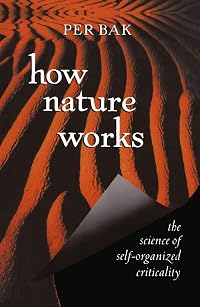
How Nature Works: The Science of Self-organized Criticality
by Per Bak
On This Page
Description
Self-organized criticality, the spontaneous development of systems to a critical state, is the first general theory of complex systems with a firm mathematical basis. This theory describes how many seemingly desperate aspects of the world, from stock market crashes to mass extinctions, avalanches to solar flares, all share a set of simple, easily described properties. "...a'must read'...Bak writes with such ease and lucidity, and his ideas are so intriguing...essential reading for those show more interested in complex systems...it will reward a sufficiently skeptical reader." -NATURE "...presents the theory (self-organized criticality) in a form easily absorbed by the non-mathematically inclined reader." -BOSTON BOOK REVIEW "I picture Bak as a kind of scientific musketeer; flamboyant, touchy, full of swagger and ready to join every fray... His book is written with panache. The style is brisk, the content stimulating. I recommend it as a bracing experience." -NEW SCIENTIST show lessTags
Recommendations






















Member Reviews
Interesting romp across different areas of application of self-organised criticality, following the development of the field over the course of its early phase. There is also an interesting perspective that comes from a scientist that is working on the problem and describes how they handle the problems and the opportunities that you would not get from a third party.
However, the book's title overclaims, SOC cannot fully explain how nature works, and in some ways, I get the sense we don't completely understand how SOC works, which are similar classes of phenomena and which are different. Also, the book is not entirely clear, I don't feel like I learned so much about SOC compared to what I knew from Wikipedia. But there were experiments show more and domains I was not aware of that made the book interesting and worthwhile. show less
However, the book's title overclaims, SOC cannot fully explain how nature works, and in some ways, I get the sense we don't completely understand how SOC works, which are similar classes of phenomena and which are different. Also, the book is not entirely clear, I don't feel like I learned so much about SOC compared to what I knew from Wikipedia. But there were experiments show more and domains I was not aware of that made the book interesting and worthwhile. show less
Ratings
Members
- Recently Added By
Lists

Books in the Bibliography of The Cold War by John Lewis Gaddis
192 works; 1 member
Author Information
2+ Works 188 Members
Series
Belongs to Publisher Series
Work Relationships
Is abridged in
Common Knowledge
- Original publication date
- 1996
Classifications
Statistics
- Members
- 187
- Popularity
- 174,667
- Reviews
- 1
- Rating
- (3.85)
- Languages
- English
- Media
- Paper, Ebook
- ISBNs
- 4