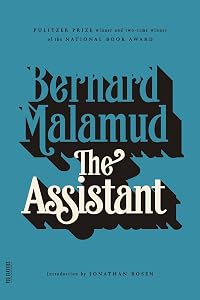
The Assistant
by Bernard Malamud
On This Page
Description
Bernard Malamud's second novel is the story of Morris Bober, a grocer in post-WWII Brooklyn, who "wants better" for himself and his family. First, two robbers appear and hold him up, then things take a turn for the better when broken-nosed Frank Alpine becomes his assistant. But there are complications: Frank, whose reaction to Jews is ambivalent, falls in love with Helen Bober at the same time he begins to steal from the store.Tags
Recommendations


































Member Reviews
The Assistant is a book you brood over after finishing, because the questions its characters ask—what does it mean to be a Jew?—and the questionable actions they take—working for a man you have robbed at gunpoint, having sex with a woman you have just rescued from being raped —are the powerful relics of purpose-driven writing, of a time when books were serious examinations of some aspect of society, rather than formulaic accumulations of ideology.
Bernard Malamud intertwines the lives of two down-on-their-luck characters, Morris Bober, the Jewish owner of a failing grocery store in Brooklyn, and Frank Alpine, a drifter whose tenuous connection to the grocery store, its owner and his family devolves over time as the truth behind show more his motivation for helping out at the store is slowly revealed. Bober, as the archetypal Jew, struggles to overcome the harms inflicted on him by an unfair world; Alpine, haunted by images of Saint Francis of Assisi, struggles to overcome the self-inflicted harms resulting from his own poor choices.
The Assistant plays the boredom of working in a store where hours pass without a single customer and the slow process of wooing a reluctant woman against sudden, seemingly Deus ex machina acts of criminality and violence as the push and pull on Frank as he works out who he is. The use of an omniscient third-person narrator is particularly effective, subtly providing the reader multiple perspectives to highlight the contrasts between not just Bober and Alpine but also what each character of the novel portrays.
The Assistant is ultimately a redemption story which focuses on the worthiness of faith, regardless of whether one is rewarded,while leaving unresolved what Frank gains in converting to Judaism, relinquishing the metaphorical vows of poverty, chastity, and obedience he has taken in choosing to run Bober's store for a life of suffering implied through Bober's example . show less
Bernard Malamud intertwines the lives of two down-on-their-luck characters, Morris Bober, the Jewish owner of a failing grocery store in Brooklyn, and Frank Alpine, a drifter whose tenuous connection to the grocery store, its owner and his family devolves over time as the truth behind show more his motivation for helping out at the store is slowly revealed. Bober, as the archetypal Jew, struggles to overcome the harms inflicted on him by an unfair world; Alpine, haunted by images of Saint Francis of Assisi, struggles to overcome the self-inflicted harms resulting from his own poor choices.
The Assistant plays the boredom of working in a store where hours pass without a single customer and the slow process of wooing a reluctant woman against sudden, seemingly Deus ex machina acts of criminality and violence as the push and pull on Frank as he works out who he is. The use of an omniscient third-person narrator is particularly effective, subtly providing the reader multiple perspectives to highlight the contrasts between not just Bober and Alpine but also what each character of the novel portrays.
The Assistant is ultimately a redemption story which focuses on the worthiness of faith, regardless of whether one is rewarded,
I first read this novel as part of a course on the novel and business more than a decade ago. While Malamud was a writer who always had one eye fixed on the eternal and one on the here and now, the here and now in this case was represented by a small business. The eternal was the realm of moral quandaries. It was his genius to show the two constantly intersecting. In this book, his masterpiece, Morris Bober is a neighborhood grocer whose modest store is failing and whose luck actually takes a turn for the worse when he is held up by masked hoodlums. Or is it worse? When a stranger (Frank Alpine) appears and offers to work without pay, "for the experience", it doesn't take long for the reader to realize that the stranger is one of the show more men who robbed Bober. But just what are his motives in returning? He seems to be seeking atonement, but he soon begins simultaneously robbing the till and also falling in love with Bober's daughter, theft of a different kind.
Certainly there is the question of suffering present when Morris and Frank engage in the following interchange:
""If you live, you suffer. Some people suffer more, but not because they want. But I think if a Jew don't suffer for the Law he will suffer for nothing."
"What do you suffer for, Morris?" Frank said.
"I suffer for you," Morris said calmly.
Frank laid his knife down on the table. His mouth ached. "What do you mean?"
"I mean you suffer for me."
The clerk let it go at that."
Malamud sees suffering as the fate of the whole of mankind, with responsibility taken for each other as the way to mitigate this. It is reminiscent of Dostoevsky's idea of universal brotherhood and mutual responsibility, but without Dimitri Karamazov's notion that we are all monsters. Alpine is able to engage in a symbolic death and rebirth in Malamud's devastating meditation upon suffering, penance and forgiveness. It is a story about the ways in which the weight of the world can be lifted, just a little, by determined acts of grace. And it is a story which makes you think about these important issues and that is always a good thing. show less
Certainly there is the question of suffering present when Morris and Frank engage in the following interchange:
""If you live, you suffer. Some people suffer more, but not because they want. But I think if a Jew don't suffer for the Law he will suffer for nothing."
"What do you suffer for, Morris?" Frank said.
"I suffer for you," Morris said calmly.
Frank laid his knife down on the table. His mouth ached. "What do you mean?"
"I mean you suffer for me."
The clerk let it go at that."
Malamud sees suffering as the fate of the whole of mankind, with responsibility taken for each other as the way to mitigate this. It is reminiscent of Dostoevsky's idea of universal brotherhood and mutual responsibility, but without Dimitri Karamazov's notion that we are all monsters. Alpine is able to engage in a symbolic death and rebirth in Malamud's devastating meditation upon suffering, penance and forgiveness. It is a story about the ways in which the weight of the world can be lifted, just a little, by determined acts of grace. And it is a story which makes you think about these important issues and that is always a good thing. show less
Una storia di desolazione e fatica quotidiana, apparentemente senza un perchè.
Morris Bober, droghiere ebreo che ha subito la morte prematura di un figlio, conduce la sua bottega senza successo, fra peripezie e sofferenze per sbarcare il lunario. Ma in maniera limpidissima e onesta, senza cadere in sotterfugi per cavare qualche dollaro in più (pure aiutando chi sta peggio di lui).
La moglie Ida è gretta e lamentosa, la figlia Helen eterna insoddisfatta soffre di non aver potuto studiare per le ristrettezze economiche della famiglia.
Appare in scena il commesso, che si scopre poi aver partecipato alla rapina al droghiere, che causa la forzata chiusura momentanea della bottega. Frank, il commesso, vuole redimersi, e si insinua nella vita show more della famiglia cercando il modo di sollevare le sorti della bottega.
Una storia dolorosa e di fatica, descritta senza fronzoli, in maniera diretta; che ti costringe a partecipare alla fatica e non ad esserne semplice spettatore.
Personalmente ho trovato antipatiche le figure femminili. Figure lamentose e piene di recriminazioni. Al funerale di Morris in cuor loro rinfacciano al defunto la estrema onestà e rettitudine di comportamento quasi fosse la sua colpa. In realtà è il suo punto di forza che lo rende una bella persona.
Le figure maschili invece sono figure che hanno la volontà di agire, di risollevare la situazione di fallimento che vivono. Che vedono o compiono il male, ma con il desiderio di redimere o di redimersi. Chi nella vita non ha mai compiuto errori? e perchè deve essere preclusa loro la possibilità di redenzione se soffrono per il male compiuto?
La bellezza di questo libro, per me, consiste nel fatto che mi ha dato modo di immedesimarmi e di calarmi dolorosamente in una realtà non solo descritta, che mi ha costretto a partecipare al dolore e alla voglia di redenzione. Notando parecchi parallelismi con la vita vissuta. Non è poco show less
Morris Bober, droghiere ebreo che ha subito la morte prematura di un figlio, conduce la sua bottega senza successo, fra peripezie e sofferenze per sbarcare il lunario. Ma in maniera limpidissima e onesta, senza cadere in sotterfugi per cavare qualche dollaro in più (pure aiutando chi sta peggio di lui).
La moglie Ida è gretta e lamentosa, la figlia Helen eterna insoddisfatta soffre di non aver potuto studiare per le ristrettezze economiche della famiglia.
Appare in scena il commesso, che si scopre poi aver partecipato alla rapina al droghiere, che causa la forzata chiusura momentanea della bottega. Frank, il commesso, vuole redimersi, e si insinua nella vita show more della famiglia cercando il modo di sollevare le sorti della bottega.
Una storia dolorosa e di fatica, descritta senza fronzoli, in maniera diretta; che ti costringe a partecipare alla fatica e non ad esserne semplice spettatore.
Personalmente ho trovato antipatiche le figure femminili. Figure lamentose e piene di recriminazioni. Al funerale di Morris in cuor loro rinfacciano al defunto la estrema onestà e rettitudine di comportamento quasi fosse la sua colpa. In realtà è il suo punto di forza che lo rende una bella persona.
Le figure maschili invece sono figure che hanno la volontà di agire, di risollevare la situazione di fallimento che vivono. Che vedono o compiono il male, ma con il desiderio di redimere o di redimersi. Chi nella vita non ha mai compiuto errori? e perchè deve essere preclusa loro la possibilità di redenzione se soffrono per il male compiuto?
La bellezza di questo libro, per me, consiste nel fatto che mi ha dato modo di immedesimarmi e di calarmi dolorosamente in una realtà non solo descritta, che mi ha costretto a partecipare al dolore e alla voglia di redenzione. Notando parecchi parallelismi con la vita vissuta. Non è poco show less
This is the first book I've read by Malamud, and I found it quite compelling. At first the characterizations seemed somewhat stereotypical, but what is stereogype other than a partial reflection of the truth. What drove me through the novel was the transformation of the character (Frank), and the complexification of the character (Morris). Underneath the stereotypes of these men, and the women as well, there is a spiritual battle, that is nicely resolved in the destiny, or is it fate, that Frank effects. Perhaps it is so telling because we assign to the Jews a spiritual journey that is only informed by either the Holocaust, the Christian perspective, or the perspective of the Torah. It is Ida that functions as the Torah, always setting show more a moral boundry, and it is Helen who functions as Moses, always attempting to reach the promised land. Fundamental to all of this is the mandatory hospitality that is owed to the stranger - something that the righteous man (Morris) and the law (Ida) circle about, giving a sense of rabbinic casuistry and interpretation. That the stranger (Frank) embodies so many moralities makes the stew all that much richer. That these spiritual perspectives are embodied in the drudgery of a poor grocery store, and the lives that are ensnared there, is the genius of Malamud's prose and storytelling. show less
"It frustrated him hopelessly that every move he made seemed to turn into an inevitable thing." That's the essence of The Assistant, a modern version of Crime and Punishment set in a turn-of-the-century Jewish grocery. The portrait of the suffering Morris Bober is perfect and Malamud avoids the kind of sentimentality or easy answers that would make a novel in this setting unreadable.
I very much enjoyed the writing style, and that we knew many of the characters, but not many details of their backstory. I was very interested in the content of the book and the fate of the characters. However, there were so many details I wish were better explained to those unfamiliar with Jewish History. I also felt there were too many unexpected and unbelievable incidents in the end.
Morris Bober is an aging Jewish grocer in a poor neighborhood of immigrants in post-war Brooklyn. Amidst greed, competition, and modernism, he struggles to keep his small business afloat. Despite the long hours he puts in with the dedication of an ant, he is losing the fight. His wife becomes cynical and believes a good marriage for the daughter, Helen, is the only way out of their poverty. Helen, on the other hand, only wants an education.
Frank Alpine, a young homeless Italian immigrant, turns up and manages to convince Morris to hire him as assistant in the store. Frank has a secret, and unbeknownst to the Bobers, he is there to “pay his debt.” He is determined, ambitious, hardworking, and strives to live a morally correct life, show more but he is dogged by his demons. Between the comings and goings in the deteriorating store, tensions increase as Frank and Helen become romantically involved. With the continuing decline of the business and the neighborhood, a quiet desperation settles, and each withdraws even more into him/herself, almost as if existed merely to await the impending doom.
Although there is some melodrama involved (one misfortune begetting another almost no end), I find the novel very compelling. The story is about disillusionment, fear, loyalty, hope and courage. It is also about having a second chance, a rebirth. Nothing grand or spectacular happens here, our characters are small people, the silent ones, whose lives are a grind, depressing even. But goodness, we realize, continue to exist amidst bleakness and isolation, and grace triumphs.
There are plenty of insights to be had from this novel, yet Malamud is able to expertly frame the story without moralizing. The story is very absorbing too, it was quite hard to put it down. This was my first Malamud and definitely not my last! show less
Frank Alpine, a young homeless Italian immigrant, turns up and manages to convince Morris to hire him as assistant in the store. Frank has a secret, and unbeknownst to the Bobers, he is there to “pay his debt.” He is determined, ambitious, hardworking, and strives to live a morally correct life, show more but he is dogged by his demons. Between the comings and goings in the deteriorating store, tensions increase as Frank and Helen become romantically involved. With the continuing decline of the business and the neighborhood, a quiet desperation settles, and each withdraws even more into him/herself, almost as if existed merely to await the impending doom.
Although there is some melodrama involved (one misfortune begetting another almost no end), I find the novel very compelling. The story is about disillusionment, fear, loyalty, hope and courage. It is also about having a second chance, a rebirth. Nothing grand or spectacular happens here, our characters are small people, the silent ones, whose lives are a grind, depressing even. But goodness, we realize, continue to exist amidst bleakness and isolation, and grace triumphs.
There are plenty of insights to be had from this novel, yet Malamud is able to expertly frame the story without moralizing. The story is very absorbing too, it was quite hard to put it down. This was my first Malamud and definitely not my last! show less
Members
- Recently Added By
Lists

The Guardian's 1000 Novels Everyone Must Read
1,005 works; 547 members

Time Magazine's "All-Time 100"
113 works; 15 members
National Book Award Finalists - Fiction
377 works; 12 members

100 Most Recommended Works
100 works; 11 members

1950s
340 works; 22 members
Time's All-Time 100 Novels
100 works; 27 members

Anthony Burgess 99 Post War Novels
99 works; 7 members

Books Read in 2009
464 works; 11 members

Recommended Reading : 600 Classics Reviewed, Editors of Salem Press, 2015
634 works; 6 members

bound
100 works; 1 member
Author Information

98+ Works 11,763 Members
Bernard Malamud was born in 1914 in New York City and later received his B. A. from City College of New York and his M. A. from Columbia University. All of Malamud's works are highly respected, including "Armistice" (his first), "The Magic Barrel," which won the National Book Award, "The Fixer," which received a Pulitzer Prize. "The Assistant," show more "The Natural," "The Fixer," and "The Angel Levine," which were all adapted as films. Bernard Malamud died in 1986. (Bowker Author Biography) show less
Some Editions
Awards and Honors
Awards
Series
Belongs to Publisher Series
Work Relationships
Common Knowledge
- Canonical title
- The Assistant
- Original title
- The Assistant
- Original publication date
- 1957
- People/Characters
- Morris Bober; Frank Alpine; Ida Bober; Helen Bober; Ward Minogue
- Important places
- Brooklyn, New York, New York, USA
- Important events
- Passover Seder
- Related movies
- Der Gehilfe (1978 | IMDb); The Assistant (1997 | IMDb)
- Dedication
- For Ann with love
- First words
- The early November street was dark though night had ended, but the wind, to the grocer's surprise, already clawed.
- Quotations
- Dio benedica Julius Karp, pensò il negoziane. Senza di lui la mia vita sarebbe troppo facile. Dio fece Karp perché un povero bottegaio non si scordasse che la vita è dura. Per Karp, pensò, non era - miracolo! - così dura... (show all), ma perché invidiarlo?lasciava volentieri al negoziane di liquori le sue bottiglie e il suo denaro solo per non essere lui. La vita era già abbastanza brutta.
- Last words
- (Click to show. Warning: May contain spoilers.)After Passover he became a Jew.
Classifications
Statistics
- Members
- 1,699
- Popularity
- 13,050
- Reviews
- 32
- Rating
- (3.85)
- Languages
- 12 — Czech, Dutch, English, Finnish, French, German, Hungarian, Italian, Korean, Polish, Spanish, Swedish
- Media
- Paper, Audiobook, Ebook
- ISBNs
- 51
- ASINs
- 35