On This Page
Description
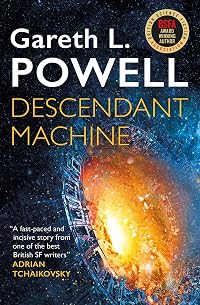
"When Nicola Mafalda's scout ship comes under attack, she's left deeply traumatised by the drastic action it takes to keep her alive. Months later, when an old flame comes to her for help, she realises she has to find a way to forgive both the ship and her former lover. Reckless elements are attempting to reactivate a giant machine that has lain dormant for thousands of years. To stop them, Nicola and her crew will have to put aside their differences, sneak aboard a vast alien megaship, and show more try to stay alive long enough to prevent galactic devastation."--Page 4 of cover. show lessTags
Recommendations



















Member Reviews
I received this novel from Titan Books through NetGalley, in exchange for an honest review: my thanks to both of them for this opportunity.
I was looking forward to the continuation of this series, where the author Gareth Powell portrays a wandering humanity relocated on huge ark-ships by the powerful aliens called Angels of Benevolence. Descendant Machine is not exactly the direct continuation of the first book, Stars and Bones, since it takes place some fifty years after the events depicted there, and as such it can be read as a stand-alone, although I would recommend reading the first volume as well, to better appreciate the nuances of characters and backgrounds. Before delving into my review I would like to share a detail about the show more writing of this book: in the Afterword, Mr. Powell speaks about the difficult genesis of Descendant Machine, since the first draft was completely lost due to some technical problems, and he had to start again from scratch. Everyone who lost some important file to computers’ quirks understands what kind of blow that must have been, so this book also stands as the proof that no situation is unsurmountable, no matter how dire it looks - and in light of the events that constitute the core of this novel, I wonder how much of this realization went into the crafting of the story itself…
Nicola Mafalda is the pilot of the scout ship Frontier Chic, belonging to the Vanguard - the exploratory arm of the Continuance, the vast fleet of ark ships on which humanity has been forging the vastness of space for the past 125 years. At the start of the novel, Nicola is ferrying passengers to Jzat, a planet inhabited by furry, four-armed humanoids who have been studying for generations a mysterious object orbiting their planet: the Grand Mechanism - the same size as Saturn’s rings, the object has been the source of endless debate about its origins and function, and there is a growing faction on Jzat that’s set on opening the Mechanism to uncover its secrets and, hopefully, reap the rewards that its superior technology might offer.
What started as a pretty routine run ends quite badly for Nicola and the Frontier Chic (I will let you discover how badly on your own…) and when we see her again she’s recuperating from the ordeal on one of the arks: contacted by her superiors, she is sent - not exactly willingly - to look for a Jzat mystic, the Rav'nah Abelisk, the latest in a long line of custodians of the Mechanism’s secrets, to obtain his help in avoiding the disasters that might follow the opening of the construct. Fighting against time and the Jzat faction bent on harnessing the Mechanism’s powers, Nicola faces dangers, betrayals and a threat to the end of the universe as we know it, in a non-stop, enthralling story whose stakes keep mounting from one chapter to the next.
Descendant Machine is written in alternating POV chapters belonging respectively to Nicola Mafalda, to the Frontier Chic’s envoy (envoys are the ships’ avatars) and to Orlando Walden, a young, bright scientist whose letters to his lover Ramona are a delightful mix of purple prose and self-centeredness. This narrative choice keeps the novel moving along at a swift pace, turning it into a compulsive read once the pieces are all set on the board and the action rolls on with unstoppable momentum, without however forgetting a good number of well-placed sparkles of humor and a few forays into emotions that feel natural and organically developed and contribute to the excellent narrative balance of this story.
I enjoyed Nicola’s portrayal very much: she possesses a delightfully snarky disposition that does not shy away from a consistent use of profanity, but which also hides the self-doubt and vulnerabilities that round up her character into a very relatable one. If she can be all business when performing her tasks, it’s in her dealings with the Chic’s envoy that we are able to see the real Nicola: here lies one of the most intriguing aspects of the novel, because we learn that Vanguard’s navigators and their envoys are somewhat mentally linked to better travel the intricacies of the Substrate (or hyperspace), and therefore share a bond that is as deep as it is unique. The voice of the Chic’s envoy is an equal mixture of intelligence, humor and shrewdness that works as the perfect foil for Nicola’s prickly attitude and the exchanges between the two of them are among my favorite sections of the book, particularly where the undeniable affection underlying their relationship comes to the fore.
The chapters devoted to Orlando Walden are of a very different nature for two reasons: on one side they explore his personality through the impassioned letters sent to Ramona, his love for her expressed in a flowery and childish way that’s quite funny; on the other they afford readers a peek into the mindset of the Openers - the faction set on uncovering the Mechanism’s secrets - and in particular of their leader Aulco, whose speeches pave the road for some humorous pokes at the sectarian kinds of politics we have seen crop up in recent years.
Narratively speaking, Descendant Machine enjoys a lighter tone in respect of its predecessor, even though it does not lack for drama or the levels of tension that accompany the possibility of seeing the universe as we know it vanish in a puff of smoke - from my point of view, it’s space opera of the most gratifying kind, where alongside the more adventurous themes you will find deeper considerations about life and death, love and friendship, the strength to accept one’s end for a higher purpose, and much more. Once again I can rest assured that Mr. Powell is very comfortable in this genre, as well as skilled, and that I will welcome every new book of his with great expectations. show less
I was looking forward to the continuation of this series, where the author Gareth Powell portrays a wandering humanity relocated on huge ark-ships by the powerful aliens called Angels of Benevolence. Descendant Machine is not exactly the direct continuation of the first book, Stars and Bones, since it takes place some fifty years after the events depicted there, and as such it can be read as a stand-alone, although I would recommend reading the first volume as well, to better appreciate the nuances of characters and backgrounds. Before delving into my review I would like to share a detail about the show more writing of this book: in the Afterword, Mr. Powell speaks about the difficult genesis of Descendant Machine, since the first draft was completely lost due to some technical problems, and he had to start again from scratch. Everyone who lost some important file to computers’ quirks understands what kind of blow that must have been, so this book also stands as the proof that no situation is unsurmountable, no matter how dire it looks - and in light of the events that constitute the core of this novel, I wonder how much of this realization went into the crafting of the story itself…
Nicola Mafalda is the pilot of the scout ship Frontier Chic, belonging to the Vanguard - the exploratory arm of the Continuance, the vast fleet of ark ships on which humanity has been forging the vastness of space for the past 125 years. At the start of the novel, Nicola is ferrying passengers to Jzat, a planet inhabited by furry, four-armed humanoids who have been studying for generations a mysterious object orbiting their planet: the Grand Mechanism - the same size as Saturn’s rings, the object has been the source of endless debate about its origins and function, and there is a growing faction on Jzat that’s set on opening the Mechanism to uncover its secrets and, hopefully, reap the rewards that its superior technology might offer.
What started as a pretty routine run ends quite badly for Nicola and the Frontier Chic (I will let you discover how badly on your own…) and when we see her again she’s recuperating from the ordeal on one of the arks: contacted by her superiors, she is sent - not exactly willingly - to look for a Jzat mystic, the Rav'nah Abelisk, the latest in a long line of custodians of the Mechanism’s secrets, to obtain his help in avoiding the disasters that might follow the opening of the construct. Fighting against time and the Jzat faction bent on harnessing the Mechanism’s powers, Nicola faces dangers, betrayals and a threat to the end of the universe as we know it, in a non-stop, enthralling story whose stakes keep mounting from one chapter to the next.
Descendant Machine is written in alternating POV chapters belonging respectively to Nicola Mafalda, to the Frontier Chic’s envoy (envoys are the ships’ avatars) and to Orlando Walden, a young, bright scientist whose letters to his lover Ramona are a delightful mix of purple prose and self-centeredness. This narrative choice keeps the novel moving along at a swift pace, turning it into a compulsive read once the pieces are all set on the board and the action rolls on with unstoppable momentum, without however forgetting a good number of well-placed sparkles of humor and a few forays into emotions that feel natural and organically developed and contribute to the excellent narrative balance of this story.
I enjoyed Nicola’s portrayal very much: she possesses a delightfully snarky disposition that does not shy away from a consistent use of profanity, but which also hides the self-doubt and vulnerabilities that round up her character into a very relatable one. If she can be all business when performing her tasks, it’s in her dealings with the Chic’s envoy that we are able to see the real Nicola: here lies one of the most intriguing aspects of the novel, because we learn that Vanguard’s navigators and their envoys are somewhat mentally linked to better travel the intricacies of the Substrate (or hyperspace), and therefore share a bond that is as deep as it is unique. The voice of the Chic’s envoy is an equal mixture of intelligence, humor and shrewdness that works as the perfect foil for Nicola’s prickly attitude and the exchanges between the two of them are among my favorite sections of the book, particularly where the undeniable affection underlying their relationship comes to the fore.
The chapters devoted to Orlando Walden are of a very different nature for two reasons: on one side they explore his personality through the impassioned letters sent to Ramona, his love for her expressed in a flowery and childish way that’s quite funny; on the other they afford readers a peek into the mindset of the Openers - the faction set on uncovering the Mechanism’s secrets - and in particular of their leader Aulco, whose speeches pave the road for some humorous pokes at the sectarian kinds of politics we have seen crop up in recent years.
Narratively speaking, Descendant Machine enjoys a lighter tone in respect of its predecessor, even though it does not lack for drama or the levels of tension that accompany the possibility of seeing the universe as we know it vanish in a puff of smoke - from my point of view, it’s space opera of the most gratifying kind, where alongside the more adventurous themes you will find deeper considerations about life and death, love and friendship, the strength to accept one’s end for a higher purpose, and much more. Once again I can rest assured that Mr. Powell is very comfortable in this genre, as well as skilled, and that I will welcome every new book of his with great expectations. show less
Gareth Powell’s Continuance series is far-future space opera in the tradition of Iain M. Banks, Peter F. Hamilton, and Alastair Reynolds. The human survivors of an interstellar war live on a fleet of spacecraft protected by a few well-armed scouts. In the standalone Descendant Machine, Nicola Mafalda is the navigator of the sentient scout Frontier Chic. When the Frontier Chic is attacked, it saves Nicola’s life in a way she may not be able to forgive. Yet together, they uncover a plot that could, quite literally, destroy the universe.
Despite the high stakes, their snarky humor makes Nicola and the Chic easy to root for.
Despite the high stakes, their snarky humor makes Nicola and the Chic easy to root for.
I have to say that was a lot more fun than I expected. An extremely fast paced slice of space opera that works entirely as a stand-alone as well as a continuation of his latest setting. A setting which I enjoyed learning about as we see humanity evicted to the stars in varied communal arks by an alien species due to our tendencies to destroy the world around us thanks to nationalism, selfishness and the excesses of capitalism (oh how on the nose this all is..). The author also appears to pay homage to the likes of Banks, Stross, Asimov and other giants of SF with plenty of inspiration drawn from their works, even if it does feel a trifle tropey.
There’s also lots of cool, colossal sized concepts in the story - a vast and mysterious show more structure which houses something of galactic importance, the ancient, almost Kaiju-like megaships drifting through the galaxy and a whole ton of mental stuff at the end. Coupled with lots of action, some reasonably pulpish attempts at science, one of the craziest over-the-top final sequences and you get a fun, action adventure that doesn’t take itself too seriously. There are some minor plot holes and contradictions which don’t detract enough to worry about, but they are a bit odd given how disciplined the rest of it is given the pace it all runs at.
The main downsides otherwise are mostly in the characters. There’s not a lot to differentiate most of them in style, their interlinking chemistry is rather flat and it leans too heavily into stereotypes and generic templates for my liking. There’s also a lot of weak and often cheesy dialogue which made me cringe a lot, exasperated by an over-reliance on (the same) repeated profanities to replace clever banter. I don’t mind swearing, but used right it provides character flavour. Here it just grates and I much prefer quality dialogue over cheap vulgarity which almost never works. I will say though it was interesting to see humans as the technologically advanced race. Often they’re typecast as the primitives catching up to a superior alien species and this flipped that.
Those are small issues though and overall it’s a recommended couple of days reading that packs a lot into a short novel. It’s not going to change the face of science fiction and far better space opera exists out there, but it does ensure a fun time as long as you don’t stop to think too hard about it. show less
There’s also lots of cool, colossal sized concepts in the story - a vast and mysterious show more structure which houses something of galactic importance, the ancient, almost Kaiju-like megaships drifting through the galaxy and a whole ton of mental stuff at the end. Coupled with lots of action, some reasonably pulpish attempts at science, one of the craziest over-the-top final sequences and you get a fun, action adventure that doesn’t take itself too seriously. There are some minor plot holes and contradictions which don’t detract enough to worry about, but they are a bit odd given how disciplined the rest of it is given the pace it all runs at.
The main downsides otherwise are mostly in the characters. There’s not a lot to differentiate most of them in style, their interlinking chemistry is rather flat and it leans too heavily into stereotypes and generic templates for my liking. There’s also a lot of weak and often cheesy dialogue which made me cringe a lot, exasperated by an over-reliance on (the same) repeated profanities to replace clever banter. I don’t mind swearing, but used right it provides character flavour. Here it just grates and I much prefer quality dialogue over cheap vulgarity which almost never works. I will say though it was interesting to see humans as the technologically advanced race. Often they’re typecast as the primitives catching up to a superior alien species and this flipped that.
Those are small issues though and overall it’s a recommended couple of days reading that packs a lot into a short novel. It’s not going to change the face of science fiction and far better space opera exists out there, but it does ensure a fun time as long as you don’t stop to think too hard about it. show less
My experience with the last couple of novels that Powell has kicked out was a certain sense of diminishing returns, as while those books weren't bad, I also didn't find them that invigorating. This then is a return to form, besides feeling like something of an upgrade in regards to Powell's take on space opera. I still wonder what a direct follow-up to "Stars and Bones" might look like, but I'm looking forward to it more than I was.
Descendant Machine is a fun, a true delight of a book that is exciting, innovative and crazy at all places. It’s playtime for the imagination, and I loved it.
The action starts with a nuclear missile exploding and rarely slows down from there. Human Navigators, Ships with personalities, and four armed aliens all feature. Taking place around 50 years after Stars and Bones this book is funny at times and all around a fun read.
The action starts with a nuclear missile exploding and rarely slows down from there. Human Navigators, Ships with personalities, and four armed aliens all feature. Taking place around 50 years after Stars and Bones this book is funny at times and all around a fun read.
Ratings
Members
- Recently Added By
Author Information

52+ Works 2,247 Members

Gareth L. Powell is a LibraryThing Author, an author who lists their personal library on LibraryThing.
Some Editions
Awards and Honors
Series

Classifications
Statistics
- Members
- 78
- Popularity
- 405,876
- Reviews
- 5
- Rating
- (3.69)
- Languages
- English
- Media
- Paper, Audiobook, Ebook
- ISBNs
- 3
- ASINs
- 3