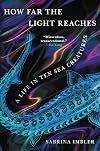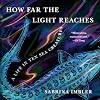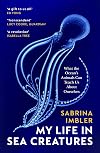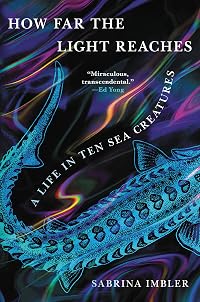
How Far the Light Reaches: A Life in Ten Sea Creatures
by Sabrina Imbler
On This Page
Description
A queer, mixed race writer working in a largely white, male field, science and conservation journalist Sabrina Imbler has always been drawn to the mystery of life in the sea, and particularly to creatures living in hostile or remote environments. Each essay in their debut collection profiles one such creature: the mother octopus who starves herself while watching over her eggs, the Chinese sturgeon whose migration route has been decimated by pollution and dams, the bizarre Bobbitt worm show more (named after Lorena), and other uncanny creatures lurking in the deep ocean, far below where the light reaches. Imbler discovers that some of the most radical models of family, community, and care can be found in the sea, from gelatinous chains that are both individual organisms and colonies of clones to deep-sea crabs that have no need for the sun, nourished instead by the chemicals and heat throbbing from the core of the Earth. Exploring themes of adaptation, survival, sexuality, and care, and weaving the wonders of marine biology with stories of their own family, relationships, and coming of age, How Far the Light Reaches is a book that invites us to envision wilder, grander, and more abundant possibilities for the way we live. show lessTags
Recommendations







Member Reviews
Sabrina Imbler is a queer, mixed-race science writer who does not come from a traditional science background. In this memoir, they compare their life experiences - being queer, realizing they’re trans, being part Asian, moving from California to New York City, etc. - with the weird lives of sea creatures from feral goldfish to maternal octopuses to communal salps.
I think I would call this more “essays” than a memoir, because there isn’t really a throughline or chronology. It’s just their feelings about bits and pieces of their life. Which is fine! I have read other books that try to make the same connections between other living creatures and the author's life, and this is far better than most. Imbler does extensive research show more and the connections are made on a paragraph-by-paragraph basis, not just chapter-by-chapter. I am a big fan of Imbler’s science writing on the internet and this is more of the same. My only quibble is that I wish there had been more of it…both more memoir and more about the animals. show less
I think I would call this more “essays” than a memoir, because there isn’t really a throughline or chronology. It’s just their feelings about bits and pieces of their life. Which is fine! I have read other books that try to make the same connections between other living creatures and the author's life, and this is far better than most. Imbler does extensive research show more and the connections are made on a paragraph-by-paragraph basis, not just chapter-by-chapter. I am a big fan of Imbler’s science writing on the internet and this is more of the same. My only quibble is that I wish there had been more of it…both more memoir and more about the animals. show less
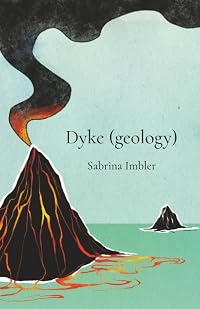
I loved Dyke [geology] so much that I wasn't sure that this one would quite hold up, but it's possible that I loved this one even more. A collection of essays that is part memoir, part marine biology, it compares brooding octopus moms starving to death to eating disorders, sturgeons spawning up rivers to ancestors boating upriver in China to flee the Japanese. I loved all of these, but my favorite essay examined both salps (a clear, gelatinous creature that lives part of its life in solitary phase, another as a chain of clones of tens to hundreds of individuals, and sometimes erupts into booms that can cover THOUSANDS OF SQUARE MILES of ocean surface) to the Dyke March and queer gathering spaces. It may sounds like a strange structure show more for a book, but it was superb. show less
Memoirs are usually not to my taste, but the way this one interspersed facts about sea creatures with personal stories somehow made it interesting to me. I feel like I learned a lot about marine animals. The connections the author drew to their own life are also masterfully chosen, and executed well. I particularly like the chapter that drew connections between yeti crabs at transient undersea vents and queers finding community in fleeting underground dance parties. Definitely one to check out. The audiobook is narrated by the author, who does a good job. I like the added authenticity from this, and the way they laugh at the parts we're supposed to find funny.
This book is incredible -- deep and thoughtful and intense, revealing and penetrating, and absolutely one of the best books of personal essays/memoirs I've read. In terms of sheer quality, it's a five-star book for sure, and I admired the hell out of it.
But wow, I wish I had known going in what this book was. (That I didn't is entirely my fault; I see a book of personal essays and I want to read it, and if sea creatures are involved, I want to read it twice as much, so I failed to do my due diligence.) For me, reading this was really rough; there's a ton of animal harm, a ton of climate horror, because those are just the realities of writing about nature right now. And there's a ton of homophobia and transphobia and fatphobia and show more racism and sexual assault and sexism and general pain, because that's the reality Imbler lived through and is describing. I'm glad they wrote this, and I'm glad they put it all down, but I had to read this in small doses to avoid drowning.
(Also, there was one chapter that left me wanting to say to Imbler what I always want to say to people when they describe their joyful, beautiful, totally inaccessible queer rituals and gathering spots and communities: "You leave no space for the disabled in your queer community, which means someday there will be no space for you. You'll lose the joy and love and togetherness at a time you're also losing your health or your mobility or your energy or your life." But, you know, no one wants to be around a Cassandra, so I mostly keep that knowledge to myself.) show less
But wow, I wish I had known going in what this book was. (That I didn't is entirely my fault; I see a book of personal essays and I want to read it, and if sea creatures are involved, I want to read it twice as much, so I failed to do my due diligence.) For me, reading this was really rough; there's a ton of animal harm, a ton of climate horror, because those are just the realities of writing about nature right now. And there's a ton of homophobia and transphobia and fatphobia and show more racism and sexual assault and sexism and general pain, because that's the reality Imbler lived through and is describing. I'm glad they wrote this, and I'm glad they put it all down, but I had to read this in small doses to avoid drowning.
(Also, there was one chapter that left me wanting to say to Imbler what I always want to say to people when they describe their joyful, beautiful, totally inaccessible queer rituals and gathering spots and communities: "You leave no space for the disabled in your queer community, which means someday there will be no space for you. You'll lose the joy and love and togetherness at a time you're also losing your health or your mobility or your energy or your life." But, you know, no one wants to be around a Cassandra, so I mostly keep that knowledge to myself.) show less
By the end of How Far the Light Reaches readers understand a lot about the author, Sabrina Imbler, and what surviving as a queer, mixed-race person feels like for them. Oh, and there’s also some science about sea creatures. This book eludes a typical genre description as it encompasses aspects of a memoir, essays, and nonfiction which may be an excellent metaphor for the author who also slips past society’s desire for binary classification. Imbler’s writing really illuminates their emotional struggles but maintains a healthy sense of humor while still able to clearly convey complicated science — quite a feat. How Far the Light Reaches is an excellent book for people hoping to deepen their understanding of queer and trans folks show more while also learning about some very cool ocean animals. (I listened to the audio and it is read by the author who does a wonderful job.) show less
This is a remarkable book that manages to combine "memoir with marine biology" as the podcast Science Friday put it (which was the impetus for me to put the book on my reading list). What keeps it from a full five stars for me is the whiplash between the two, but I'll address that in a bit.
The words after the colon in the title are important here: A Life in Ten Sea Creatures. Imbler is a very gifted writer who sets upon the task of creating substantial and meaningful metaphor through ten creatures: the goldfish, the octopus, the sturgeon, the sperm whale, the yeti crab, the sand striker, the butterflyfish, the salp, the cuttlefish, and the immortal jellyfish. Imbler hones in on the characteristics and circumstances of each of these show more creatures and connects to those as a queer and mixed-race person. Ira Flatow's interview didn't quite prepare me for the level of intimacy that Imbler brings to this book, but I am better for it. The metaphors are not forced, but seem to blossom forth: "They are one of the best-studied jellyfish in the world, and yet no one noticed the moon jelly's power of regeneration until someone gave it time and trust that it might grow into itself." Often, it is the passages focused on the sea creatures where Imbler offers their most potent observations. There are passages that brought me to tears: "But life always finds a place to begin anew, and communities in need will always find one another and invent new ways to glitter, together, in the dark"--some of them hopeful, some of them recognizing the darkness in the depths of identity.
And this is very much a book about identity and taxonomy--biological and social. There are moments where just as you are caught up in either the science or the memoir, however, the prose switches abruptly. This seems like a stylistic choice on Imbler's part, but it didn't work for me, as I felt yanked out of things just as I was connecting to the intimacy of their narratives. I worry that the title and marketing (the Science Friday interview downplays the memoir side) might mean potential readers may miss out if deep sea creatures aren't a ready-made point of interest. Imbler's personal experiences no doubt mirror that of many queer youths, swimming in the murky waters of identity. I hope they know this book is for them, because Imbler's words reach up from the bottom like a kelp forest toward the light, and everyone is better for it. Perhaps if we could all embrace a little bit more of ourselves in the creatures we know and don't yet know, existence might be a bit less fraught. show less
The words after the colon in the title are important here: A Life in Ten Sea Creatures. Imbler is a very gifted writer who sets upon the task of creating substantial and meaningful metaphor through ten creatures: the goldfish, the octopus, the sturgeon, the sperm whale, the yeti crab, the sand striker, the butterflyfish, the salp, the cuttlefish, and the immortal jellyfish. Imbler hones in on the characteristics and circumstances of each of these show more creatures and connects to those as a queer and mixed-race person. Ira Flatow's interview didn't quite prepare me for the level of intimacy that Imbler brings to this book, but I am better for it. The metaphors are not forced, but seem to blossom forth: "They are one of the best-studied jellyfish in the world, and yet no one noticed the moon jelly's power of regeneration until someone gave it time and trust that it might grow into itself." Often, it is the passages focused on the sea creatures where Imbler offers their most potent observations. There are passages that brought me to tears: "But life always finds a place to begin anew, and communities in need will always find one another and invent new ways to glitter, together, in the dark"--some of them hopeful, some of them recognizing the darkness in the depths of identity.
And this is very much a book about identity and taxonomy--biological and social. There are moments where just as you are caught up in either the science or the memoir, however, the prose switches abruptly. This seems like a stylistic choice on Imbler's part, but it didn't work for me, as I felt yanked out of things just as I was connecting to the intimacy of their narratives. I worry that the title and marketing (the Science Friday interview downplays the memoir side) might mean potential readers may miss out if deep sea creatures aren't a ready-made point of interest. Imbler's personal experiences no doubt mirror that of many queer youths, swimming in the murky waters of identity. I hope they know this book is for them, because Imbler's words reach up from the bottom like a kelp forest toward the light, and everyone is better for it. Perhaps if we could all embrace a little bit more of ourselves in the creatures we know and don't yet know, existence might be a bit less fraught. show less
How Far the Light Reaches is a unique book, part science and part memoir. The author uses sea creatures' habits as metaphors for personal life experiences. I learned some interesting facts about sea creatures, such as goldfish's growth potential and octopuses' starvation when brooding. Also, there were many tidbits about regeneration, predator/prey relationships, and morphing. The real focus, however, was on this author's ability to be true to self and explain complex feelings and iterations of growth by examining models in the sea. Imbler described sustained abuse at the hands of men by studying and comparing experiences with men to the habits of a predatory sand-striker worm, an ambush predator.
Another vivid comparison was the show more emotional morphing from family expectations to the life of a lesbian and member of a queer community. Imbler aligns life phases to that of a morphing cuttlefish. The cuttlefish has distinct disguises for different predators. The cuttlefish transformations are triggered by evolution, but the author could not wait for the evolving process to occur; it was essential to purposely morph, wear clothes that defied societal expectations, and convey personal messages about an invisible yet heartfelt internal evolution.
An easy-to-grasp description was that of a sturgeon starting its life in freshwater but mainly living in the sea. This was a great way to show a human metaphorically treading different waters during maturation. A quote from page 101 encapsulates one of the themes of Imbler's book:
"As queer people, we get to choose our families. Vent bacteria, tube worms, and yeti crabs take it one step further. They choose what nourishes them. They turn away from the sun and toward something more elemental, the inner heat and chemistry of Earth."
It was clear that the author found much satisfaction in studying instinct, life cycles, and stages of life. The statement that "metamorphosis in humans doesn't have to be a full-body thing" sums up the human's need to regrow in acceptance of self and others. show less
Another vivid comparison was the show more emotional morphing from family expectations to the life of a lesbian and member of a queer community. Imbler aligns life phases to that of a morphing cuttlefish. The cuttlefish has distinct disguises for different predators. The cuttlefish transformations are triggered by evolution, but the author could not wait for the evolving process to occur; it was essential to purposely morph, wear clothes that defied societal expectations, and convey personal messages about an invisible yet heartfelt internal evolution.
An easy-to-grasp description was that of a sturgeon starting its life in freshwater but mainly living in the sea. This was a great way to show a human metaphorically treading different waters during maturation. A quote from page 101 encapsulates one of the themes of Imbler's book:
"As queer people, we get to choose our families. Vent bacteria, tube worms, and yeti crabs take it one step further. They choose what nourishes them. They turn away from the sun and toward something more elemental, the inner heat and chemistry of Earth."
It was clear that the author found much satisfaction in studying instinct, life cycles, and stages of life. The statement that "metamorphosis in humans doesn't have to be a full-body thing" sums up the human's need to regrow in acceptance of self and others. show less
Members
- Recently Added By
Lists

Science: Zoology
107 works; 1 member

Books about Octopuses
23 works; 1 member

Sapph-Lit
78 works; 4 members

Books Read in 2025
4,128 works; 98 members

The Best LGBTQ Nonfiction
217 works; 70 members
Author Information
2+ Works 640 Members
Some Editions
Awards and Honors
Awards
Distinctions
Common Knowledge
- Original publication date
- 2022
- People/Characters
- Sabrina Imbler
- Important places
- New York, New York, USA; Jacob Riis Park, Rockaway Park, New York, USA
- Epigraph
- What does the light want?
More of its kind?
Yes.
Yes and
a wish to disturb the dark.
- from Kimiko Hahn, Resplendent Slug - First words
- The truth is I was asked to leave the Petco, but I told everyone I was banned.
- Last words
- (Click to show. Warning: May contain spoilers.)Thank you for the life we share together, it is more than I ever could have dreamed.
Classifications
- Genres
- Science & Nature, LGBTQ+, Sexuality and Gender Studies, General Nonfiction, Biography & Memoir, Nonfiction
- DDC/MDS
- 578.77 — Natural sciences & mathematics Biology Natural history of organisms and related subjects Organisms characteristic of specific kinds of environments
- LCC
- QL122 — Science Zoology Zoology General
- BISAC
Statistics
- Members
- 580
- Popularity
- 50,843
- Reviews
- 26
- Rating
- (3.94)
- Languages
- English, German, Spanish
- Media
- Paper, Audiobook, Ebook
- ISBNs
- 15
- ASINs
- 4