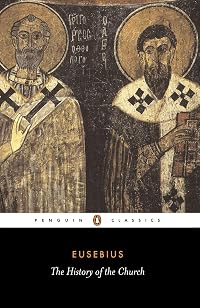
The History of the Church: From Christ to Constantine
by Eusebius
On This Page
Description
"Eusebius of Caesarea's Ecclesiastical History remains the single most important source for the history of the first three centuries of Christianity and stands among the classics of Western literature. Eusebius's iconic story of the church's origins, endurance of persecution, and ultimate triumph, with its cast of martyrs, heretics, bishops, and emperors, has profoundly shaped the understanding of Christianity's past. This fresh new translation, which includes detailed introductory essays show more and explanatory notes, presents Eusebius's work in a way that is both accessible to new readers and thought provoking for specialists"--Provided by publisher. show lessTags
Recommendations






Member Recommendations

divinepeacelutheran My go-to version of the Bible. No additions or deletions. Easy to read.
12
Member Reviews
The first surviving history of the Christian Church is well served by this translation and commentary. Eusebius has the occasional dry passage, but his perspective as a Christian writing about Christians in first three centuries of the Roman Empire more than make up for this.
For my latest history fix, I decided to go way back to the first 300 years after Christ. (Of course, having received this book for Christmas influenced this decision somewhat.) It was interesting and amusing to read about the first centuries of the Christian Church, reading of controversies and heresies that have been revived almost 20 centuries later. Once, Eusebius gets to the years of his life, however, and speaks of the persecutions that some faced, I was reminded that American Christians, at least, live in a very different world.
--J.
--J.
This was a very readable translation with helpful commentary. As I am only somewhat interested in early church history, it did end up being more information than I could absorb. My main takeaways were a more vivid picture of the persecution of the Christians and the subsequent appreciation for the work of Constantine.
Absolutely essential reading for those interested in the development of early Christianity up to the 4th century, since it's the first full historical narrative written from the Christian point of view. The glossary in this new edition titled "Who's Who in Eusebius" is practical and helpful for keeping track of the numerous historical figures mentioned in these pages—I wish I'd had recourse to it the first time I read through this book as a student.
The text was translated by Paul Maier who did an amazing job. I was impressed by how he culled some of the more superfluous words condensing it and making it easier to read.
This work is included as a foundational historical source on the early Christian Church’s development from Christ’s era to the age of Constantine. Written by Eusebius — an early Christian bishop and historian — it provides readers with firsthand insight into the struggles, leadership, heresies, and growth of the early Church. It is not a doctrinal manual, so readers should pair it with Catholic Church history texts and Magisterial resources for balanced understanding within Catholic teaching.
Eusebius is a scholar, I learnt a lot of new things from this book. I am encouraged by the Early Church fathers especially Origen. It seems that the Early Christians had to face internal threats (heresies), external threats (ridicule, persecution), this is simply too much to Handle but God blessed them. The persecutions in the Roman empire is appalling. There's depth details about persecution especially during Diocletian Era, I could not digest a lot. I wish the Christians today would read this and teach their children. All the Church fathers had written polemics, defended the Christian claims during their Era. The Questions today faced by the Church are nothing great compared to their Era. Overall, a Great book, Eusebius taught me how show more the Early Bishops were, they were scholars, preachers, philosophers. show less
Members
- Recently Added By
Lists

100 Books to Read in a Lifetime (That Are Older Than 200 Years)
415 works; 175 members

Wayland Preaching Class
31 works; 2 members

CCE 100 Great Books List
145 works; 8 members

r/History Recommended Reading List
603 works; 12 members

Further Reading Recommended by Herrin's Byzantium
151 works; 1 member

Western Canon
206 works; 2 members

Top Five Books of 2025
954 works; 303 members

Books in the Bibliography of The History of Hell by Alice K. Turner
155 works; 1 member

In Our Time books
4,934 works; 2 members
Author Information

140+ Works 6,770 Members
Eusebius is best remembered for his celebrated Ecclesiastical History, which provides a history of Christianity from the apostolic age down to the early fourth century. It is primarily this work that earned Eusebius the title of Father of Church History. Eusebius was born in Palestine about A. D. 264. Beginning about 315, he was made bishop of show more Caesarea. His Praeparatio Evanglica contains valuable extracts from the ancient philosophers. His Chronica is likewise valuable to students of ancient history. Theologically, Eusebius is remembered for his retelling of Christian history to include a positive role for the admired Roman emperors as instruments of God's will. Eusebius died about 340. (Bowker Author Biography) show less
Some Editions
Awards and Honors
Distinctions
Series
Belongs to Publisher Series
Common Knowledge
- Canonical title
- The History of the Church: From Christ to Constantine
- Original title
- Historia Ecclesiastica
- Alternate titles
- History of the Church; Eusebius' ecclesiastical history
- Original publication date
- 321
- People/Characters
- Constantine the Great; Simon Peter; Montanus, 2nd century; Decius, Emperor of Rome; Sabellius, fl. Early 3rd century; Novatus (show all 17); Diocletian; Maximin, Emperor of Rome; Eusebius of Caesarea, 260/265–339/340; Hegesippus; Irenaeus, c. 130-202; John the Apostle; Licinius; Marcus Aurelius; Mark, the Evangelist; Polycarp, 69-155; Jesus Christ
- Important places
- Roman Empire; Alexandria, Egypt; Jerusalem; Antioch; Constantinople
- Important events
- Council of Nicaea; Edict of Toleration
- First words
- If Herodotus is the father of history, then Eusebius of Caesarea (c. A.D.260-339) is certainly the father of church history.
Introduction to the G. A. Williamson edition -- 'The only work of its kind, possessing a value to subsequent ages which belongs to no other uninspired work.' - Last words
- (Click to show. Warning: May contain spoilers.)They, having first cleansed the world of hatred to God and knowing all the good He had conferred on them, showing their love of virtue and of God, their devotion and gratitude to the Almighty, by their actions for all to see.
- Original language
- Greek (Ancient) (Ancient)
Classifications
- Genres
- Religion & Spirituality, History, Nonfiction, General Nonfiction
- DDC/MDS
- 270.1 — Religion History of Christianity History, geographic treatment, biography of Christianity Apostolic; Nativity to Constantine
- LCC
- BR160 .E5 .E5 — Philosophy, Psychology and Religion Christianity Christianity History By period Early and medieval
- BISAC
Statistics
- Members
- 5,096
- Popularity
- 2,723
- Reviews
- 30
- Rating
- (3.74)
- Languages
- 11 — Dutch, English, Finnish, French, German, Greek (Ancient), Greek, Russian, Spanish, Swedish, Portuguese (Portugal)
- Media
- Paper, Audiobook, Ebook
- ISBNs
- 71
- UPCs
- 1
- ASINs
- 66