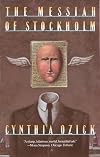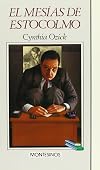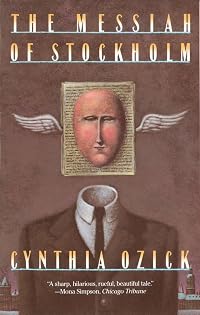
The Messiah of Stockholm
by Cynthia Ozick
On This Page
Description
A small group of Jews weave a web of intrigue and fantasy around a book reviewer's contention that he is the son of Borus Schultz, the legendary Polish writer killed by the Nazis before his magnum opus, THE MESSIAH, could be brought to light.Tags
Recommendations



















Member Reviews
I had a shaky start with this book, and ended really enjoying it. Based on a real-life lost manuscript of Polish writer, Bruno Schulz, murdered by the nazis, it explores lost identity, lost family and lost culture, and how those vacuums are filled. The holocaust is woven through the narrative, at times explicitly, at times in the drift of smoke from something roasting or on fire.
There's a progression from febrile unreality towards bland materiality, that in gaining, the main character, Lars Andemening, loses something.
Although by the book's end Andemening's trajectory has been from night into day, from private to consensus reality, there remains a thrill of the uncertain, the possibility that the fantastic, veiled and withdrawn, is show more still imminent, its potential to break through and disrupt still alive and ready to reclaim.
I'm glad that I persevered beyond the first 19 pages, and I'm inspired to seek out the surviving works of Schulz, which is one of the blessings of reading books inspired on the works of other writers. show less
There's a progression from febrile unreality towards bland materiality, that in gaining, the main character, Lars Andemening, loses something.
I'm glad that I persevered beyond the first 19 pages, and I'm inspired to seek out the surviving works of Schulz, which is one of the blessings of reading books inspired on the works of other writers. show less
30 [The Messiah of Stockholm] by [[Cynthia Ozick]]
Rating: 3* of five
The Publisher Says: In The Messiah of Stockholm, Cynthia Ozick brings her extraordinary artistry and intelligence to bear on a wry and wildly inventive, heart-breaking tale of one man's comically desperate struggle with an illusory identity.
The man is Lars Andemening: orphaned in Poland during World War II, brought up in Sweden by a begrudging foster family, "seized in infancy by an unnatural history" that has followed him into middle age. Divorced twice, estranged from his only child, an ultraliterary book reviewer for a decidedly unliterary newspaper, he is more comfortable in the "wilderness of his quilt" than in the company of people. And he is obsessed with an show more impassioning notion: that he is the son of Bruno Schulz, the legendary Polish writer killed by the Nazis before his magnum opus, The Messiah, could come to light. Lars has no proof of his lineage, but he has "the orphan's terrifying freedom to choose," and it is Schulz he has chosen, entering the phantasmagoria of the mind he finds in the writer's work in order to extract from it the fullness of a life.
Lars reveals his profoundly imagined identity to Heidi Eklund—self-exiled from Germany, owner of a dark, labyrinthine bookstore, the only one in Stockholm to have Lars's "father" in the original Polish. Heidi has her own imagined identity (or so Lars interprets the stories she tells of herself), and it is this shared status as "refugee imposter" that draws him to her. She becomes a source for Lars, offering up obscure Schulz letters and photographs and generous doses of her own sardonic enthusiasm, which succeed in driving Lars deeper and deeper into his obsession. Until: Heidi brings him the most astounding piece of Schulziana—a woman claiming to be Schulz's daughter and claiming, as well, to have, in the ratty white plastic bag she carries everywhere, the original manuscript of The Messiah....
My Review: Like every Cynthia Ozick book I've ever read, this is a series of gorgeous sentences describing i acute, sharp-edged clarity the existence of Jews whose inner lives are bound to a vision of amorphous Jewishness. It is protean, this sense of Jewishness, it refuses to settle into a single defining characteristic while imbuing the entire story with its unique but barely detectable presence.
This is an astonishing achievement. It is also the thing that Ozick does. It is, therefore, susceptible to aesthetic fatigue. I've read this book...[The Shawl], [The Puttermesser Papers]...and am full up on Ozickishness. I am glad I read this short novel, I am delighted with the conceit of [[Bruno Schulz]]'s unknown son, I was delighted with the richly imagined bookshop world Ozick sets so much of the action within. But I am done now, I've been there and I've done that and there isn't a lot of reading time left in the next 20-ish years so I'll be moving on to other delights. show less
Rating: 3* of five
The Publisher Says: In The Messiah of Stockholm, Cynthia Ozick brings her extraordinary artistry and intelligence to bear on a wry and wildly inventive, heart-breaking tale of one man's comically desperate struggle with an illusory identity.
The man is Lars Andemening: orphaned in Poland during World War II, brought up in Sweden by a begrudging foster family, "seized in infancy by an unnatural history" that has followed him into middle age. Divorced twice, estranged from his only child, an ultraliterary book reviewer for a decidedly unliterary newspaper, he is more comfortable in the "wilderness of his quilt" than in the company of people. And he is obsessed with an show more impassioning notion: that he is the son of Bruno Schulz, the legendary Polish writer killed by the Nazis before his magnum opus, The Messiah, could come to light. Lars has no proof of his lineage, but he has "the orphan's terrifying freedom to choose," and it is Schulz he has chosen, entering the phantasmagoria of the mind he finds in the writer's work in order to extract from it the fullness of a life.
Lars reveals his profoundly imagined identity to Heidi Eklund—self-exiled from Germany, owner of a dark, labyrinthine bookstore, the only one in Stockholm to have Lars's "father" in the original Polish. Heidi has her own imagined identity (or so Lars interprets the stories she tells of herself), and it is this shared status as "refugee imposter" that draws him to her. She becomes a source for Lars, offering up obscure Schulz letters and photographs and generous doses of her own sardonic enthusiasm, which succeed in driving Lars deeper and deeper into his obsession. Until: Heidi brings him the most astounding piece of Schulziana—a woman claiming to be Schulz's daughter and claiming, as well, to have, in the ratty white plastic bag she carries everywhere, the original manuscript of The Messiah....
My Review: Like every Cynthia Ozick book I've ever read, this is a series of gorgeous sentences describing i acute, sharp-edged clarity the existence of Jews whose inner lives are bound to a vision of amorphous Jewishness. It is protean, this sense of Jewishness, it refuses to settle into a single defining characteristic while imbuing the entire story with its unique but barely detectable presence.
This is an astonishing achievement. It is also the thing that Ozick does. It is, therefore, susceptible to aesthetic fatigue. I've read this book...[The Shawl], [The Puttermesser Papers]...and am full up on Ozickishness. I am glad I read this short novel, I am delighted with the conceit of [[Bruno Schulz]]'s unknown son, I was delighted with the richly imagined bookshop world Ozick sets so much of the action within. But I am done now, I've been there and I've done that and there isn't a lot of reading time left in the next 20-ish years so I'll be moving on to other delights. show less
A little treasure, this novella by Cynthia Ozick, set in Stockholm, tells the story of a bereft, unadmired book reviewer. Lars Andemening, is an orphan of WW II, who imagines his father to be the Polish writer Bruno Schulz, who was shot down by Nazi thugs before his works could be fully discovered.
Obsessed with this imaginary literary legacy, Lars toils as the Monday reviewer of the local newspaper. His fellow reviewers publish on Wednesday and Friday and have popular followers. Lars chooses to write reviews of Middle European writers like Musil, Canetti, Broch, etc. whose despairing tales can be a turn off to most readers.
Lars is befriended by a local book shop owner, who helps him find a Polish language teacher and finds him editions show more from behind the Iron Curtain. She also introduces him to a woman claiming to be the daughter of Bruno Shulz, possessing a copy of his unpublished and unseen masterpiece entitled, The Messiah.
What unfolds is a bizarre, whirlwind of events around the crumpled pages of this lost book and how it effects Lars identity and his transformation into a popular reviewer of mundane books.
A funny, satirical tale that pokes fun at book elites while at the same time celebrating those Middle European mini giants of the early 20th century. show less
Obsessed with this imaginary literary legacy, Lars toils as the Monday reviewer of the local newspaper. His fellow reviewers publish on Wednesday and Friday and have popular followers. Lars chooses to write reviews of Middle European writers like Musil, Canetti, Broch, etc. whose despairing tales can be a turn off to most readers.
Lars is befriended by a local book shop owner, who helps him find a Polish language teacher and finds him editions show more from behind the Iron Curtain. She also introduces him to a woman claiming to be the daughter of Bruno Shulz, possessing a copy of his unpublished and unseen masterpiece entitled, The Messiah.
What unfolds is a bizarre, whirlwind of events around the crumpled pages of this lost book and how it effects Lars identity and his transformation into a popular reviewer of mundane books.
A funny, satirical tale that pokes fun at book elites while at the same time celebrating those Middle European mini giants of the early 20th century. show less
Dreamlike, obsessive, magical mixed with the mundane...satisfies in a similar way that writers as diverse as Bruno Schulz and Henry James satisfy. One has to put in some work up front (which sometimes feels outsized), but there is something unexpected (valuable, indescribable) that lingers.
Nice to read but I had no idea what was happening most of the time. the structure of the book seems to have appeared in my mind a few hours after finishing it, but at the time of reading I was just swirling along in a surreal pool of words.
Contains some very tasty sentences and memorably odd characters.
A book for book lovers. I wasn't always sure if they were talking about real authors or made up ones (I only recognised a fraction of the names), I clearly need to try harder at reading widely.
Contains some very tasty sentences and memorably odd characters.
A book for book lovers. I wasn't always sure if they were talking about real authors or made up ones (I only recognised a fraction of the names), I clearly need to try harder at reading widely.
I usually lean more towards 'popular' than 'literary' fiction, or however you want to define it, but this book held some interest for me. I've been interested at various times in Swedish mythology, and I've gone through cycles of extreme Slavophilia (at times pro-Polish in nature) as well. So it was somewhat interesting for me to hear this story of Northern Europeans bitterly and guiltlessly struggling against the Nazis-- shades of "The Sound of Music". (Although incidentally I know that not only those of European stock like that film.) Or, as it happens, a rather happily somewhat less violent and dramatic story of the orphan of a (murdered) Polish writer tramping about bookstores in Stockholm looking for the lost gems in the Original show more Polish. (A rather happy phrase, since I find Poles to be very sensible and likeable people, and they deserve a bit more literary nonsense to boast about.) Anyway, literary fiction has its drawbacks, but this tale is at least clear rather than muddled or hypercomplicated, even if it does inevitably find itself at times forced to explain the darker, and sometimes hopelessly muddled, side of life.
At any rate, it was done with great competence.
(8/10) show less
At any rate, it was done with great competence.
(8/10) show less
This is one of the strangest and most interesting books I have ever read. I ordered it from Amazon on a whim - I had read something about the author, and I was intrigued. I'm not sure if I will pursue this author - I think she is an acquired taste. But the book certainly is imaginative.
Members
- Recently Added By
Lists

Jewish Books
367 works; 24 members

Novels Published in 1987
81 works; 19 members

Book Riot's 100 must-read works of Jewish Fiction
100 works; 8 members

Pen/Faulkner Winners and Finalists
178 works; 9 members

Books Read in 2020
4,379 works; 123 members

History: Eastern Europe
97 works; 2 members

501 Must-Read Books
529 works; 72 members

Harold Bloom - The Western Canon: D. The Chaotic Age
833 works; 24 members
Author Information

51+ Works 6,079 Members
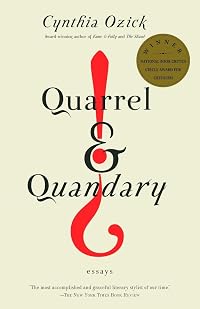
Writer Cynthia Ozick was born on April 17, 1928. She grew up in the Bronx and attended New York University, where she earned a B. A., and The Ohio State University, where she completed her master's degree in English literature with a specific focus on Henry James's works. Ozick wrote the novel Trust, and the short stories "The Sense of Europe", show more which was published in Prairie Schooner, and "The Shawl", which was included in The World of the Short Story. Her work has also appeared in The New Yorker, Harper's, Partisan Review, and Esquire. Ozick has received a Guggenheim Fellowship and a Harold Straus Living Award from the American Academy and National Institute of Arts and Letters. Three of her stories won first prize in the O. Henry competition. In 1986, she was selected as the first winner of the Rea Award for the Short Story. In 2000, she won the National Book Critics Circle Award for Quarrel & Quandary. Her novel Heir to the Glimmering World (2004) won high literary praise. Ozick was on the shortlist for the 2005 Man Booker International Prize, and in 2008 she was awarded the PEN/Nabokov Award and the PEN/Malamud Award, which was established by Bernard Malamud¿s family to honor excellence in the art of the short story. Her novel Foreign Bodies was shortlisted for the Orange Prize (2012). (Bowker Author Biography) show less
Some Editions
Awards and Honors
Common Knowledge
- Canonical title
- The Messiah of Stockholm
- Original title
- The Messiah of Stockholm
- Original publication date
- 1987
- People/Characters
- Lars Andemening; Heidi Eklund; Olle Eklund; Adela; Bruno Schulz
- Important places
- Stockholm, Sweden; Drohobycz, Poland
- Epigraph
- My father never tired of glorifying this extraordinary element- matter.
"There is no head matter," he taught us.
"Life-lessness is only a disguise behind which hide unknown forms of life. The range of these forms is inf... (show all)inite and their shades and nuances limitless. The Demiurge was in possession of important and interesting creative recipes. Thanks to them, he created a multiplicity of species which renew themselves by their own devices. No one knows whether these recipes will ever be reconstructed. But this is unnecessary, because even if the classical methods of creation should prove inaccessible for evermore, there still remain some illegal methods, an infinity of heretical and criminal methods."
Bruno Schultz, The Street of Crocodiles
Jag är stjärnan som speglar sig i dig.
...
Din själ är mitt hem. Jag har inget annat.
I am the star that mirrors itself in you.
...
Your soul is my home. I have no other.
Pär Lagerkvist, Afto... (show all)nland
(Translated by W. H. Auden and Leif Sjöberg) - Dedication
- To Philip Roth
- Original language
- English
Classifications
Statistics
- Members
- 413
- Popularity
- 74,970
- Reviews
- 7
- Rating
- (3.73)
- Languages
- 7 — Dutch, English, French, German, Italian, Spanish, Swedish
- Media
- Paper, Ebook
- ISBNs
- 14
- ASINs
- 3