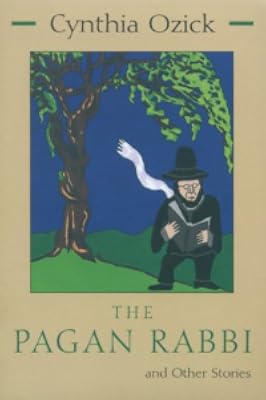
The Pagan Rabbi, and Other Stories (Library of Modern Jewish Literature)
by Cynthia Ozick
On This Page
Description
Ozick is a kind of narrative hypnotist. Her range is extraordinary; there is seemingly nothing she can't do. Her stories contain passages of intense lyricism and brilliant, hilarious, uncontainable inventiveness.Tags
Recommendations



















Member Reviews
Concernig the titular story only:
Right, so this was a pretty good one, in spite of getting near mired in the muck (literally).
It begins with some subtle foreshadowing: “I . . . journeyed out TO SEE THE TREE.”
There is more in this vein, or should I say, xylem, e.g. “the COMELY neck of the [tree] limb.
“Fathers like ours don’t know how to love. They live too much indoors.”
The red herring – “Idolatry is the abomination . . . not philosophy.”
The damning epigraph that leads to this epitaph-tale. Whereas Shakespeare once penned “What’s past is prologue,” yet here the overwhelming weight of underlying indoctrinated culture irreversibly sets the mold.
Of the several stories we have read (Short Story Club) highlighting and show more self-deprecatingly lowbrowing Yiddishness (Mishnaicness?) this one certainly rings the bell. (Although I found it hard to pin down specific quotable examples to present here, nevertheless the aura succeeds in this regard spectacularly.)
The uniquely colorful phrases; for an avid reader – “wearing the look of a man half-sotted with print.”
The line about uttering “Bring the tea.” Again, “He could concoct holiness out of the fine line of a serif.” By the way Sans Serif is a flutingly fanciful moniker meaning, simply, plain.
The Yogi-ism to consider:
“What are they like, those people?”
“They’re exactly like us, if you can think what we would be if we were like them.”
Ponder that thought in this age of discordancy.
Another harbinger of trouble brewing, “To them their bodies are holy.”
Then there is the clever dichotomy of having the wife Sheindal (“beautiful”), once physically liberated from a concentration camp, married to a man who becomes convinced escape comes from release of the soul from the incarnation.
Then there is the clever dichotomy of having the wife Sheindal (“beautiful”), once physically liberated from a concentration camp, married to a man who becomes convinced escape comes from release of the soul from the incarnation.
It’s true that there’s a lot of what comes across as pedantic theological philosophizing. However although the author places Isaac on a bit of a pedestal, later Ozick pulls the carpet (and stand) away, leaving the character and us dangling momentarily, until cutting away to something else. No biblical-like reprieve for Isaac on this occasion! And all the time set against the backdrop (“fringing’) of the fetid stagnant undercurrent. Musty as it must be aside, the decay process spews forth again in later passages renewed.
It was briefly intriguing to consider, although perhaps I just ran momentarily with a tangent, that Moses chastising the “idol” worshippers actually drove them away from their “real” spiritual underpinnings. As they say, history is written, not necessarily specifically by the victors, but by historians, and when their tale survives, it makes them victors in a sense. (The pen is mightier than the sword.)
Later the author, expressed through the (looong note, goes off on another tangent himself . . . It seems to me that, if man is the exception to some rule, then there may be an exception to the exception, as in I before e, except . . . except . . . just except it show less
Right, so this was a pretty good one, in spite of getting near mired in the muck (literally).
It begins with some subtle foreshadowing: “I . . . journeyed out TO SEE THE TREE.”
There is more in this vein, or should I say, xylem, e.g. “the COMELY neck of the [tree] limb.
“Fathers like ours don’t know how to love. They live too much indoors.”
The red herring – “Idolatry is the abomination . . . not philosophy.”
The damning epigraph that leads to this epitaph-tale. Whereas Shakespeare once penned “What’s past is prologue,” yet here the overwhelming weight of underlying indoctrinated culture irreversibly sets the mold.
Of the several stories we have read (Short Story Club) highlighting and show more self-deprecatingly lowbrowing Yiddishness (Mishnaicness?) this one certainly rings the bell. (Although I found it hard to pin down specific quotable examples to present here, nevertheless the aura succeeds in this regard spectacularly.)
The uniquely colorful phrases; for an avid reader – “wearing the look of a man half-sotted with print.”
The line about uttering “Bring the tea.” Again, “He could concoct holiness out of the fine line of a serif.” By the way Sans Serif is a flutingly fanciful moniker meaning, simply, plain.
The Yogi-ism to consider:
“What are they like, those people?”
“They’re exactly like us, if you can think what we would be if we were like them.”
Ponder that thought in this age of discordancy.
Another harbinger of trouble brewing, “To them their bodies are holy.”
Then there is the clever dichotomy of having the wife Sheindal (“beautiful”), once physically liberated from a concentration camp, married to a man who becomes convinced escape comes from release of the soul from the incarnation.
Then there is the clever dichotomy of having the wife Sheindal (“beautiful”), once physically liberated from a concentration camp, married to a man who becomes convinced escape comes from release of the soul from the incarnation.
It’s true that there’s a lot of what comes across as pedantic theological philosophizing. However although the author places Isaac on a bit of a pedestal, later Ozick pulls the carpet (and stand) away, leaving the character and us dangling momentarily, until cutting away to something else. No biblical-like reprieve for Isaac on this occasion! And all the time set against the backdrop (“fringing’) of the fetid stagnant undercurrent. Musty as it must be aside, the decay process spews forth again in later passages renewed.
It was briefly intriguing to consider, although perhaps I just ran momentarily with a tangent, that Moses chastising the “idol” worshippers actually drove them away from their “real” spiritual underpinnings. As they say, history is written, not necessarily specifically by the victors, but by historians, and when their tale survives, it makes them victors in a sense. (The pen is mightier than the sword.)
Later the author, expressed through the (looong note, goes off on another tangent himself . . . It seems to me that, if man is the exception to some rule, then there may be an exception to the exception, as in I before e, except . . . except . . . just except it show less
The Pagan Rabbi
I was slightly intrigued at first, although I worried I might find the suicide angle triggering (I didn’t, as it was all so unrelatable to my father's death).
The narrator dropped out of a New York rabbinical seminary, but his friend, Isaac Kornfeld, went on to become a renowned rabbinical thinker and regularly ordered books from the narrator’s bookstore. Their own fathers had been rival rabbis, competing to be the most charitable, pious, and esteemed.
When he learns of his friend’s suicide, the narrator goes first to visit the carefully chosen tree Isaac hung himself from with his prayer shawl, and then, with mixed motives, he calls on Sheindel, Isaac’s devout widow, and mother of seven girls.
Next-level show more tree-hugging
With horror and disgust, she shows him the notebook and letter found in her husband’s coat pocket that suggest he turned from appreciating nature to full Paganism.
“She was an orphan and had been saved by magic [from a concentration camp] and [therefore] had a terror of it.”
The narrator’s father had not forgiven his apostasy, and Sheindel is equally fixed in her views of her late husband.
There is page after page of overwrought theology, philosophy, and mysticism, with quotes within quotes between various entities, detailing a rather literal love of nature.
“I… plucked a leaf and made my tongue travel meditatively along its periphery… The taste was sticky and exaltingly bitter. A jubilation carpeted my groin.”
Image: Mosaic of Pan and a hamadryad (Source)
Meh
A crisis of faith, let alone changing leaving the religion one was raised in and that pays the bills, creates interesting dilemmas. Or can do.
Others in the Short Story Club got far more from this than I did, finding it both profound and funny, so join the group, or look for other reviews on GR. I wonder if a bit more knowledge of Jewish-American thought and culture would have helped me - though I expect strict, Orthodox Jews might find it heretical.
Quotes
• “Count the babies. The Jews are also Puritans, but only in public.”
• “We are not like them [non-Jews]. Their bodies are more to them than ours are to us. Our books are holy, to them their bodies are holy.”
• “‘Everybody marries for the same reason.’
‘No,’ said my wife. ‘Some for love and some for spite.’”
• “His intention was not to accumulate mystery but to dispel it.”
Short story club
I read this in Black Water: The Anthology of Fantastic Literature, by Alberto Manguel, from which I’m reading one story a week with The Short Story Club, starting 4 September 2023.
You can read this story HERE.
You can join the group here. show less
I was slightly intrigued at first, although I worried I might find the suicide angle triggering (I didn’t, as it was all so unrelatable to my father's death).
The narrator dropped out of a New York rabbinical seminary, but his friend, Isaac Kornfeld, went on to become a renowned rabbinical thinker and regularly ordered books from the narrator’s bookstore. Their own fathers had been rival rabbis, competing to be the most charitable, pious, and esteemed.
When he learns of his friend’s suicide, the narrator goes first to visit the carefully chosen tree Isaac hung himself from with his prayer shawl, and then, with mixed motives, he calls on Sheindel, Isaac’s devout widow, and mother of seven girls.
Next-level show more tree-hugging
With horror and disgust, she shows him the notebook and letter found in her husband’s coat pocket that suggest he turned from appreciating nature to full Paganism.
“She was an orphan and had been saved by magic [from a concentration camp] and [therefore] had a terror of it.”
The narrator’s father had not forgiven his apostasy, and Sheindel is equally fixed in her views of her late husband.
There is page after page of overwrought theology, philosophy, and mysticism, with quotes within quotes between various entities, detailing a rather literal love of nature.
“I… plucked a leaf and made my tongue travel meditatively along its periphery… The taste was sticky and exaltingly bitter. A jubilation carpeted my groin.”
Image: Mosaic of Pan and a hamadryad (Source)
Meh
A crisis of faith, let alone changing leaving the religion one was raised in and that pays the bills, creates interesting dilemmas. Or can do.
Others in the Short Story Club got far more from this than I did, finding it both profound and funny, so join the group, or look for other reviews on GR. I wonder if a bit more knowledge of Jewish-American thought and culture would have helped me - though I expect strict, Orthodox Jews might find it heretical.
Quotes
• “Count the babies. The Jews are also Puritans, but only in public.”
• “We are not like them [non-Jews]. Their bodies are more to them than ours are to us. Our books are holy, to them their bodies are holy.”
• “‘Everybody marries for the same reason.’
‘No,’ said my wife. ‘Some for love and some for spite.’”
• “His intention was not to accumulate mystery but to dispel it.”
Short story club
I read this in Black Water: The Anthology of Fantastic Literature, by Alberto Manguel, from which I’m reading one story a week with The Short Story Club, starting 4 September 2023.
You can read this story HERE.
You can join the group here. show less
I hadn't really meant to read this, but when I looked at the first page, I thought the writing was arrestingly direct and good. But while there are moments of wonderful writing here, the stories as a whole felt overlong and tired. Finishing this book was a bit of a chore.
Ratings
Members
- Recently Added By
Lists

Jewish Books
367 works; 24 members

National Book Award Finalists - Fiction
377 works; 12 members
Author Information

51+ Works 6,066 Members
Writer Cynthia Ozick was born on April 17, 1928. She grew up in the Bronx and attended New York University, where she earned a B. A., and The Ohio State University, where she completed her master's degree in English literature with a specific focus on Henry James's works. Ozick wrote the novel Trust, and the short stories "The Sense of Europe", show more which was published in Prairie Schooner, and "The Shawl", which was included in The World of the Short Story. Her work has also appeared in The New Yorker, Harper's, Partisan Review, and Esquire. Ozick has received a Guggenheim Fellowship and a Harold Straus Living Award from the American Academy and National Institute of Arts and Letters. Three of her stories won first prize in the O. Henry competition. In 1986, she was selected as the first winner of the Rea Award for the Short Story. In 2000, she won the National Book Critics Circle Award for Quarrel & Quandary. Her novel Heir to the Glimmering World (2004) won high literary praise. Ozick was on the shortlist for the 2005 Man Booker International Prize, and in 2008 she was awarded the PEN/Nabokov Award and the PEN/Malamud Award, which was established by Bernard Malamud¿s family to honor excellence in the art of the short story. Her novel Foreign Bodies was shortlisted for the Orange Prize (2012). (Bowker Author Biography) show less
Awards and Honors
Work Relationships
Contains
Common Knowledge
- Original publication date
- 1971
Classifications
Statistics
- Members
- 247
- Popularity
- 131,155
- Reviews
- 3
- Rating
- (3.14)
- Languages
- English, French, Italian
- Media
- Paper
- ISBNs
- 10
- ASINs
- 1