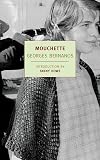
Mouchette
by Georges Bernanos
On This Page
Description
One of the great mavericks of French literature, Georges Bernanos combined raw realism with a spiritual focus of visionary intensity. Mouchette stands with his celebrated Diary of a Country Priest as the perfection of his singular art. "Nothing but a little savage" is how the village school-teacher describes fourteen-year-old Mouchette, and that view is echoed by every right-thinking local citizen. Mouchette herself doesn't bother to contradict it; ragged, foulmouthed, dirt-poor, a born liar show more and loser, she knows herself to be, in the words of the story, "alone, completely alone, against everyone." Hers is a tale of "tragic solitude" in which despair and salvation appear to be inextricably intertwined. Bernanos uncompromising genius was a powerful inspiration to Flannery O'Connor, and Mouchette was the source of a celebrated movie by Robert Bresson. show lessTags
Recommendations

































Member Reviews
Mouchette, all of fourteen years old, leads an isolated existence. She’s the odd one out at school -- her family is dirt-poor; she can’t sing; her hands are always filthy -- and the headmistress systematically singles her out as the bad example other pupils would do well to avoid. Things are much the same at home: she is barely tolerated within her poverty-stricken and child-rich family, in that she’s just useful enough to deserve her food and lodging. Her father is an alcoholic who is physically abusive; her mother is distant and a stranger to caresses.
One night, while lost in a forest during a storm, Mouchette runs into the local smuggler, Mr. Arsène, who shelters her from the elements, shares his illicitly distilled alcohol show more with her, and makes her complicit in his maybe-he-did-maybe-he-didn’t murder of the gendarme by making her his alibi.He also rapes her. . In the hours that follow, Mouchette will see, understand, really grok that a woman’s expected lifestyle, in her village, is one of suffering in silence, even though she lacks the words to verbalise that understanding.
This novel was short, but pretty well-written. In keeping Mouchette firmly at omniscient-narrator distance, its readers are forcibly reduced to powerless observers. Its themes of social injustice and gendered discrimination fall naturally out of its almost-ya story and its setting in a timeless hamlet by the sea. Recommended (given the appropriate trigger warnings)! show less
One night, while lost in a forest during a storm, Mouchette runs into the local smuggler, Mr. Arsène, who shelters her from the elements, shares his illicitly distilled alcohol show more with her, and makes her complicit in his maybe-he-did-maybe-he-didn’t murder of the gendarme by making her his alibi.
This novel was short, but pretty well-written. In keeping Mouchette firmly at omniscient-narrator distance, its readers are forcibly reduced to powerless observers. Its themes of social injustice and gendered discrimination fall naturally out of its almost-ya story and its setting in a timeless hamlet by the sea. Recommended (given the appropriate trigger warnings)! show less
Imagine a typical mid century European-continental novel. It's existentialist. It's full of angst. There are large dollops of absurd events. There is a political point in there somewhere, but everything is so personal and subjective that you're never sure what that political point might be. And there's lots of reflection. Okay. And now, instead of the middle-class, twenty or thirty something, over-educated male protagonist, put in a completely impoverished pubescent girl who lacks the words to describe any kind of emotion, thought or abstract notion. And you have this book, which is, thanks to its hero, far more interesting than anything I've read by Camus/Sartre/Moravia et al. I don't know how accurate the translation is, but it's very show more readable. show less
I still find this book disturbing, and yet, Bernanos tilts ever so slightly toward merciful.
Having read this book four years ago, I still champion Mouchette; the girl, not the novel.
Having read this book four years ago, I still champion Mouchette; the girl, not the novel.
Melancholic. Sublime. Tragic.
read on most lovely sofa across from fireplace at the Met
Ratings
Members
- Recently Added By
Lists

Short and Sweet
246 works; 24 members

Anti-heroines in fiction
59 works; 9 members
Author Information

109+ Works 4,030 Members
A novelist and essayist, Georges Bernanos was interested in the struggle between good and evil within saintly individuals. He was born in Paris in 1888. He studied at the Sorbonne where he received a degree in law and in literature in 1909. He served in the military from 1909 to 1910 and again during World War I. After the war, Bernanos worked as show more an inspector for an insurance company. Bernanos's first major success as a writer came in 1926 with the publication of the novel Under the Sun of Satan. His well-known work The Diary of a Country Priest followed in 1936. Both novels traced the unknowing submission of characters, after some early disappointing experience, to the forces of Satan and the subsequent destruction of their moral selves. From 1930 to 1932, Bernanos wrote for Le Figaro. In his articles and essays, Bernanos pleaded for a renewed spirituality in France and a renewed moral integrity. Mouchette, a short novel set in a bleak village untouched by the twentieth century was published in 1937. As was The Diary of a Country Priest, Mouchette was made into a film by Robert Bresson. The writings of Georges Bernanos are concerned with the struggle between pride and innocence that lies within every individual. They treat spiritual concerns and the mystery of Christianity. Bernanos is considered among the most original of Roman Catholic novelists. Bernanos died of cancer in Paris on July 5, 1948. (Bowker Author Biography) show less
Some Editions
Series
Belongs to Publisher Series
Work Relationships
Is contained in
Has the adaptation
Common Knowledge
Classifications
Statistics
- Members
- 346
- Popularity
- 91,385
- Reviews
- 5
- Rating
- (3.76)
- Languages
- 8 — Catalan, English, Finnish, French, German, Portuguese, Spanish, Swedish
- Media
- Paper, Ebook
- ISBNs
- 22
- ASINs
- 13