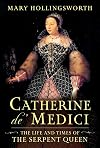
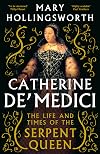
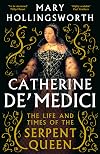
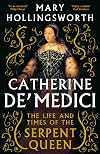
Catherine de' Medici: The Life and Times of the Serpent Queen
by Mary Hollingsworth
On This Page
Description
The life and times of Catherine de' Medici, the most powerful woman in sixteenth-century Europe, as seen through her often-controversial role in religion and the arts. During an age of heightened religious conflict, Catherine de' Medici lived her life at the center of sixteenth-century European and French politics. Daughter of Lorenzo II, the Medici ruler of Florence, and then wedded to a French prince by papal decree at the age of fourteen-Catherine first became queen consort of France and show more then mother to three French kings (Francis II, Charles IX, and Henry III) who reigned in an era of almost continuous civil and religious strife. A lavish promoter of the arts, Catherine patronized poets, painters, and sculptors; lavished ruinous sums on the building and embellishment of monuments and palaces; and masterminded spectacular entertainments and tournaments that prefigure the splendor and ritual of the court of Versailles. Catherine maintained eighty ladies-in-waiting at court; it was rumored she used these women as bait to seduce courtiers for her political ends. Her admiration for the seer Nostradamus fueled claims of her love for the occult and the dark arts. Posterity has condemned her as the epitome of the scheming royal matriarch, her reputation tainted forever by her role in instigating the St. Bartholomew's Day massacre of Protestants in 1572. "Catherine de' Medici: The Life and Times of the Serpent Queen" is Mary Hollingsworth's evocative, authoritative biography of the most extraordinary woman of the sixteenth-century. show lessTags
Recommendations






































Member Reviews
In early 1579 the 25-year-old Henri de Bourbon, king of Navarre and future king of France, was in talks with a seasoned negotiator. It was neither a government minister nor a monarch, but the French king’s mother and Navarre’s own mother-in-law: Catherine de’ Medici. A dowager queen some 60 years old, Catherine had been consort to Henri II, after whose sudden demise in 1559 she was pushed aside by the powerful Guise brothers (duke and cardinal), who briefly governed France on behalf of her teenage son François II. But François’ unexpected death in 1560 returned Catherine to prominence. As regent for Charles IX, her second son, and then adviser to his brother and successor Henri III, she worked with – and frequently in place show more of – her young, sickly and sometimes negligent children. In early 1579 it was Henri III who had entrusted Catherine to broker peace in the south of France, where many were failing to observe a royal edict aimed at ending war between Protestants and Catholics, a situation which threatened not only violence but also the authority of the Crown. Worse still, the Protestant Navarre, governor in the region, was at loggerheads with his Catholic lieutenant-general, the Baron of Biron. To break the deadlock, Catherine delayed and dragged out meetings; on one day she denied the negotiators a break for food. While presiding over the talks the dowager queen maintained a constant correspondence with the royal court, soliciting news from trusted ministers and secretaries and relaying details of her own progress. Taking a shrewd line on the information that should be passed on to the sovereign, Catherine advised one secretary: ‘If it is bad throw it on the fire; if it is good show it to the king.’
Catherine de’ Medici was not necessarily destined for a position of great influence. Though a member of a cadet branch of the Medici family, and the relative and ward of two popes, she was orphaned within a month of her birth in 1519 and raised quietly by relatives and nuns. Before she had reached her eighth birthday, the Medici had been overthrown as rulers of Florence and the authority of her papal uncles, Leo X and then Clement VII, gravely threatened, as Martin Luther’s protests catalysed the rejection of papal authority across Europe. Catherine’s prospects improved in 1533 when she married the future Henri II, but her influence was dwarfed by that of Diane de Poitiers, the mistress to whom Henri would devote himself. The king’s position was far from stable: he inherited a bellicose rivalry with the Habsburgs who had extended their influence across the continent (and globe) during the reign of Holy Roman Emperor Charles V. A lasting peace with the Habsburgs would not arrive until the eve of Henri’s death. Moreover, while these Catholic princes fought among themselves their subjects clashed with increasing ferocity, as Protestants inspired by men such as Luther and John Calvin fought for religious liberty and the right to worship, while Catholics sought to exterminate the heresies of these so-called ‘reformers’.
Read the rest of the review at https://www.historytoday.com/archive/review/catherine-de-medici-mary-hollingswor...
Jessica Wärnberg is author of City of Echoes: A New History of Rome, its Popes and its People (Icon, 2023). show less
Catherine de’ Medici was not necessarily destined for a position of great influence. Though a member of a cadet branch of the Medici family, and the relative and ward of two popes, she was orphaned within a month of her birth in 1519 and raised quietly by relatives and nuns. Before she had reached her eighth birthday, the Medici had been overthrown as rulers of Florence and the authority of her papal uncles, Leo X and then Clement VII, gravely threatened, as Martin Luther’s protests catalysed the rejection of papal authority across Europe. Catherine’s prospects improved in 1533 when she married the future Henri II, but her influence was dwarfed by that of Diane de Poitiers, the mistress to whom Henri would devote himself. The king’s position was far from stable: he inherited a bellicose rivalry with the Habsburgs who had extended their influence across the continent (and globe) during the reign of Holy Roman Emperor Charles V. A lasting peace with the Habsburgs would not arrive until the eve of Henri’s death. Moreover, while these Catholic princes fought among themselves their subjects clashed with increasing ferocity, as Protestants inspired by men such as Luther and John Calvin fought for religious liberty and the right to worship, while Catholics sought to exterminate the heresies of these so-called ‘reformers’.
Read the rest of the review at https://www.historytoday.com/archive/review/catherine-de-medici-mary-hollingswor...
Jessica Wärnberg is author of City of Echoes: A New History of Rome, its Popes and its People (Icon, 2023). show less
Members
- Recently Added By
Lists

Western & Northern Europe
60 works; 1 member

Library Non-Fiction
164 works; 1 member
Author Information

12 Works 906 Members
Common Knowledge
- People/Characters
- Catherine de Medici
Classifications
- Genres
- History, Nonfiction, Biography & Memoir, General Nonfiction
- DDC/MDS
- 944.028 — History & geography History of Europe France and Monaco France Capet and Valois 987-1589 Francis I 1515-47; Henry II 1547-59 ; XVIth Century
- LCC
- DC119.8 .H65 — History of Europe, Asia, Africa and Oceania France – Andorra – Monaco History of France Modern, 1515- 1515-1589. 16th century
- BISAC
Statistics
- Members
- 55
- Popularity
- 556,987
- Reviews
- 1
- Languages
- English
- Media
- Paper, Audiobook, Ebook
- ISBNs
- 7
- ASINs
- 1