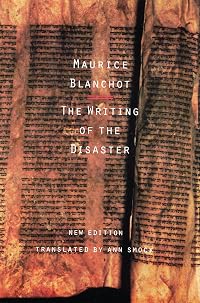
The Writing of the Disaster
by Maurice Blanchot
On This Page
Description
Modern history is haunted by the disasters of the century--world wars, concentration camps, Hiroshima, and the Holocaust--grief, anger, terror, and loss beyond words, but still close, still impending. How can we write or think about disaster when by its very nature it defies speech and compels silence, burns books and shatters meaning? The Writing of the Disaster reflects upon efforts to abide in disaster's infinite threat. First published in French in 1980, it takes up the most serious show more tasks of writing: to describe, explain, and redeem when possible, and to admit what is not possible. Neither offers consolation. Maurice Blanchot has been praised on both sides of the Atlantic for his fiction and criticism. The philosopher Emmanuel Levinas once remarked that Blanchot's writing is a "language of pure transcendence, without correlative." Literary theorist and critic Geoffrey Hartman remarked that Blanchot's influence on contemporary writers "cannot be overestimated." show lessTags
Recommendations













































Member Reviews
Do not forgive. Forgiveness accuses before it forgives. By accusing, by stating the injury, it makes the wrong irredeemable. It carries the blow all the way to culpability. Thus, all becomes irrepairable; giving and forgiving cease to be possible.
I found this collection an errant scattering of rather profound poetry. It may also be a sustained meditation on disaster, writing and loss, but I was unable to locate any connective tissue.
I read this on a lovely spring day, most of such in an IKEA parking lot. It was wonderful to read a few lines and then ponder the resonance while gazing upon the blue sky. Blanchot appears intrigued by certain stances of Nietzsche and Celan. This interest is manifested in a half dozen lines.
I found this collection an errant scattering of rather profound poetry. It may also be a sustained meditation on disaster, writing and loss, but I was unable to locate any connective tissue.
I read this on a lovely spring day, most of such in an IKEA parking lot. It was wonderful to read a few lines and then ponder the resonance while gazing upon the blue sky. Blanchot appears intrigued by certain stances of Nietzsche and Celan. This interest is manifested in a half dozen lines.
I couldn't even begin to rate this, unsure as I am that I even understood it. But thrilling all the same.
Ratings
Members
- Recently Added By
Author Information

126+ Works 4,328 Members
Maurice Blanchot, 1907 - Novelist and critic Maurice Blanchot was born in 1907. Some of his works in translation include "Death Sentence" (1978), "The Gaze of Orpheus" (1981), "Madness of the Day" (1988), "The One Who Was Standing Apart From Me" (1993), all of which were translated by Lydia Davis, and "Michel Foucault as I Imagine Him" (translated show more by Jeffrey Mehlman, 1987). (Bowker Author Biography) show less
Some Editions
Common Knowledge
- Original publication date
- 1980 (original French) (original French); 1986 (English: Smock) (English: Smock)
- Dedication
- The disaster ruins everthing, all the while leaving everything intact.
Classifications
- Genres
- Nonfiction, Literature Studies and Criticism, Fiction and Literature
- DDC/MDS
- 848.91207 — Literature & rhetoric French Literature French miscellaneous writings 1900- 1900-1999 1900-1945 Without identifiable literary form
- LCC
- PQ2603 .L3343 .E2813 — Language and Literature French, Italian, Spanish and Portuguese literatures French literature Modern literature 1900-1960
- BISAC
Statistics
- Members
- 358
- Popularity
- 88,449
- Reviews
- 2
- Rating
- (4.06)
- Languages
- 6 — English, French, German, Italian, Spanish, Swedish
- Media
- Paper, Ebook
- ISBNs
- 11
- ASINs
- 1