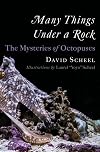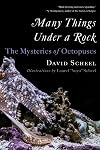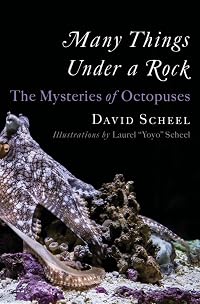
Many Things Under a Rock: The Mysteries of Octopuses
by David Scheel
On This Page
Description
"A behavioral ecologist's riveting account of his decades-long obsession with octopuses: his discoveries, adventures, and new scientific understanding of their behaviors. Of all the creatures of the deep blue, none is as captivating as the octopus. In Many Things Under a Rock, marine biologist David Scheel investigates four major mysteries about these elusive beings. How can we study an animal with perfect camouflage and secretive habitats? How does a soft and boneless creature defeat sharks show more and eels, while thriving as a predator of the most heavily armored animals in the sea? How do octopus bodies work? And how does a solitary animal form friendships, entice mates, and outwit rivals? Over the course of his twenty-five years studying octopuses, Scheel has witnessed a sea change in what we know and are able to discover about octopus physiology and behavior-even an octopus's inner life. Here he explores amazing new scientific developments, weaving accounts of his own research, and surprising encounters, with stories and legends of Indigenous peoples that illuminate our relationship with these creatures across centuries. In doing so, he reveals a deep affinity between humans and even the most unusual and unique undersea dwellers. Octopuses are complex, emotional, and cognitive beings; even as Scheel unearths explanations for the key mysteries that have driven his work, he turns up many more things of wonder that lurk underneath. This is the story of what we have learned and what we are still learning about the natural history and wondrous lives of these animals with whom we share our blue planet"-- show lessTags
Recommendations












Member Reviews
“In Eyak, he told us, the word for octopus is tse-le:x-guh. Broken into its constituent parts, it means literally “rock under many-dwell” or “many things under a rock.”
David Scheel had no experience with octopuses, nor other ocean animals, when he led his first expedition in 1995 to study the Giant Pacific octopus, or Enteroctopus dofleini, in Prince William Sound. An ecologist, specialising in animal behaviour, habitat use, and the evolution of predator-prey relations, he became intrigued by the cephalopod after receiving a grant to study their viability as a harvestable food supply along the southern Alaska shores following the Exxon Valdez spill.
Many Things Under a Rock is an interesting account of Scheel’s subsequent 25 show more years of fieldwork and study focusing on the Giant Pacific octopus, from accompanying Alaska Native elders to count octopuses at low tide using green alder branches, to collecting octopus mucus to chart genetics, and discrete underwater monitoring. Chapters include scientific detail about the octopus’s biology, cognition, and social behaviour. Scheel also includes relevant cultural and historical perspectives on the octopus, particularly those involving Eyak and Sugpiaq tales and myths, and briefly discuses impending threats to the population of octopuses, like climate change and ocean pollution.
Scheel makes good use of personal anecdotes and observations that communicate his fascination with, and understanding of his subject, without compromising scientific detail. I do think the material could have been ordered better, and while at times I found the text to be a little dry, and the tone generally more professorial than personable, the writing is largely accessible.
Importantly I felt I learned a lot about the the Giant Pacific octopus in the wild that I didn’t know before. Many Things Under a Rock is an informative and engaging read. show less
David Scheel had no experience with octopuses, nor other ocean animals, when he led his first expedition in 1995 to study the Giant Pacific octopus, or Enteroctopus dofleini, in Prince William Sound. An ecologist, specialising in animal behaviour, habitat use, and the evolution of predator-prey relations, he became intrigued by the cephalopod after receiving a grant to study their viability as a harvestable food supply along the southern Alaska shores following the Exxon Valdez spill.
Many Things Under a Rock is an interesting account of Scheel’s subsequent 25 show more years of fieldwork and study focusing on the Giant Pacific octopus, from accompanying Alaska Native elders to count octopuses at low tide using green alder branches, to collecting octopus mucus to chart genetics, and discrete underwater monitoring. Chapters include scientific detail about the octopus’s biology, cognition, and social behaviour. Scheel also includes relevant cultural and historical perspectives on the octopus, particularly those involving Eyak and Sugpiaq tales and myths, and briefly discuses impending threats to the population of octopuses, like climate change and ocean pollution.
Scheel makes good use of personal anecdotes and observations that communicate his fascination with, and understanding of his subject, without compromising scientific detail. I do think the material could have been ordered better, and while at times I found the text to be a little dry, and the tone generally more professorial than personable, the writing is largely accessible.
Importantly I felt I learned a lot about the the Giant Pacific octopus in the wild that I didn’t know before. Many Things Under a Rock is an informative and engaging read. show less
The SciFri Book Club chose this book to read in June 2025. I didn't actually get around to reading it until July but, once I started it, I found it quite interesting. I had never really thought about octopuses before so everything in the book was new to me.
The author started looking at octopuses in the waters off Alaska after the Exxon Valdez oil spill. There was grant money to study marine life as it was affected by the spill. Despite having no knowledge of octopuses (he had previously studied predator mammals in Africa), he just dove in and got his feet wet (pun intended). Octopuses were known to be solitary and rather elusive so it made for a difficult species to study. Perhaps that is what made them interesting to study. Since his show more initial studies, Scheel has learned much about octopuses and other cephalopods. For instance, the tentacles can act on their own without direction from the brain. They can also recognize people that they have met before. Scheel tells an amusing story about an octopus in a tank at his university who has a dislike for him. Whenever he comes near her tank she squirts cold water at him, even when he holds up the cover as a shield. Since octopuses are mostly solitary, mating is a quick conjunction of a male and female and the male uses his right third tentacle to deliver the sperm. And, octopuses are not always solitary with some even sharing nesting spots with others or with fish.
Scheel acknowledges learning much from the Indigenous people he met. He even shares some of the oral traditions from them. This was refreshing. Otherwise, I found his writing a little repetitious and, at the same time, lacking some fundamental information. It would have been good if one of the illustrations had pointed out what the mantle consists of and where the mouth is. show less
The author started looking at octopuses in the waters off Alaska after the Exxon Valdez oil spill. There was grant money to study marine life as it was affected by the spill. Despite having no knowledge of octopuses (he had previously studied predator mammals in Africa), he just dove in and got his feet wet (pun intended). Octopuses were known to be solitary and rather elusive so it made for a difficult species to study. Perhaps that is what made them interesting to study. Since his show more initial studies, Scheel has learned much about octopuses and other cephalopods. For instance, the tentacles can act on their own without direction from the brain. They can also recognize people that they have met before. Scheel tells an amusing story about an octopus in a tank at his university who has a dislike for him. Whenever he comes near her tank she squirts cold water at him, even when he holds up the cover as a shield. Since octopuses are mostly solitary, mating is a quick conjunction of a male and female and the male uses his right third tentacle to deliver the sperm. And, octopuses are not always solitary with some even sharing nesting spots with others or with fish.
Scheel acknowledges learning much from the Indigenous people he met. He even shares some of the oral traditions from them. This was refreshing. Otherwise, I found his writing a little repetitious and, at the same time, lacking some fundamental information. It would have been good if one of the illustrations had pointed out what the mantle consists of and where the mouth is. show less
Octopuses are quirky and enigmatic creatures, and so are many of the people who study and write about them. Quite interesting, if a bit all over the place.
Ratings
Members
- Recently Added By
Lists

Books about Octopuses
23 works; 1 member
Author Information

2 Works 140 Members
All Editions
Awards and Honors
Awards
Work Relationships
Has the adaptation
Common Knowledge
- Original publication date
- 2023
Classifications
Statistics
- Members
- 131
- Popularity
- 249,583
- Reviews
- 3
- Rating
- (3.59)
- Languages
- English
- Media
- Paper, Audiobook, Ebook
- ISBNs
- 9
- ASINs
- 4