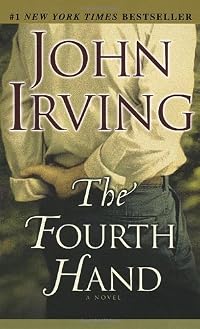
The Fourth Hand
by John Irving
On This Page
Description
The fourth hand asks an interesting question: "How can anyone identify a dream of the future?" The answer: "Destiny is not imaginable, except in dreams or to those in love." While reporting a story from India, a New York television journalist has his left hand eaten by a lion; millions of TV viewers witness the accident. In Boston, a renowned hand surgeon awaits the opportunity to perform the nation's first hand transplant; meanwhile, in the distracting aftermath of an acrimonious divorce, show more the surgeon is seduced by his housekeeper. A married woman in Wisconsin wants to give the one-handed reporter her husband's left hand--that is, after her husband dies. But the husband is alive, relatively young, and healthy.This is how John Irving's tenth novel begins; it seems, at first, to be a comedy, perhaps a satire, almost certainly a sexual farce. Yet, in the end, The fourth hand is as realistic and emotionally moving as any of Mr. Irving's previous novels--including The world according to Garp, A prayer for Owen Meany, and A widow for one year--or his Oscar-winning screenplay of The Cider House rules. show lessTags
Recommendations







Member Recommendations
Member Reviews
This was quite a jolly, easy read, suitable for whiling away a day or so whilst ill in bed. It's not really my sort of book, but I turned the pages happily enough. Patrick Wallingford, TV reporter and serial womaniser, loses his hand in a ghastly incident with a lion whilst reporting from an Indian circus. Offered the possibility of a replacement hand, he finds true love in the form of the widow of the donor. That, baldly, is it. But there's plenty of fun to be had on the way to the story's conclusion: his hand-surgeon's transformation from social inadequate to happily married family man plus dog; sexual adventures with colleague Mary and make-up artist Rita; and of course the progress of his relationship with Mrs Clausen, she who was show more so keen to offer her husband's hand. A well written comedy of manners. show less
Reading this was like struggling to eat soggy cereal - I kept hoping the next mouthful might have a raisin to redeem it, but it never did. Eventually I forced it all down.
It was bland, tedious, and vaguely annoying. I found everyone so covered in exaggerated oddness that there was no character underneath to identify with. And there was a strange middle-aged-boy fantasy feel to it, where every woman in the book is irresistibly drawn to an unappealing male character. The poop-eating dog seemed to be the only female with taste!
I was an avid reader of [[John Irving]] while I was in college, and I still enjoy rereading his books from that period. But his later ones have all disappointed me. It is possible that I am still cross about the show more introduction to [A Son of the Circus], which said something silly about not needing to go to India to write an novel about India. I mean, what an irritating stance to take, avoiding an entire country just to make a literary point (grin.) show less
It was bland, tedious, and vaguely annoying. I found everyone so covered in exaggerated oddness that there was no character underneath to identify with. And there was a strange middle-aged-boy fantasy feel to it, where every woman in the book is irresistibly drawn to an unappealing male character. The poop-eating dog seemed to be the only female with taste!
I was an avid reader of [[John Irving]] while I was in college, and I still enjoy rereading his books from that period. But his later ones have all disappointed me. It is possible that I am still cross about the show more introduction to [A Son of the Circus], which said something silly about not needing to go to India to write an novel about India. I mean, what an irritating stance to take, avoiding an entire country just to make a literary point (grin.) show less
I know that John Irving is a human being. I’ve seen him in person; therefore I know that he is human, which is to say, flawed. I accept that. What I have not accepted—until reading “The Fourth Hand”—is that he is a flawed writer. As a MASSIVE John Irving fan, I have genuinely loved every novel he published prior to this one, from the middle-aged suburban angst of “The 158-Pound Marriage” to the exotic lunacy of “A Son of the Circus” (which required three attempts before I could actually even make it past page 50 or so).
Most of Irving’s novels are saturated in his signature style, which is one of the features that I positively love about an Irving novel. But this one, well, it’s certainly not his best effort. It show more lacks his style and tone. If I hadn’t read his name on the front cover of the book, I would have had a difficult time believing that he is the author. The protagonist, although he does experience some redemption and growth throughout this relatively brief—for Irving—novel, is just not very likeable. Perhaps that was Irving’s point—he’s a TV news personality who’s lost his left hand in a bizarre lion attack, and that odd fate makes him more curious than sympathetic. He falls in love with the woman who donates her recently deceased husband’s hand as a transplant. And bizarre romantic lunacy ensues. Or maybe it was supposed to.
And that’s just it—in an Irving novel, a huge part of the enjoyment of the story is going along for the narrative ride. Although it’s usually impossible to tell where Irving is going with a story, I have always been confident that he knew what he was doing, and I was truly comfortable ceding narrative vision to him as a master storyteller. That vision is absent from “The Fourth Hand.” It pains me to say that this is the first John Irving novel that I do not truly love. But that will not stop me from reading the ones he’s written after this one, and the ones he’s yet to write. show less
Most of Irving’s novels are saturated in his signature style, which is one of the features that I positively love about an Irving novel. But this one, well, it’s certainly not his best effort. It show more lacks his style and tone. If I hadn’t read his name on the front cover of the book, I would have had a difficult time believing that he is the author. The protagonist, although he does experience some redemption and growth throughout this relatively brief—for Irving—novel, is just not very likeable. Perhaps that was Irving’s point—he’s a TV news personality who’s lost his left hand in a bizarre lion attack, and that odd fate makes him more curious than sympathetic. He falls in love with the woman who donates her recently deceased husband’s hand as a transplant. And bizarre romantic lunacy ensues. Or maybe it was supposed to.
And that’s just it—in an Irving novel, a huge part of the enjoyment of the story is going along for the narrative ride. Although it’s usually impossible to tell where Irving is going with a story, I have always been confident that he knew what he was doing, and I was truly comfortable ceding narrative vision to him as a master storyteller. That vision is absent from “The Fourth Hand.” It pains me to say that this is the first John Irving novel that I do not truly love. But that will not stop me from reading the ones he’s written after this one, and the ones he’s yet to write. show less
I'm a devoted fan of John Irving's books and have read six other of this earlier novels. There's something about his characters and his worldview that resonates with me, and it's that fact that kept me interested in this novel even when it became less interesting than I hoped. Or maybe that's not quite right. The story remained of interest, but the outcome of the characters' fates began to feel less compelling. The redemption of the main character felt increasingly certain (which may have been difficult to avoid, considering that premonitions and fate play a role in this book), even when he indulged in a bit of backsliding and bad behavior late in the book.
I realize now that enjoyed the first half of the book much more than the last show more half, and that's owing to two things. One reason is the lack of storytelling propulsion that linked to the lack of jeopardy and uncertainty. The other is the increasing absence of the odder, more intriguing characters. The main character himself always seems much less interesting than his exterior as a one-handed news reporter covering disasters and accidents would suggest, so his alteration does little to diminish his profile. He's a guy who gets along and acquiesces at the outset, and though he shows more will at the end, his choices steer him toward a more placid life. The characters I wished I could see more were the hand surgeon and his family, who felt too settled too soon and could have injected at the end of the story some of the humor they provided at the beginning. In a novel with a protagonist who is prone to being acted upon, the phasing out of these strong secondary characters was particularly evident. show less
I realize now that enjoyed the first half of the book much more than the last show more half, and that's owing to two things. One reason is the lack of storytelling propulsion that linked to the lack of jeopardy and uncertainty. The other is the increasing absence of the odder, more intriguing characters. The main character himself always seems much less interesting than his exterior as a one-handed news reporter covering disasters and accidents would suggest, so his alteration does little to diminish his profile. He's a guy who gets along and acquiesces at the outset, and though he shows more will at the end, his choices steer him toward a more placid life. The characters I wished I could see more were the hand surgeon and his family, who felt too settled too soon and could have injected at the end of the story some of the humor they provided at the beginning. In a novel with a protagonist who is prone to being acted upon, the phasing out of these strong secondary characters was particularly evident. show less
* NO SPOILERS WERE USED IN THE WRITING OF THIS REVIEW *
The direct, informative and un-flowery writing in this book resembles journalism, appropriately one of it's main themes. Like the reporter he is describing, Irving doesn't concentrate on poetic prose, preferring to simply get his character's story across to the reader. This direct approach should have disappointed me (I savor gorgeous prose!), but compact writing works in this book due to an incredibly entertaining story and unforgettable characters. Irving allows himself free reign with the quirky minor characters he's so good at creating, with some hilarious and touching results, and a number of HIGHLY unusual bedroom scenes! On a more serious note, his insights into America's show more lamentable state of journalism perfectly express the reasons why my own journalism degree is gathering dust in the closet ( will America EVER admit that making a corporate business out of the news defeats the concept of unbiased reporting?!). If comedy and social commentary weren't enough, Irving throws both a touching love story and poetic view of American football into the mix. It may not be a challenging or breath-taking read, but this book has something for everyone! show less
The direct, informative and un-flowery writing in this book resembles journalism, appropriately one of it's main themes. Like the reporter he is describing, Irving doesn't concentrate on poetic prose, preferring to simply get his character's story across to the reader. This direct approach should have disappointed me (I savor gorgeous prose!), but compact writing works in this book due to an incredibly entertaining story and unforgettable characters. Irving allows himself free reign with the quirky minor characters he's so good at creating, with some hilarious and touching results, and a number of HIGHLY unusual bedroom scenes! On a more serious note, his insights into America's show more lamentable state of journalism perfectly express the reasons why my own journalism degree is gathering dust in the closet ( will America EVER admit that making a corporate business out of the news defeats the concept of unbiased reporting?!). If comedy and social commentary weren't enough, Irving throws both a touching love story and poetic view of American football into the mix. It may not be a challenging or breath-taking read, but this book has something for everyone! show less
i like john irving a lot, and somehow always manage to forget how funny he is. this starts out light and interesting, funny in the odd way he is funny (by making fun of situations that really aren't actually funny in real life; he does this adeptly) and then turns more melancholy. usually i'm a fan of the melancholy, but it didn't work for me in this book, mostly because it centered around a relationship that i didn't buy at all. both the falling in love bit but also the change/shift in patrick wallingford didn't ring true to me. conceptually i liked the idea here, and i enjoyed reading it overall, but didn't like the last quarter or so when it was clear where he was going with this. also he makes the mistake of referring multiple times show more to (and even quoting a few times) a much superior book, the english patient, calling attention to the fact that this book isn't as well done as that one. still, i enjoy irving and this is no exception, even if it isn't one of his strongest.
(this might be the first irving that i've read with no bears and no wrestling!) show less
(this might be the first irving that i've read with no bears and no wrestling!) show less
Definitely an Irving novel, lots of sex, quirky characters, divorce, some Boston, but no wrestling and minimal prep schools. The horror which sets the stage for the entire story is hinted at in both the book's cover and the very first sentence. We can see here's a man whose lost his left hand. It takes some more pages for us to learn about his getting too close to a lion which results in the loss of his hand. In the acknowledgements we learn that the entire book is based on a simple premise suggested by Irving's wife, "what if the donor's wife demanded visitation rights?". Irving takes it from there and spins an interesting story of a man too good looking for his own good. Women are immediately drawn to him, wanting to have sex with him show more and possibly have a child by him, no questions asked. He's not much of a striver and once he becomes a national celebrity, "the lion man," he continues to blunder upward in his career. It helps that he's a cable news person and the incident with the lion was on air leading to instant worldwide viral videos.
A Boston/Harvard hand surgeon with his own set of issues enters the picture. Lacrosse with dog turds is one of his things. Divorce and shared custody round out the picture. Eventually a donor hand is located and this is when the story takes off. The donor's wife has a condition, she wants to meet with the recipient privately before she'll consent to giving him her husband's hand. Simple enough but she immediately lets him know she and her late husband have been trying unsuccessfully for ten years to have a baby and she sees this as her last opportunity. While at first resistant, his go along nature kicks in and he reluctantly complies. Astoundingly he immediately falls in love with her. Her sexual prowess reminds him of his experience with an illegal pain killing drug he used in India immediately after losing his hand whose side effect was intense erotic fantasies. But her goal was only insemination which was successful and now she wants nothing to do with him. Eventually once the baby is born she sees that he has some right to occasionally visit his son. All this sets up the rest. Will she finally give in to his repeated advances? Will he meet with her demands?
To make this more interesting they are very different people. He's a global hopping loner who enjoys his detachment and has a long history of sexual partners. She's a down to earth Midwesterner, with a large family all living in Green Bay, Wisconsin devoted cheeseheads and even employed by the beloved Packers. Will he see the light and overcome his total lack of interest in sports? And then of course there's the question of whether the hand transplant will be rejected. Stay tuned, is this going to have the Hollywood ending it all points to? You'll have to read it for that answer.
This is a relatively short novel, possibly Irving's shortest. There's a problem here. It's based on a situation that can never happen. Irving admits medical ethicists would prevent this from ever happening. They see the downsides of donor and recipient interaction. To Irving's credit he's spun this into an interesting story. The shortness indicated to me he was straining to keep it interesting. Caveat emptor. show less
A Boston/Harvard hand surgeon with his own set of issues enters the picture. Lacrosse with dog turds is one of his things. Divorce and shared custody round out the picture. Eventually a donor hand is located and this is when the story takes off. The donor's wife has a condition, she wants to meet with the recipient privately before she'll consent to giving him her husband's hand. Simple enough but she immediately lets him know she and her late husband have been trying unsuccessfully for ten years to have a baby and she sees this as her last opportunity. While at first resistant, his go along nature kicks in and he reluctantly complies. Astoundingly he immediately falls in love with her. Her sexual prowess reminds him of his experience with an illegal pain killing drug he used in India immediately after losing his hand whose side effect was intense erotic fantasies. But her goal was only insemination which was successful and now she wants nothing to do with him. Eventually once the baby is born she sees that he has some right to occasionally visit his son. All this sets up the rest. Will she finally give in to his repeated advances? Will he meet with her demands?
To make this more interesting they are very different people. He's a global hopping loner who enjoys his detachment and has a long history of sexual partners. She's a down to earth Midwesterner, with a large family all living in Green Bay, Wisconsin devoted cheeseheads and even employed by the beloved Packers. Will he see the light and overcome his total lack of interest in sports? And then of course there's the question of whether the hand transplant will be rejected. Stay tuned, is this going to have the Hollywood ending it all points to? You'll have to read it for that answer.
This is a relatively short novel, possibly Irving's shortest. There's a problem here. It's based on a situation that can never happen. Irving admits medical ethicists would prevent this from ever happening. They see the downsides of donor and recipient interaction. To Irving's credit he's spun this into an interesting story. The shortness indicated to me he was straining to keep it interesting. Caveat emptor. show less
Members
- Recently Added By
Lists

Llibres que he llegit el 2007
24 works; 1 member

Biggest Disappointments
606 works; 168 members

Lucy's Long List
69 works; 1 member
Author Information

61+ Works 96,585 Members
John Irving published his first novel at the age of twenty-six. He has received awards from the Rockefeller Foundation, the National Endowment for the Arts, and the Guggenheim Foundation; he has won an O. Henry Award, a National Book Award, and an Academy Award. (Publisher Provided) John Irving was born John Wallace Blunt, Jr. on March 2, 1942 in show more Exeter, New Hampshire. His named was changed to John Winslow Irving when his stepfather adopted him at the age of six. He was a dyslexic child and it took him five years to get through Exeter Academy, which is where his adoptive father taught Russian history. He received a B.A. (cum laude) from the University of New Hampshire in 1965 and an M.F.A. from the Iowa Writers' Workshop, in 1967, where he studied with Kurt Vonnegut Jr. His first novel was Setting Free the Bears (1969) but it wasn't until The World According to Garp was published in 1978, that he became a literary star. The novel spent six months on the bestseller list and won the American Book Award in 1980. It was also made into a movie in 1982 starring Robin Williams and costarring Glenn Close and John Lithgow. In 1981, he received an O. Henry Award for the short story Interior Space. Some of his other novels were also made into movies including The Hotel New Hampshire starring Jodie Foster and Rob Lowe; A Prayer for Owen Meany, which was titled Simon Birch starring Jim Carrey; and The Cider House Rules starring Michael Caine. He won the Oscar for Best Adapted Screenplay for The Cider House Rules in 2000. Irving also wrote two memoirs; one detailing his wrestling adventures entitled The Imaginary Girlfriend, and another concerning his novels made into Hollywood films entitled My Movie Business: A Memoir. (Bowker Author Biography) show less
Some Editions
Awards and Honors
Distinctions
Series
Belongs to Publisher Series
Common Knowledge
- Canonical title
- The Fourth Hand
- Original title
- The Fourth Hand
- Original publication date
- 2001-07-03
- People/Characters
- Patrick Wallingford; Nicholas M. Zajac; Doris Clausen; Otto Clausen
- Important places
- Japan; Green Bay, Wisconsin, USA; Wisconsin, USA
- Epigraph*
- '... wie ergens naar op zoek is, verplaatst zich niet zo snel.' (de man van het telefoon bedrijf in E.B.Whites Stuart Little)
- Dedication*
- Voor Richard Gladstein en Lasse Hallstrom
- First words
- Imagine a young man on his way to a less-than-thirty-second event--the loss of his left hand, long before he reached middle age.
- Quotations
- But books, and sometimes movies, are more personal than that; they can be mutually appreciated, but the specific reasons for loving them cannot satisfactorily be shared. (Patrick Wallingford)
Bez ustání se polekaně usmíval jako kdosi, kdo tuší, že vás už někde potkal, ale nemůže si vzpomenout, při jaké příležitosti. Možná si lámal hlavu, zda to bylo na pohřbu, nebo v bordelu, což by vysvětlo... (show all)valo, proč se v jeho úsměvu tak znepokojivě snoubil zármutek s rozpaky. (s.7)
Jenže knihy - a někdy i filmy - jsou záležitostmi intimnějšího rázu: lidé se jim mohou společně obdivovat, ale každý pro to má vlastní důvody, které jsou zřídkakdy totožné s důvody druhých lidí. (s.248... (show all)) - Last words
- (Click to show. Warning: May contain spoilers.)Hluší jako všichni milenci, ani oni nevnímali poryvy větru, který nepřestával burácet divokou, nehostinnou wisconsinskou nocí.
*Some information comes from Common Knowledge in other languages. Click "Edit" for more information.
Classifications
Statistics
- Members
- 4,784
- Popularity
- 2,963
- Reviews
- 65
- Rating
- (3.21)
- Languages
- 19 — Catalan, Czech, Danish, Dutch, English, Estonian, Finnish, French, German, Greek, Italian, Japanese, Lithuanian, Norwegian (Bokmål), Norwegian, Polish, Russian, Spanish, Swedish
- Media
- Paper, Audiobook, Ebook
- ISBNs
- 86
- ASINs
- 13