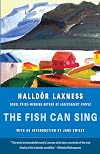
The Fish Can Sing
by Halldór Laxness
On This Page
Description
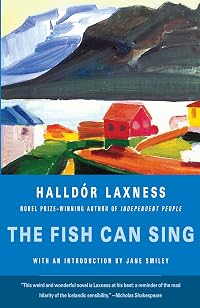
The Fish Can Sing is one of Nobel Prize winner Halldór Laxness’s most beloved novels, a poignant coming-of-age tale marked with his peculiar blend of light irony and dark humor. The orphan Alfgrimur has spent an idyllic childhood sheltered in the simple turf cottage of a generous and eccentric elderly couple. Alfgrimur dreams only of becoming a fisherman like his adoptive grandfather, until he meets Iceland's biggest celebrity. The opera singer Gardar Holm’s international fame is a show more source of tremendous pride to tiny, insecure Iceland, though no one there has ever heard him sing. A mysterious man who mostly avoids his homeland and repeatedly fails to perform for his adoring countrymen, Gardar takes a particular interest in Alfgrimur’s budding musical talent and urges him to seek out the world beyond the one he knows and loves. But as Alfgrimur discovers that Gardar is not what he seems, he begins to confront the challenge of finding his own path without turning his back on where he came from. show lessTags
Recommendations






















Member Reviews
Gli scrittori del grande nord non finiscono mai di stupirmi, e non finiscono mai di farmi venire voglia di leggerne ancora e ancora.
Laxness è stato premio Nobel per la letteratura nel 1955, eppure la sua scrittura, aiutata da una traduzione magnifica, è viva, fresca, fa sentire "l'odore della torba e dell'ossifraga".
Il romanzo è una specie di quadro fiammingo che descrive nei minimi dettagli l'infanzia e l'adolescenza di un piccolo figlio di nessuno, che cresce nell'ultimo ricovero gratuito rimasto al mondo, assieme a dei nonni che non sono i suoi nonni, ma non per questo lo amano di meno, e a tutta una umanità minimale, eppure piena di saggezza e di humour, finché il piccolo anatroccolo non diventerà un cigno, e ripercorrerà, show more questa volte senza menzogne, la strada del suo "parente", il più famoso cantante lirico islandese.
Un libro semplicemente meraviglioso. show less
Laxness è stato premio Nobel per la letteratura nel 1955, eppure la sua scrittura, aiutata da una traduzione magnifica, è viva, fresca, fa sentire "l'odore della torba e dell'ossifraga".
Il romanzo è una specie di quadro fiammingo che descrive nei minimi dettagli l'infanzia e l'adolescenza di un piccolo figlio di nessuno, che cresce nell'ultimo ricovero gratuito rimasto al mondo, assieme a dei nonni che non sono i suoi nonni, ma non per questo lo amano di meno, e a tutta una umanità minimale, eppure piena di saggezza e di humour, finché il piccolo anatroccolo non diventerà un cigno, e ripercorrerà, show more questa volte senza menzogne, la strada del suo "parente", il più famoso cantante lirico islandese.
Un libro semplicemente meraviglioso. show less
The title conjures a poetic image, but it opens with a shocking statement:
“A wise man once said that next losing its mother, there is nothing more healthy for a child than to lose its father.”
Álfgrímur is looking back on his life. His father is unknown and his mother left Iceland for the US as soon as he was born, leaving him with an elderly couple he refers to as his grandparents. He doesn’t miss what he never had, and it’s an odd, but very loving home, although the word “love”, along with other modern fads, is never used there.
It’s full of charming insight into Icelandic life in the early/mid 20th century, a time of great change: the advent of barbershops was hotly debated as modern, un-Icelandic decadence. The family show more live an almost subsistence life: fishing, curing, and selling lumpfish, but birth, death, and local politics intrude. A motley crew live in their mid-loft, which has a cubicle for the sick, mentally ill, giving birth, and dying.
There is a slightly mythic air: people are in tune with nature and the supernatural (belief in the Hidden People and exhortations not to kill flies in other people’s homes), and there are dashes of magical realism concerning a grandfather clock and grandfather’s spotless shoes and never-ageing hat.
An increasingly significant figure is Garðar Hólm, a local who is now a global opera star. But he’s elusive, and it’s delightfully uncertain what is real and true. He is somehow connected to the broken grandfather clock and, more prosaically, to Álfgrímur.
Image: Lumpfish hanging in the open air to dry, Reykjavik, Iceland (Source)
Boundaries
“The Barbed-wire Age was about to begin in Iceland… the most desirable luxury commodity in the land for a while, next only to alcohol and cement… A by-law was issued to the effect that anyone caught climbing over these sacred boundary-fences would have to pay a fine… the price of a yearling ram.”
The cottage’s turnstile-gate is a psychological and linguistic threshold as much as a physical one. The grandparents welcome strangers, but have no desire to be part of the wider world, and as a small boy, that’s true for Álfgrímur as well. With adolescence comes noticing boundaries of every kind, and deciding whether to cross them and how. Will he be a lumpfisherman or get an education, and if the latter, then who and what will he be?
Music and language
There’s little literature or music in the house, but Álfgrímur is drawn to both:
“In certain ancient musical scales there are different intervals than those to which people are now attuned… Words which were commonplace elsewhere sounded not only strange to our ears but were downright embarrassing.”
Storytelling is a different matter: Viking sagas, Bible stories, and gossip are as integral to life as the sea itself.
“The story itself had a life of its own, cool and remote and independent of the telling, free of all odour of man - rather like Nature itself, where the elements alone reign over everything.”
Yet the storytelling of the book felt like the weakest aspect: a rambling memoir, with a huge cast of quirky characters, sometimes excessive detail, and not much narrative drive. But gradually, occasionally, it becomes a quest for a rare, fantastical object: “the one pure note”.
“In Brekkukot, words were too precious to use - because they meant something… Experience was too profound to be capable of expression.. But one note, if it were played in correct relationship to other notes, could tell me much; and sometimes everything..”
Image: Icelandic turf houses (Source)
See also
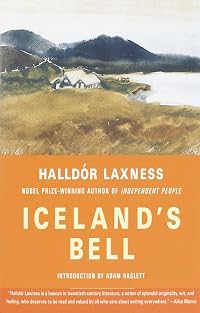
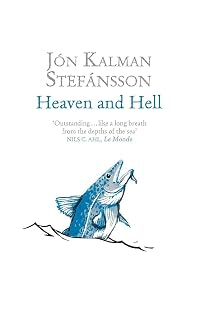
• That my first Laxness was a bit of a disappointment probably says more about me than him, a Nobel laureate. I was hoping for something more like the profound and elemental lyricism of Jón Kalman Stefánsson’s three-volume novel Heaven and Hell, which I reviewed HERE.
• The simple, rural childhood in a somewhat chaotic family reminded me of Laurie Lee’s Cider With Rosie, which I briefly reviewed HERE.
Quotes
• “The sun shining from a sky with as much brightness as a sun can have in this mortal world.”
• “The sun glistened on the fish-scales in the mire.”
• “Somewhere out in the infinite distance lay the spring, at least in God’s mind, like the babies that are not yet conceived in the mother’s womb.”
• “She looked at me with that strange smile that seemed to live in the air itself… the air clad in a soul, or the soul clad in air, and light.”
• “Having a soul is the monopoly of fish.”
• “The cake melted on the tongue like snow in sunshine and slid unbidden down one’s throat just when the good taste was beginning to make itself felt.”
• “I possessed that string of grace, the note that reached the heart and could call forth that useless salt water we call tears.”
• “It was the custom to advertise in verse if one wanted to sell stockfish or needed a girl for spring work…
Gentle clients, I invite you,
Come and look around my store;
Whips and saddles to delight you,
Leatherwork galore…” It continues for another eight lines.
• “The fish can sing just like a bird,
And grazes on the moorland scree,
While cattle in a lowing herd
Roam the rolling sea.” - A traditional Icelandic paradox, apparently. show less
“A wise man once said that next losing its mother, there is nothing more healthy for a child than to lose its father.”
Álfgrímur is looking back on his life. His father is unknown and his mother left Iceland for the US as soon as he was born, leaving him with an elderly couple he refers to as his grandparents. He doesn’t miss what he never had, and it’s an odd, but very loving home, although the word “love”, along with other modern fads, is never used there.
It’s full of charming insight into Icelandic life in the early/mid 20th century, a time of great change: the advent of barbershops was hotly debated as modern, un-Icelandic decadence. The family show more live an almost subsistence life: fishing, curing, and selling lumpfish, but birth, death, and local politics intrude. A motley crew live in their mid-loft, which has a cubicle for the sick, mentally ill, giving birth, and dying.
There is a slightly mythic air: people are in tune with nature and the supernatural (belief in the Hidden People and exhortations not to kill flies in other people’s homes), and there are dashes of magical realism concerning a grandfather clock and grandfather’s spotless shoes and never-ageing hat.
An increasingly significant figure is Garðar Hólm, a local who is now a global opera star. But he’s elusive, and it’s delightfully uncertain what is real and true. He is somehow connected to the broken grandfather clock and, more prosaically, to Álfgrímur.
Image: Lumpfish hanging in the open air to dry, Reykjavik, Iceland (Source)
Boundaries
“The Barbed-wire Age was about to begin in Iceland… the most desirable luxury commodity in the land for a while, next only to alcohol and cement… A by-law was issued to the effect that anyone caught climbing over these sacred boundary-fences would have to pay a fine… the price of a yearling ram.”
The cottage’s turnstile-gate is a psychological and linguistic threshold as much as a physical one. The grandparents welcome strangers, but have no desire to be part of the wider world, and as a small boy, that’s true for Álfgrímur as well. With adolescence comes noticing boundaries of every kind, and deciding whether to cross them and how. Will he be a lumpfisherman or get an education, and if the latter, then who and what will he be?
Music and language
There’s little literature or music in the house, but Álfgrímur is drawn to both:
“In certain ancient musical scales there are different intervals than those to which people are now attuned… Words which were commonplace elsewhere sounded not only strange to our ears but were downright embarrassing.”
Storytelling is a different matter: Viking sagas, Bible stories, and gossip are as integral to life as the sea itself.
“The story itself had a life of its own, cool and remote and independent of the telling, free of all odour of man - rather like Nature itself, where the elements alone reign over everything.”
Yet the storytelling of the book felt like the weakest aspect: a rambling memoir, with a huge cast of quirky characters, sometimes excessive detail, and not much narrative drive. But gradually, occasionally, it becomes a quest for a rare, fantastical object: “the one pure note”.
“In Brekkukot, words were too precious to use - because they meant something… Experience was too profound to be capable of expression.. But one note, if it were played in correct relationship to other notes, could tell me much; and sometimes everything..”
Image: Icelandic turf houses (Source)
See also
• That my first Laxness was a bit of a disappointment probably says more about me than him, a Nobel laureate. I was hoping for something more like the profound and elemental lyricism of Jón Kalman Stefánsson’s three-volume novel Heaven and Hell, which I reviewed HERE.
• The simple, rural childhood in a somewhat chaotic family reminded me of Laurie Lee’s Cider With Rosie, which I briefly reviewed HERE.
Quotes
• “The sun shining from a sky with as much brightness as a sun can have in this mortal world.”
• “The sun glistened on the fish-scales in the mire.”
• “Somewhere out in the infinite distance lay the spring, at least in God’s mind, like the babies that are not yet conceived in the mother’s womb.”
• “She looked at me with that strange smile that seemed to live in the air itself… the air clad in a soul, or the soul clad in air, and light.”
• “Having a soul is the monopoly of fish.”
• “The cake melted on the tongue like snow in sunshine and slid unbidden down one’s throat just when the good taste was beginning to make itself felt.”
• “I possessed that string of grace, the note that reached the heart and could call forth that useless salt water we call tears.”
• “It was the custom to advertise in verse if one wanted to sell stockfish or needed a girl for spring work…
Gentle clients, I invite you,
Come and look around my store;
Whips and saddles to delight you,
Leatherwork galore…” It continues for another eight lines.
• “The fish can sing just like a bird,
And grazes on the moorland scree,
While cattle in a lowing herd
Roam the rolling sea.” - A traditional Icelandic paradox, apparently. show less
An endearing coming-of-age story, told with Icelandic restraint and irony. This would make a great introductory book to anyone looking to try Halldór Laxness, or book to read while travelling in Iceland. In this story, young Álfgrímur grows up and tries to find his place in the world, prefers to be a simple lumpfisherman, but is sent off to school by his ‘grandfather’ nonetheless. He is drawn to a relation (possibly his father), Garðar Hólm, who has become a recognized ‘world singer’, but who always seems to disappoint when he returns home.
There is a parallel with both men (Álfgrímur and Garðar) to Iceland as a nation trying to forge an identity for itself, being a small country little known in the world, and following show more centuries of Danish domination. There is also a parallel to Laxness himself, who became a world celebrity when he had won the Nobel Prize in 1955, two years before The Fish Can Sing was published.
The novel highlights the hidden, quiet virtues of ordinary Icelanders, those without ambition or ego, and has some great chapters which serve as vignettes of Álfgrímur’s experiences. It also evokes some of the interesting aspects of life in Iceland, just a few of which were open cesspools near houses, which ‘drowned more Icelanders than the sea’, low ceilinged living rooms with windows of coarse, slightly blue glass with air bubbles and other flaws in it, and the practice of trying to cure headaches by stopping up one’s nostrils with cow dung. Yikes. Oh, and this one: “the only insult that can really rile an Icelander is to be called a Dane”.
Quotes:
On memories:
“Curiosity can be called a virtue or a vice, depending on what kind of elementary ethics one reads; in our house at Brekkukot, curiosity was considered on a par with thievishness. But now, when all the parties to these confidences are gone elsewhere and that world is no more, and I am the only one left, the spirits rise up from the well of oblivion. People and pictures from a vanished world are reincarnated and assume a significance which was hidden at the time.”
And this one:
“Oh, most of the things I am told about fame and such-like go right over my head, although I’m rather fond of singing. I’m so bound to Brekkukot, somehow. I have always hoped to be allowed to become a lumpfisherman; and I know that when I am ninety and have lost all sight, hearing, sense of smell, taste, and feeling, I shall sit in a corner somewhere and think about when I was seeing to the lumpfish-nets with my grandfather in Skerjafjordur late in the winter before another living soul was up and about, and there was no glimmer of light anywhere except in one little cottage on Alftanes.”
On money:
“I think that our own standard had its origins in my grandfather’s conviction that the money which people consider theirs by right was unlawfully accumulated, or counterfeit, if it exceeded the average income of the working man; and therefore that all great wealth was inconsistent with common sense. I can remember him saying often that he would never accept more money than he had earned.”
On oneness, this from the ‘superintendent’, who leads a very humble life by choice:
“I sold up all my possessions in order to pursue this vocation. I know you will understand, when you start to think about it, that I cannot find it disgusting work to pursue a vocation from a good god. The only disgusting work there is, is badly done work. The world is One, and mankind is One, and therefore work too is only One; there can be a difference in workmanship, but not in work.”
On parents, or in this case, his ‘grandmother’, who raised him:
“All the same, it was probably she who brought me up, so far as I have been brought up at all; at least, I believe that she had a greater part than several other people in making me the way I am. But it was not until after I was fully grown that I noticed her sufficiently to feel that I really saw her. Suddenly one day I simply felt that she was probably closer to me than anyone else and despite the fact that she had been in her grave for some time by then. It is anything but easy trying to speak of a person one knows so little about but who is nevertheless so close to one.”
On religion:
“Or did people perhaps become pastors in Iceland on the sober advice of some grandfather who, because of some caprice of the history of religion, read Vidalin’s Book of Sermons on Sundays instead of sacrificing to the bird Colibri, the bull Apis, or the idol Ra?” show less
There is a parallel with both men (Álfgrímur and Garðar) to Iceland as a nation trying to forge an identity for itself, being a small country little known in the world, and following show more centuries of Danish domination. There is also a parallel to Laxness himself, who became a world celebrity when he had won the Nobel Prize in 1955, two years before The Fish Can Sing was published.
The novel highlights the hidden, quiet virtues of ordinary Icelanders, those without ambition or ego, and has some great chapters which serve as vignettes of Álfgrímur’s experiences. It also evokes some of the interesting aspects of life in Iceland, just a few of which were open cesspools near houses, which ‘drowned more Icelanders than the sea’, low ceilinged living rooms with windows of coarse, slightly blue glass with air bubbles and other flaws in it, and the practice of trying to cure headaches by stopping up one’s nostrils with cow dung. Yikes. Oh, and this one: “the only insult that can really rile an Icelander is to be called a Dane”.
Quotes:
On memories:
“Curiosity can be called a virtue or a vice, depending on what kind of elementary ethics one reads; in our house at Brekkukot, curiosity was considered on a par with thievishness. But now, when all the parties to these confidences are gone elsewhere and that world is no more, and I am the only one left, the spirits rise up from the well of oblivion. People and pictures from a vanished world are reincarnated and assume a significance which was hidden at the time.”
And this one:
“Oh, most of the things I am told about fame and such-like go right over my head, although I’m rather fond of singing. I’m so bound to Brekkukot, somehow. I have always hoped to be allowed to become a lumpfisherman; and I know that when I am ninety and have lost all sight, hearing, sense of smell, taste, and feeling, I shall sit in a corner somewhere and think about when I was seeing to the lumpfish-nets with my grandfather in Skerjafjordur late in the winter before another living soul was up and about, and there was no glimmer of light anywhere except in one little cottage on Alftanes.”
On money:
“I think that our own standard had its origins in my grandfather’s conviction that the money which people consider theirs by right was unlawfully accumulated, or counterfeit, if it exceeded the average income of the working man; and therefore that all great wealth was inconsistent with common sense. I can remember him saying often that he would never accept more money than he had earned.”
On oneness, this from the ‘superintendent’, who leads a very humble life by choice:
“I sold up all my possessions in order to pursue this vocation. I know you will understand, when you start to think about it, that I cannot find it disgusting work to pursue a vocation from a good god. The only disgusting work there is, is badly done work. The world is One, and mankind is One, and therefore work too is only One; there can be a difference in workmanship, but not in work.”
On parents, or in this case, his ‘grandmother’, who raised him:
“All the same, it was probably she who brought me up, so far as I have been brought up at all; at least, I believe that she had a greater part than several other people in making me the way I am. But it was not until after I was fully grown that I noticed her sufficiently to feel that I really saw her. Suddenly one day I simply felt that she was probably closer to me than anyone else and despite the fact that she had been in her grave for some time by then. It is anything but easy trying to speak of a person one knows so little about but who is nevertheless so close to one.”
On religion:
“Or did people perhaps become pastors in Iceland on the sober advice of some grandfather who, because of some caprice of the history of religion, read Vidalin’s Book of Sermons on Sundays instead of sacrificing to the bird Colibri, the bull Apis, or the idol Ra?” show less
I was enchanted by the story of Alfgrimur, a young orphan growing up in a fishing village near Reykjavik. Alfgrimur is happy in the home of an elderly man and woman he calls grandfather and grandmother. His uncertain origins don't seem to bother him. When he discovers he has an aptitude for music, he is satisfied to develop his talent for his own pleasure. He dreams of nothing more than becoming a fisherman like his grandfather. Will his encounter with opera singer Gardar Holm, Iceland's most famous native and some sort of distant relation to Alfgrimar, change his perspective?
Iceland is as much character as location in this story. While Alfgrimar is discovering his identity on a personal level, Iceland is discovering its national show more identity. During the time of the story, Iceland is still under Danish rule. Some of the Icelanders in the book seem to view themselves as the “country cousins” of the more sophisticated Danes. Will Iceland embrace its cultural traditions, or exchange them for those of their “city cousins'?
Although this book isn't considered magical realism, it reminded me of the few books I've read from that genre, particularly Midnight's Children and One Hundred Years of Solitude. If you've read and enjoyed either of those books, you might want to give this one a try. show less
Iceland is as much character as location in this story. While Alfgrimar is discovering his identity on a personal level, Iceland is discovering its national show more identity. During the time of the story, Iceland is still under Danish rule. Some of the Icelanders in the book seem to view themselves as the “country cousins” of the more sophisticated Danes. Will Iceland embrace its cultural traditions, or exchange them for those of their “city cousins'?
Although this book isn't considered magical realism, it reminded me of the few books I've read from that genre, particularly Midnight's Children and One Hundred Years of Solitude. If you've read and enjoyed either of those books, you might want to give this one a try. show less
Oh man, I could quote bits of Icelandic novelist Halldor Laxness to you all day long, making this book seem like just a string of bon mots, but that would be doing The Fish Can Sing a great disservice even though it probably would make you want to drop everything and read it. Laxness is a funny, funny writer, in that surreal and dry Scandanavian way that always makes me feel like I'm missing what's really funny about it but grasping just enough to laugh anyway. For example, describing some pictures on his adopted family's walls, the narrator says "these people had achieved 'good times' in America, as the saying went, which consisted of clearing away boulders and uprooting tree-stumps or digging ditches, and then posing in collar and tie show more in a photographer's studio."
This book is usually described as a coming of age story, but what I have found in its pages is a lot of sly discourse on how we place values on things, of economics as a sort of cargo cult, and on modernity as something more risible than desirable.* So we have the narrator's grandfather stubbornly charging the same price for his lumpfish whatever the market might say they're worth, an equally stubborn transaction in which a bible salesman offers a cheaply printed one in exchange for lodging but that same grandfather clings to the old saw that a bible's price is one cow, and the narrator himself amusingly detailing how his repeated violations of a stretch of barbed wire fence are adding up to his having ducked enough fines to buy all of the chocolate that has ever been imported into Iceland "even counting caramels as well." There is way more of this sort of thing, at any rate, than of the typical idyllic/tragic boyhood tale of home, though there are bits of that as well; the little place at Brekkukot where the narrator grows up with his adopted grandparents is quite an extraordinary place, and one at which anyone is welcome for any length of time. Yeah, his grandparents are kind of proto-hippies like that.
And of course, eventually our hero is sent away from this weird idyll. The trigger there, more or less, is an opera singer who comes from the same settlement where the narrator grew up and who now "travels."** Once this large-living man has come on the scene, nothing is the same again, but not because the boy whom he regards as "more myself than I am" wants to follow in his footsteps; the singer is merely a herald for change. Before the boy knows it, he is being sent to school to learn Latin by rote because that will make him an educated man (shades of George Orwell's "Such, Such Were the Joys" there, but with a lot more humor of course) and thrown into a larger world that doesn't want to let him be a lumpfisherman like his grandfather but doesn't seem to have any real idea of what it does want from him.
Which is fine with him.
What makes The Fish Can Sing most striking overall, whatever its other charms, is that strange element I mentioned above, the peculiar thoughts about economics present throughout. Given what became of Iceland after it, as the economists I can't stop reading like to put it, "stopped fishing and started banking" I can't help but see this novel as a sort of subtle treatise on how all that went wrong. If lots of Icelanders were like the characters in this story (a particular anecdote comes to mind from the novel, in which the famous singer eats a whole tray of creme cakes at a bakery and tries to pay with a single gold coin, which is more money than the bakery girl has ever seen and she is so frightened to have that much money in one place that she won't accept the coin and essentially just lets him go without paying at all -- and the coin haunts the rest of the story in various peculiar ways) perhaps what happened there in the early 21st century isn't really much of a surprise?
At any rate, this is a most peculiar novel, and while it kept me entertained and chuckling, as it came to its strangely airless end, I was left with the most peculiar feeling that the joke had been on me -- and that I hadn't gotten it at all.
Ah, me.
*The story is set in Rekjavik before it was Rekjavik, when the land there was still mostly stone-and-turf houses and cow pastures, and follows the city's and the narrator's gradual transformation from bucolic youth to bustling and busy adulthood. Along the way, there is a lot to mock.
**Grandmother has convinced our hero that "traveling" is a punishment and a sin all rolled into one, so convincing him to do it is no mean feat. show less
This book is usually described as a coming of age story, but what I have found in its pages is a lot of sly discourse on how we place values on things, of economics as a sort of cargo cult, and on modernity as something more risible than desirable.* So we have the narrator's grandfather stubbornly charging the same price for his lumpfish whatever the market might say they're worth, an equally stubborn transaction in which a bible salesman offers a cheaply printed one in exchange for lodging but that same grandfather clings to the old saw that a bible's price is one cow, and the narrator himself amusingly detailing how his repeated violations of a stretch of barbed wire fence are adding up to his having ducked enough fines to buy all of the chocolate that has ever been imported into Iceland "even counting caramels as well." There is way more of this sort of thing, at any rate, than of the typical idyllic/tragic boyhood tale of home, though there are bits of that as well; the little place at Brekkukot where the narrator grows up with his adopted grandparents is quite an extraordinary place, and one at which anyone is welcome for any length of time. Yeah, his grandparents are kind of proto-hippies like that.
And of course, eventually our hero is sent away from this weird idyll. The trigger there, more or less, is an opera singer who comes from the same settlement where the narrator grew up and who now "travels."** Once this large-living man has come on the scene, nothing is the same again, but not because the boy whom he regards as "more myself than I am" wants to follow in his footsteps; the singer is merely a herald for change. Before the boy knows it, he is being sent to school to learn Latin by rote because that will make him an educated man (shades of George Orwell's "Such, Such Were the Joys" there, but with a lot more humor of course) and thrown into a larger world that doesn't want to let him be a lumpfisherman like his grandfather but doesn't seem to have any real idea of what it does want from him.
Which is fine with him.
What makes The Fish Can Sing most striking overall, whatever its other charms, is that strange element I mentioned above, the peculiar thoughts about economics present throughout. Given what became of Iceland after it, as the economists I can't stop reading like to put it, "stopped fishing and started banking" I can't help but see this novel as a sort of subtle treatise on how all that went wrong. If lots of Icelanders were like the characters in this story (a particular anecdote comes to mind from the novel, in which the famous singer eats a whole tray of creme cakes at a bakery and tries to pay with a single gold coin, which is more money than the bakery girl has ever seen and she is so frightened to have that much money in one place that she won't accept the coin and essentially just lets him go without paying at all -- and the coin haunts the rest of the story in various peculiar ways) perhaps what happened there in the early 21st century isn't really much of a surprise?
At any rate, this is a most peculiar novel, and while it kept me entertained and chuckling, as it came to its strangely airless end, I was left with the most peculiar feeling that the joke had been on me -- and that I hadn't gotten it at all.
Ah, me.
*The story is set in Rekjavik before it was Rekjavik, when the land there was still mostly stone-and-turf houses and cow pastures, and follows the city's and the narrator's gradual transformation from bucolic youth to bustling and busy adulthood. Along the way, there is a lot to mock.
**Grandmother has convinced our hero that "traveling" is a punishment and a sin all rolled into one, so convincing him to do it is no mean feat. show less
This is a delightful and low key kunstlerroman, narrated by Álfgrímur, an orphan brought up by two old people whom he calls his grandparents. They live in a turf cottage called Brekkukot, just outside of Reykjavik, where all travellers, philosophers and lost souls are welcome. He learns the fishing trade from his grandfather, who nevertheless insists that he get an education. When the pastor discovers him singing in the meadow, he enlists his services to sing at the burials of the poor and unknown, as he had earlier enlisted a boy who grew up to be the enigmatic Garðar Holm, a world renowned Icelandic singer.
It is tempting to see Laxness exploring his own artistic journey and conflicting views of his fame in the dualities of show more Álfgrímur and Garðar. Laxness pokes gentle and not-so-gentle fun at Icelandic insularity, religion, Danes, and the emerging bourgeois middle-class. But at the heart of this book is Álfgrímur's grandmother: "Suddenly one day I simply felt that she was probably closer to me than anyone else in the world, even though I knew less about her than anyone else...."
In his Nobel acceptance speech, Laxness said of his grandmother:
“... the moral principles she (his grandmother) instilled in me: never to harm a living creature; throughout my life, to place the poor, the humble, the meek of this world above all others; never to forget those who were slighted or neglected or who had suffered injustice, because it was they who, above all others, deserved our love and respect...” show less
It is tempting to see Laxness exploring his own artistic journey and conflicting views of his fame in the dualities of show more Álfgrímur and Garðar. Laxness pokes gentle and not-so-gentle fun at Icelandic insularity, religion, Danes, and the emerging bourgeois middle-class. But at the heart of this book is Álfgrímur's grandmother: "Suddenly one day I simply felt that she was probably closer to me than anyone else in the world, even though I knew less about her than anyone else...."
In his Nobel acceptance speech, Laxness said of his grandmother:
“... the moral principles she (his grandmother) instilled in me: never to harm a living creature; throughout my life, to place the poor, the humble, the meek of this world above all others; never to forget those who were slighted or neglected or who had suffered injustice, because it was they who, above all others, deserved our love and respect...” show less
On the surface, this is a coming-of-age story of a young orphan, Álfgrímur, being raised by foster "grand-parents" who are poor in a material sense but rich in friends and spirit. Alongside that, you sense that this is also a coming-of-age story of Iceland, itself—a puberty that is making many bad choices, but occurring nonetheless.
This book fools you. The several story lines seem like unconnected sketches: Álfgrímur's desire to be a lumpfisherman, his love of singing, his odd relationship with his relative, the mysterious and reclusive opera singer, Gardar Holm, all seem to be simple scenes in the story of his childhood. This isn't an unpleasant experience; Laxness' warm and simple presentation, reminding me of a folk tale, show more paints a dryly humorous picture of a large cast of colorful and interesting characters, gives us many amusing anecdotes, and slyly pokes fun at everything from government to proper manners to Eastern religion.
As the book draws to its close, however, we find those story threads weaving together into a larger story line, a satisfying morality tale about what is valuable in life, about the disappointing nature of pride and fame.
Distinctive, thoughtful, never trite—a real find. show less
This book fools you. The several story lines seem like unconnected sketches: Álfgrímur's desire to be a lumpfisherman, his love of singing, his odd relationship with his relative, the mysterious and reclusive opera singer, Gardar Holm, all seem to be simple scenes in the story of his childhood. This isn't an unpleasant experience; Laxness' warm and simple presentation, reminding me of a folk tale, show more paints a dryly humorous picture of a large cast of colorful and interesting characters, gives us many amusing anecdotes, and slyly pokes fun at everything from government to proper manners to Eastern religion.
As the book draws to its close, however, we find those story threads weaving together into a larger story line, a satisfying morality tale about what is valuable in life, about the disappointing nature of pride and fame.
Distinctive, thoughtful, never trite—a real find. show less
Members
- Recently Added By
Lists

Recommend the 20 best books you've read in the last five years
2,168 works; 602 members

Pleasant Surprises: Books That Exceeded Our Expectations
418 works; 143 members

Best books read in 2011
200 works; 50 members

Books Set on Islands
190 works; 24 members

A Novel Cure
742 works; 23 members

Favorite Books in Translation
320 works; 133 members

Classics
31 works; 1 member

Best of World Literature
432 works; 51 members
Author Information

123+ Works 8,028 Members
When presenting the 1955 Nobel Prize to Laxness, the Swedish Academy of Letters cited "his vivid writing, which has renewed the Icelandic narrative art." Laxness has been by turns a Catholic convert, a socialist, and a target of the radical press, some of whom accused Laxness of a class ambivalence the Saturday Review summarized this way: "Though show more Laxness came to believe that the novelist's best material is to be found in the proletariat, his rejection of middle-class concerns was never complete, and the ambiguity of his attitude toward the conflict of cultural values accounts for the mixture of humor and pathos that is characteristic of all his novels." Independent People (1934--35) was a bestseller in this country; Paradise Reclaimed Reclaimed (1960), based in part on Laxness's own experiences in the United States, is a novel about a nineteenth-century Icelandic farmer and his travels and experiences, culminating in his conversion to the Mormon church. Laxness owes much to the tradition of the sagas and writes with understated restraint, concentrating almost entirely on external details, from which he extracts the utmost in absurdity. An Atlantic writer found that The Fish Can Sing (1957), the adventures of a young man in 1900 who wants to be a singer, "simmers with an ironic, disrespectful mirth which gives unexpected dimensions to the themes of lost innocence and the nature of art." (Bowker Author Biography) show less
Some Editions
Series
Belongs to Publisher Series
Common Knowledge
- Canonical title
- The Fish Can Sing
- Original title
- Brekkukotsannáll
- Original publication date
- 1957 (original Icelandic) (original Icelandic); 1966 (English: Magnusson) (English: Magnusson)
- People/Characters
- Álfgrímur; Gardar Holm; Björn i Brekkukot; Bestemor; Gudmunsen; Johann prost
- Important places
- Iceland; Reykjavik, Iceland
- Related movies
- Brekkukotsannál (1972 | IMDb)
- First words
- En klok mann har sagt at nest etter det å miste sin mor, er det få ting osm er sunnere for små barn enn det å miste sin far.
When Halldor Kiljan Laxness stood up, in 1955, to accept the Nobel Prize in Literature he opened by referring to his double obscurity: "I was travelling in the south of Sweden a few weeks ago, when I heard the rumour that the... (show all) choice of the Swedish Academy might possibly fall on me. Alone in my hotel room that night, I naturally began to ask myself what it would mean to a poor wanderer, a writer from one of the most remote islands in the world, to be suddenly singled out by an institution famous for its promotion of culture, and brought her to the platform by its command."
...But, as The Fish Can Sing demonstrates, Laxness was preoccupied with the interplay of fame and obscurity, worldliness and humility, "out there" and "back home" while he was writing the novel, and it is a remarkable novel for a man at the height of his career to have been writing. -Introduction to the Vintage Edition, Jane Smiley
A wise man once said that next to losing its mother, there is nothing more healthy for a child than to lose its father And though I would never subscribe to such a statement wholeheartedly, I would be the last person to rejec... (show all)t it out of hand. For my own part, I would express such a doctrine without any suggestion of bitterness against the world, or rather without the hurt which the mere sound of the words implies. -Chapter 1, A Strange Creature - Last words
- (Click to show. Warning: May contain spoilers.)De holdt hverandre i hendene som barn.
- Original language
- Icelandic
- Canonical DDC/MDS
- 813
- Canonical LCC
- PZ3.L449 F
Classifications
Statistics
- Members
- 732
- Popularity
- 38,559
- Reviews
- 25
- Rating
- (3.97)
- Languages
- 14 — Danish, Dutch, English, Finnish, French, German, Hebrew, Icelandic, Italian, Norwegian (Bokmål), Norwegian, Portuguese, Spanish, Swedish
- Media
- Paper, Ebook
- ISBNs
- 28
- ASINs
- 12