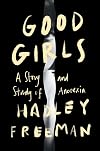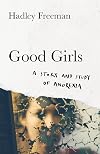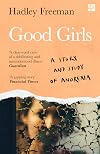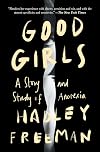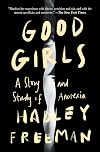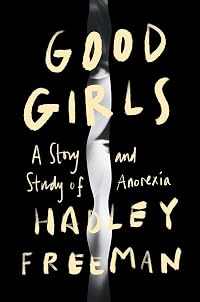
Good Girls: A Story and Study of Anorexia
by Hadley Freeman
On This Page
Description
In 1995, Hadley Freeman wrote in her diary: "I just spent three years of my life in mental hospitals. So why am I crazier than I was before????" From the ages of fourteen to seventeen, Freeman lived in psychiatric wards after developing anorexia nervosa. Her doctors informed her that her body was cannibalizing her muscles and heart for nutrition, but they could tell her little why she had it, what it felt like, what recovery looked like. For the next twenty years, Freeman lived as a show more "functioning anorexic," grappling with new forms of self-destructive behavior as the anorexia mutated and persisted. Anorexia is one of the most widely discussed but least understood mental illnesses. In a brilliant narrative that combines personal experience with deep reporting, Freeman delivers an incisive and bracing work that details her experiences with anorexia--the shame, fear, loneliness and rage--and how she overcame it. She interviews doctors to learn how treatment for the illness has changed since she was hospitalized and what new discoveries have been made about the illness, including its connection to autism, OCD, and metabolic rate. She learns why the illness always begins during adolescence and how this reveals the difficulties for girls to come of age. Freeman tracks down the women with whom she was hospitalized and reports on how their recovery has progressed over decades. Good Girls is an honest and hopeful story of resilience that offers a message to the nearly 30 million Americans who suffer from eating disorders: life can be enjoyed, rather than merely endured. show lessTags
Recommendations












Member Reviews
Hadley Freeman is a journalist (ex Guardian, now The Times), and as a teenager spent 2-3 years living in psychiatric wards being treated for anorexia nervosa. In this open account of her mental health struggles, she gives the 'insider's' view of this heartbreaking illness both from her own experience and that of others treated at the same time as her in some of the hospitals, as well as examining how treatment has / hasn't changed since the 1990s.
Anorexia has the highest mortality rate of any mental health disorder, with up to 10% dying within 10 years of diagnosis and up to 20% within 20 years. 20% of deaths are due to suicide.
Although desperately sad I found this an engaging and really informative book. Parts that stuck out for me show more included how seemingly innocuous some of the triggers to this dreadful illness were (her own trigger was a thinner girl in PE telling her she wished her legs could look 'normal' like her's), and how the drastic food reduction is a symptom rather than the issue itself, with the real issue being poor self-esteem and mental health often triggered by the onset of puberty. 90% of sufferers are girls, with many struggling to cope with the confusing transition from girlhood to womanhood, and as the average age of puberty is getting younger, so too is the age girls are developing anorexia.
As Freeman describes it, calorie counting and excessive exercising is a control mechanism for young girls terrified of all the things that feel so out of control in their lives. In her view it's not triggered by skinny models or even really about wanting to be thin, but is a mental disorder than shares commonality with traits of obsession (OCD is common for many sufferers) and addiction (ditto higher rates than normal of alcohol or drug abuse in later life). In the recent past it was thought that there was a strong correlation between autism and anorexia, and while this has been mostly debunked there is again a lot of crossover in traits and behaviours, although with different causes,
The author is also very honest about how she came to see extended hospital stays as a safe retreat from the world, somewhere where she didn't have to worry about anything beyond restricting her calorie intake and where life could be put on pause.
Another area that was thought provoking was the struggle of living life after so-called recovery; how anorexia food controls can be quickly replaced by other obsessive and/or destructive behaviour, and how difficult it is to develop a normal relationship with food after so many years of self-sabotage. Also how the body often keeps the score of the damage done to it in those years of self-starvation.
The bleak reality for any parent trying to help a child with anorexia is that in Freeman's view the only constructive thing a parent can do is to hand the child over to specialist in-patient help. No amount of cajoling, tough love or eggshell stepping will have any impact on a child with such serious mental health issues.
4 stars - not a sunny read, but an honest and well-written insight into such a grave mental illness. show less
Anorexia has the highest mortality rate of any mental health disorder, with up to 10% dying within 10 years of diagnosis and up to 20% within 20 years. 20% of deaths are due to suicide.
Although desperately sad I found this an engaging and really informative book. Parts that stuck out for me show more included how seemingly innocuous some of the triggers to this dreadful illness were (her own trigger was a thinner girl in PE telling her she wished her legs could look 'normal' like her's), and how the drastic food reduction is a symptom rather than the issue itself, with the real issue being poor self-esteem and mental health often triggered by the onset of puberty. 90% of sufferers are girls, with many struggling to cope with the confusing transition from girlhood to womanhood, and as the average age of puberty is getting younger, so too is the age girls are developing anorexia.
As Freeman describes it, calorie counting and excessive exercising is a control mechanism for young girls terrified of all the things that feel so out of control in their lives. In her view it's not triggered by skinny models or even really about wanting to be thin, but is a mental disorder than shares commonality with traits of obsession (OCD is common for many sufferers) and addiction (ditto higher rates than normal of alcohol or drug abuse in later life). In the recent past it was thought that there was a strong correlation between autism and anorexia, and while this has been mostly debunked there is again a lot of crossover in traits and behaviours, although with different causes,
The author is also very honest about how she came to see extended hospital stays as a safe retreat from the world, somewhere where she didn't have to worry about anything beyond restricting her calorie intake and where life could be put on pause.
Another area that was thought provoking was the struggle of living life after so-called recovery; how anorexia food controls can be quickly replaced by other obsessive and/or destructive behaviour, and how difficult it is to develop a normal relationship with food after so many years of self-sabotage. Also how the body often keeps the score of the damage done to it in those years of self-starvation.
The bleak reality for any parent trying to help a child with anorexia is that in Freeman's view the only constructive thing a parent can do is to hand the child over to specialist in-patient help. No amount of cajoling, tough love or eggshell stepping will have any impact on a child with such serious mental health issues.
4 stars - not a sunny read, but an honest and well-written insight into such a grave mental illness. show less
Very well written and engaging. Freeman mixes her own story with testimony of other anorexic women (as she says few young men are affected). As a man, I was fascinated and educated. It would make helpful reading for all parents. As a father, I am relieved that my daughter was not so obviously affected by worries about food (I credit my wife with a sensible approach to our children’s eating). I was glad that Freeman had a “happy” (able to eat and have a family) ending to this tale.
I thought this was a very poignant and informative memoir about the author's struggle with anorexia, sprinkled with interviews with medical experts on the disorder and stories about other girls she knew from hospital. Then I read a little too much online about her journalistic career and discovered she has defended Woody Allen's behavior and been labeled as a TERF for her views on trans rights. So does that mean I shouldn't like her book? YMMV if you are able to separate the art from the artist.
Beautifully written. I always used to read Hadley Freemans articles in The Guardian. Really excellent style.
A book for all women to read. I gasped out loud at various points. Anorexia is brutal! I don’t know how she has survived and recovered. All that teenage angst. Pretty sure the anorexic girl in my school did not survive sad to say. Now I can understand what she was going through. I surely didn’t back then.
A book for all women to read. I gasped out loud at various points. Anorexia is brutal! I don’t know how she has survived and recovered. All that teenage angst. Pretty sure the anorexic girl in my school did not survive sad to say. Now I can understand what she was going through. I surely didn’t back then.
Ratings
Members
- Recently Added By
Author Information

6+ Works 626 Members
Hadley Freeman is a columnist and writer for the Guardian newspaper in the UK. She was born in New York and lives in London. Her other books include The Meaning of Sunglasses and Be Awesome.
Awards and Honors
Distinctions
Common Knowledge
- Canonical title
- Good Girls: A Story and Study of Anorexia
Classifications
- Genres
- Biography & Memoir, Nonfiction, General Nonfiction
- DDC/MDS
- 616.852620092 — Applied science & technology Medicine & health Diseases, Allergies, Skin Conditions Nervous Disorders: Autism, Anorexia, OCD Miscellaneous Neuroses Eating disorders
- LCC
- RC552 .A5 .F74 — Medicine Internal medicine Internal medicine Neurosciences. Biological psychiatry. Neuropsychiatry Psychiatry Psychopathology Neuroses
- BISAC
Statistics
- Members
- 61
- Popularity
- 506,795
- Reviews
- 4
- Rating
- (4.32)
- Languages
- English
- Media
- Paper, Audiobook, Ebook
- ISBNs
- 11
- ASINs
- 4