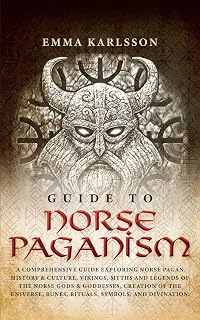
Guide To Norse Paganism: A Comprehensive Guide Exploring Norse Pagan History & Culture, Vikings, Myths and Legends of the Norse Gods & Goddesses, ... Runes, Rituals, Symbols, and Divination.
by Emma Karlsson
On This Page
Description
Guide to Norse Paganism A Comprehensive Guide to Explore Viking History and Culture, Myths and Legends of the Gods & Goddess, Creation of the Universe, Runes, Rituals, Symbols, and Divination. Emma Karlsson Explore the roots of Viking culture and traditions as you embark on a Norse mythology, mysticism, and magic journey. How did the universe come into being? Was it a creation of a God that shaped the cosmos in a matter of days? Or was it the slaying of a giant at the hands of three brothers show more that gave rise to everything we know? That last question might seem odd, but it forms the very foundation of one of the richest and most fascinating religions that flourished in Europe during the Early Middle Ages. Very different from monotheistic religions and prominent in the Scandinavian regions, Norse Paganism was a collection of customs, beliefs, and sagas that defined the Viking way of life - full of magic, mysticism, and an ever-expanding mythos. Today, however, you'd recognize the elements of Norse Paganism populating the fabric of pop culture - in historical TV shows, superhero movies, video games, and even novels - retelling the sagas of gods such as Odin, Thor, Loki, and more. But Norse Paganism packs more within its intricate layers of stories and cultural practices - it is a melting pot of high values, interwoven with nature and a true sense of freedom. Sounds interesting? If you want to explore this fascinating pantheon and perhaps become a Norse Pagan yourself, you're at the right place. In this beginner-friendly guide to understanding the Norse faith, you will discover: A detailed guide to what it takes to be a Norse Paganist - explore the world of Norse traditions, beliefs, mystical practices, and more A brief history and the origin of the Nordic Pagan practices - unravel the rise and fall of the Viking people as you trace their history and explore their unusual traditions A thrilling dive into Norse cosmology - follow in the footsteps of Odin and see how the universe, the nine realms, and the world tree came into being Norse Sagas at your fingertips - travel with Thor, revel in the beauty of Freya, and play tricks with Loki as you explore a plethora of fascinating gods and goddesses Elves, dwarves, trolls, giants, and many magical creatures and monsters in a comprehensive Norse bestiary Runic Magic 101 - uncover the magic and mysticism of ancient runic symbols The cycle of birth and death and how it shaped the Viking culture How to practice your beliefs while living in modern times - discover a complete framework to becoming a Norse Pagan And much more. All this is just the tip of the iceberg. Within the Norse traditions, you'll find a more profound and meaningful way to live your life. Its refreshing and liberating ways allow you to unlock your spiritual, physical, material, and emotional potential. So, what are you waiting for? The world of Norse Paganism awaits you - scroll up and click "Add to Cart" right now. show lessTags
Recommendations


















Member Recommendations

by anonymous user
by anonymous user
by anonymous user
Member Reviews
Ever since I began untangling my beliefs from the Evangelical belief system, I’ve been spending a lot of time learning more about Christian theology, where evangelical ideas about the Bible came from, and other belief systems. A Guide to Norse Paganism, written by Emma Karlsson, is an example of the kinds of resources I’ve been reading.
I enjoyed this walkthrough of Norse Paganism for newbies. Karslson enthusiastically walks the reader through the Norse world view and their beliefs about Creation, Magic, Orthopraxy (Virtues, ways of living), Apocalyptic beliefs, the Norse calendar, the pantheon of gods and the history of Norse Paganism.
I was surprised by how much Norse mythology and theology is woven into popular culture. Reading show more through this book was like hearing a familiar melody then realizing that the melody was the sources of the muzak you heard playing in the elevator.
From the obvious references in Marvel movies or shows like Loki and Thor...to sneaky little references that have been hiding out in plain sight in culturally prominent books or movies.
* Think Lord of the Rings or the world of the Silmarillion. Anyone familiar with Tolkien's works can hear echoes of Norse mythology in his naming and his stories.
* References to the Kraken in English poetry.
* To the references that were absorbed into the Guild Wars 2 Video game, where they went so far as to create a race called the Norn and name a prominent hero's dog, Garm.
* To the use of the draugr, the Nordic equivalent of a zombie or ghost - which sounds like the name of a nightmarish creature that I would have sworn that I've read about in another a fantasy novel.
I was reading stories and ideas that were brand new, but felt as if I was coming home again to familiar faces and myths that were in different garb.
Aside from re-discovering the familiar, I found a lot that was very interesting:
* The Norse concept of the self. The self was thought to have four parts: The Hamr (Body), the Hugr (your Thoughts/ Personality/ Consciousness), the Fylgja, and the Hamingja. Like other belief systems, Norse cultures split out the body, and the mind, but they added the Fylgia (that seems to be something like a spirit animal) and the Hamingia (a person's Luck). Luck in Norse culture was considered a character trait that could be passed down through generations.
* The Wyrd - which she defined as "the connection that you form with others, the tapestry that you weave as you interact with the world and leave your mark on it." At first glance, the Wyrd sounds a lot like Indra's Net.
The world being what it is now, she had to warn people about White Nationalists masquerading as believers in Odin. She reminded us that Odin would have had nothing to do with them. She reminded me of left-wing Christians reminding people that Jesus wouldn't pick up an AK-47 to 'defend his rights'. I appreciated her zeal.
I was happy to read along through page after page of detail on Norse beliefs, but she lost me when she started to talk about paganism in general. The sections of the book that provided a quick overview of Shamanism, Wicca and other pagan beliefs could have been left out. I am interested in the other belief systems, but I think the tangent took away from her topic and risked losing her readers.
While I don't think I want to convert to Norse Paganism at this time, I am fascinated by the richness of the culture. So much of it echoes and rhymes with other stories or beliefs throughout the world. I will be looking for more now that I know that Norse paganism is far richer than the Norse gods depicted in Marvel movies. show less
I enjoyed this walkthrough of Norse Paganism for newbies. Karslson enthusiastically walks the reader through the Norse world view and their beliefs about Creation, Magic, Orthopraxy (Virtues, ways of living), Apocalyptic beliefs, the Norse calendar, the pantheon of gods and the history of Norse Paganism.
I was surprised by how much Norse mythology and theology is woven into popular culture. Reading show more through this book was like hearing a familiar melody then realizing that the melody was the sources of the muzak you heard playing in the elevator.
From the obvious references in Marvel movies or shows like Loki and Thor...to sneaky little references that have been hiding out in plain sight in culturally prominent books or movies.
* Think Lord of the Rings or the world of the Silmarillion. Anyone familiar with Tolkien's works can hear echoes of Norse mythology in his naming and his stories.
* References to the Kraken in English poetry.
* To the references that were absorbed into the Guild Wars 2 Video game, where they went so far as to create a race called the Norn and name a prominent hero's dog, Garm.
* To the use of the draugr, the Nordic equivalent of a zombie or ghost - which sounds like the name of a nightmarish creature that I would have sworn that I've read about in another a fantasy novel.
I was reading stories and ideas that were brand new, but felt as if I was coming home again to familiar faces and myths that were in different garb.
Aside from re-discovering the familiar, I found a lot that was very interesting:
* The Norse concept of the self. The self was thought to have four parts: The Hamr (Body), the Hugr (your Thoughts/ Personality/ Consciousness), the Fylgja, and the Hamingja. Like other belief systems, Norse cultures split out the body, and the mind, but they added the Fylgia (that seems to be something like a spirit animal) and the Hamingia (a person's Luck). Luck in Norse culture was considered a character trait that could be passed down through generations.
* The Wyrd - which she defined as "the connection that you form with others, the tapestry that you weave as you interact with the world and leave your mark on it." At first glance, the Wyrd sounds a lot like Indra's Net.
The world being what it is now, she had to warn people about White Nationalists masquerading as believers in Odin. She reminded us that Odin would have had nothing to do with them. She reminded me of left-wing Christians reminding people that Jesus wouldn't pick up an AK-47 to 'defend his rights'. I appreciated her zeal.
I was happy to read along through page after page of detail on Norse beliefs, but she lost me when she started to talk about paganism in general. The sections of the book that provided a quick overview of Shamanism, Wicca and other pagan beliefs could have been left out. I am interested in the other belief systems, but I think the tangent took away from her topic and risked losing her readers.
While I don't think I want to convert to Norse Paganism at this time, I am fascinated by the richness of the culture. So much of it echoes and rhymes with other stories or beliefs throughout the world. I will be looking for more now that I know that Norse paganism is far richer than the Norse gods depicted in Marvel movies. show less
 This review was written for LibraryThing Early Reviewers.
This is an interesting book although not what I was expecting. I am interested in Viking mythology, pagan deities, and the historical genesis of literary heroes. This author says that she was raised Christian but never shied away from her Swedish heritage. In fact, she says she was disconnected from Christianity since it wasn’t the religion of her ancestors. This book is an encouragement to become a practitioner of Norse paganism by following her guidebook and the initiative of the reader to immerse themselves in the writings, mythology, and exercises of paganism. Karlsson says that this will necessarily mean a rejection of other religious traditions like Islam, Christianity, and Judaism. Karlsson says that curiosity is not enough to show more be a pagan. The practitioner will have possess a desire to be pagan. Without practice, you would be merely an observer. Karlsson says that the best place to start is with the gods and goddesses of Norse polytheism. These gods are not perfect in behavior but that this would not hinder them from being held aloft as gods. The easiest way to access the gods is by reading the poetic Edda and the Prose Edda. After that the Sagas provide much more material to satisfy the reader’s interest. Karlsson shows some familiarity with the sociological and anthropological aspects of Norse traditions but she gives short shrift to Christianity as too ritual oriented and lacking personal engagement with object of religion. She does acknowledge that Christianity eclipsed Norse paganism by the 10th century. Karlsson argues that despite Christianity’s triumph many Norse traditions survived within Christianity. She then goes on to pay tribute to the Vikings. The main reason I found this work interesting was the chapter on the cosmos. Although Karlsson gives a poor exegesis on the Christian doctrine of creation she summarizes Norse mythological conception of the "gap" which transforms into the realms of fire and ice and the primeval cow. This was very interesting before she covers the calendar days like father’s day in mid-winter and mother’s day at the end of winter. The Kraken is described briefly. Karlsson mentions writers Gaiman and Lovecraft as means of illustrating some similarities between imaginative conceptions. For some reason Karlsson endorses Wicca and Wiccans which are not reputable. She does warn against Norse pagans who are racists or white supremacists. Skin heads in other words. At least she has sense enough to warn off on that. There are some bibliographical notes provided which you can consult. Overall this book is not a historical excursion toward clarity on Norse chronology or mythology. It is a book promoting paganism and pagan lifestyles. There are reasons why a reader might want to know this. Mainly because following any spiritual path without a competent and trustworthy guide could lead to disastrous results. The endorsement of any shaman is also a red flag for the same reason. This book as a summary of Norse ideas, I feel is its best use. I will continue to read and buy more books on Vikings, Norse mythology, pagan cosmological & belief systems. show less
This review was written for LibraryThing Early Reviewers.Emma Karlsson's book sets out to introduce readers to the knowledge needed to understand Norse Mythology and Paganism and provide guidelines for those who want to align with these teachings (xix). I found the writing easy to follow, especially for such a robust topic. Karlsson breaks down the similarities of world religions and the creation story of each. She relates information about the Nordic Eddas in a way that previous knowledge is not necessary to understand the context. I thought this was very helpful and glad she did not overlook the opportunity to contextualize without assuming the reader already has this knowledge. I found the Norse calendar and the Pantheon of the Norse Gods informative. Throughout the book I did not feel I show more was being indoctrinated but instead educated in an topic that interests me as a descendent of Swedish Americans and overall interest in Norse Mythology. show less
This review was written for LibraryThing Early Reviewers.I enjoyed this book and believe that it helps your spiritual wellbeing to learn about other cultures and religions. The introduction of the book is a bit like being back in school where you try not to drift off! But the rest of the book is very interesting and written to comfortably give you insight to Norse Pagenism. It’s easy to understand and Emma doesn’t try to strong arm you join. You feel her joy and commitment to religion. I love a book that gets you interested in learning more about something!
This review was written for LibraryThing Early Reviewers.This was just one revelation after another. It was very complex in its many explanations and interpretations of the Norse beliefs. It’s not just something you read through once and absorb everything. There is the history, the many gods, the stories of the people and how they civilized so many places in the world. It tells of the significant days of the year, runes, the decline and now current resurrection of Norse beliefs. I appreciate that it offers a wide variety of topics and never demands one pick any but can choose what feels true and best for oneself. This is a reference type book for me to go back to and read about different topics offered until I feel comfortable settling into my own comfort zone of beliefs that I’ll follow.
This review was written for LibraryThing Early Reviewers.The teachings and writings of old school paganism is on the rise, being promoted by several governments and established institutions in the 21st century. Norse paganism like Greek mythology, Druid mysticism, and Eygptian hieroglyphs are some of civilizations earliest belief systems.
Emma Karlsson's book Guide to Norse Paganism opens the reader's mind to the Viking culture, whose impressions of the earth and physical surroundings are steep in elemental forces. She describes in depth the gods that shape Norse paganism, what they represent and how their lives were metaphors relatable to practical life.
She identifies nine realms detailed in Norse paganism, where the various gods reside, composing the world tree called Yggdrasil. How the show more gods, some destructive and others benevolent, affect the world and human life. Similarly to Tolkien's Lord of the Rings, Middle Earth or midgard in Norse paganism is where humans reside, manipulated by the eternal forces residing in the eight other realms.
Karlsson's book has a persuasive slant as though she wants to convince readers to adopt Norse paganism as their religion. Separating her opinion from the historical value of the figures in Norse paganism may prove to give audiences insight and an understanding of early civilization's mindset.
Karlsson gives credit to Norse paganism and demonstrates how the belief system gave the world its seasons and its days of the week, Sunday through Saturday. It is an enlightening read to discover the staples and teachings of early Viking and Norse cultures, some of which continue to be practiced today and are universally accepted. show less
Emma Karlsson's book Guide to Norse Paganism opens the reader's mind to the Viking culture, whose impressions of the earth and physical surroundings are steep in elemental forces. She describes in depth the gods that shape Norse paganism, what they represent and how their lives were metaphors relatable to practical life.
She identifies nine realms detailed in Norse paganism, where the various gods reside, composing the world tree called Yggdrasil. How the show more gods, some destructive and others benevolent, affect the world and human life. Similarly to Tolkien's Lord of the Rings, Middle Earth or midgard in Norse paganism is where humans reside, manipulated by the eternal forces residing in the eight other realms.
Karlsson's book has a persuasive slant as though she wants to convince readers to adopt Norse paganism as their religion. Separating her opinion from the historical value of the figures in Norse paganism may prove to give audiences insight and an understanding of early civilization's mindset.
Karlsson gives credit to Norse paganism and demonstrates how the belief system gave the world its seasons and its days of the week, Sunday through Saturday. It is an enlightening read to discover the staples and teachings of early Viking and Norse cultures, some of which continue to be practiced today and are universally accepted. show less
This review was written for LibraryThing Early Reviewers.This is a serious delving into Norse mythology, the origin of numerous Pagan religions and sects based on the Norse Gods and and various rites, beliefs, Norse holidays. A LOT of information.
I was familiar with much of Norse mythology, a lot of it from Marvel comics, but also read some other material when I was younger. The author gives a thorough description of the Gods, their origins, points out things that are different from some of the common stories.
Well worth the read if you're interested in some Scandinavian history, Norse Mythology or Paganism.
I was familiar with much of Norse mythology, a lot of it from Marvel comics, but also read some other material when I was younger. The author gives a thorough description of the Gods, their origins, points out things that are different from some of the common stories.
Well worth the read if you're interested in some Scandinavian history, Norse Mythology or Paganism.
Members
- Recently Added By
Lists

Heathenry - Norse Pagan 101
31 works; 1 member
Author Information
6 Works 31 Members
Common Knowledge
- Original title
- Guide To Norse Paganism
- Original publication date
- 2022
- Related movies
- The Northman (2022 | IMDb)
- Original language
- English
Classifications
- Genres
- Nonfiction, Religion & Spirituality, History
Statistics
- Members
- 20
- Popularity
- 1,281,874
- Reviews
- 17
- Rating
- (4.15)
- Languages
- English
- Media
- Paper, Ebook
- ISBNs
- 1
- ASINs
- 2