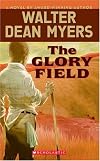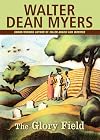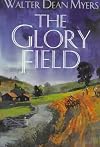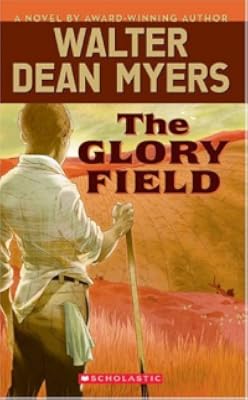
The Glory Field
by Walter Dean Myers
On This Page
Description
Follows a family's two hundred forty-one year history, from the capture of an African boy in the 1750s through the lives of his descendants, as their dreams and circumstances lead them away from and back to the small plot of land in South Carolina that they call the Glory Field.Tags
Recommendations














Member Reviews
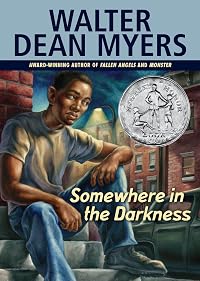
stunning novel about the perseverance and courage of one African-American family from the author of the award-winning Somewhere in the Darkness (1992). Myers begins the story of the Lewis family in Africa in 1753 with the capture of 11-year-old Muhammad Bilal, who is shackled and put on a ship bound for America. The story then skips to 1864 on Curry Island, S.C., where the descendants of Muhammad now live on the Lewis plantation. Two of them, Joshua and Lem, have run away, but Lem is caught tied to a tree as bait for Joshua. Lizzy, Lem's 13-year-old cousin, is seen giving Lem a drink and must flee as well. All three escape and the men join the Union army to fight for their freedom. In 1900, Lizzy's son Elijah stands up to the white men show more of Curry Island and is forced to leave for Chicago. His daughter, Luvenia, is thwarted in her dream to go to the University of Chicago in 1930, but she defies expectations and succeeds in business. Tommy Lewis, back in South Carolina in 1964, must choose between appeasing the establishment — and receiving a scholarship to attend college — or fighting for his ideals. And now in Harlem, talented young musician Malcolm Lewis is responsible for bringing his crack-addicted cousin, Shep, to the Lewis family reunion on Curry Island. In this fluid, simple book, Myers brings to life an entire history of a people, highlighting the Lewis family's commitment and strength. A must read for absolutely everyone.
-Kirkus Review show less
-Kirkus Review show less
stunning novel about the perseverance and courage of one African-American family from the author of the award-winning Somewhere in the Darkness (1992). Myers begins the story of the Lewis family in Africa in 1753 with the capture of 11-year-old Muhammad Bilal, who is shackled and put on a ship bound for America. The story then skips to 1864 on Curry Island, S.C., where the descendants of Muhammad now live on the Lewis plantation. Two of them, Joshua and Lem, have run away, but Lem is caught tied to a tree as bait for Joshua. Lizzy, Lem's 13-year-old cousin, is seen giving Lem a drink and must flee as well. All three escape and the men join the Union army to fight for their freedom. In 1900, Lizzy's son Elijah stands up to the white men show more of Curry Island and is forced to leave for Chicago. His daughter, Luvenia, is thwarted in her dream to go to the University of Chicago in 1930, but she defies expectations and succeeds in business. Tommy Lewis, back in South Carolina in 1964, must choose between appeasing the establishment — and receiving a scholarship to attend college — or fighting for his ideals. And now in Harlem, talented young musician Malcolm Lewis is responsible for bringing his crack-addicted cousin, Shep, to the Lewis family reunion on Curry Island. In this fluid, simple book, Myers brings to life an entire history of a people, highlighting the Lewis family's commitment and strength. A must read for absolutely everyone.
-Kirkus Review show less
-Kirkus Review show less
"Those shackles didn't rob us of being black, son, they robbed us of being human."
This is the story of one family. A family whose history saw its first ancestor captured, shackled, and brought to this country from Africa. A family who can still see remnants of the shackles that held some of its members captive -- even today. It is a story of pride, determination, struggle, and love. And of the piece of the land that holds them together throughout it all.
This is the story of one family. A family whose history saw its first ancestor captured, shackled, and brought to this country from Africa. A family who can still see remnants of the shackles that held some of its members captive -- even today. It is a story of pride, determination, struggle, and love. And of the piece of the land that holds them together throughout it all.
RGG: A YA version of Roots. Well-written. Important perspective for students.
This powerful novel tells the story of the Lewis family through six generations. It begins with Muhammad Bilal's journey from Africa in the belly of a slave ship, then progresses through stories set during the Civil War, the Great Depression, the Civil Rights movement, all the way to 1990's Harlem. Throughout, the Lewis's own a very special plot of land that they call The Glory Field. It is a reminder of everything they and their ancestors have been through. Told in short vignettes, we only see glimpses of each of the characters' lives, but it is enough to illustrate their strength and love of their family.
Each section of the novel has a lot of action, and is historically accurate. The white characters aren't demonized (except for maybe show more the slave drivers in the first section), but they do portray accurately the attitudes and prejudices of the day, and each is subtly different. This novel is chock full of potential discussions about everything from racism to family life to freedom. Some students may be frightened or dismayed by the violence in some sections of the novel, but it is never gratuitous, and shows them how violence was and is a fact of life for many people of color during various parts of history.
For ages 10 and up. show less
Each section of the novel has a lot of action, and is historically accurate. The white characters aren't demonized (except for maybe show more the slave drivers in the first section), but they do portray accurately the attitudes and prejudices of the day, and each is subtly different. This novel is chock full of potential discussions about everything from racism to family life to freedom. Some students may be frightened or dismayed by the violence in some sections of the novel, but it is never gratuitous, and shows them how violence was and is a fact of life for many people of color during various parts of history.
For ages 10 and up. show less
Published in 1994, but still relevant today. It begins in 1753 in Africa with the capture of 11-year-old Muhammad, who is sent to America as a slave. It follows his family's story, jumping in time from a plantation on Curry Island in SC in 1864 to various places and years, ending with that same piece of land and family in 1994. Inspirational novel, but sad to think that even now, hundreds of years later, the color of your skin makes a difference in how you're treated.
Although The Glory Field is grand in scope, spanning many generations of the Lewis family, each segment of the story is filled with the thoughts and dreams of the brave individuals who acted on their aspirations, and a saga of the African American experience is brought to life by the precise and evocative language of Walter Dean Myers.
Members
- Recently Added By
Author Information

150+ Works 38,420 Members
Walter Dean Myers was born on August 12, 1937 in Martinsberg, West Virginia. When he was three years old, his mother died and his father sent him to live with Herbert and Florence Dean in Harlem, New York. He began writing stories while in his teens. He dropped out of high school and enlisted in the Army at the age of 17. After completing his army show more service, he took a construction job and continued to write. He entered and won a 1969 contest sponsored by the Council on Interracial Books for Children, which led to the publication of his first book, Where Does the Day Go? During his lifetime, he wrote more than 100 fiction and nonfiction books for children and young adults. His works include Fallen Angels, Bad Boy, Darius and Twig, Scorpions, Lockdown, Sunrise Over Fallujah, Invasion, Juba!, and On a Clear Day. He also collaborated with his son Christopher, an artist, on a number of picture books for young readers including We Are America: A Tribute from the Heart and Harlem, which received a Caldecott Honor Award, as well as the teen novel Autobiography of My Dead Brother. He was the winner of the first-ever Michael L. Printz Award for Monster, the first recipient of the Coretta Scott King-Virginia Hamilton Award for Lifetime Achievement, and a recipient of the Margaret A. Edwards Award for lifetime achievement in writing for young adults. He also won the Coretta Scott King Award for African American authors five times. He died on July 1, 2014, following a brief illness, at the age of 76. (Bowker Author Biography) show less
Awards and Honors
Awards
Distinctions
Work Relationships
Has as a student's study guide
Common Knowledge
- First words
- Eleven-year-old Muhammad Bilal flinched.
Classifications
Statistics
- Members
- 948
- Popularity
- 28,153
- Reviews
- 11
- Rating
- (3.71)
- Languages
- English, French
- Media
- Paper, Audiobook, Ebook
- ISBNs
- 24
- ASINs
- 6