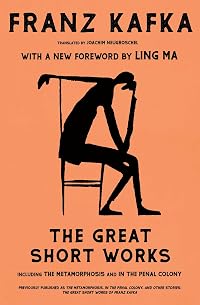
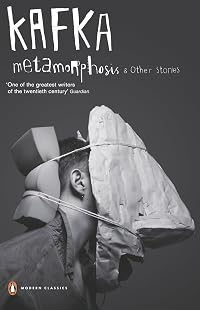
The Metamorphosis, In the Penal Colony, and Other Stories: The Great Short Works of Franz Kafka
by Franz Kafka 
On This Page
Description
Translated by PEN translation award-winner Joachim Neugroschel, The Metamorphosis, In the Penal Colony, and Other Stories has garnered critical acclaim and is widely recognized as the preeminent English-language anthology of Kafka's stories. These translations illuminate one of this century's most controversial writers and have made Kafka's work accessible to a whole new generation. This classic collection of forty-one great short works -- including such timeless pieces of modern fiction as show more "The Judgment" and "The Stoker" -- now includes two new stories, "First Sorrow" and "The Hunger Artist." show lessTags
Recommendations






Member Reviews
I'd read some of the works collected here before--most notably "The Hunger Artist" and "The Metamorphosis"--and rereading them was a clear reminder of why and how they've stuck with me all these years. Kafka's sideways examination of the human condition, and social contracts and understandings, is as powerful and striking as ever, smartly written and driven forward with such intention as to be near other-worldly. Somehow, it's still "The Hunger Artist" that draws me back again and again as a heartbreaking and yet ever-meaningful story. But on this read, going through the whole of the collection, I also was left speechless by a number of other stories of Kakfa's which I'd not gotten around to reading before--especially "The Stoker", "A show more Report for an Academy", and "First Sorrow." I'm sure I'll be returning to this collection. show less
This collection of 41 pieces of Franz Kafka's shorter fiction includes English versions of the well-known classics as well as several more obscure works.
The four classics that are included are "The Metamorphosis", "The Hunger Artist", "The Judgment", and "In the Penal Colony". Other included works are "First Sorrow", 14 short pieces that made up his book "A Country Doctor", 18 short items that made up his first book, "Contemplation", and "The Stoker" (first chapter of the posthumous book "America"), plus 3 early stories ("Conversation with the Worshipper", "Conversation with the Drunk", and "Great Noise").
The works were translated into English by Joachim Neugroschel. Two book jacket blurbs praise Neugroschel's translations as being an show more advance over previous translations (clearly including the older Willa and Edwin Muir translations). An introduction by Neugroschel reflects on the confusion and complexities involved in the translation of Kafka's prose. He notes that Kafka's wrote in "Prague" German, a form that "lacks the slang, colloquialisms, and dialectal influences" of High German.
This collection is a useful survey of Kafka's short fiction, and in addition to the classic works, includes a number of others not found in the early volume edited by the Muirs. Among them are Kafka's early stories, plus his first published collection "Contemplation" (published in 1912 as "Betrachtung", a title often rendered in English as "Meditation"), as well as the short stories that make up the 1917 collection "A Country Doctor". However, this collection also lacks some other short stories that Kafka fans and scholars consider to be notable, such as "The Great Wall of China", "The Burrow", and "Josephine the Singer or the Mouse Folk".
For my part, I favor three classic works ("The Metamorphosis", "The Hunger Artist", and "The Judgment") while considering "In the Penal Colony" bizarre and disturbing. The remaining selections I find to be as enigmatic and perplexing, and have few attractions for me. My ratings for this collection reflect its coverage and the perceived quality of its translations more than my own reaction to the pieces themselves.
Readers interested in reading descriptive commentaries on each of the stories found in "A Country Doctor" and "Contemplations can find them at Wikipedia, via the links below:
https://en.wikipedia.org/wiki/A_Country_Doctor_(short_story_collection)
https://en.wikipedia.org/wiki/Contemplation_(short_story_collection) show less
The four classics that are included are "The Metamorphosis", "The Hunger Artist", "The Judgment", and "In the Penal Colony". Other included works are "First Sorrow", 14 short pieces that made up his book "A Country Doctor", 18 short items that made up his first book, "Contemplation", and "The Stoker" (first chapter of the posthumous book "America"), plus 3 early stories ("Conversation with the Worshipper", "Conversation with the Drunk", and "Great Noise").
The works were translated into English by Joachim Neugroschel. Two book jacket blurbs praise Neugroschel's translations as being an show more advance over previous translations (clearly including the older Willa and Edwin Muir translations). An introduction by Neugroschel reflects on the confusion and complexities involved in the translation of Kafka's prose. He notes that Kafka's wrote in "Prague" German, a form that "lacks the slang, colloquialisms, and dialectal influences" of High German.
This collection is a useful survey of Kafka's short fiction, and in addition to the classic works, includes a number of others not found in the early volume edited by the Muirs. Among them are Kafka's early stories, plus his first published collection "Contemplation" (published in 1912 as "Betrachtung", a title often rendered in English as "Meditation"), as well as the short stories that make up the 1917 collection "A Country Doctor". However, this collection also lacks some other short stories that Kafka fans and scholars consider to be notable, such as "The Great Wall of China", "The Burrow", and "Josephine the Singer or the Mouse Folk".
For my part, I favor three classic works ("The Metamorphosis", "The Hunger Artist", and "The Judgment") while considering "In the Penal Colony" bizarre and disturbing. The remaining selections I find to be as enigmatic and perplexing, and have few attractions for me. My ratings for this collection reflect its coverage and the perceived quality of its translations more than my own reaction to the pieces themselves.
Readers interested in reading descriptive commentaries on each of the stories found in "A Country Doctor" and "Contemplations can find them at Wikipedia, via the links below:
https://en.wikipedia.org/wiki/A_Country_Doctor_(short_story_collection)
https://en.wikipedia.org/wiki/Contemplation_(short_story_collection) show less
I'm giving this book a certain score, but realize first and foremost that it is wildly inconsistent. There can be no doubt that "The Metamorphosis" and "In The Penal Colony" are masterpieces of short literature that rank with the highest of perhaps anything that's been written in the form. The works that come close to those are "The Judgment" and "A Hunger Artist" which perhaps most merit the score I give. They're very good achievements, but they don't have a good connection to the hand that wrote "The Trial", which is Kafka's unfinished masterpiece.
The rest of this collection is somewhat similar to Typee from Herman Melville. The elements of good writing are present but they haven't formed into that je ne sais quois that forms show more literature. These works can't even be called Kafka-esque in the same way Typee can't be considered Melvillean. Everyone will remember Melville for Moby Dick, a work that almost achieves the status of The Great American Novel, and similarly Kafka will be remembered for "The Trial" and the short stories for which this collection is partially named, but both authors must've not been able to feel their way out naturally since they both produce art that is wildly non-indicative.
It's not so much that these other stories are bad, but in a collection like this they are indeed "other." It's too bad that Kafka was not as prolific as Melville, since Melville managed to pump out a good bevy of excellent short stories between Moby Dick and his final hurrah of "Billy Budd, Sailor." This final stage of Melville's life carries almost as much of his legacy as Moby Dick itself. Kafka, on the other hand couldn't seem to decide what he wanted to produce in finality. Or else he could, but he still dotted it with less important work along the way.
I would suppose it were a blessing that Kafka couldn't decide on his ultimate vision the way Edgar Allan Poe or H.P. Lovecraft could. After all, his vision was a lot more complicated. It encased the full experience of the 20th century man, parts of which were left out for Poe or Lovecraft- Poe being nevertheless a literary auteur of the strange, frightening, and imaginative. Kafka, in his few masterworks, reached into the soul of man and reflected it back to us in all of its stunning sadism and otherwise. His beautiful portraits of transformation and auto-mechanism should be familiar to all. We can learn the ways we shouldn't treat each other in Kafka. show less
The rest of this collection is somewhat similar to Typee from Herman Melville. The elements of good writing are present but they haven't formed into that je ne sais quois that forms show more literature. These works can't even be called Kafka-esque in the same way Typee can't be considered Melvillean. Everyone will remember Melville for Moby Dick, a work that almost achieves the status of The Great American Novel, and similarly Kafka will be remembered for "The Trial" and the short stories for which this collection is partially named, but both authors must've not been able to feel their way out naturally since they both produce art that is wildly non-indicative.
It's not so much that these other stories are bad, but in a collection like this they are indeed "other." It's too bad that Kafka was not as prolific as Melville, since Melville managed to pump out a good bevy of excellent short stories between Moby Dick and his final hurrah of "Billy Budd, Sailor." This final stage of Melville's life carries almost as much of his legacy as Moby Dick itself. Kafka, on the other hand couldn't seem to decide what he wanted to produce in finality. Or else he could, but he still dotted it with less important work along the way.
I would suppose it were a blessing that Kafka couldn't decide on his ultimate vision the way Edgar Allan Poe or H.P. Lovecraft could. After all, his vision was a lot more complicated. It encased the full experience of the 20th century man, parts of which were left out for Poe or Lovecraft- Poe being nevertheless a literary auteur of the strange, frightening, and imaginative. Kafka, in his few masterworks, reached into the soul of man and reflected it back to us in all of its stunning sadism and otherwise. His beautiful portraits of transformation and auto-mechanism should be familiar to all. We can learn the ways we shouldn't treat each other in Kafka. show less
A collection of Kafka's shorter fiction published in his lifetime with some travel writing as an appendix.
This is the first Kafka I've read. I can see why 'The Metamorphosis' is well known but I found the rest of the collection to be pretty much hit or miss, with some weird tales and others that just left going "so?". 'The Hunger Artist' was interesting, but actually my favourite was 'The Aeroplanes at Brescia', a piece of travel writing about a trip Kafka made in 1909 by train and car to see the air show at Brescia in 1909 - the whole idea of doing such a thing in 1909 seems so unexpected.
This is the first Kafka I've read. I can see why 'The Metamorphosis' is well known but I found the rest of the collection to be pretty much hit or miss, with some weird tales and others that just left going "so?". 'The Hunger Artist' was interesting, but actually my favourite was 'The Aeroplanes at Brescia', a piece of travel writing about a trip Kafka made in 1909 by train and car to see the air show at Brescia in 1909 - the whole idea of doing such a thing in 1909 seems so unexpected.
Striving to understand the frequent usage of 'Kafkaesque' to describe a proliferation of things literary, I found a nice bargain copy of this translation of Kafka many moons past. I'm unsure if I accomplished my goal, being left wondering if I need to read 'The Trial' to solidify that understanding, yet having no desire to engage anymore with his works. This collection of stories left me repulsed ('The Metamorphosis'), disgusted ('In the Penal Colony'), irritated ('The Stoker'), or bored (all inclusive). I used the experience as a stylistic exercise, but even that failed to render the stories any more approachable for me. Taking a month to finally finish, the slow progress was a source of frustration, and the more frustrating thought is show more that Kafka would have probably found that entirely too funny. show less
I was not looking forward to reading this book, as I had previously read Metamorphosis and The Trial. I was pleasantly surprised by Country Doctor and especially Penal Colony. Very strong characters and symbolism in PC. You have to do your research on these stories or you miss quite a bit of symbolism.
Dreamlike stories where everything is possible and normal. Absurdity is considered normal, and then the keen & vivid description follows. Consider following:
- In "The Metamorphosis", the narrator wakes up late to find himself turned into a large insect. And, his first worry is how is he going to reach office and explain the reason for lateness.
- In "In the Penal Colony", a torture device is described in detail, how a complex mechanism drives harrow like needle to write the pronounced judgement on the skin of prisoner over a course of 12 hours. Prison is not told the judgement, but he figures it out as it is written on his skin.
- In "A Hunger Artist", the artist specializes in starving himself for long period, and how his "art" is not show more appreciated by others and is in decline.
Above short description do not describe all the details. One must read the book to get in the despairing dreams. show less
- In "The Metamorphosis", the narrator wakes up late to find himself turned into a large insect. And, his first worry is how is he going to reach office and explain the reason for lateness.
- In "In the Penal Colony", a torture device is described in detail, how a complex mechanism drives harrow like needle to write the pronounced judgement on the skin of prisoner over a course of 12 hours. Prison is not told the judgement, but he figures it out as it is written on his skin.
- In "A Hunger Artist", the artist specializes in starving himself for long period, and how his "art" is not show more appreciated by others and is in decline.
Above short description do not describe all the details. One must read the book to get in the despairing dreams. show less
Members
- Recently Added By
Lists

Weird and Weirder Fiction
270 works; 35 members

1910s
90 works; 16 members

Jewish Books
367 works; 24 members

Best of World Literature
432 works; 51 members

Philosophical Fiction
97 works; 27 members
Author Information

1,502+ Works 103,665 Members
Franz Kafka -- July 3, 1883 - June 3, 1924 Franz Kafka was born to middle-class Jewish parents in Prague, Czechoslovakia on July 3, 1883. He received a law degree at the University of Prague. After performing an obligatory year of unpaid service as law clerk for the civil and criminal courts, he obtained a position in the workman's compensation show more division of the Austrian government. Always neurotic, insecure, and filled with a sense of inadequacy, his writing is a search for personal fulfillment and understanding. He wrote very slowly and deliberately, publishing very little in his lifetime. At his death he asked a close friend to burn his remaining manuscripts, but the friend refused the request. Instead the friend arranged for publication Kafka's longer stories, which have since brought him worldwide fame and have influenced many contemporary writers. His works include The Metamorphosis, The Castle, The Trial, and Amerika. Kafka was diagnosed with tuberculosis (TB) in August 1917. As his disease progressed, his throat became affected by the TB and he could not eat regularly because it was painful. He died from starvation in a sanatorium in Kierling, near Vienna, after admitting himself for treatment there on April 10, 1924. He died on June 3 at the age of 40. (Bowker Author Biography) show less
Franz Kafka has a Legacy Library. Legacy libraries are the personal libraries of famous readers, entered by LibraryThing members from the Legacy Libraries group.
Some Editions
Work Relationships
Common Knowledge
- Canonical title
- The Metamorphosis, In the Penal Colony, and Other Stories: The Great Short Works of Franz Kafka
- First words
- "As Gregor Samsa awoke one morning from uneasy dreams he found himself transformed in his bed into a gigantic insect."
- Last words
- (Click to show. Warning: May contain spoilers.)But they pulled themselves together, thronged around the cage, and refused to move on.
- Publisher's editor
- Goldman, Erika
- Blurbers
- Bloom, Harold; Coates, Joseph; Hayman, Ronald; Havel, Vaclav
- Disambiguation notice
- Contents
- Conversation With the Worshiper
- Conversation With the Drunk
- Great Noise
- Children on the Highway
- Exposing a City Slicker
- The Sudden Stroll
- Decisions
- The O... (show all)uting in the Mountains
- The Bachelor's Unhappiness
- The Businessman
- Absently Gazing Out
- The Way Home
- The People Running By
- The Passenger
- Frocks
- The Rejection
- Reflections for Amateur Jockeys
- The Window Facing the Street
- The Wish to Be an Indian
- The Trees
- Unhappiness
- The Judgment
- The Stoker
- The Metamorphosis
- In the Penal Colony
- The New Lawyer
- A Country Doctor
- Up in the Gallery
- An Ancient Manuscript
- Before the Law
- Jackals and Arabs
- A Visit to the Mine
- The Next Village
- An Imperial Message
- The Anxiety of the Head of Family
- Eleven Sons
- A Fratricide
- A Dream
- A Report for an Academy
- First Sorrow
- The Hunger Artist
Classifications
- Genres
- Fiction and Literature, General Fiction
- DDC/MDS
- 833.912 — Literature & rhetoric German & related literatures German fiction 1900- 1900-1990 1900-1945
- LCC
- PT2621 .A26 .A257 — Language and Literature German, Dutch and Scandinavian literatures German literature Individual authors or works 1860/70-1960
- BISAC
Statistics
- Members
- 1,834
- Popularity
- 11,815
- Reviews
- 11
- Rating
- (4.08)
- Languages
- English
- Media
- Paper, Ebook
- ISBNs
- 5
- ASINs
- 10