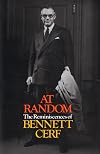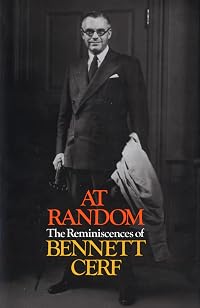
At Random: The Reminiscences of Bennett Cerf
by Bennett Cerf
On This Page
Description
“I’ve got the name for our publishing operation. We just said we were going to publish a few books on the side at random. Let’s call it Random House.” So recounts Bennett Cerf in this wonderfully amusing memoir of the making of a great publishing house. An incomparable raconteur, possessed of an irrepressible wit and an abiding love of books and authors, Cerf brilliantly evokes the heady days of Random House’s first decades. Part of the vanguard of young New York publishers who show more revolutionized the book business in the 1920s and ’30s, Cerf helped usher in publishing’s golden age. Cerf was a true personality, whose other pursuits (columnist, anthologist, author, lecturer, radio host, collector of jokes and anecdotes, perennial judge of the Miss America pageant, and panelist on What’s My Line?) helped shape his reputation as a man of boundless energy and enthusiasm and brought unprecedented attention to his company and to his authors. At once a rare behind-the-scenes account of book publishing and a fascinating portrait of four decades’ worth of legendary authors, from James Joyce and William Faulkner to Ralph Ellison and Eudora Welty, At Random is a feast for bibliophiles and anyone who’s ever wondered what goes on inside a publishing house. show lessTags
Recommendations

















Member Reviews
I vaguely remember watching Cerf on "What's My Line" back in the early 60s and loving his wit & humor, so when I found his 'autobiography,' AT RANDOM (1977, re-issued 2003), on sale this past summer, I snapped it up. Calling it a memoir or autobiography is not quite accurate, however, as Cerf died before he ever had the chance to do the book. But, per his son's intro, Bennet Cerf had recorded numerous interviews over his lifetime that were filled with anecdotes, stories and memories from his forty-plus years in the publishing business, and so much of what's in here comes from transcriptions of those interviews, as well as from Cerf's copious journals and notes. So what you get is a narrative that makes you feel like he's right there in show more the room with you, talking and remembering and laughing, etc. And there are plentiful stories of his interactions and friendships with some pretty notable authors, folks like John O'Hara, Moss Hart, Eugene O'Neil, Truman Capote and more - all of which I found most entertaining. He also gives you an insider's close-up look at the publishing business in its heyday, from the 1920s all the way up into the sixties, when even the authors could make a living. Not so easy today in the digital age. The book became a bit less interesting in the final chapters when he talked more about big money and mergers among the major publishing houses. But all the rest of it was fascinating as hell. Bennet Cerf was one of a kind. Recommended highly for book nerds.
- Tim Bazzett, author of the memoir, BOOKLOVER show less
- Tim Bazzett, author of the memoir, BOOKLOVER show less
[Reprinted from the Chicago Center for Literature and Photography (cclapcenter.com). I am the original author of this essay, as well as the owner of CCLaP; it is not being reprinted illegally.]
Recently at a party, someone favorably compared me to Random House co-founder Bennett Cerf; and that inspired me to read his autobiography, because not only did I know barely anything about him, but indeed about the entire formation of the modern American publishing industry, other than the vague realization like many others that there used to be no publishing companies, then at some point a lot, then at some point a few again, which then all got bought up by multinational corporate conglomerates in the 1970s and '80s. And the big surprise is that show more this turned out to be one of the most riveting and entertaining books I've read in years, precisely because there turned out to be so much drama and so many anecdotes leading to the rise of American literature in the early 20th century into the mainstream powerhouse it now is, and to the establishment and then consolidation of what's now known as the "Big Six" in the publishing world, around for so long and so powerful for so long that we tend to now think of them as unmoving monoliths. But when Random House first started almost a hundred years ago, it was just Cerf and his buddy around, two stockbrokers with naughty sides who enjoyed hanging out with bohemians, and thought it'd be a lot more fun to publish them for a living than work at a bank; and that's essentially how this raconteur's memoirs read, as half business and half drunken party all the time back then, with not only all the eventual giants of the publishing industry turning out to have all been friends, but with all of them essentially flying by the seat of their pants just as the Early Modernist era was starting to take shape, what seems now like a deliberate and crafty plan to change the entire arts community as they knew it, but in reality more like all these people just throwing crap at a wall every day and seeing what stuck.
And man, Cerf has just a ton of anecdotes to share here, both praising and pissy in nature, with dozens of pages in this fast-turning and endlessly titillating book devoted to embarrassingly personal tales regarding Theodore Dreiser, Dorothy Parker, James Michener, William Faulkner, Ayn Rand, and the scores of other writers and drinking pals who he almost single-handedly turned into the literary icons we know today. Along the way, then, he also offers up lots of advice for others who want to become editors and publishers, stuff that surprisingly mirrors a lot of the best lessons of the high-tech startup industry: avoid outside money (either loans or investments) as long as you possibly can, treat your talent like the rock stars they are, be funny when your competitors are serious and serious when they're funny, and pounce on those competitors' employees in the cases where they become disgruntled with their working conditions and quit. Bawdy, confessional, laugh-out-loud funny, sometimes jaw-droppingly unbelievable in the sheer audacity of these arts-industry mavericks, this is easily one of the best "insider" books you'll ever read about the publishing industry, and it comes strongly recommended to those like me who are interested in learning more. show less
Recently at a party, someone favorably compared me to Random House co-founder Bennett Cerf; and that inspired me to read his autobiography, because not only did I know barely anything about him, but indeed about the entire formation of the modern American publishing industry, other than the vague realization like many others that there used to be no publishing companies, then at some point a lot, then at some point a few again, which then all got bought up by multinational corporate conglomerates in the 1970s and '80s. And the big surprise is that show more this turned out to be one of the most riveting and entertaining books I've read in years, precisely because there turned out to be so much drama and so many anecdotes leading to the rise of American literature in the early 20th century into the mainstream powerhouse it now is, and to the establishment and then consolidation of what's now known as the "Big Six" in the publishing world, around for so long and so powerful for so long that we tend to now think of them as unmoving monoliths. But when Random House first started almost a hundred years ago, it was just Cerf and his buddy around, two stockbrokers with naughty sides who enjoyed hanging out with bohemians, and thought it'd be a lot more fun to publish them for a living than work at a bank; and that's essentially how this raconteur's memoirs read, as half business and half drunken party all the time back then, with not only all the eventual giants of the publishing industry turning out to have all been friends, but with all of them essentially flying by the seat of their pants just as the Early Modernist era was starting to take shape, what seems now like a deliberate and crafty plan to change the entire arts community as they knew it, but in reality more like all these people just throwing crap at a wall every day and seeing what stuck.
And man, Cerf has just a ton of anecdotes to share here, both praising and pissy in nature, with dozens of pages in this fast-turning and endlessly titillating book devoted to embarrassingly personal tales regarding Theodore Dreiser, Dorothy Parker, James Michener, William Faulkner, Ayn Rand, and the scores of other writers and drinking pals who he almost single-handedly turned into the literary icons we know today. Along the way, then, he also offers up lots of advice for others who want to become editors and publishers, stuff that surprisingly mirrors a lot of the best lessons of the high-tech startup industry: avoid outside money (either loans or investments) as long as you possibly can, treat your talent like the rock stars they are, be funny when your competitors are serious and serious when they're funny, and pounce on those competitors' employees in the cases where they become disgruntled with their working conditions and quit. Bawdy, confessional, laugh-out-loud funny, sometimes jaw-droppingly unbelievable in the sheer audacity of these arts-industry mavericks, this is easily one of the best "insider" books you'll ever read about the publishing industry, and it comes strongly recommended to those like me who are interested in learning more. show less
An intriguing autobiography from a leading publisher of the 20th century. This depicts the life of a man who was interested in both the development of television through the program "What is My Line" and literary greatness. Being friends and acquaintances with so many different types of cultural icons helped him become one himself.
These reminiscences by the late publisher Bennett Cerf are a joy to read. He repeatedly describes himself as a lucky man, and his many stories about famous and fascinating people proves that he was right.
I remember my father introducing me to Bennett Cerf while on What's My Line. I was pretty small and it was just a name and game I couldn't follow. Then a few years ago What's My Line started being shown on late night television. After taping it for several years I think I've seen all the existing episodes and absolutely love the shows with Dorothy Killgallen, Arlene Francis and Bennet Cerf. Guests panelists are fun but it was the interaction of the three main panel members and John Daly as the host that captures the imagination.
Knowing all that, and that Bennett was President of Random House I really didn't know a lot about his life and this book was the perfect thing to read.
Bennett started a memoir while in his late 60's that he did show more talking to a reporter. He also was a journaler and kept track of most of his life. When he died suddenly in 1971 his wife and sons took on the task of completing the book using the title he had chosen, At Random.
What a fascinating life Bennett led, starting with making friends in high school and college who go on to become superstars to the amazing array of authors he found, supported and published. If I tried to make a list it would be book length! Just a sampling would be Rodgers and Hart and Hammerstein, Ernest Hemmingway, Ayn Rand, and Boris Pasternak.
I loved it and it makes me want to read some of his edited books, short stories and puns, and great authors. Modern Library is still going strong so I need to see about reading some of the titles he talked about in the book.
Oh, just what I need, more books to read! show less
Knowing all that, and that Bennett was President of Random House I really didn't know a lot about his life and this book was the perfect thing to read.
Bennett started a memoir while in his late 60's that he did show more talking to a reporter. He also was a journaler and kept track of most of his life. When he died suddenly in 1971 his wife and sons took on the task of completing the book using the title he had chosen, At Random.
What a fascinating life Bennett led, starting with making friends in high school and college who go on to become superstars to the amazing array of authors he found, supported and published. If I tried to make a list it would be book length! Just a sampling would be Rodgers and Hart and Hammerstein, Ernest Hemmingway, Ayn Rand, and Boris Pasternak.
I loved it and it makes me want to read some of his edited books, short stories and puns, and great authors. Modern Library is still going strong so I need to see about reading some of the titles he talked about in the book.
Oh, just what I need, more books to read! show less
My only reason for reading this book was to get some insight into a TV personality that I grew up with. This is a breezy book with Cerf telling you about all the books he got involved with abd meeting notweorthy personalities. But he had a rather distinguished accent reflecting East Coast origins and an academic bent, but not strongly New Yorkish. He grew up in Manhattan as did both of his parents and all four of his grandparents. But I didn't get my answer until I reread the first chapter and noted that his father gave elocution lessons.
For all this, it is fun to read about a passed era, where publishing and books seemed to have a real relevance in American life.
For all this, it is fun to read about a passed era, where publishing and books seemed to have a real relevance in American life.
I was surprised to find this in a St. Vincent De Paul Op Shop. I enjoyed it immensely as it is by (and about) one of bookdom's major players. A lot of "life as we know it" flowed through Mr. Cerf's life and he tells about it very well.
Members
- Recently Added By
Author Information

100+ Works 5,136 Members
Bennett Cerf was born in 1898, in Manhattan. He was educated at Columbia University. In 1925 he acquired the Modern Library with Donald Klopfer, providing the foundation for their next publishing venture, Random House. A major figure of American publishing for more than four decades, Cerf died in 1971.
Awards and Honors
Distinctions
Common Knowledge
- Canonical title
- At Random: The Reminiscences of Bennett Cerf
- People/Characters
- Bennett Cerf
Classifications
- Genres
- Biography & Memoir, Nonfiction, General Nonfiction
- DDC/MDS
- 070.5 — Computer science, information & general works News media, journalism & publishing Documentary media, educational media, news media; journalism; publishing Publishing
- LCC
- Z473 .C45 .A36 — Bibliography, Library Science and Information Resources Book industries and trade Bookselling and publishing
- BISAC
Statistics
- Members
- 271
- Popularity
- 119,314
- Reviews
- 11
- Rating
- (4.08)
- Languages
- English, Spanish
- Media
- Paper, Ebook
- ISBNs
- 5
- ASINs
- 6