On This Page
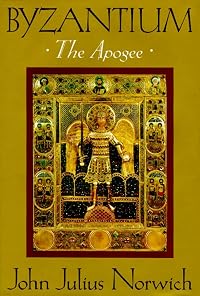
Description
Describes Byzantium's battles against foreign threats, its internal conflicts, the return of iconoclasm in the ninth century, and the struggles between Anatolia's military aristocracy and the eunuchs of the capital.Tags
Recommendations









Member Reviews
This second book in Norwich's trilogy eloquently takes the reader through Byzantium's tangled and complex high period. The journey is intriguing, at times hair-raising (most memorably the desperate and sorry end of Michael V: http://en.wikipedia.org/wiki/Michael_V) and beautifully written throughout.
The author writes with an obvious passion, critical eye and at times a dry wit as he takes the reader over the years starting with the crowning of Charlemagne, through the phases of Iconoclasm and then the Great Schism between the eastern and western churches then on past the pivotal Battle of Manzikert. All through this the Byzantine imperial families are ever restless, making both sound and ludicrous tactical and political decisions that show more see the empire's borders continue to change in an almost fluid fashion. As I turned the last page I felt just as hooked as I ever have been on any work of fiction.
A fine piece. show less
The author writes with an obvious passion, critical eye and at times a dry wit as he takes the reader over the years starting with the crowning of Charlemagne, through the phases of Iconoclasm and then the Great Schism between the eastern and western churches then on past the pivotal Battle of Manzikert. All through this the Byzantine imperial families are ever restless, making both sound and ludicrous tactical and political decisions that show more see the empire's borders continue to change in an almost fluid fashion. As I turned the last page I felt just as hooked as I ever have been on any work of fiction.
A fine piece. show less
The empress Irene having passed on, power comes to Nicephorous I, one of history's great "Fixers". He is decisive and clear about his goals, and after him, the Empire not only survives, but once again is expanding. The Saga continues through to the great catastrophe of Manzikert in 1071. Norwich has a sure hand with this popularization of a crucial age and area of Europe's History. Well worth the time spent reading this one!
A good basic introduction, by the standards of history books a racy read about a much mis-understood civilisation. Read it, enjoy it, but if you want to read more move on to Treadgold etc. for a more exacting description of a fascinating culture.
John Julius Norwich provides in his trilogy an excellent overview of Byzantine civilization. For the general reader looking to get the whole picture, or for the scholar probing into a new field, this book is an excellent introduction. For someone already well acquainted with the Byzantines, this is a narrative history, useful for quick consultation but not as deep in any particular subject as you would probably require.
Muy bueno, se lee como una saga de aventuras mas que como un libro de historia, me hace acordar a la marcha de la locura de Tuchman como se va preanunicando el desastre y nadie hace nada para cambiar el rumbo, da pena la ceguera de la gente. las peles entre los nobles, las intrigas palaciegas y religiosas. En fin la historia de la humanidad
Jan 19, 2015Spanish
Ratings
Members
- Recently Added By
Lists

r/AskHistorians' Recommended Books
1,068 works; 19 members

r/History Recommended Reading List
603 works; 12 members
Author Information

102+ Works 12,694 Members
John Julius Norwich was born in the United Kingdom on September 15, 1929. He served in the Royal Navy before receiving a degree in French and Russian at New College, Oxford. After graduation, he joined the H. M. Foreign Service and served in Belgrade, Beirut, and as a member of British delegation to the Disarmament Conference in Geneva. In 1954, show more he inherited the title of Viscount Norwich. In 1964, he resigned from the Foreign Service to become a writer. He was a historian, travel writer, and television personality. His books included The Normans in the South, A History of Venice, The Italian World, Venice: A Traveller's Companion, 50 Years of Glyndebourne: An Illustrated History, A Short History of Byzantium, Absolute Monarchs: A History of the Papacy, Sicily: An Island at the Crossroads of History, and A History of France. He and H. C. Robbins Landon wrote Five Centuries of Music in Venice. Norwich was the host of the BBC radio panel game My Word! from 1978 to 1982. He wrote and presented more than 30 television documentaries including Maestro, The Fall of Constantinople, Napoleon's Hundred Days, Cortés and Montezuma, Maximilian of Mexico, The Knights of Malta, The Treasure Houses of Britain, and The Death of the Prince Imperial in the Zulu War. In 1993, he was appointed CVO for having curated an exhibition at the Victoria and Albert Museum to mark the 40th anniversary of the Queen's accession to the throne. In 2015, he was awarded the Biographers' Club award for his lifetime service to biography. He died on June 1, 2018 at the age of 88. (Bowker Author Biography) show less
Series

Work Relationships
Is contained in
Common Knowledge
- Canonical title
- Byzantium: The Apogee
- Original title
- Byzantium: The Apogee
- Original publication date
- 1992-01-20
- Important places
- Byzantine Empire; Constantinople; Byzantium
- First words
- There is little to be said by way of introduction to this book, whose purpose is simply to continue the story which I began three years ago with its predecessor.
- Last words
- (Click to show. Warning: May contain spoilers.)But he could, and did, restore to Byzantium its reputation and its good name among nations, thus preparing it to play its part in the great drama that was to begin to unfold even before the end of that turbulent century: the Crusades.
- Original language
- English
Classifications
- Genres
- History, Nonfiction, General Nonfiction, Religion & Spirituality
- DDC/MDS
- 949.5 — History & geography History of Europe Greece, Albania, Yugoslavia, Serbia, Romania, Bulgaria Greece and the Byzantine Empire
- LCC
- DF553 .N66 — History of Europe, Asia, Africa and Oceania Greece History of Greece Medieval Greece. Byzantine Empire, 323-1453 History Eastern Empire, 323/476-1057. Constantine the Great
- BISAC
Statistics
- Members
- 851
- Popularity
- 32,297
- Reviews
- 5
- Rating
- (4.19)
- Languages
- English, German, Spanish, Turkish
- Media
- Paper
- ISBNs
- 6
- ASINs
- 4