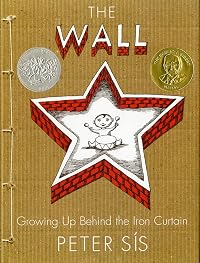
The Wall: Growing Up Behind the Iron Curtain
by Peter Sís
On This Page
Description
I was born at the beginning of it all, on the Red side - the Communist side - of the Iron Curtain. Through annotated illustrations, journals, maps, and dreamscapes, Peter Sis shows what life was like for a child who loved to draw, proudly wore the red scarf of a Young Pioneer, stood guard at the giant statue of Stalin, and believed whatever he was told to believe. But adolescence brought questions. Cracks began to appear in the Iron Curtain, and news from the West slowly filtered into the show more country. Si;s learned about beat poetry, rock 'n' roll, blue jeans, and Coca-Cola. He let his hair grow long, secretly read banned books, and joined a rock band. Then came the Prague Spring of 1968, and for a teenager who wanted to see the world and meet the Beatles, this was a magical time. It was short-lived, however, brought to a sudden and brutal end by the Soviet-led invasion. But this brief flowering had provided a glimpse of new possibilities - creativity could be discouraged but not easily killed. show lessTags
Recommendations
















Member Recommendations
Member Reviews
The Wall: Growing Up Behind the Iron Curtain is a dense and fascinating graphic memoir. Peter Sis recounts his childhood in Prague, Czechoslovakia in the 1960's through elaborate illustrations and carefully chosen words. There are two two-page spreads that include excerpts from his boyhood diary. Although it is a memoir, Sis tells a more universal story of life in Prague and the Eastern bloc during this time as well. It's a fascinating and riveting look into the historical period. This book is dense with historical information, and Sis deftly uses pictures to tell the story of his boyhood. The illustrations in this book use color in a highly emotive way to enhance the story. Because the book is so honest, the depictions of this complex show more time may not be understandable to very young children. show less
This might be my favorite book that I read all semester. Using a graphic novel narrative form in an oversized picture book allowed for both the words and the illustrations to have many details and levels of meaning. Sis writes about the difficult life of being outside of the standards of the perfect communist. His rebellion is in his art, and in his brain, but there are threats to sharing it with others. He captures the paranoia of the iron curtain and the suffering of the people who lived behind it. His illustrated memoir resonates on an emotional and a historical level, and is one of the best picture books I have ever had the pleasure of reading.
Outstanding biographical text that gives readers a glimpse of life behind the Iron Curtain without freedom, choices, and hope. Illustrations marvelously show readers the activities that were forced on people and the suspicion that was prevalent. Wonderful entry point to multiple viewpoints, and stepping into someone else's shoes. There is much to digest from the illustrations that are excellent conversation starters about freedom, dreams, trust, lies, etc. that should lead to excellent classroom discussions.
“I was born at the beginning of it all, on the Red side—the Communist side—of the Iron Curtain.” Through annotated illustrations, journals, maps, and dreamscapes, Peter Sís shows what life was like for a child who loved to show more draw, proudly wore the red scarf of a Young Pioneer, stood guard at the giant statue of Stalin, and believed whatever he was told to believe. But adolescence brought questions. show less
“I was born at the beginning of it all, on the Red side—the Communist side—of the Iron Curtain.” Through annotated illustrations, journals, maps, and dreamscapes, Peter Sís shows what life was like for a child who loved to show more draw, proudly wore the red scarf of a Young Pioneer, stood guard at the giant statue of Stalin, and believed whatever he was told to believe. But adolescence brought questions. show less
This book was about Peter Sis's experience growing up in Czechoslovakia when it was controlled by the Soviets in the mid- 1900s. The Cold War & his schooling under the Soviet rule shaped everything about Sis, but couldn't take away his love of drawing. (He did get really good at drawing tanks and pro-Soviet propaganda though.) These wonderful drawings that are mostly black and white, with the accent of communist Red throughout, (although there are some illustrations with more color - like the Beatles/1960s page!) retell an incredible time in history through the sensitive eyes of one person. There is plenty of straightforward factual & historical information, but it is all kept short, sweet & to the point, so that it effortlessly fits in show more with what the reader is seeing in illustrations. I love his rebellious nature too: 'Every one of us in the academy has to create a piece of art celebrating the Soviet Army. I'm glad I;m in the animation department! I'' just paint the backgrounds and explain that the tanks are coming later'. And I love this story: Sis's first professional assignment in 1975 was to paint a little airport for an album cover. The art director asked him which way his red-and-white wind sock was blowing in the painting. When Sis thought he was joking, he replied that 'if the wind is blowing from west to east, it could be read as coming from West Germany to the Soviet Union', which would get Sis in trouble. What a fantastic piece of artwork this book is! show less
I found The Wall filed in the children's section of my public library, but I really would argue that it belongs, or also belongs, in the adult graphic books section.
This is a memoir by artist Peter Sis of his years growing up in Soviet-controlled Czechoslovakia. Told mostly through pictures (he is also the book’s illustrator), it is in two senses a “portrait of an artist as a young man.”
Part of the book features entries from Sis’s diaries over the years, but the bulk of it consists of detailed montages of events that characterized life in the Communist Bloc. These pictures are drawn in gray, black, and white, with only a few exceptions. This reflects both the bleakness and the categorical imperatives of life under the Soviet show more umbrella. Soviet influence is shown, fittingly, in red. Western cultural incursions are shown in vivid happy colors.
Sis often dreams of being free, and he depicts these dream sequences as well. One, for example, shows two maps – his current land and his dream land (the latter featuring the New York skyline in the corner). The places in his present country have names like “Suspicion” “Corruption” and “Injustice.” On the other map, we can see “Freedom,” “Truth,” “Wisdom,” and “Integrity.” [Oh, would that it were entirely so!]
On the very last two-page panel, he proclaims, “Sometimes dreams come true. On November 9, 1980, the wall fell.” This of course refers to the Berlin Wall (which actually fell out of confusion more than a deliberate effort. See the story here, and check out this very cool interactive historical time line here.)
As Sis explains in the text that runs around the picture:
"One country after another becomes free: Poland (1989), Czechoslovakia (1989), Hungary (1989-1990), East Germany (1989-1990), Romania (1989-1990), and Bulgaria (1989-1990). East and West Germany unite (1990), and the Soviet Union breaks up (1991). The Cold War is over.”
Evaluation: There are quite a few aspects of this Caldecott Honor Book that will appeal to younger children, but I think it will have more value to young people learning about this period of history, and to adults who perhaps will even remember these revolutionary times.
Note: Václav Havel, former president of the Czech Republic, says of the work, “Peter Sís’s book is most of all about the will to live one’s life in freedom and should be required reading for all those who take their freedom for granted.” show less
This is a memoir by artist Peter Sis of his years growing up in Soviet-controlled Czechoslovakia. Told mostly through pictures (he is also the book’s illustrator), it is in two senses a “portrait of an artist as a young man.”
Part of the book features entries from Sis’s diaries over the years, but the bulk of it consists of detailed montages of events that characterized life in the Communist Bloc. These pictures are drawn in gray, black, and white, with only a few exceptions. This reflects both the bleakness and the categorical imperatives of life under the Soviet show more umbrella. Soviet influence is shown, fittingly, in red. Western cultural incursions are shown in vivid happy colors.
Sis often dreams of being free, and he depicts these dream sequences as well. One, for example, shows two maps – his current land and his dream land (the latter featuring the New York skyline in the corner). The places in his present country have names like “Suspicion” “Corruption” and “Injustice.” On the other map, we can see “Freedom,” “Truth,” “Wisdom,” and “Integrity.” [Oh, would that it were entirely so!]
On the very last two-page panel, he proclaims, “Sometimes dreams come true. On November 9, 1980, the wall fell.” This of course refers to the Berlin Wall (which actually fell out of confusion more than a deliberate effort. See the story here, and check out this very cool interactive historical time line here.)
As Sis explains in the text that runs around the picture:
"One country after another becomes free: Poland (1989), Czechoslovakia (1989), Hungary (1989-1990), East Germany (1989-1990), Romania (1989-1990), and Bulgaria (1989-1990). East and West Germany unite (1990), and the Soviet Union breaks up (1991). The Cold War is over.”
Evaluation: There are quite a few aspects of this Caldecott Honor Book that will appeal to younger children, but I think it will have more value to young people learning about this period of history, and to adults who perhaps will even remember these revolutionary times.
Note: Václav Havel, former president of the Czech Republic, says of the work, “Peter Sís’s book is most of all about the will to live one’s life in freedom and should be required reading for all those who take their freedom for granted.” show less
Using simple pictures with little color to great effect, Peter Sis tells his story of growing up in Czechoslovakia when the country was behind the Iron Curtain. Ostensibly for children, the book doesn't hold back from exploring the complexities of living under a Communist regime. The author shows how he was brainwashed as a child and told what to draw, and follows him through his teenage years when he awakened to much of the censorship and control going on around him.
This book is an excellent example of the way in which a story can be powerfully told in graphic form. The Introduction and Afterword serve as the text that grounds the story in history - both the general history of the Cold War, and Peter's personal history as he eventually show more leaves his home country behind. The images make up the bulk of the story, giving a bird's eye view as we very quickly go through twenty or so years of Peter's life and in how small the elements of the illustrations are. Most of the illustrations are black and white, except for the red of Communist flags and the colors of Peter's art. Clips from his journals serve both to move the story along through time and to give readers a fuller view of what's going on in Peter's life, including such things as the music that influenced him and photographs from his childhood. This is a really excellent, rich story that I highly recommend. show less
This book is an excellent example of the way in which a story can be powerfully told in graphic form. The Introduction and Afterword serve as the text that grounds the story in history - both the general history of the Cold War, and Peter's personal history as he eventually show more leaves his home country behind. The images make up the bulk of the story, giving a bird's eye view as we very quickly go through twenty or so years of Peter's life and in how small the elements of the illustrations are. Most of the illustrations are black and white, except for the red of Communist flags and the colors of Peter's art. Clips from his journals serve both to move the story along through time and to give readers a fuller view of what's going on in Peter's life, including such things as the music that influenced him and photographs from his childhood. This is a really excellent, rich story that I highly recommend. show less
Although this book seemed a little dark at first I really loved reading it. I originally had mixed feelings about the book because of the negativity that was gradually portrayed but it became more apparent to me as to why the author set it up in this specific manner. The language and writing that the author used was extremely well thought out and intentional. The main storyline at the bottom of all of the pages guides the reader along in the book however the subtle comments on the sides of the pictures tell the author the reality of it all. For example, the storyline at the bottom of one of the pages read, "After drawing whatever he wanted to at home, he drew whatever he was told to at school." One of the comments beside the pictures show more read, "The Communists take control of the schools." This subtly implies that changes that began in the schools and the restrictions of freedom, including drawing certain images. Another reason why I liked this book was because of the illustrations. The bold red on each page solidified and engraved the communism depicted in the pictures. A third reason why I liked this book was because of the accuracy of it. I loved how Peter was the one telling of these real-life events. Although this is considered a children's book it was also an enjoyable read for me because of the reality of it. I believe that the main message of this book was to inform readers about the life of someone who lived on the inside during the Cold War and the "norms" that they faced. show less
Members
- Recently Added By
Published Reviews
ThingScore 100
CCBC (Cooperative Children's Book Center Choices 2008)
Renowned author and illustrator Peter Sís’ brilliant autobiographical exploration of the creative spirit offers his trademark blend of intricate visual images and narrative. Sís was born in Communist-controlled Brno, Czechoslovakia, in 1949 and displayed artistic interests from very early on. His talents were indulged and encouraged show more within his home. At the same time, creativity and freedom of thought were being repressed in his school and throughout his homeland as the Iron Curtain rose and the Cold War escalated. Sís beautifully outlines the tension between socio-political repression and creativity through journal excerpts, actual drawings from his developing years as an artist, and hauntingly complex images outlining the historical context of turbulent times in Eastern Europe. Each image underscores how he questioned the world around him as a developing child and adolescent, especially as news of Western popular culture filtered through the curtain. Creative expression and opportunity exploded for the author in the spring of 1968, only to be crushed quickly by the totalitarian strong arm. Sís was able to hold on to his dreams, however, fueled by his indomitable spirit and the force of his own imagination. CCBC Category: Historical People, Places, and Events. 2007, Frances Foster Books / Farrar Straus and Giroux, 48 pages, $18.00. Age 9 and older. show less
Renowned author and illustrator Peter Sís’ brilliant autobiographical exploration of the creative spirit offers his trademark blend of intricate visual images and narrative. Sís was born in Communist-controlled Brno, Czechoslovakia, in 1949 and displayed artistic interests from very early on. His talents were indulged and encouraged show more within his home. At the same time, creativity and freedom of thought were being repressed in his school and throughout his homeland as the Iron Curtain rose and the Cold War escalated. Sís beautifully outlines the tension between socio-political repression and creativity through journal excerpts, actual drawings from his developing years as an artist, and hauntingly complex images outlining the historical context of turbulent times in Eastern Europe. Each image underscores how he questioned the world around him as a developing child and adolescent, especially as news of Western popular culture filtered through the curtain. Creative expression and opportunity exploded for the author in the spring of 1968, only to be crushed quickly by the totalitarian strong arm. Sís was able to hold on to his dreams, however, fueled by his indomitable spirit and the force of his own imagination. CCBC Category: Historical People, Places, and Events. 2007, Frances Foster Books / Farrar Straus and Giroux, 48 pages, $18.00. Age 9 and older. show less
added by kthomp25
Lists

A Child's Book Tour of Czech Republic
29 works; 3 members

Favourite Books
1,820 works; 316 members

Caldecott Honor Books
296 works; 22 members

Books Read in 2023
5,638 works; 147 members

Robert F. Sibert Informational Book Medal
102 works; 1 member
Author Information

33+ Works 9,081 Members
Peter Sis was born in Brno, Czechoslovakia, in 1949 and attended the Academy of Applied Arts in Prague and the Royal College of Art in London. He began his career as a filmmaker and won the Golden Bear Award at the 1980 West Berlin Film Festival for an animated short. He has also won the Grand Prix Toronto and the Cine Golden Eagle Award, and in show more 1983 collaborated with Bob Dylan on You Got to Serve Somebody. His film work is in the permanent collection of the Museum of Modern Art, New York. In 1982 Sis was sent to Los Angeles to produce a film for the 1984 Winter Olympics. But the film project was canceled when Czechoslovakia and the entire Eastern bloc decided to boycott the Olympics. Ordered by his government to return home, Sis decided to stay in the United States and was granted asylum. Sis then met Maurice Sendak who introduced him to children's books, and he moved to New York City in 1984 to begin a career in children's literature. Sís earned quick acclaim with the publication of the 1986 Newbery Medal Winner, The Whipping Boy by Sid Fleishman, for which he did the illustrations. Sis is a five-time winner of The New York Times Book Review Best Illustrated Book of the Year.. Komodo! and A Small Tall Tale from the Far Far North were each named a Boston Globe-Horn Book Award Honor Book, and he has won a Society of Illustrators Gold Medal for Komodo! and a Silver Medal for The Three Golden Keys. Starry Messenger: Galileo Galilei was a 1997 Caldecott Honor Book, as was Tibet Through the Red Box. Sis has also received a MacArthur Fellowship Sis' editorial illustrations have appeared in Time, Newsweek, Esquire, The Atlantic Monthly, and many other magazines in the United States and abroad. He has published nearly 1,000 drawings in The New York Times Book Review. He has designed many book jackets and posters, including, in 1984, the famous poster for Milos Forman's Academy Award-winning motion picture Amadeus. He has also completed a mural for the Washington/Baltimore Airport, a poster for the New York City subway system, and a stage set for the Joffrey Ballet. His work has been exhibited in Prague, London, Zurich, Hamburg, Los Angeles, and New York in both group and one-man shows. (Bowker Author Biography) show less
Awards and Honors
Awards
Distinctions
Common Knowledge
- Canonical title
- The Wall: Growing Up Behind the Iron Curtain
- Original title
- The Wall. Growing Up Behind the Iron Curtain
- Original publication date
- 2007 (1e édition originale américaine) (1e édition originale américaine); 2007-10-10 (1e traduction et édition française, Grasset Jeunesse) (1e traduction et édition française, Grasset Jeunesse)
- Important places
- Prague, Czechoslovakia; Czech Republic
- Important events
- Cold War
- First words
- As long as he could remember, he had loved to draw.
- Quotations
- I find it difficult to explain my childhood; it's hard to put it into words, and since I have always drawn everything, I have tried to draw my life-before America-for them.
p. 47 - Last words
- (Click to show. Warning: May contain spoilers.)As long as he can remember, he will continue to draw.
- Original language*
- Anglais (Etats-Unis) (Etats-Unis)
*Some information comes from Common Knowledge in other languages. Click "Edit" for more information.
Classifications
Statistics
- Members
- 1,323
- Popularity
- 18,312
- Reviews
- 145
- Rating
- (4.15)
- Languages
- 10 — Czech, Danish, English, French, German, Italian, Japanese, Portuguese, Slovak, Spanish
- Media
- Paper, Ebook
- ISBNs
- 17
- ASINs
- 3