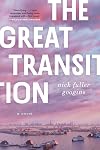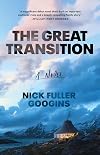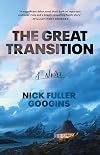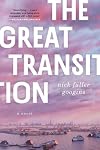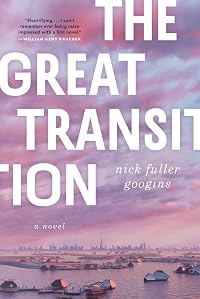
The Great Transition
by Nick Fuller Googins
On This Page
Description
"A hopeful climate crisis novel exploring the possibilities of our near future and humanity's capacity for change, about one family trying to protect each other and the place we all call home"--Tags
Recommendations
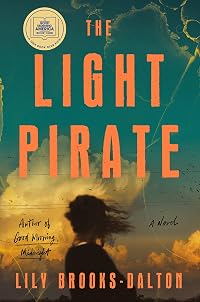
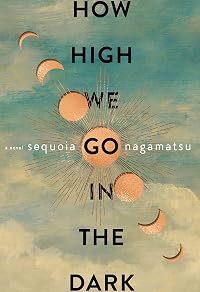
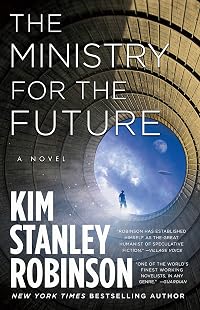
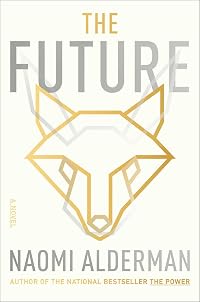

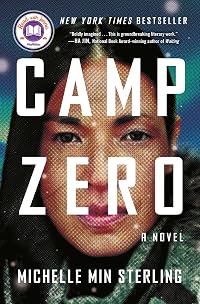
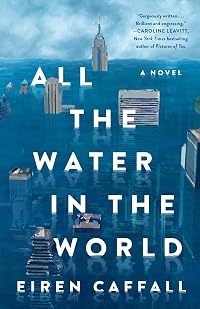
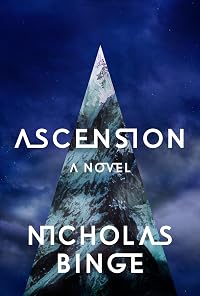
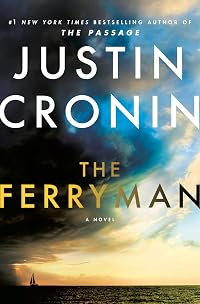
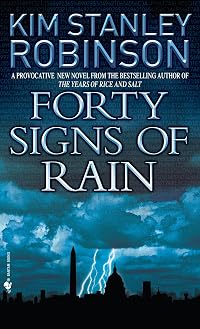
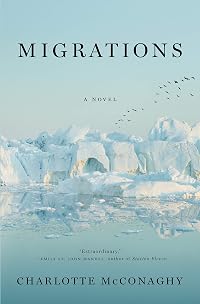
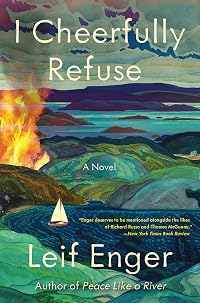
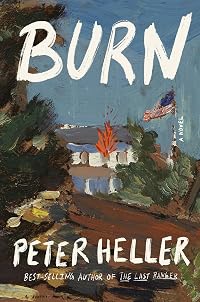


Member Recommendations

Member Reviews
Just when I thought I was through with dystopian climate change fiction, along comes a novel so immersive, so well conceived, and frightening believable that I can’t stop thinking about its implications.
Take everything thing wrong with today’s world, the trajectory of where things are going, and follow it to its most awful fulfillment: the internet merely MemeFeed, the rich using the working classes to protect it’s wealth, wildfires barraging over land that isn’t flooded by collapsing ice sheets. After great devastation, millions of climate refugees treated worse than animals, Earth reaches Net Zero, the Great Transition accomplished. It took the hard labor and sacrifice of volunteer workers to pull it off, like Emi’s parents, show more reality star hero dad fighting fires, her mom separated from her family as a child in the immigrant camps, risking her life for the cause and a heroine in her own right.
Now a father, Emi’s dad takes on the role of protector and primary parent, while her mom bristles at his complacency and constantly reminds Emi of the horror of the past and that society must stay vigilant, continuing the fight. Mom regularly volunteers for duty in New York City, while Dad’s job in Nuuk allows him to give stability to Emi.
Underground groups deal out delayed justice, targeting climate enemies for murder, octogenarian capitalists who never paid for their crimes against the Earth.
With mom gone, Emi convinces her dad to allow her to see the Great Transition celebration that her mother has forbade them to attend. Violence breaks out, and the whole world as Emi knew it collapses. With her father, Emi goes searching for her mom, encountering a shifting reality of good and evil, the journey a refining experience of growth and understanding.
This reads like a thriller, and hits hard with a political punch.
Thanks to the publisher for a free book. My review is fair and unbiased. show less
Take everything thing wrong with today’s world, the trajectory of where things are going, and follow it to its most awful fulfillment: the internet merely MemeFeed, the rich using the working classes to protect it’s wealth, wildfires barraging over land that isn’t flooded by collapsing ice sheets. After great devastation, millions of climate refugees treated worse than animals, Earth reaches Net Zero, the Great Transition accomplished. It took the hard labor and sacrifice of volunteer workers to pull it off, like Emi’s parents, show more reality star hero dad fighting fires, her mom separated from her family as a child in the immigrant camps, risking her life for the cause and a heroine in her own right.
Now a father, Emi’s dad takes on the role of protector and primary parent, while her mom bristles at his complacency and constantly reminds Emi of the horror of the past and that society must stay vigilant, continuing the fight. Mom regularly volunteers for duty in New York City, while Dad’s job in Nuuk allows him to give stability to Emi.
Underground groups deal out delayed justice, targeting climate enemies for murder, octogenarian capitalists who never paid for their crimes against the Earth.
With mom gone, Emi convinces her dad to allow her to see the Great Transition celebration that her mother has forbade them to attend. Violence breaks out, and the whole world as Emi knew it collapses. With her father, Emi goes searching for her mom, encountering a shifting reality of good and evil, the journey a refining experience of growth and understanding.
This reads like a thriller, and hits hard with a political punch.
Thanks to the publisher for a free book. My review is fair and unbiased. show less
In Nick Fuller Googins debut novel, The Great Transition, he captures the post-environmental apocalypse (circa the late twenty-first century) which some have worked tirelessly to lessen by building a different, less resource extraction focused way of living, one that is cooperative and ecologically sound.
Working against them, even in the present, are the wealthy and privileged, who knew exactly what they were doing as they enriched themselves and brought earth's systems to the edge of collapse.
Told through the significant angst of one teen and her parents: a father who naively believes that his hard work has already created a better world and a mother who sees clearly the maneuvering of the wealthy and privileged and determines that show more only radical action can stop their advance.
The Great Transition is a dark, well-written novel that pulls no punches. show less
Working against them, even in the present, are the wealthy and privileged, who knew exactly what they were doing as they enriched themselves and brought earth's systems to the edge of collapse.
Told through the significant angst of one teen and her parents: a father who naively believes that his hard work has already created a better world and a mother who sees clearly the maneuvering of the wealthy and privileged and determines that show more only radical action can stop their advance.
The Great Transition is a dark, well-written novel that pulls no punches. show less
The Great Transition is the climate science fiction we needed. It takes place in the near future on a dual timeline, the earliest is during the years of struggle after the melting ice sheets, droughts, and wildfires have made large parts of the world uninhabitable, the other is a generation later, after humans have reached net zero emissions, a day that is marked by annual celebrations of “The Great Transition.”
The narrators are Larch, one of the heroes of The Great Transition, whose work building barriers to save New York City and fighting forest fires was documented for reality television. His wife, Kristina, was a climate refugee with her family, forced into internment camps where they were abused by racist guards and underfed show more and ill-housed. Those who were willing to do the most dangerous and difficult reclamation and forest-fighting work were allowed to work for their release. Their work brought the two of them together fighting fires in the Yosemite area where they fell in love.
In the later timeline, they live in Nuuk, Greenland. Their daughter Emi is in high school, Larch is chef for a sports team, and Kristina still volunteers annually to spend time on extraction duty, going to the devastated areas to extract energy and salvage what they can of the environment. While Kristina is gone for extraction, Larch and Emi attend the Great Transition celebration, an event Kristina opposed ideologically. Kristina calls Larch and tells them to leave, immediately. Before they can, a bomb explodes. Across the world, the authors of climate destruction are being assassinated. How did Kristina know?
While never articulating their suspicions, Larch and Emi search for Kristina who is not answering her screen (cell phone) and mysterious people are looking for her. They head to New York City, a largely depopulated city that is a central extraction area.
The Great Transition is the kind of hopeful climate fiction we need today. So many climate activists present the climate crisis as an extinction event, prompting despair and a nihilistic acceptance of what’s to come. It’s also unlikely. What is more likely is the future of The Great Transition where many die in weather events triggered by climate change or of privation in refugee camps. A significant remnant of people remain to build a new society in the higher latitudes. In this future, people embrace a more egalitarian communitarian society though many of the climate criminals remain alive and trying to claw back into power. It could have easily gone toward an authoritarian oligarchy, a possibility averted in a confrontation in New York City during the reclamation efforts.
While this future is richly imagined and quite possible, this is not just a climate warning novel. It wrestles with family dynamics, what makes a good parent, what makes a marriage and is love enough to withstand other pressures such as fundamentally conflicting values. Another theme is they ethics of terrorism and assassination when dealing with people whose cupidity destroyed the environment and who itch for the power to do it again. A third important theme is the need for vigilance even when you think things are going well. In a way, this mirrors our national complacency about our democracy and how very real the threat is. These ideas add so much more depth to The Great Transition that one should not just classify it as climate fiction.
I am so grateful to read about a more likely dystopian future that is, in its essentials, hopeful. Humans survive, they work to save the planet, they achieve zero emissions. Right now, a majority of young people in the world think we are doomed. That’s not good. Climate doomerism is less likely to inspire efforts to change our course than optimism. We need more optimism to inspire realistic efforts to change our trajectory toward one of a communitarian environmentalism.
I received an e-galley of The Great Transition from the publisher through Edelweiss.
The Great Transition at Simon & Schuster
Nick Fuller Googins author site
Against Doomerism: A VOX project
https://tonstantweaderreviews.wordpress.com/2023/08/19/the-great-transition-by-n... show less
The narrators are Larch, one of the heroes of The Great Transition, whose work building barriers to save New York City and fighting forest fires was documented for reality television. His wife, Kristina, was a climate refugee with her family, forced into internment camps where they were abused by racist guards and underfed show more and ill-housed. Those who were willing to do the most dangerous and difficult reclamation and forest-fighting work were allowed to work for their release. Their work brought the two of them together fighting fires in the Yosemite area where they fell in love.
In the later timeline, they live in Nuuk, Greenland. Their daughter Emi is in high school, Larch is chef for a sports team, and Kristina still volunteers annually to spend time on extraction duty, going to the devastated areas to extract energy and salvage what they can of the environment. While Kristina is gone for extraction, Larch and Emi attend the Great Transition celebration, an event Kristina opposed ideologically. Kristina calls Larch and tells them to leave, immediately. Before they can, a bomb explodes. Across the world, the authors of climate destruction are being assassinated. How did Kristina know?
While never articulating their suspicions, Larch and Emi search for Kristina who is not answering her screen (cell phone) and mysterious people are looking for her. They head to New York City, a largely depopulated city that is a central extraction area.
The Great Transition is the kind of hopeful climate fiction we need today. So many climate activists present the climate crisis as an extinction event, prompting despair and a nihilistic acceptance of what’s to come. It’s also unlikely. What is more likely is the future of The Great Transition where many die in weather events triggered by climate change or of privation in refugee camps. A significant remnant of people remain to build a new society in the higher latitudes. In this future, people embrace a more egalitarian communitarian society though many of the climate criminals remain alive and trying to claw back into power. It could have easily gone toward an authoritarian oligarchy, a possibility averted in a confrontation in New York City during the reclamation efforts.
While this future is richly imagined and quite possible, this is not just a climate warning novel. It wrestles with family dynamics, what makes a good parent, what makes a marriage and is love enough to withstand other pressures such as fundamentally conflicting values. Another theme is they ethics of terrorism and assassination when dealing with people whose cupidity destroyed the environment and who itch for the power to do it again. A third important theme is the need for vigilance even when you think things are going well. In a way, this mirrors our national complacency about our democracy and how very real the threat is. These ideas add so much more depth to The Great Transition that one should not just classify it as climate fiction.
I am so grateful to read about a more likely dystopian future that is, in its essentials, hopeful. Humans survive, they work to save the planet, they achieve zero emissions. Right now, a majority of young people in the world think we are doomed. That’s not good. Climate doomerism is less likely to inspire efforts to change our course than optimism. We need more optimism to inspire realistic efforts to change our trajectory toward one of a communitarian environmentalism.
I received an e-galley of The Great Transition from the publisher through Edelweiss.
The Great Transition at Simon & Schuster
Nick Fuller Googins author site
Against Doomerism: A VOX project
https://tonstantweaderreviews.wordpress.com/2023/08/19/the-great-transition-by-n... show less
This is a thoroughly researched and gripping page-turner about the future of the planet. Though it leans hopeful, it does a great job capturing the complexity of what could happen both to the Earth and to us as a species: the anger, the hope, the work, the suffering, the adaptation, the inequities, and the cost (financial, emotional, and physical) of success. I listened to the audiobook which was fabulous, especially the voice of Emi. I think this could be a worthwhile read for a teen (I'm trying to get my daughter to read it now) or even a parent-child buddy read -- lots to discuss about agency and generational responsibility. I thought the parent-teen relationships were expertly drawn as well. In addition to this being a show more thought-provoking novel, it was also a fun read, the kind of book I didn't want to put down. I wouldn't mind a sequel... show less
This book has a lot of interesting things to say about how we might finally address the climate crisis, and the high costs of not fixing things sooner, and who's to blame, and who governments tend to prioritize. Interleaved with the big-picture stuff is an intimate portrait of a family and a teenager who's coming of age in the "after", and how the legacy of the crisis affects everyone personally. (Side note: There's a POV character with some serious disordered eating issues; that's the major content warning I'd note in recommending this book.) It's good! I thought the "history project" sections were a great way to do some basic exposition in a way that felt natural to the story. And the ending was good.
In The Great Transition, debut author Nick Fuller Googins delivers an exquisitely built future world where The Crisis almost destroyed everything from fire and floods, but The Transition saved us. In the new present, Emi is a typical teenager — fighting with her parents, struggling to make friends, and managing an eating disorder. Her parents, Larch and Kristina, are famous figures from the Transition who fought for justice and then settled down to have a family, but secrets and danger threaten to blow their quiet existence apart. Although the delivery at times comes across as clunky — especially when Googins falls into one of the drawn-out, preachy dialogues (with no quotation marks) — the message of climate crisis is real and show more packaged in quite a page-turner. The Great Transition delivers an exciting thriller with the soul of an environmental justice novel with themes of family, loyalty, and global responsibility that will appeal to many readers. show less
Being a fan of climate fiction I got this as soon as it was published. I even read the sample chapters because I was so excited about this premise: a family drama set in a world post-transition. Finally a cli-fi novel that doesn’t speak only about the complete downfall of humanity and offers some hope. The family in question consists of two transition heroes and their daughter born in this new world. The conflict comes from the parents’ relationship and their different stances on how to tackle the climate crisis. One of the parents is more revolutionary, while the other is more moderate. I really liked the way book explores those two viewpoints. Just for that reason I give this book 4 stars, as it opens many good questions for show more discussion and would be great for book clubs.
I had an Audible credit, so I gave a chance to the audio book first. The narration was good and engaging, but especially in the audio version I immediately caught what I didn’t like about this novel. Even though there are three PoVs in the book, it felt very YA to me, not only the parts narrated by the teenager. At 30% I switched to an ebook.
Larch was my favorite character and I enjoyed his parts the best, but even those read very clean and YA-like. Kristina was a very unlikeable character, and I felt like she was a character who was conceived with a lot of stereotypes about immigrants etc. There were also some cringey references, mama Greta etc. I guess what I’m trying to say is that for a book with so much vision it lacked a little maturity for me. 3.5 stars. show less
I had an Audible credit, so I gave a chance to the audio book first. The narration was good and engaging, but especially in the audio version I immediately caught what I didn’t like about this novel. Even though there are three PoVs in the book, it felt very YA to me, not only the parts narrated by the teenager. At 30% I switched to an ebook.
Larch was my favorite character and I enjoyed his parts the best, but even those read very clean and YA-like. Kristina was a very unlikeable character, and I felt like she was a character who was conceived with a lot of stereotypes about immigrants etc. There were also some cringey references, mama Greta etc. I guess what I’m trying to say is that for a book with so much vision it lacked a little maturity for me. 3.5 stars. show less
Members
- Recently Added By
Published Reviews
added by JenMDB
Lists

Top Five Books of 2023
767 works; 317 members

naturallogg's 2025 in Books
50 works; 1 member
Author Information

3+ Works 238 Members
Some Editions
Awards and Honors
Awards
Distinctions
Common Knowledge
- Canonical title
- The Great Transition
- Original publication date
- 2023-08-15
- People/Characters
- Emi Vargas; Larch Brinkman
- Epigraph
- For your friends beneath the earth,
for your friends above, prefer
a brutal rage to joy. Perform
the scarlet stroke; erase the cause of criminal and crime. -Aeschylus, "The Libation Bearers" (458 BC)
We are not expecting Utopia here on this earth. But God meant things to be much easier than we have made them. -Dorothy Day, "On Pilgrimage" (1948)
In order to rise
from its own ashes
A phoenix
First
Must
Burn -Octavia Butler "Parable of the Sower" (1993) - First words
- There was this big throwback craze at school that started on Cooperative Day with a band called U2. Cooperative Day is when all the major cooperatives make presentations in the auditorium to convince you to apply. PepsiCo was... (show all) there, and the Alibaba Cooperative and CareCorps (Juniors and Seniors), and Uniqlo and Public Safety and DisneyCo and MemeFeed and tons more. The day isn't so awful except it's on a Sunday and mandatory. It got me out of the garden hours with my mom, but still, who wants to be at school on a weekend? But then Maddie Choi somehow got on the network during the first presentation - the Carbon Capture Cooperative was onstage - and she cast a song, "Sunday Bloody Sunday," through the auditorium. It was hilarious. Maddie Choi was a hero - for the prank and for introducing us all to U2. I remember sitting in the auditorium, laughing, and then suddenly quiet with everyone as we were like How come we've heard heard anything this good before?
- Blurbers
- Krueger, William Kent
- Original language
- English
- Canonical DDC/MDS
- 813.6
- Canonical LCC
- PS3606.U5585
Classifications
Statistics
- Members
- 204
- Popularity
- 160,726
- Reviews
- 11
- Rating
- (3.79)
- Languages
- English
- Media
- Paper, Audiobook, Ebook
- ISBNs
- 8
- ASINs
- 4