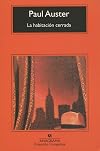
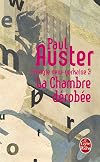
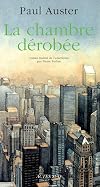
The Locked Room
by Paul Auster
On This Page
Description
"The narrator gets a summons from Sophie, the wife of his boyhood friend Fanshawe, who has vanished mysteriously, and then from Fanshawe himself. He is to oversee the publication of Fanshawe's waywardly brilliant works, marry his deserted wife and reconstruct Fanshawe's life in order to write his biography"--Publisher's Weekly.Tags
Recommendations


















Member Reviews
The Locked Room is the final book of the New York Trilogy. I wrote reviews of the previous novels in sections, each an impression after completing one book of the three. I expected to gain insights into the previous books as I finished subsequent books. I was mistaken.
The New York Trilogy's main story is told in The Locked Room. The unnamed author, who narrates this novel and who appears at the end of the previous two novels, is tasked by his childhood friend Fanshawe with curating his literary opus. This assignment is conveyed via Fanshawe's widow. Like the characters in the previous novels, Fanshawe's significance to the novel is defined by his absence from the novel. Also similar to the previous novels, the narrator loses touch with show more reality during his winding journey to find Fanshawe. In the end, however, the story told is independent of those told in City of Glass and Ghosts. The truth in the fictive author's claim that "these three stories are finally the same story" refers to the repetitive nature of each novel's plot; the three novels remain only tangentially connected.
Similar to both City of Glass and Ghosts, The Locked Room is a well-written, somewhat entertaining novel, but I wouldn't include it on my must-read list. While the narrator's story is ultimately resolved, his mysterious appearances at the end of each of the previous two novels makes him essentially irrelevant to those novels. With some minor revision (explaining who Peter Stillman is within this novel or, better yet, omitting him altogether), this novel could stand on its own. That leaves me confused why these three novels are considered a trilogy, which diminishes their ultimate value. show less
The New York Trilogy's main story is told in The Locked Room. The unnamed author, who narrates this novel and who appears at the end of the previous two novels, is tasked by his childhood friend Fanshawe with curating his literary opus. This assignment is conveyed via Fanshawe's widow. Like the characters in the previous novels, Fanshawe's significance to the novel is defined by his absence from the novel. Also similar to the previous novels, the narrator loses touch with show more reality during his winding journey to find Fanshawe. In the end, however, the story told is independent of those told in City of Glass and Ghosts. The truth in the fictive author's claim that "these three stories are finally the same story" refers to the repetitive nature of each novel's plot; the three novels remain only tangentially connected.
Similar to both City of Glass and Ghosts, The Locked Room is a well-written, somewhat entertaining novel, but I wouldn't include it on my must-read list. While the narrator's story is ultimately resolved, his mysterious appearances at the end of each of the previous two novels makes him essentially irrelevant to those novels. With some minor revision (explaining who Peter Stillman is within this novel or, better yet, omitting him altogether), this novel could stand on its own. That leaves me confused why these three novels are considered a trilogy, which diminishes their ultimate value. show less
“It seems to me now that Fanshawe was always there. He is the place where everything begins for me, and without him I would hardly know who I am.” So begins ‘The Locked Room’, Paul Auster’s final novel in his ‘New York Trilogy’ where an unnamed 1st person narrator tells the tale using the simple, straightforward language of detective fiction. In this way, the novel makes for easy reading.
But underneath this hard-boiled linguistic skin, oh my goodness, we encounter the narrator, a writer by profession, navigating the choppy waters of passion and commitment, forever brooding on an entire range of topics: life and death, self and other, childhood and memory, friendship and fatherhood, love and hate, reading and writing, show more self-definition and self-identity.
In a strange, offbeat way, all the philosophic reflections and ruminations give Auster’s short novel an irresistible drive. Fanshawe was a writer, leaving boxes of novels, journals, poetry and plays to be read and judged. Fanshawe also leaves his beautiful wife, Sophie, and his baby boy. Sophie contacts the narrator, who was Fanshawe’s dearest friend, to do the reading and judging. To tell more than these few facts would be to tell too much. Let me simply say that once I started reading ‘The Locked Room’, I couldn’t put it down. show less
“It seems to me now that Fanshawe was always there. He is the place where everything begins for me, and without him I would hardly know who I am.” So begins ‘The Locked Room’, Paul Auster’s final novel in his ‘New York Trilogy’ where an unnamed 1st person narrator tells the tale using the simple, straightforward language of detective fiction. In this way, the novel makes for easy reading.
But underneath this hard-boiled linguistic skin, oh my goodness, we encounter the narrator, a writer by profession, navigating the choppy waters of passion and commitment, forever brooding on an entire range of topics: life and death, self and other, childhood and memory, friendship and fatherhood, love and hate, reading and writing, show more self-definition and self-identity.
In a strange, offbeat way, all the philosophic reflections and ruminations give Auster’s short novel an irresistible drive. Fanshawe was a writer, leaving boxes of novels, journals, poetry and plays to be read and judged. Fanshawe also leaves his beautiful wife, Sophie, and his baby boy. Sophie contacts the narrator, who was Fanshawe’s dearest friend, to do the reading and judging. To tell more than these few facts would be to tell too much. Let me simply say that once I started reading ‘The Locked Room’, I couldn’t put it down. show less
Aun cuando se pueden leer por separadas las tres novelas y tener sentido, es ésta la que viene a ligar a todas con un hilo conductor casi invisible. Los tres tomos tienen en común: detectives, alguien que 'desaparece' (en ocasiones, transformarse puede ser desaparecer de tu contorno cotidiano) y la Literatura.
Part the third!
This is probably the least detective-y of the three novels, but it too centers around one man's private investigation that gradually spirals out of control. It also involves two more writers.
I enjoyed reading this one as much as the two previous novels, but I don't think it stuck with me as well. I read it most recently of the three and already many details are fading. As with the others, I found the twists were fairly predictable and the ending was ultimately unsatisfying. I might actually have to lower this one to three stars.
This is probably the least detective-y of the three novels, but it too centers around one man's private investigation that gradually spirals out of control. It also involves two more writers.
I enjoyed reading this one as much as the two previous novels, but I don't think it stuck with me as well. I read it most recently of the three and already many details are fading. As with the others, I found the twists were fairly predictable and the ending was ultimately unsatisfying. I might actually have to lower this one to three stars.
I like Auster alot & will probably continue to read his bks - BUT I get the feeling he's stylistically sortof a one trick pony.
I found “The Locked Room” more bearable than the first two books in the trilogy, but apart from the occasional interesting scene, the novel lacks engagement. In short, it bored me.
Members
- Recently Added By
Lists

1,001 BYMRBYD Concensus
723 works; 27 members

Books Read in 2015
3,299 works; 126 members

My TBR
371 works; 3 members
Author Information

106+ Works 64,987 Members
Paul Auster was born on February 3, 1947, in Newark, New Jersey. He received a B.A. and a M.A. in English and Comparative Literature from Columbia University. In addition to his career as a writer, Auster has been a census taker, tutor, merchant seaman, little-league baseball coach, and a telephone operator. He started his writing career as a show more translator. He soon gained popularity for the detective novels that make up his New York Trilogy. His other works include The Invention of Solitude; Leviathan; Moon Palace; Facing the Music; In the Country of Last Things; The Music of Chance; Mr. Vertigo; and The Brooklyn Follies. His latest novels are entitled, Invisible and Sunset Park. In addition to his novels, Auster has written screenplays and directed several films. He is the recipient of a fellowship from the National Endowment for the Arts and a French Prix Medicis for Foreign Literature. (Bowker Author Biography) show less
Some Editions
Series
Belongs to Publisher Series
Work Relationships
Is contained in
Common Knowledge
- Canonical title
- The Locked Room
- Original title
- The locked room
- Original publication date
- 1987-01-20
- Important places
- New York, New York, USA
- First words*
- Nykyään minusta tuntuu että Fanshawe oli aina läsnä.
- Last words*
- (Click to show. Warning: May contain spoilers.)Pääsin viimeiseen sivuun juuri kun juna oli lähdössä.
- Original language*
- englanti
*Some information comes from Common Knowledge in other languages. Click "Edit" for more information.
Classifications
Statistics
- Members
- 487
- Popularity
- 62,340
- Reviews
- 16
- Rating
- (3.79)
- Languages
- 13 — Danish, Dutch, English, Finnish, French, German, Greek, Italian, Japanese, Portuguese (Brazil), Spanish, Swedish, Turkish
- Media
- Paper
- ISBNs
- 20
- ASINs
- 4