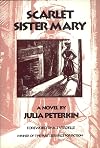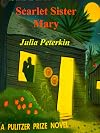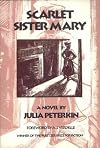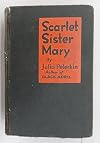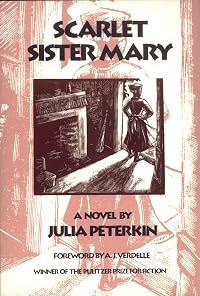
Scarlet Sister Mary
by Julia Peterkin
On This Page
Description
Banned in Boston when it was first published in 1928, Scarlet Sister Mary is the story of a sexy, independent, and outspoken woman who lives to please herself. Abandoned by her husband, the heroine takes many lovers, loses her firstborn son, and eventually "finds peace" as a church member, although she refuses to give up her love charm and her gold hoop earrings. Scarlet Sister Mary shocked readers with its sensual portrayal of a black woman's private life, but it was universally lauded for show more its honesty and courage. The first edition sold more than one million copies worldwide, and was awarded the Pulitzer Prize for Fiction in 1929. show lessTags
Recommendations














Member Reviews
Julia Peterkin pioneered in demonstrating the literary potential for serious depictions of the African American experience. Rejecting the prevailing sentimental stereotypes of her times, she portrayed her black characters with sympathy and understanding, endowing them with the full dimensions of human consciousness.
In these novels and stories, she tapped the richness of rural southern black culture and oral traditions to capture the conflicting realities in an African American community and to reveal a grace and courage worthy of black pride. (From the publisher.)
~~~~
Scarlet Sister May is vibrant with the urge of life, poetical in its conception and finished in its art. Oklahoma City Oklahoman
~~~~
Scarlet Sister Mary is a noble book, show more reaching into the hearts of a simple and highly attractive people. It is a novel like fine old wood, deep-grained, pungent, stout. Philadelphia Public Ledger
~~~~
All but cries with color, scent, sound, in a style that is a happy combination of solidity, brilliance and pure beauty. New York Times
~~~~
While all these things may be true, I still cannot ignore the silent scream that was in my head the entire time I was reading Sister Mary.
Julia Peterkin may have been correct in her representations, but she was also a White American; moreover, a WA who was married to a plantation owner and who enjoyed immense and (probably) undue privilege in her lifetime, having garnered it on the backs of those people she ultimately came to write about. I am having the most difficult time in my life deciding whether she honours the memory of the Gullah people of South Carolina, or whether this is the most egregious example appropriation of voice ever written.
Usually there are some clues to tip the reader one way or the other, but this one leaves me ... without breath ...
The novel is enjoyable, and very well written. There isn't one weak note that jumps out and says, "I am false", whether or not one agrees with the heavy-handed Christian ethos that runs like a spine throughout the work. Scarlet Mary is true to herself, right to the end: always on the edge of reconciling with God, in the end she strives for and achieves the ultimate conversion: accepted by her community, but very much on her own terms.
I cannot begin to imagine why Peterkin chose to write this book in this voice -- there is very little biographical information available on her. What there is is sparse, and repetitive: obviously each culled, almost verbatim, from previous sources.
The novel won the Pulitzer Prize in 1929 amid controversy, but no one speaks of the objections in any detail: Dr. Richard S. Burton resigned from the committee when his own choice was not upheld for John Rathbone Oliver's Victim and Victor. There are a few enigmatic hints that Peterkin's novel was rejected, based on "obscenity", but that charge was never elaborated. Was it obscene because Sister Mary had (most of her) children out of wedlock or was it obscene because she seemed to turn her back on God? Was it obscene because she dared write an African-American's story; or obscene because she wrote an African American's story through appropriation of voice?
In 1930, Ethel Barrymore starred in a blackface performance of this novel, on Broadway.
And there lies the rub ...
Was Barrymore being true to the author's intent?
I had a nagging feeling throughout that Peterkin may not have been completely on the up-and-up in wishing to portray a true vision of the Gullah. I was overwhelmed with doubt about her authenticity. What kept coming to mind was Scarlet O'Hara writing a book in Mammy's voice: in true Scarlet fashion, she would use it to advance her own cause.
My impressions of Peterkin may be completely off-centre, but it is a persistent doubt that I will continue to carry. Far too many questions are left unanswered in her sketchy biography. It is interesting to me that she later became an actress, a role that perhaps suited her better in the end.
I will return to Peterkin one day to pursue my doubts. For now, I'll let her rest at a comfortable 3 stars. show less
In these novels and stories, she tapped the richness of rural southern black culture and oral traditions to capture the conflicting realities in an African American community and to reveal a grace and courage worthy of black pride. (From the publisher.)
~~~~
Scarlet Sister May is vibrant with the urge of life, poetical in its conception and finished in its art. Oklahoma City Oklahoman
~~~~
Scarlet Sister Mary is a noble book, show more reaching into the hearts of a simple and highly attractive people. It is a novel like fine old wood, deep-grained, pungent, stout. Philadelphia Public Ledger
~~~~
All but cries with color, scent, sound, in a style that is a happy combination of solidity, brilliance and pure beauty. New York Times
~~~~
While all these things may be true, I still cannot ignore the silent scream that was in my head the entire time I was reading Sister Mary.
Julia Peterkin may have been correct in her representations, but she was also a White American; moreover, a WA who was married to a plantation owner and who enjoyed immense and (probably) undue privilege in her lifetime, having garnered it on the backs of those people she ultimately came to write about. I am having the most difficult time in my life deciding whether she honours the memory of the Gullah people of South Carolina, or whether this is the most egregious example appropriation of voice ever written.
Usually there are some clues to tip the reader one way or the other, but this one leaves me ... without breath ...
The novel is enjoyable, and very well written. There isn't one weak note that jumps out and says, "I am false", whether or not one agrees with the heavy-handed Christian ethos that runs like a spine throughout the work. Scarlet Mary is true to herself, right to the end: always on the edge of reconciling with God, in the end she strives for and achieves the ultimate conversion: accepted by her community, but very much on her own terms.
I cannot begin to imagine why Peterkin chose to write this book in this voice -- there is very little biographical information available on her. What there is is sparse, and repetitive: obviously each culled, almost verbatim, from previous sources.
The novel won the Pulitzer Prize in 1929 amid controversy, but no one speaks of the objections in any detail: Dr. Richard S. Burton resigned from the committee when his own choice was not upheld for John Rathbone Oliver's Victim and Victor. There are a few enigmatic hints that Peterkin's novel was rejected, based on "obscenity", but that charge was never elaborated. Was it obscene because Sister Mary had (most of her) children out of wedlock or was it obscene because she seemed to turn her back on God? Was it obscene because she dared write an African-American's story; or obscene because she wrote an African American's story through appropriation of voice?
In 1930, Ethel Barrymore starred in a blackface performance of this novel, on Broadway.
And there lies the rub ...
Was Barrymore being true to the author's intent?
I had a nagging feeling throughout that Peterkin may not have been completely on the up-and-up in wishing to portray a true vision of the Gullah. I was overwhelmed with doubt about her authenticity. What kept coming to mind was Scarlet O'Hara writing a book in Mammy's voice: in true Scarlet fashion, she would use it to advance her own cause.
My impressions of Peterkin may be completely off-centre, but it is a persistent doubt that I will continue to carry. Far too many questions are left unanswered in her sketchy biography. It is interesting to me that she later became an actress, a role that perhaps suited her better in the end.
I will return to Peterkin one day to pursue my doubts. For now, I'll let her rest at a comfortable 3 stars. show less
Written by a white Southern author who found the lives of blacks more interesting than whites'. Sixteen-year-old Mary is two months pregnant with July's child when they marry. A year later, July disappears with another woman. Mary falls into a depressed funk but manages to overcome it with the help of Maum Hannah and Budda Ben who both raised Mary from her youth. Mary goes on to have 8 more children with different men, doing what she pleases despite being kicked out of Heaven's Gate church and the disapproval of the community. For its time, the book reveals the humanity of blacks but not without some condescension on the part of the author (again, reflecting the times). Pullitzer Prize winner in 1929.
I didn't dislike this book but it was a bit of a chore to get through. It told the tale of a black community trying to figure out their new freedom. It followed the life of Sister Mary and her dozen children. None of the characters particularly stood out to me and I wasn't really taken in by the narrative. It was interesting from a historical perspective, but I would have liked to see more emotion coming from it, or being elicited from me.
In summation : I can't say that I'm particularly thrilled to have read this, nor do I expect it to stay with me for long. This is one of those books that a year from now I will be unable to recall much about.
In summation : I can't say that I'm particularly thrilled to have read this, nor do I expect it to stay with me for long. This is one of those books that a year from now I will be unable to recall much about.
I'm not really sure what I thought of this book. Mary was an interesting character, and watching her go through life, raising her kids, and dealing with a somewhat harsh life was interesting. I wasn't bored while reading the book, but I wasn't devouring each page either. The ending was a little abrupt, and due to the religious nature of the book, I'm not really sure that I got the overall message. It was an easy read though, and a relaxing one.
This is a book that won the 1929 Pulitzer Prize in fiction.
It tells the story of Southern Life and describes the life of Mary who still lives in the Blue Brook Plantation.
She doesn't have any memory of her parents but thinks of Maum Hannah and Buddah Ben as those being as close to parents as can be.
She marries a wild man and soon bears his child. Then she begins a life that is wild and has many lovers.
There is also realistic dialogue and setting descriptions so that the reader can visualize the action as if they were there.
Also, faith comes into the story where after years of a wild life, Mary turns back to her childhood faith.
It tells the story of Southern Life and describes the life of Mary who still lives in the Blue Brook Plantation.
She doesn't have any memory of her parents but thinks of Maum Hannah and Buddah Ben as those being as close to parents as can be.
She marries a wild man and soon bears his child. Then she begins a life that is wild and has many lovers.
There is also realistic dialogue and setting descriptions so that the reader can visualize the action as if they were there.
Also, faith comes into the story where after years of a wild life, Mary turns back to her childhood faith.
Thoroughly enjoyable.
541. Scarlet Sister Mary by Julia Peterkin (read May 1958) (Pulitzer fiction prize for 1929) This was the Pulitzer prize winner for fiction for 1929, and was read when I was doing all such winners.
Members
- Recently Added By
Lists

Pulitzer Prize Winners for Fiction
102 works; 54 members

Trinity College Booklist (1951): Class Ten, English Literature
358 works; 5 members

Best Books of 1926-1935
403 works; 10 members

Publisher's Weekly Bestsellers Part I - 1895-1939
399 works; 8 members
Author Information

7+ Works 309 Members
Awards and Honors
Awards
Distinctions
Series
Belongs to Publisher Series
Common Knowledge
- Canonical title
- Scarlet Sister Mary
- Original publication date
- 1928
- Dedication
- To William George Peterkin
- First words
- The black people who live in the Quarters at Blue Brook Plantation believe they are far the best black people living on the whole "Neck," as they call that long, narrow, rich strip of land lying between the sea on one side an... (show all)d the river with its swamps and deserted rice-fields on the other.
- Last words
- (Click to show. Warning: May contain spoilers.)"E's all I got now to keep me young."
Classifications
Statistics
- Members
- 240
- Popularity
- 135,389
- Reviews
- 7
- Rating
- (3.44)
- Languages
- English
- Media
- Paper, Ebook
- ISBNs
- 9
- ASINs
- 22