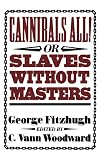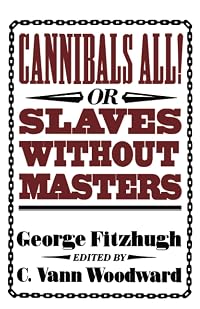
Cannibals All! Or, Slaves without Masters
by George Fitzhugh
On This Page
Description
Cannibals All! got more attention in William Lloyd Garrison's Liberator than any other book in the history of that abolitionist journal. And Lincoln is said to have been more angered by George Fitzhugh than by any other pro-slavery writer, yet he unconsciously paraphrased Cannibals All! in his House Divided speech. Fitzhugh was provocative because of his stinging attack on free society, laissez-faire economy, and wage slavery, along with their philosophical underpinnings. He used socialist show more doctrine to defend slavery and drew upon the same evidence Marx used in his indictment of capitalism. Socialism, he held, was only "the new fashionable name for slavery," though slavery was far more humane and responsible, "the best and most common form of socialism." His most effective testimony was furnished by the abolitionists themselves. He combed the diatribes of their friends, the reformers, transcendentalists, and utopians, against the social evils of the North. "Why all this," he asked, "except that free society is a failure?" The trouble all started, according to Fitzhugh, with John Locke, "a presumptuous charlatan," and with the heresies of the Enlightenment. In the great Lockean consensus that makes up American thought from Benjamin Franklin to Franklin Roosevelt, Fitzhugh therefore stands out as a lone dissenter who makes the conventional polarities between Jefferson and Hamilton, or Hoover and Roosevelt, seem insignificant. Beside him Taylor, Randolph, and Calhoun blend inconspicuously into the American consensus, all being apostles of John Locke in some degree. An intellectual tradition that suffers from uniformity--even if it is virtuous, liberal conformity--could stand a bit of contrast, and George Fitzhugh can supply more of it than any other American thinker. show lessTags
Recommendations










Member Reviews
i love this. it's a primary source in its own right for the antebellum period, but still is meaningful today for those of us trapped in the corporate culture we inherited after the industrial revolution. a fresh perspective on work and society.
Insightful commentary into the meaning of labor and its relation to capital. Fitzhugh proves himself a more than capable defender of the antebellum South while offering a damning critique of values we now take for granted in the modern world.
"Lincoln was said to have been more angered By George Fitzhugh than by any other pro-slavery writer..."
Ratings
Members
- Recently Added By
Lists

Works Cited in The History of White People by Nell Irvin Painter
321 works; 2 members
Author Information

4+ Works 189 Members
All Editions
Series
Belongs to Publisher Series
Common Knowledge
- Canonical title
- Cannibals All! Or, Slaves without Masters
- Original publication date
- 1856
- Dedication
- TO THE HONORABLE HENRY A. WISE (lengthy letter follows)
- First words
- Preface: I have endeavored, in this work, to treat the subjects of Liberty and Slavery in a more rigidly analytical manner than in Sociology for the South; and, at the same time, to furnish the reader with abundance of facts,... (show all) authorities, and admissions, whereby to test the truth of my views.
- Last words
- (Click to show. Warning: May contain spoilers.)We want to be friends with them and with all the world; and, as the curtain is falling, we conclude with the valedictory and invocation of the Roman actor -- "Vos valente! et plaudite!"
Classifications
- Genres
- Nonfiction, History, General Nonfiction, Politics and Government, Philosophy
- DDC/MDS
- 326.973 — Society, government, & culture Political science Slavery and emancipation Biography and History
- LCC
- E449 .F555 — History of the United States United States Revolution to the Civil War, 1775/1783-1861 Slavery in the United States. Antislavery
- BISAC
Statistics
- Members
- 113
- Popularity
- 287,954
- Reviews
- 3
- Rating
- (3.75)
- Languages
- English
- Media
- Paper, Ebook
- ISBNs
- 9
- ASINs
- 4