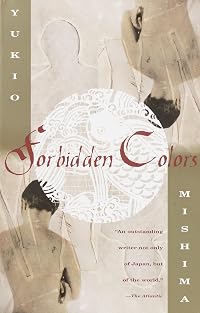
Forbidden Colors
by Yukio Mishima
On This Page
Description
Irresistible to women, the beautiful, young Yuichi embarks on a loveless marriage while he enters a homosexual underworld during postwar Japan.Tags
Recommendations




Member Recommendations

Member Reviews
An early Mishima novel that shows him at his most paradoxical. The style is mannered at times, realist at others. It is highly referential to a specific post-war Japanese culture, half-way between defeat and economic miracle, and yet looks back to European decadent and classical literature.
There are two barriers to understanding here. First, we wonder whether the translator (Alfred Marks) has always been able to communicate the subtle behaviourial codes of an upper class that hovers between traditionalism and business.
Second, Mishima's partly satirical posturing on art and beauty through the cynical, bored and rather unpleasant novelist Shinsuke, will result in some small moments of dreariness. Few of us in the twenty-first century can show more get truly excited by debates on lost aesthetics.
But these are relatively minor concerns because Mishima brilliantly portrays the homosexual underworld of post-war Tokyo in a culture that disapproves of it but more as a social weakness than as a moral failing. It is 'unnatural' but not 'evil'.
The mood is thus of turn of the century Europe rather than offering us the visceral horror of the 'deviant' to be found in the then-contemporary West and still to be found amongst many religious troglodytes in the Americas and Africa.
A sub-culture is here denied entry into the wider culture on equal terms but it is allowed its dark space. In that space, homosexuals seem to live a vacant and sad but tolerated life, albeit with more than a hint of desperation.
Mishima (when he is not posturing as the superior Japanese traditionalist able to be more modern than the moderns) writes as brilliantly here as elsewhere. He also has the ability to dissect formal heterosexual relationships as he does homosexual within a culture of shame rather than guilt.
The character of Yuichi (Yuchan to his homosexual associates), often taken to be Mishima himself, remains a cypher throughout - a cool and self-regarding person with a limited emotional range.
What is more interesting is the way he impacts on others, giving us the paradox of the cool 'Mishima' being able to define quite precisely the emotional responses of a range of figures: his wife, his mother, a high-born female, a shallow female and all grades of male lover.
As a non-procreative male, the extent of Mishima's imaginative genius can be found not only in his portayal of women but in his unsentimental portrayal of a new-born baby while giving a good account of the way that Yuichi (as a man) can 'love' both wife and baby as a father.
The book is about the complexity, lack of fixedness, of love. Yuichi is detached but no psychopath. He can feel but his position as the object of projected desires means that he is often not allowed to by circumstances. If he 'weakens', he may be denied access to his true nature for ever.
This is the fascination of the book - to see how a pure beauty without apparent moral content creates a range of desires and 'wants' in others within a society that is layered with codes on what is acceptable or is not acceptable, wholly unlike our own in the West.
It is no accident that the sophisticated novelist with a broad education brings cruelties and small evils into the world of Yuichi, whereas Yuichi merely acts, like an animal, according to his rather limited range of needs.
Shunsuke's desire for a vicious revenge on women shows a person who has ceased to function as a human being and has no place on the planet as a vindictive, dessicated old man who has lost his creative spark.
His agent (Yuichi) is so detached that it becomes clear that the novelist is only half directing events. The women he wants to humiliate are all humiliated through Yuichi but they retain their power and dignity and Shunsuke is left with nothing.
Yuichi blithely sails through the events of the novel, somehow always landing on his feet like a cat, never feeling the pain he inflicts. The book is an essay both in the injustice of life and on the Nietzschean position of a general object of desire in the world.
As a result, although the actual sexual content is limited, the book gives off an aura of eroticism even when the reader (like myself) is very dominantly heterosexual.
What Mishima does, which is remarkable, is suggest to the male heterosexual reader what parts of himself as a male would re-emerge intact within a homosexual male - in other words, what it is about being a male that exists as essential whether one is gay or not.
To make a heterosexual male empathetic to the world of the homosexual would be no mean feat today - in the early 1950s, it would have been startling.
But the book is not so much about homosexuality as about desire itself and the way that desire has a life that is far more significant than any actual meaning to be placed in the desired object - because, in the end, Yuichi is always simply an object who finds it reasonable to be an object.
There are few occasions when Yuichi/Yuchan expresses genuine unhappiness so long as he is following his true nature. His cruelty is casual, the flow of the river through the easiest channel. Shunsuke is malicious as are others but Yuchan is as disinterested in malice as in kindness.
This a-morality (not immorality) is perhaps what will 'shock' most readers - especially in one particularly nasty incident where a somewhat shallow bimbo who had hurt the novelist is seduced by the two conspirators' trickery into being, in effect, raped by the novelist in the dark.
The women are treated like objects in a very different sense but there is a sense that the novelist has seduced Yuichi into treating women as things through being directed into the realisation that everyone treats him as a thing (even if he does not care overly).
And, disturbingly, we have none of the hysterical self-traumatizing of Western women but only a determined dignity where the impression is left that these women have come to terms with their position with far more dignity than the ultimate loser in the game - the manipulative novelist.
The book brings us, the Westerner (from a culture with a serious problem in managing desire), into a medium (Japanese traditional culture) that is alienating to the degree that desire is clearly given form and that this form is then articulated in almost ritualistic ways.
By the end of the book, we are left wondering whether it would be better or worse to give desire its outlet through rigid codes and appropriate forms than (as our culture did at that time) deny it any role in formal society at all.
Homosexuality was illegal in the UK at the time the book appeared but, being Japanese, nothing is illegal here, merely shameful.
Any English homosexual reading the translation at the time must have had mixed feelings about its message - an acceptance and management of shame through combinations of secrecy, hypocrisy and denial but the 'vice' being permitted nevertheless. He might have lived with that. show less
There are two barriers to understanding here. First, we wonder whether the translator (Alfred Marks) has always been able to communicate the subtle behaviourial codes of an upper class that hovers between traditionalism and business.
Second, Mishima's partly satirical posturing on art and beauty through the cynical, bored and rather unpleasant novelist Shinsuke, will result in some small moments of dreariness. Few of us in the twenty-first century can show more get truly excited by debates on lost aesthetics.
But these are relatively minor concerns because Mishima brilliantly portrays the homosexual underworld of post-war Tokyo in a culture that disapproves of it but more as a social weakness than as a moral failing. It is 'unnatural' but not 'evil'.
The mood is thus of turn of the century Europe rather than offering us the visceral horror of the 'deviant' to be found in the then-contemporary West and still to be found amongst many religious troglodytes in the Americas and Africa.
A sub-culture is here denied entry into the wider culture on equal terms but it is allowed its dark space. In that space, homosexuals seem to live a vacant and sad but tolerated life, albeit with more than a hint of desperation.
Mishima (when he is not posturing as the superior Japanese traditionalist able to be more modern than the moderns) writes as brilliantly here as elsewhere. He also has the ability to dissect formal heterosexual relationships as he does homosexual within a culture of shame rather than guilt.
The character of Yuichi (Yuchan to his homosexual associates), often taken to be Mishima himself, remains a cypher throughout - a cool and self-regarding person with a limited emotional range.
What is more interesting is the way he impacts on others, giving us the paradox of the cool 'Mishima' being able to define quite precisely the emotional responses of a range of figures: his wife, his mother, a high-born female, a shallow female and all grades of male lover.
As a non-procreative male, the extent of Mishima's imaginative genius can be found not only in his portayal of women but in his unsentimental portrayal of a new-born baby while giving a good account of the way that Yuichi (as a man) can 'love' both wife and baby as a father.
The book is about the complexity, lack of fixedness, of love. Yuichi is detached but no psychopath. He can feel but his position as the object of projected desires means that he is often not allowed to by circumstances. If he 'weakens', he may be denied access to his true nature for ever.
This is the fascination of the book - to see how a pure beauty without apparent moral content creates a range of desires and 'wants' in others within a society that is layered with codes on what is acceptable or is not acceptable, wholly unlike our own in the West.
It is no accident that the sophisticated novelist with a broad education brings cruelties and small evils into the world of Yuichi, whereas Yuichi merely acts, like an animal, according to his rather limited range of needs.
Shunsuke's desire for a vicious revenge on women shows a person who has ceased to function as a human being and has no place on the planet as a vindictive, dessicated old man who has lost his creative spark.
His agent (Yuichi) is so detached that it becomes clear that the novelist is only half directing events. The women he wants to humiliate are all humiliated through Yuichi but they retain their power and dignity and Shunsuke is left with nothing.
Yuichi blithely sails through the events of the novel, somehow always landing on his feet like a cat, never feeling the pain he inflicts. The book is an essay both in the injustice of life and on the Nietzschean position of a general object of desire in the world.
As a result, although the actual sexual content is limited, the book gives off an aura of eroticism even when the reader (like myself) is very dominantly heterosexual.
What Mishima does, which is remarkable, is suggest to the male heterosexual reader what parts of himself as a male would re-emerge intact within a homosexual male - in other words, what it is about being a male that exists as essential whether one is gay or not.
To make a heterosexual male empathetic to the world of the homosexual would be no mean feat today - in the early 1950s, it would have been startling.
But the book is not so much about homosexuality as about desire itself and the way that desire has a life that is far more significant than any actual meaning to be placed in the desired object - because, in the end, Yuichi is always simply an object who finds it reasonable to be an object.
There are few occasions when Yuichi/Yuchan expresses genuine unhappiness so long as he is following his true nature. His cruelty is casual, the flow of the river through the easiest channel. Shunsuke is malicious as are others but Yuchan is as disinterested in malice as in kindness.
This a-morality (not immorality) is perhaps what will 'shock' most readers - especially in one particularly nasty incident where a somewhat shallow bimbo who had hurt the novelist is seduced by the two conspirators' trickery into being, in effect, raped by the novelist in the dark.
The women are treated like objects in a very different sense but there is a sense that the novelist has seduced Yuichi into treating women as things through being directed into the realisation that everyone treats him as a thing (even if he does not care overly).
And, disturbingly, we have none of the hysterical self-traumatizing of Western women but only a determined dignity where the impression is left that these women have come to terms with their position with far more dignity than the ultimate loser in the game - the manipulative novelist.
The book brings us, the Westerner (from a culture with a serious problem in managing desire), into a medium (Japanese traditional culture) that is alienating to the degree that desire is clearly given form and that this form is then articulated in almost ritualistic ways.
By the end of the book, we are left wondering whether it would be better or worse to give desire its outlet through rigid codes and appropriate forms than (as our culture did at that time) deny it any role in formal society at all.
Homosexuality was illegal in the UK at the time the book appeared but, being Japanese, nothing is illegal here, merely shameful.
Any English homosexual reading the translation at the time must have had mixed feelings about its message - an acceptance and management of shame through combinations of secrecy, hypocrisy and denial but the 'vice' being permitted nevertheless. He might have lived with that. show less
This review may wind up being sadly briefer than needed and less useful than hoped. Not surprisingly, "Forbidden Colors" is a complicated work. The characters are complex and very often disappointing. The story seems to be composed of never ending machinations with little evidence of what might be termed progress. So, is this a bad read? Certainly not. But at the same time it is far from an easy read.
The prose is superb and the themes challenging. Passion, sexuality, and issues of identity abound. The challenge for me was that Mishima's characters' monologues, as well as dialogs, are immersed in his world view and communicated in his unique psychological categories. I often felt that I was circling around the mind set of his characters show more without ever fully comprehending them. There also is an abundance of cynical and exploitive motivation fueling the characters' behaviors.
I would say I appreciated the book while at the same time not necessarily enjoying the book. I felt disappointed not with the book but with it's characters. Even though I see myself at this point in life as being abundantly cynical about our species, I found the book almost painfully misanthropic. show less
The prose is superb and the themes challenging. Passion, sexuality, and issues of identity abound. The challenge for me was that Mishima's characters' monologues, as well as dialogs, are immersed in his world view and communicated in his unique psychological categories. I often felt that I was circling around the mind set of his characters show more without ever fully comprehending them. There also is an abundance of cynical and exploitive motivation fueling the characters' behaviors.
I would say I appreciated the book while at the same time not necessarily enjoying the book. I felt disappointed not with the book but with it's characters. Even though I see myself at this point in life as being abundantly cynical about our species, I found the book almost painfully misanthropic. show less
While reading this fairly dense novel with its themes of misogyny, forbidden love and the gay scene in Tokyo just after the second world war, I was wondering why I should be getting so much enjoyment from Mishima's novel. Certainly I had no desire to become interested in what happens to the characters, whose lack of feeling or indeed lack of humanity is at times quite frightening. It is interspersed with some philosophising and moralising; some of which is tantalisingly difficult to grasp, (maybe the 1968 translation by Alfred H Marks doesn't help), but every now and again something would click and shed light on what Mishima was trying to achieve. What was fascinating about the book was the authors ability to transport his reader into show more another culture and another world.
Published in 1951 Kinjiki: the Japanese title is a euphemism for same sex love. The story starts with Shunsuke one of Japans most respected authors, he is old and suffering with neuralgia; as a young man he was known for chasing after women, but with little success because of his ugly appearance. On holiday at a beach resort he sees Yuichi coming out of the sea; god-like after a swim and is entranced by this beautiful young student. He makes his acquaintance discovering that Yuichi is engaged to a conventional woman but has no real physical desire for her. Shunsuke soon forms a plan to use Yuichi to gain revenge on women in general and some who have rejected his advances. He offers Yuichi money if he will follow his instructions. He encourages him to marry, Yusoko, but to show no desire for her, instead he should embark on a series of homosexual escapades which he should barely conceal from his wife. Shunsuke tells Yuichi that;
"to teach a woman pleasure is to incur a hundred liabilities and not one asset."
Yuichi throws himself into the gay underground milieu of Tokyo. His astonishing beauty is a beacon for other gay men and he soon becomes well known and is sought after by powerful Japanese and foreign men. He becomes a star at Rudons a cafe/restaurant at the heart of the gay scene. Shunsuke employs him in more nefarious deeds by arranging for him to meet the sophisticated Kyoko and the socialite Mrs Kaburagi; women who have rejected Shunsuke in the past and it is now Yuichi's task to do the same to them.
Shunsuke lectures Yuichi on classic Western literature and Japanese poetry and Yuichi takes on the characteristics of a cipher or a sponge soaking up Shunsuke's own brand of philosophy
"To samurai and homosexuals the ugliest vice is femininity. Even though their reason for it differ, the samurai and the homosexual do not see manliness as instinctive but rather as something gained only from moral effort."
However Yuichi although entrapped by his own narcism, starts to draw away from Shunsuke. His success with business men leads him to become more financially independent and his own thoughts and feelings begin to assert themselves. He insists in remaining in the delivery room, holding the hand of Yusoko when she gives birth to their first child. He becomes a friend and confident of Mrs Kaburagi even though she has seen him sleeping with her husband. Yuichi himself remains an enigma, we are made aware of the feelings of the people that he uses and abuses, but he seems to glide through life with little thought about what he is doing. It is only towards the end of the novel that Mishima lets us glimpse into his character.
It is Shunsuke though who has the last word:
"And now we see that beauty is bound by life and sensuality. It teaches men to have faith only in the validity of sensuality. In that respect indeed we may understand how beauty is logical to men"
Heterosexuality; that tiresome principle of majority rule, as one of the wits hanging out at Rudons describes it, is the enemy. Revenge as well as an exploration of beauty in human and artistic form are major themes in this novel, but as Shunsuke says;
"The artist disguises in order to reveal, the man of society disguise in order to conceal."
The novel's sense of time and place is captivating, with descriptions of the goings on at Rudons, the gay scene; edgy, but thriving in post war Tokyo and the beautiful men and the gorgeous women. Mashima also takes us around Japan, its seaside resorts, countryside and the more salubrious hotels used by the student fraternity. The business men and their drive to make money. the work ethic and their place in society and their dalliances at Rudons. It all becomes a fabric of the novel and a background to Shunsuke and Yuichi's misogynistic story. This is a novel that takes the reader in all sorts of directions, some of which are not so easy to assimilate, maybe because of cultural differences, but there is no denying some stylish prose, and a provocative story - 4 stars. show less
Published in 1951 Kinjiki: the Japanese title is a euphemism for same sex love. The story starts with Shunsuke one of Japans most respected authors, he is old and suffering with neuralgia; as a young man he was known for chasing after women, but with little success because of his ugly appearance. On holiday at a beach resort he sees Yuichi coming out of the sea; god-like after a swim and is entranced by this beautiful young student. He makes his acquaintance discovering that Yuichi is engaged to a conventional woman but has no real physical desire for her. Shunsuke soon forms a plan to use Yuichi to gain revenge on women in general and some who have rejected his advances. He offers Yuichi money if he will follow his instructions. He encourages him to marry, Yusoko, but to show no desire for her, instead he should embark on a series of homosexual escapades which he should barely conceal from his wife. Shunsuke tells Yuichi that;
"to teach a woman pleasure is to incur a hundred liabilities and not one asset."
Yuichi throws himself into the gay underground milieu of Tokyo. His astonishing beauty is a beacon for other gay men and he soon becomes well known and is sought after by powerful Japanese and foreign men. He becomes a star at Rudons a cafe/restaurant at the heart of the gay scene. Shunsuke employs him in more nefarious deeds by arranging for him to meet the sophisticated Kyoko and the socialite Mrs Kaburagi; women who have rejected Shunsuke in the past and it is now Yuichi's task to do the same to them.
Shunsuke lectures Yuichi on classic Western literature and Japanese poetry and Yuichi takes on the characteristics of a cipher or a sponge soaking up Shunsuke's own brand of philosophy
"To samurai and homosexuals the ugliest vice is femininity. Even though their reason for it differ, the samurai and the homosexual do not see manliness as instinctive but rather as something gained only from moral effort."
However Yuichi although entrapped by his own narcism, starts to draw away from Shunsuke. His success with business men leads him to become more financially independent and his own thoughts and feelings begin to assert themselves. He insists in remaining in the delivery room, holding the hand of Yusoko when she gives birth to their first child. He becomes a friend and confident of Mrs Kaburagi even though she has seen him sleeping with her husband. Yuichi himself remains an enigma, we are made aware of the feelings of the people that he uses and abuses, but he seems to glide through life with little thought about what he is doing. It is only towards the end of the novel that Mishima lets us glimpse into his character.
It is Shunsuke though who has the last word:
"And now we see that beauty is bound by life and sensuality. It teaches men to have faith only in the validity of sensuality. In that respect indeed we may understand how beauty is logical to men"
Heterosexuality; that tiresome principle of majority rule, as one of the wits hanging out at Rudons describes it, is the enemy. Revenge as well as an exploration of beauty in human and artistic form are major themes in this novel, but as Shunsuke says;
"The artist disguises in order to reveal, the man of society disguise in order to conceal."
The novel's sense of time and place is captivating, with descriptions of the goings on at Rudons, the gay scene; edgy, but thriving in post war Tokyo and the beautiful men and the gorgeous women. Mashima also takes us around Japan, its seaside resorts, countryside and the more salubrious hotels used by the student fraternity. The business men and their drive to make money. the work ethic and their place in society and their dalliances at Rudons. It all becomes a fabric of the novel and a background to Shunsuke and Yuichi's misogynistic story. This is a novel that takes the reader in all sorts of directions, some of which are not so easy to assimilate, maybe because of cultural differences, but there is no denying some stylish prose, and a provocative story - 4 stars. show less
"Even in that moment I could not believe that my interior beauty was consonant with Yuichi's exterior beauty. Socrates' prayer to the various gods of the place on that summer morning when he lay under the plane tree on the bank of the Ilissus River, chatting to the beautiful boy Phaedrus until the day cooled, seems to me the highest teaching on earth: "Pan, first, and all the gods that dwell in this place, grant that I may become fair within, and that such outward things as I have may be at peace with the spirit within me."
The Greeks had the rare power to look at internal beauty as if it were hewn from marble. Spirit was badly corrupted in later times, exalted through the action of lustless loathing. Beautiful young Alcibiades, drawn by show more the internal, love-lust wisdom of Socrates, was so aroused by the prospect of being passionately loved by that man as ugly as Silenus that he crept in with him and slept under the same mantle. When I read the beautiful words of Alcibiades in "The Drinking Party" dialogue, they almost bowled me over: "It would be embarrassing to tell men of intelligence that I did not give my body to someone like you--even more embarrassing that to admit to the uncultured multitude that I had surrendered to you. Much more!" (299-300).
This long citation comes from the Japanese novel Forbidden colours by Yukio Mishima. It shows that the key to understanding this complex novel lies in the understanding of Mishima's ideas about Greek philosophy.
In Forbidden colours an old novelist, Shunsuke Hinoki, wants to take revenge on women, as he feels women have scorned him throughout his life. To effectuate his revenge, Shunsuke has devised a plan in which he will use an irresistibly beautiful young man, Yuichi Minami, to drive women mad with love, and lust, and jealousy. He encourages the young Yuichi to marry Yasuko, and thus destroy her life. He later carefully plots to set other women up against each other, and foment jealousy. Partially successful, the novel develops to explore myriad other human relationships of lovers and friendship. Choosing Yuichi, Shunsuke did not know that Yuichi is gay. Regardless of his sexual orientation, Yuichi is a able to develop true love for his wife Yasuko, while this relation is not governed by lust. For lust, Yuichi turns to anonymous lovers whom he picks up cruising; he does not develop relationships with these young men; in the gay scene of Tokyo, under the eyes of his gay acquaintances, Yuichi appears a very restraint and chaste young man, never giving in to flirts of foreigners or other Japanese men. However, when he meets Count Kaburagi in this scene he develops an extended, sexual relationship with him, despite the fact that he is not attracted to the old man. With Shunsuke, the other old man in his life, he develops a long-term, asexual friendship. The clearly heterosexual Shunsuke's is oriented towards women in his lust, but ultimately decides that his true friend must have been the Narcissistic Yuichi.
Thus, in Forbidden colours Mishima paints all possible human sexual and friendship relations. Shunsuke would obviously stand for Socrates, while Yuichi, takes the role of a young Japanese Phaedrus. In as much as Mishima was fascinated by Greek ideals of love, he must have been shaped by, or have tried to reconcile these Greek ideals with Japanese cultural patterns. The famous chariot parable from Plato's Phaedrus in which the soul is described as a chariot drawn by complementary forces, a good horse and a bad horse, would be very well compatible with Japanese Zen Buddhist views of Yin and Yang, which could help explain the balance achieved between lust and restraint.
It is surprising to see how a young Japanese novelist could be influenced so profoundly by classical Greek literature, at an age just about 70 years into the opening up of the Japanese mind to Western culture.
Forbidden colours is a very long novel, and sometimes plot lines are vague, or even nearly forgotten. It is a very poetic novel, with often many beautiful descriptions. The novel is of special interest to gay readers attempting to understand the complex and hidden gay relations in Asian societies, and it beautifully explains how gay Asian man may truly find fulfillment in marriage, and starting a family. show less
The Greeks had the rare power to look at internal beauty as if it were hewn from marble. Spirit was badly corrupted in later times, exalted through the action of lustless loathing. Beautiful young Alcibiades, drawn by show more the internal, love-lust wisdom of Socrates, was so aroused by the prospect of being passionately loved by that man as ugly as Silenus that he crept in with him and slept under the same mantle. When I read the beautiful words of Alcibiades in "The Drinking Party" dialogue, they almost bowled me over: "It would be embarrassing to tell men of intelligence that I did not give my body to someone like you--even more embarrassing that to admit to the uncultured multitude that I had surrendered to you. Much more!" (299-300).
This long citation comes from the Japanese novel Forbidden colours by Yukio Mishima. It shows that the key to understanding this complex novel lies in the understanding of Mishima's ideas about Greek philosophy.
In Forbidden colours an old novelist, Shunsuke Hinoki, wants to take revenge on women, as he feels women have scorned him throughout his life. To effectuate his revenge, Shunsuke has devised a plan in which he will use an irresistibly beautiful young man, Yuichi Minami, to drive women mad with love, and lust, and jealousy. He encourages the young Yuichi to marry Yasuko, and thus destroy her life. He later carefully plots to set other women up against each other, and foment jealousy. Partially successful, the novel develops to explore myriad other human relationships of lovers and friendship. Choosing Yuichi, Shunsuke did not know that Yuichi is gay. Regardless of his sexual orientation, Yuichi is a able to develop true love for his wife Yasuko, while this relation is not governed by lust. For lust, Yuichi turns to anonymous lovers whom he picks up cruising; he does not develop relationships with these young men; in the gay scene of Tokyo, under the eyes of his gay acquaintances, Yuichi appears a very restraint and chaste young man, never giving in to flirts of foreigners or other Japanese men. However, when he meets Count Kaburagi in this scene he develops an extended, sexual relationship with him, despite the fact that he is not attracted to the old man. With Shunsuke, the other old man in his life, he develops a long-term, asexual friendship. The clearly heterosexual Shunsuke's is oriented towards women in his lust, but ultimately decides that his true friend must have been the Narcissistic Yuichi.
Thus, in Forbidden colours Mishima paints all possible human sexual and friendship relations. Shunsuke would obviously stand for Socrates, while Yuichi, takes the role of a young Japanese Phaedrus. In as much as Mishima was fascinated by Greek ideals of love, he must have been shaped by, or have tried to reconcile these Greek ideals with Japanese cultural patterns. The famous chariot parable from Plato's Phaedrus in which the soul is described as a chariot drawn by complementary forces, a good horse and a bad horse, would be very well compatible with Japanese Zen Buddhist views of Yin and Yang, which could help explain the balance achieved between lust and restraint.
It is surprising to see how a young Japanese novelist could be influenced so profoundly by classical Greek literature, at an age just about 70 years into the opening up of the Japanese mind to Western culture.
Forbidden colours is a very long novel, and sometimes plot lines are vague, or even nearly forgotten. It is a very poetic novel, with often many beautiful descriptions. The novel is of special interest to gay readers attempting to understand the complex and hidden gay relations in Asian societies, and it beautifully explains how gay Asian man may truly find fulfillment in marriage, and starting a family. show less
Probably the best book I read all year. It was very repetitive -- it's like 500 pages and mostly the same handful of characters going to the same handful of places and having pretty similar conversations, with only the barest hint of character or plot development. I kept thinking, did this book have to be so LONG? And yet, at the same time, I found myself highlighting passages every third page or so... There was just a lot of stuff that made go, "oh huh, that's interesting." So maybe in fact it couldn't have been shorter.
In Japan, Yukio Mishima's novel Forbidden Colors was released in two parts. The first eighteen chapters were compiled in 1951 while the collection with the final fourteen chapters was published in 1953. The English translation of Forbidden Colors by Alfred H. Marks was first published by Alfred A. Knopf in 1968. Like Mishima's earlier novel Confessions of a Mask, Forbidden Colors deals with prominent homosexual themes, although the two works approach the material in vastly different ways. Also like Confessions of a Mask, and many of Mishima's other works, Forbidden Colors contains some autobiographical elements. In addition to being my introduction to Japanese literature, Mishima and his works fascinate me. I've been slowly making my show more way through all of his material available in English, but I was particularly interested in reading Forbidden Colors.
After being betrayed time and again the aging author Shunsuke Hinoki has developed an intense hatred of women. Seeking revenge, he enters into a peculiar arrangement with a beautiful young man by the name of Yuichi Minami. Yuichi has come to realize that he loves men and is tormented by what that means living in a society which doesn't accept homosexuality. Shunsuke is willing to assist Yuichi in hiding his secret by helping to arrange his marriage and to develop a reputation as a philanderer. In exchange, Yuichi promises Shunsuke to make the women he seduces miserable. They may fall in love with him, but he will never love them in return. The agreement is advantageous for both men. Yuichi will have a perfect cover allowing him the freedom to explore his sexuality--no one would suspect a married man and a womanizer to have male lovers--and Shunsuke will have the revenge he so greatly desires.
Shunsuke is an unapologetic misogynist. His anti-women rhetoric can be difficult to take, but without it the plot of Forbidden Colors would never go anywhere. It is necessary and important as the story's catalyst. Mishima has very deliberately created a distasteful character who at the same time is enthralling in his extremes. Yuichi, despite being loved by all, isn't a particularly pleasant person, either. However, I did find his portrayal to be much more sympathetic. He's vain and self-centered, but he also has an air of naivety and innocence about him. Both men and women fall victim to his charms but Yuichi himself is often manipulated as well. Forbidden Colors is an absorbing tale as Yuichi struggles to keep his two lives separate, sinking deeper into Japan's underground gay community while trying to keep up appearances in his public life. It's an outlandish battle of the sexes that is hard to look away from and no one comes out unscathed.
Forbidden Colors explores and deals with a number of dualities: homosexuality and heterosexuality, love and hatred, youth and old age, beauty and ugliness, truth and deceit, cruelty and kindness, morality and immorality, and so on. Mishima plays the dichotomies off one another, but also reveals how closely intertwined they can be. The complexities of the characters' relationships show that opposites are rarely just that and how at times in the end they aren't really all that different. Yuichi, for example, comes to genuinely care for his wife but in his twisted way of thinking expresses that love through cruelty. There is a certain logic to his decision and his concern is real, though someone else might not reach the same conclusion. At it's heart Forbidden Colors is a fairly dark story with erotic underpinnings and characters who, though often unlikeable, are captivating. I found the novel to be incredibly engrossing.
Experiments in Manga show less
After being betrayed time and again the aging author Shunsuke Hinoki has developed an intense hatred of women. Seeking revenge, he enters into a peculiar arrangement with a beautiful young man by the name of Yuichi Minami. Yuichi has come to realize that he loves men and is tormented by what that means living in a society which doesn't accept homosexuality. Shunsuke is willing to assist Yuichi in hiding his secret by helping to arrange his marriage and to develop a reputation as a philanderer. In exchange, Yuichi promises Shunsuke to make the women he seduces miserable. They may fall in love with him, but he will never love them in return. The agreement is advantageous for both men. Yuichi will have a perfect cover allowing him the freedom to explore his sexuality--no one would suspect a married man and a womanizer to have male lovers--and Shunsuke will have the revenge he so greatly desires.
Shunsuke is an unapologetic misogynist. His anti-women rhetoric can be difficult to take, but without it the plot of Forbidden Colors would never go anywhere. It is necessary and important as the story's catalyst. Mishima has very deliberately created a distasteful character who at the same time is enthralling in his extremes. Yuichi, despite being loved by all, isn't a particularly pleasant person, either. However, I did find his portrayal to be much more sympathetic. He's vain and self-centered, but he also has an air of naivety and innocence about him. Both men and women fall victim to his charms but Yuichi himself is often manipulated as well. Forbidden Colors is an absorbing tale as Yuichi struggles to keep his two lives separate, sinking deeper into Japan's underground gay community while trying to keep up appearances in his public life. It's an outlandish battle of the sexes that is hard to look away from and no one comes out unscathed.
Forbidden Colors explores and deals with a number of dualities: homosexuality and heterosexuality, love and hatred, youth and old age, beauty and ugliness, truth and deceit, cruelty and kindness, morality and immorality, and so on. Mishima plays the dichotomies off one another, but also reveals how closely intertwined they can be. The complexities of the characters' relationships show that opposites are rarely just that and how at times in the end they aren't really all that different. Yuichi, for example, comes to genuinely care for his wife but in his twisted way of thinking expresses that love through cruelty. There is a certain logic to his decision and his concern is real, though someone else might not reach the same conclusion. At it's heart Forbidden Colors is a fairly dark story with erotic underpinnings and characters who, though often unlikeable, are captivating. I found the novel to be incredibly engrossing.
Experiments in Manga show less
Forbidden Colors, originally serialized in magazines and then published as two books in 1951 and 1953, is a fascinating psychological portrait of homosexuality (including interracial homosexuality), heterosexual societal responses to it, and its ubiquitousness throughout postwar Japan. Forbidden Colors is a story of considerable depth, though, it is a bit unwieldy, long, and as the author later admitted, it is "unnecessarily confused" (Henry Scott-Stokes, 100).
On a deeper, more intellectual level, the book is about classical Greek aesthetics, wherein the perfect and innocent homosexual Adonis, Yuichi, must toil through life as complicated by the empty, evil, and selfish people around him, symbolically depicted as, old and ugly people, show more with his perfect beauty as both his most valuable asset, his most potent weapon, and as his life’s bane.
Having read earlier reviews and now having read the entire double-novel, I don't buy into the argument that Forbidden Colors is a misogynist book. Earlier reviewers have argued that Shunsuke–Yuichi subplot, wherein Shunsuke, an evil teacher archetype, plots to use Yuichi to get revenge on the women who have exploited and ruined him, taints the entire work as misogynist. I am skeptical of that thesis on variety of bases. First, the part of the Shunsuke–Yuichi subplot wherein women are manipulated out of vengeance constitutes but 1/5 of the work. Second, the protagonist felt genuine remorse for Shunsuke's misogynist schemes after he realized the magnitude of his own acts. Thirdly, the woman who is ruined through betrayal by Shunsuke and Yuichi returns as a hero who is praised by the protagonist, through him the author. Fourthly, Shunsuke, the only true misogynist in the novel, minus a conflicted young man who appears at the end, meets his just and inglorious end. Otherwise, the majority of the work is a realist portrait of homosexuality in postwar Japan.
Another, though lesser complaint against the novel has been the fact that the protagonist does not change at the end. I am baffled by this complaint. Forbidden Colors is written as a fictional though highly accurate depiction of homosexuality in a heterosexual dominant society. That being typed, I now ask, “how could Yuichi have changed or developed beyond himself?” Could he have left his family to live his life openly? Possibly, but aside from charges of irresponsibility and cruelty, it would have been socially unacceptable (and) unnecessary given the tacit acceptance of his sexual orientation in the relationship between him and his family. I guess he could’ve killed himself, but why and what for? Mishima, I guess to satiate the subconsciousness desires of some readers out there, could have converted Yuichi to heterosexuality, but that would have not only been a denial of Yuichi’s true nature, not have only been insulting to the gay community Mishima befriended, but would it also have been unrealistic given the real lives of many gay men in a predominantly heterosexual society of the 1950s that viewed gays as disgusting and as abnormal.
In all, this is an interesting book, though I doubt that it is a masterpiece as some blurbers have insisted. What I admired the most of the book was the insightfulness of its author and his stunning prose, even in translation, though the speech by the "evil Socrates" at the end was rather anticlimactic. Also, I disliked the confusing first chapter, which stumped me the two previous tries I had with this book back in 2009. Regardless, I found his frank, far-reaching, and ambivalent but arguably pro-gay study of homosexuals in the early 1950s laudable. show less
On a deeper, more intellectual level, the book is about classical Greek aesthetics, wherein the perfect and innocent homosexual Adonis, Yuichi, must toil through life as complicated by the empty, evil, and selfish people around him, symbolically depicted as, old and ugly people, show more with his perfect beauty as both his most valuable asset, his most potent weapon, and as his life’s bane.
Having read earlier reviews and now having read the entire double-novel, I don't buy into the argument that Forbidden Colors is a misogynist book. Earlier reviewers have argued that Shunsuke–Yuichi subplot, wherein Shunsuke, an evil teacher archetype, plots to use Yuichi to get revenge on the women who have exploited and ruined him, taints the entire work as misogynist. I am skeptical of that thesis on variety of bases. First, the part of the Shunsuke–Yuichi subplot wherein women are manipulated out of vengeance constitutes but 1/5 of the work. Second, the protagonist felt genuine remorse for Shunsuke's misogynist schemes after he realized the magnitude of his own acts. Thirdly, the woman who is ruined through betrayal by Shunsuke and Yuichi returns as a hero who is praised by the protagonist, through him the author. Fourthly, Shunsuke, the only true misogynist in the novel, minus a conflicted young man who appears at the end, meets his just and inglorious end. Otherwise, the majority of the work is a realist portrait of homosexuality in postwar Japan.
Another, though lesser complaint against the novel has been the fact that the protagonist does not change at the end. I am baffled by this complaint. Forbidden Colors is written as a fictional though highly accurate depiction of homosexuality in a heterosexual dominant society. That being typed, I now ask, “how could Yuichi have changed or developed beyond himself?” Could he have left his family to live his life openly? Possibly, but aside from charges of irresponsibility and cruelty, it would have been socially unacceptable (and) unnecessary given the tacit acceptance of his sexual orientation in the relationship between him and his family. I guess he could’ve killed himself, but why and what for? Mishima, I guess to satiate the subconsciousness desires of some readers out there, could have converted Yuichi to heterosexuality, but that would have not only been a denial of Yuichi’s true nature, not have only been insulting to the gay community Mishima befriended, but would it also have been unrealistic given the real lives of many gay men in a predominantly heterosexual society of the 1950s that viewed gays as disgusting and as abnormal.
In all, this is an interesting book, though I doubt that it is a masterpiece as some blurbers have insisted. What I admired the most of the book was the insightfulness of its author and his stunning prose, even in translation, though the speech by the "evil Socrates" at the end was rather anticlimactic. Also, I disliked the confusing first chapter, which stumped me the two previous tries I had with this book back in 2009. Regardless, I found his frank, far-reaching, and ambivalent but arguably pro-gay study of homosexuals in the early 1950s laudable. show less
Members
- Recently Added By
Published Reviews
Lists

Pre-1969 LGBTQ Literature
184 works; 67 members

Global Reads: Books Set in East Asia
139 works; 12 members
Author Information

Yukio Mishima, the pseudonym for Hiraoka Kimitake, was born in Tokyo in 1925. His work covers many styles: poetry, essays, modern Kabuki ja Noh drama, and novels. Among his masterpieces are The Temple of the Golden Pavilion, and the four-volume novel Sea of Fertility, which outlines the Japanese experience in the 20th century. Each of the four show more volumes in this series has a distinct title--Spring Snow, Runaway Horses, The Temple of Dawn, and Five Signs of a God's Decay--and they were published over a six-year period, from 1965-1970. Mishima's plays include Tenth Day Chrysanthemum, and the Kabuki piece The Moon Like a Drawn Bow. Although Mishima was been nominated three times for the Nobel Prize for Literature, he never received it. Nevertheless, he is considered by many critics as one of the most important Japanese novelists of the 20th century. Yukio Mishima died by his own hand in 1970, committing seppuku (ritual disembowelment). (Bowker Author Biography) show less
Some Editions
Series
Belongs to Publisher Series
Mishima Yukio Zenshu (The Collected Works of Yukio Mishima, 41 volumes)
Gallimard, Folio (2570)
Work Relationships
Is contained in
Common Knowledge
- Canonical title
- Forbidden Colors
- Original title
- 禁色
- Original publication date
- 1953 (original Japanese) (original Japanese); 1968 (English: Marks) (English: Marks)
- People/Characters
- Yuichi Minami; Yasuko Minami; Shunsuké Hinoki
- Important places
- Tokyo, Japan
- First words
- YASUKO HAD GROWN accustomed to coming and blithely seating herself on Shunsuké's lap as he rested in the rattan chair at the edge of the garden.
- Quotations
- Beauty is something that burns the hand when you touch it.
Someone once said that homosexuals have on their faces a certain loneliness that will not come off. - Last words
- (Click to show. Warning: May contain spoilers.)First, get your shoes shined ... Yuichi thought.
- Original language
- Japanese
Classifications
- Genres
- General Fiction, Fiction and Literature, LGBTQ+
- DDC/MDS
- 895.635 — Literature & rhetoric Literatures of other languages Literatures of East and Southeast Asia Japanese Japanese fiction 1945–2000
- LCC
- PL833 .I7 .K5313 — Language and Literature Languages and literatures of Eastern Asia, Africa, Oceania Languages of Eastern Asia, Africa, Oceania Japanese language and literature Japanese literature Individual authors and works
- BISAC
Statistics
- Members
- 1,072
- Popularity
- 24,052
- Reviews
- 12
- Rating
- (3.93)
- Languages
- 8 — English, French, Italian, Japanese, Portuguese, Russian, Slovenian, Spanish
- Media
- Paper, Ebook
- ISBNs
- 31
- ASINs
- 15