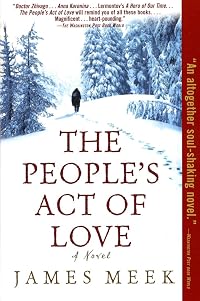
The People's Act of Love
by James Meek
On This Page
Description
In a remote Siberian town torn apart by civil war and inhabited by a small Christian sect, Anna Petrovna, a beautiful photographer, becomes involved in the fate of Samarin, an escapee from Russia's northernmost prison camp.Tags
Recommendations
















Member Recommendations
Snow by Orhan Pamuk
by IamAleem
Member Reviews
The People’s Act of Love takes place in a remote Siberian village called Yasyk in 1919 when the Bolshevik Revolution is consolidating power, driving out the Tsarist Whites. Yasyk is home to an ascetic cult of castrates, a remnant of a regiment of Czechoslovakian soldiers waiting for orders to go back home, and Anna Petrovna with her son. Anna came to Yasyk after learning her husband, a hussar, died in the war. The leader of the Czechs is a sociopathic madman named Captain Matula whose life was saved by Mutz, an outsider among the Czechs as he is Jewish and somewhat of a philosopher at heart.
All the Czechs long to go home, though Mutz suspects Matula does not and is perhaps lying to them about their orders. After all, he’s the lord show more and master of Yasyk and back in Czechoslovakia he would be a small fish in a big pond and perhaps held to account for a massacre of civilians he ordered. It is all coming to a head, though, as the Red Army is approaching.
Into this already tense setting comes Samarin, an escaped political prisoner with a story of a prison called the White Garden in the far north of Siberia more than a thousand miles from anywhere. He claimed he escaped with another prisoner, the Mohican, who took him along as his pig’ whom he had fattened with extra rations so that when the food ran out, he could eat him. He warns people the Mohican is coming, but somehow Samarin is here alive, still uneaten.
To complicate matters, a shaman being held prisoner was murdered and Samarin seemed the obvious suspect but while he was testifying to Matula and the officers, another person was murdered. Not to mention, the body of a soldier with his hand cut off outside the village with a much older, long-dead hand laid on top of it. It would be easier to blame it all on the new arrival, but that is impossible.
The People’s Act of Love has many deep questions about sin, faith, extremism, and morality. The castrates cut off their sexual organs to remove sin and the knowledge of sin, to become angels. But does that act really remove them from them their very human sins? The book opens with Samarin falling for a woman who is eventually charged with conspiracy to commit terrorism. The question is what justifies evil acts? Does political belief justify a bombing? Does survival needs justify treating a human being like livestock, fattening it up to eat later? What if the motive was love? What justifies killing another?
“What looks like an act of evil to a single person is the people’s act of love to its future self,” Samarin says. There are no easy answers in this book.
The People’s Act of Love at Grove Atlantic
James Meek author site
https://tonstantweaderreviews.wordpress.com/2019/06/07/9781841958774/ show less
All the Czechs long to go home, though Mutz suspects Matula does not and is perhaps lying to them about their orders. After all, he’s the lord show more and master of Yasyk and back in Czechoslovakia he would be a small fish in a big pond and perhaps held to account for a massacre of civilians he ordered. It is all coming to a head, though, as the Red Army is approaching.
Into this already tense setting comes Samarin, an escaped political prisoner with a story of a prison called the White Garden in the far north of Siberia more than a thousand miles from anywhere. He claimed he escaped with another prisoner, the Mohican, who took him along as his pig’ whom he had fattened with extra rations so that when the food ran out, he could eat him. He warns people the Mohican is coming, but somehow Samarin is here alive, still uneaten.
To complicate matters, a shaman being held prisoner was murdered and Samarin seemed the obvious suspect but while he was testifying to Matula and the officers, another person was murdered. Not to mention, the body of a soldier with his hand cut off outside the village with a much older, long-dead hand laid on top of it. It would be easier to blame it all on the new arrival, but that is impossible.
The People’s Act of Love has many deep questions about sin, faith, extremism, and morality. The castrates cut off their sexual organs to remove sin and the knowledge of sin, to become angels. But does that act really remove them from them their very human sins? The book opens with Samarin falling for a woman who is eventually charged with conspiracy to commit terrorism. The question is what justifies evil acts? Does political belief justify a bombing? Does survival needs justify treating a human being like livestock, fattening it up to eat later? What if the motive was love? What justifies killing another?
“What looks like an act of evil to a single person is the people’s act of love to its future self,” Samarin says. There are no easy answers in this book.
The People’s Act of Love at Grove Atlantic
James Meek author site
https://tonstantweaderreviews.wordpress.com/2019/06/07/9781841958774/ show less
OK, this was indeed a fantastic book. Meek's intentions of writing a Great Russian Novel, as mentioned by Stewart above, certainly shine through - it has scope, multiple-character plot, ethical quandaries and satire that wouldn't be unworthy of ol' Fyodor D himself - while still modern (and postmodern) enough to make it a novel for today's age.
But the similarities I keep finding aren't as much to writers as to movies; Col mentioned Ravenous, the praising of which I would like to join, but I also found myself thinking of two others:
- Andrei Konchalovsky's Runaway Train - somewhat ironically an American movie made by a Russian, and in a sense the mirror image of Meek's book, tackling some of the same existential questions; that would be show more Samarin (not the Mohican) in Jon Voight's role.
- Werner Herzog's Aguirre - that's Klaus Kinski as Matula, leading his men on a hopeless quest, far beyond what is defensible or even sane. I kept expecting him to call himself the wrath of God, but of course the wrath of God - if indeed there is such a thing here - is much sneakier in Meek's world.
Yet for all its genre nods (it's something of a Wild East novel, isn't it? I'm sure we could find a role for a young Eastwood too) it's also something entirely its own. Meek's language is beautifully descriptive (I guess the fact that I keep seeing it as a movie is a testament to that) and the way he uses his realistic characters (of course, the Czechoslovak raids through Siberia is an actual historical event - and one I've always meant to read more about) to create a very personal drama out of The Big Questions is... again, the unwieldy adjective "Dostoevskyan" springs to mind. Or is it Dostoevskyesque? The book is just self-conscious enough to pull it off, despite - or perhaps thanks to - lines like this:
I don't serve. You know that. I'm a manifestation. Of the present anger and the future love.
How much can we be expected to sacrifice, and for what? How much can we demand that others sacrifice? The Czechoslovaks are, officially, fighting for a homeland they've never even set foot in. The Reds are fighting for a homeland they have barely even begun to imagine. Samarin has gone so far beyond idealism that he's passed into psychosis, and yet keeps going in the same direction. Balashov, the 19th century enlightened soldier, has stepped off the arena and the big industrial train comes down the track too fast to stop, dropping men and horses along the way as humanity eats itself to survive. show less
But the similarities I keep finding aren't as much to writers as to movies; Col mentioned Ravenous, the praising of which I would like to join, but I also found myself thinking of two others:
- Andrei Konchalovsky's Runaway Train - somewhat ironically an American movie made by a Russian, and in a sense the mirror image of Meek's book, tackling some of the same existential questions; that would be show more Samarin (not the Mohican) in Jon Voight's role.
- Werner Herzog's Aguirre - that's Klaus Kinski as Matula, leading his men on a hopeless quest, far beyond what is defensible or even sane. I kept expecting him to call himself the wrath of God, but of course the wrath of God - if indeed there is such a thing here - is much sneakier in Meek's world.
Yet for all its genre nods (it's something of a Wild East novel, isn't it? I'm sure we could find a role for a young Eastwood too) it's also something entirely its own. Meek's language is beautifully descriptive (I guess the fact that I keep seeing it as a movie is a testament to that) and the way he uses his realistic characters (of course, the Czechoslovak raids through Siberia is an actual historical event - and one I've always meant to read more about) to create a very personal drama out of The Big Questions is... again, the unwieldy adjective "Dostoevskyan" springs to mind. Or is it Dostoevskyesque? The book is just self-conscious enough to pull it off, despite - or perhaps thanks to - lines like this:
I don't serve. You know that. I'm a manifestation. Of the present anger and the future love.
How much can we be expected to sacrifice, and for what? How much can we demand that others sacrifice? The Czechoslovaks are, officially, fighting for a homeland they've never even set foot in. The Reds are fighting for a homeland they have barely even begun to imagine. Samarin has gone so far beyond idealism that he's passed into psychosis, and yet keeps going in the same direction. Balashov, the 19th century enlightened soldier, has stepped off the arena and the big industrial train comes down the track too fast to stop, dropping men and horses along the way as humanity eats itself to survive. show less
The People's Act of Love is not a simple tale. It is a curious and fascinating story of people existing and surviving on the edge: the edge of order; the edge of sanity; and the edge of reason. It is in some ways a war story, but not your typical war story. This becomes clear from the very first pages. The cast of characters have purposefully been placed on the periphery of grand events and the periphery of civilisation and culture.
A lot of ground is covered in just 391 pages. The People's Act of Love explores its very human themes of belief, loyalty, betrayal, longing-ness, sacrifice, mission and love through the obscure prisms of bizarre Christian sects, revolution and civil war, mad charismatic would-be despots, tribal shamans, war show more widows, criminals and displaced Czech soldiers who have somehow missed the end of World War I. And all of this plays out amid the desolation of a wintry Siberia in 1919 and an encroaching Bolshevik victory over the Whites. James Meek has written a compelling novel, and a courageous one.
The novel is courageous in the sense that Meek delves into the motivations and consciousnesses of at least two characters whose manner of being is not something accessible to average human experience. Despite this, Meek successfully rents the veils occluding these human oddities. The result is persuasive and forceful, and the essence of these two characters – a religious mystic and a driven political fugitive – ring true within the confines of the story. The novel is courageous too in the sense that Meek willingly dives headfirst into a novelistic genre whose native canon is rich and deep – the 'Great Russian Novel'. This is a risk, for while his novel's setting is in some ways unique and Meek brings an impressive amount of research to bear, he does not have the usual necessary qualification: that is, to actually be a Russian, and, given his story's setting, a Russian who has either lived through revolution, war or political incarceration. But the risk pays off because Meek succeeds in delivering a tale with a psychological and intellectual resonance that lasts beyond the closing of its pages, and he does so without heavy riffing on the well-thumbed material of the Russian masters. Meek defiantly brings his own voice and his own approach.
This is not to imply the novel says what it says in an entirely new way, and without recourse to any recognisable motifs whatsoever. If it did avoid all relevants tropes and themes then the story wouldn't work. But it does work because of the way Meek skillfully inserts his unique vision into an established literary landscape. It _is_ a war story, and it is set in a recognisable Russian milieu. Within its pages sit many of the familiar themes found in the best novels about people persisting through times of war and occupation, and the book could not do its job if they weren't – this is what we have come to read! – but they are applied to startling effect.
That said, the story is not without its weaknesses. Particularly, there is an element to its denouement which disappointed me: One of the central characters was to make an important decision; it was tragically though not life-threateningly obvious what it would be, yet for this character to do so would have been understandable and not inconsistent with her personality. Instead, Meek inexplicably introduces an external element to account for a change of mind. This insertion is a glaringly gratuitous flourish which damages the momentum of the story at this point and debases the character in question. It may be that Meek wants readers to lower our estimation of and reduce our sympathy for this character, but it is difficult to see to what end. To me it is sabotage. Especially when instead the character could have exited with her integrity and honour somewhat intact. But while that particular intervention was clumsy and amateurish, it is also thankfully exclusive.
None of the story's flaws are glaring or sufficient enough to reduce Meek's achievement, including the anomaly discussed above. How did he manage this? Well, partly because The People's Act of Love is not a 'Great Russian Novel' and Meek didn't set out to write one. The book he created is something related to that venerable genus, but perverted and strange, and beautiful because of this. It is not a story about Russia or Russian history nor Russian peoples. It is a story about people, and the things we do for or in spite of others, and for or in spite of ourselves. Under Meek's expert hand the convolutions of his plot are a kind of laboratory within which ideas and relationships are arranged, then plucked and strummed, and stretched.
Meek does not give us a fictionalised history of the Russian civil war. Instead, the civil war remains mostly in the background as a felt, pervasive, smothering force. Chiefly, The People's Act of Love is about relationships: relationships between individuals; between people and states; between soldiers and commanders; between men and women; between men and women and God; between existential individuality and the impersonal inexorable weight of history; and between conscience and ideology, be it religious or political.
Not only is Meek's prose easy to read, but it is also capable of displaying a remarkable clarity – moments of pure insight – without burdening the text or appearing portentous. At numerous times while reading I had to stop and marvel at ideas, feelings or images that were so exquisitely captured that I needed to dwell on the words or turn the idea over in my mind a few times. The People's Act of Love is not a difficult read but it is a rewarding one, if you want it to be. Nothing is forced upon the reader and the level of immersion is purely voluntary.
As for the evocative title, the linchpin character who is the catalyst of the events that unfold in the town of Yazyk at one point discusses a theoretical man he terms ‘destruction’: "He is the will of the people. He's the hundred thousand curses they utter every day against their enslavement. To hold such a man to the same standards as ordinary men would be strange, like putting wolves on trial for killing elk, or trying to shoot the wind... What looks like an act of evil to a single person is the people's act of love to its future itself. He's the storm the people summoned, against which not all good people find shelter in time.” When history is a force and not an accumulation of individual actions, or at least people willingly accept it as such, there is no limit to the number of individuals who can be treated this way.
Indeed, it is the key question of 20th century history – can an act of evil to a single person ever legitimately be the people's act of love to its future itself? This is the ultimate utilitarian argument because it goes beyond traditional humanistic utilitarianism by abandoning humanism altogether – it is utilitarianism of the starkest sort, wedded to the triumph of an idea over humanity. It is the ultimate expression of the power of belief, whether it be self-belief or belief in a dogma or political ideology. In this kind of mental space there is no room for doubt or opposition.
The experience of reading The People's Act of Love will be further enhanced for those familiar with the dissolution of the multi-ethnic empires which accompanied the First World War and the political struggles surrounding the civil war which accompanied the Russian Revolution. And unless you are particularly well-versed, you will probably learn something about the obscure episodes and groups that contextualise this story – drawn from fact, though not necessarily as portrayed here – that barely usually even rate as footnotes in the conventional histories. For those without this background the story no doubt will seem steeped at times in remarkable mysteries, but this will in no way detract from its enjoyment, and may even enhance it.
The People's Act of Love is a challenging and original exposition of humanity under duress. This novel does what all good novels does – it explores the human condition in such a way that once finished, you feel you have gained a sliver more insight into what it is to be a moral being, and may even have enriched your inner life through the consideration of complex, unnameable things. show less
A lot of ground is covered in just 391 pages. The People's Act of Love explores its very human themes of belief, loyalty, betrayal, longing-ness, sacrifice, mission and love through the obscure prisms of bizarre Christian sects, revolution and civil war, mad charismatic would-be despots, tribal shamans, war show more widows, criminals and displaced Czech soldiers who have somehow missed the end of World War I. And all of this plays out amid the desolation of a wintry Siberia in 1919 and an encroaching Bolshevik victory over the Whites. James Meek has written a compelling novel, and a courageous one.
The novel is courageous in the sense that Meek delves into the motivations and consciousnesses of at least two characters whose manner of being is not something accessible to average human experience. Despite this, Meek successfully rents the veils occluding these human oddities. The result is persuasive and forceful, and the essence of these two characters – a religious mystic and a driven political fugitive – ring true within the confines of the story. The novel is courageous too in the sense that Meek willingly dives headfirst into a novelistic genre whose native canon is rich and deep – the 'Great Russian Novel'. This is a risk, for while his novel's setting is in some ways unique and Meek brings an impressive amount of research to bear, he does not have the usual necessary qualification: that is, to actually be a Russian, and, given his story's setting, a Russian who has either lived through revolution, war or political incarceration. But the risk pays off because Meek succeeds in delivering a tale with a psychological and intellectual resonance that lasts beyond the closing of its pages, and he does so without heavy riffing on the well-thumbed material of the Russian masters. Meek defiantly brings his own voice and his own approach.
This is not to imply the novel says what it says in an entirely new way, and without recourse to any recognisable motifs whatsoever. If it did avoid all relevants tropes and themes then the story wouldn't work. But it does work because of the way Meek skillfully inserts his unique vision into an established literary landscape. It _is_ a war story, and it is set in a recognisable Russian milieu. Within its pages sit many of the familiar themes found in the best novels about people persisting through times of war and occupation, and the book could not do its job if they weren't – this is what we have come to read! – but they are applied to startling effect.
That said, the story is not without its weaknesses. Particularly, there is an element to its denouement which disappointed me: One of the central characters was to make an important decision; it was tragically though not life-threateningly obvious what it would be, yet for this character to do so would have been understandable and not inconsistent with her personality. Instead, Meek inexplicably introduces an external element to account for a change of mind. This insertion is a glaringly gratuitous flourish which damages the momentum of the story at this point and debases the character in question. It may be that Meek wants readers to lower our estimation of and reduce our sympathy for this character, but it is difficult to see to what end. To me it is sabotage. Especially when instead the character could have exited with her integrity and honour somewhat intact. But while that particular intervention was clumsy and amateurish, it is also thankfully exclusive.
None of the story's flaws are glaring or sufficient enough to reduce Meek's achievement, including the anomaly discussed above. How did he manage this? Well, partly because The People's Act of Love is not a 'Great Russian Novel' and Meek didn't set out to write one. The book he created is something related to that venerable genus, but perverted and strange, and beautiful because of this. It is not a story about Russia or Russian history nor Russian peoples. It is a story about people, and the things we do for or in spite of others, and for or in spite of ourselves. Under Meek's expert hand the convolutions of his plot are a kind of laboratory within which ideas and relationships are arranged, then plucked and strummed, and stretched.
Meek does not give us a fictionalised history of the Russian civil war. Instead, the civil war remains mostly in the background as a felt, pervasive, smothering force. Chiefly, The People's Act of Love is about relationships: relationships between individuals; between people and states; between soldiers and commanders; between men and women; between men and women and God; between existential individuality and the impersonal inexorable weight of history; and between conscience and ideology, be it religious or political.
Not only is Meek's prose easy to read, but it is also capable of displaying a remarkable clarity – moments of pure insight – without burdening the text or appearing portentous. At numerous times while reading I had to stop and marvel at ideas, feelings or images that were so exquisitely captured that I needed to dwell on the words or turn the idea over in my mind a few times. The People's Act of Love is not a difficult read but it is a rewarding one, if you want it to be. Nothing is forced upon the reader and the level of immersion is purely voluntary.
As for the evocative title, the linchpin character who is the catalyst of the events that unfold in the town of Yazyk at one point discusses a theoretical man he terms ‘destruction’: "He is the will of the people. He's the hundred thousand curses they utter every day against their enslavement. To hold such a man to the same standards as ordinary men would be strange, like putting wolves on trial for killing elk, or trying to shoot the wind... What looks like an act of evil to a single person is the people's act of love to its future itself. He's the storm the people summoned, against which not all good people find shelter in time.” When history is a force and not an accumulation of individual actions, or at least people willingly accept it as such, there is no limit to the number of individuals who can be treated this way.
Indeed, it is the key question of 20th century history – can an act of evil to a single person ever legitimately be the people's act of love to its future itself? This is the ultimate utilitarian argument because it goes beyond traditional humanistic utilitarianism by abandoning humanism altogether – it is utilitarianism of the starkest sort, wedded to the triumph of an idea over humanity. It is the ultimate expression of the power of belief, whether it be self-belief or belief in a dogma or political ideology. In this kind of mental space there is no room for doubt or opposition.
The experience of reading The People's Act of Love will be further enhanced for those familiar with the dissolution of the multi-ethnic empires which accompanied the First World War and the political struggles surrounding the civil war which accompanied the Russian Revolution. And unless you are particularly well-versed, you will probably learn something about the obscure episodes and groups that contextualise this story – drawn from fact, though not necessarily as portrayed here – that barely usually even rate as footnotes in the conventional histories. For those without this background the story no doubt will seem steeped at times in remarkable mysteries, but this will in no way detract from its enjoyment, and may even enhance it.
The People's Act of Love is a challenging and original exposition of humanity under duress. This novel does what all good novels does – it explores the human condition in such a way that once finished, you feel you have gained a sliver more insight into what it is to be a moral being, and may even have enriched your inner life through the consideration of complex, unnameable things. show less
A strange and fascinating story about love in many different forms - religious fanaticism, romantic love, sexual love, parental love. It grips like a thriller and builds to a nail-biting climax. Involves a bunch of strange stuff (cannibalism, castration cults) that actually happened during this period in Russian history. Unusual, compelling, thought-provoking - one of my favourite books of recent years.
The People's Act of Love is a breathtaking literary achievement, and was the TurboBookSnob's pick for the winner of the Booker Prize in 2005. Set in Siberia in 1919, it can best be described with 4 “c's” – Communism, castration, Czech soldiers, and cannibalism.
The small town of Yazyk is populated by two diverse groups – a strange Christian sect led by a man named Balashov, and a group of Czech soldiers who have been marooned there and are struggling to hold onto their control of the small Siberian village.
Samarin, a young former student who has escaped from a Russian prison, wanders into Yazyk, weak and broken, and on the run from a mysterious man called the Mohican, who Samarin insists is tracking him with murderous show more intentions. Soon after Samarin's arrival in town, the local shaman is murdered, and Samarin becomes the likely suspect. The beautiful Anna Petrovna falls in love with the enigmatic Samarin, and, believing him to be innocent, offers herself as bail in exchange for his freedom.
To reveal any more of this exquisitely plotted story would be a disservice to the novel's potential readers. This is a grand novel, worthy of the best in Russian literature. The characters are expertly developed, the plot is daring and horrifying. Meek's descriptions of Siberia are coldly gorgeous, and the originality of his story beckons the reader deeper and deeper into the frozen tundra of the tale. show less
The small town of Yazyk is populated by two diverse groups – a strange Christian sect led by a man named Balashov, and a group of Czech soldiers who have been marooned there and are struggling to hold onto their control of the small Siberian village.
Samarin, a young former student who has escaped from a Russian prison, wanders into Yazyk, weak and broken, and on the run from a mysterious man called the Mohican, who Samarin insists is tracking him with murderous show more intentions. Soon after Samarin's arrival in town, the local shaman is murdered, and Samarin becomes the likely suspect. The beautiful Anna Petrovna falls in love with the enigmatic Samarin, and, believing him to be innocent, offers herself as bail in exchange for his freedom.
To reveal any more of this exquisitely plotted story would be a disservice to the novel's potential readers. This is a grand novel, worthy of the best in Russian literature. The characters are expertly developed, the plot is daring and horrifying. Meek's descriptions of Siberia are coldly gorgeous, and the originality of his story beckons the reader deeper and deeper into the frozen tundra of the tale. show less
"The People's Act of Love" by James Meek is a thrilling and surprising page-turner, situated in Siberia in 1919. Since the plot of the story is compact and full of surprises, I will not spoil the story by describing it, but instead I will give an impression of the book's atmosphere.
Through the eyes of several people present in a small town in the wilderness of Siberia, we see all the chaos and cynicism as well as dreams and aspirations of the time reflected. The characters, among which we find a mysterious cannibal, a Cavalry officer who becomes a member of a bizarre sect, a Jewish officer in the Czechoslovak Legion, and a woman with a gift for photography, may not be immediately likable, but they are certain to make a strong impression show more on the reader. Meek weaves the story of the meeting and eventual clash of all these characters together very well, making excellent use of evocative flashbacks, letters and monologues to create narrative tension, while maintaining at the same time a high pace of action.
The storyline is generally violent and cynical, as fits those times, and the brutal backdrop of Siberia in winter during times of shortage only serves to heighten the tension. After the various characters find themselves in Siberia, the Czechslovak Legion's presence in the area, an interesting yet historically real adventure tale, becomes the pivot around which all the events unfold. The bitterness of the cold as well as the people and their ideals portrays this crossing in Russia's history very well, and Meek has done a good job keeping the storyline actually exciting with constant surprises and plot twists. Although some of the praise on the cover must surely be taken as hyperbole, this is certainly an intriguing and riveting book, and well worth picking up to read on a lonely winter night.
NB: My review applies to the Dutch translation of this book only, as I have not read the English original. I see no reason to assume there are material differences between the two though. show less
Through the eyes of several people present in a small town in the wilderness of Siberia, we see all the chaos and cynicism as well as dreams and aspirations of the time reflected. The characters, among which we find a mysterious cannibal, a Cavalry officer who becomes a member of a bizarre sect, a Jewish officer in the Czechoslovak Legion, and a woman with a gift for photography, may not be immediately likable, but they are certain to make a strong impression show more on the reader. Meek weaves the story of the meeting and eventual clash of all these characters together very well, making excellent use of evocative flashbacks, letters and monologues to create narrative tension, while maintaining at the same time a high pace of action.
The storyline is generally violent and cynical, as fits those times, and the brutal backdrop of Siberia in winter during times of shortage only serves to heighten the tension. After the various characters find themselves in Siberia, the Czechslovak Legion's presence in the area, an interesting yet historically real adventure tale, becomes the pivot around which all the events unfold. The bitterness of the cold as well as the people and their ideals portrays this crossing in Russia's history very well, and Meek has done a good job keeping the storyline actually exciting with constant surprises and plot twists. Although some of the praise on the cover must surely be taken as hyperbole, this is certainly an intriguing and riveting book, and well worth picking up to read on a lonely winter night.
NB: My review applies to the Dutch translation of this book only, as I have not read the English original. I see no reason to assume there are material differences between the two though. show less
It was interesting reading a "Russian" novel not written by a Russian. It was so much easier. It'd about an outer Siberian town at the end of the Russian Revolution. Soldiers, outlaws, and a mysterious religious sect mix it up. Meek does a great job of letting each of the many characters have their story told in turn before he really starts to weave all the stories together. I was not expecting some of the more gruesome and troubling scenes. That didn't bother me, but some people would probably stop reading. I wish I had a better grounding in the geo-political details of the era prior to starting this book but it wasn't totally necessary-- just would've been nice. A good read, interesting period and setting. Great character development.
Members
- Recently Added By
Lists

Booker Prize
491 works; 62 members

Man Booker Prize Longlist 2005
17 works; 3 members

BBC Radio 4 Bookclub
340 works; 13 members

O, those Russians (as Boney M sang)
16 works; 1 member

Favourite Books
1,817 works; 310 members

Top Five Books of 2012
55 works; 10 members
Author Information

12+ Works 2,207 Members
Awards and Honors
Series
Belongs to Publisher Series
Common Knowledge
- Canonical title
- The People's Act of Love
- Original title
- The People's Act of Love
- Original publication date
- 2005
- People/Characters
- Kyrill Ivanovich Samarin; Uncle Pavel; Yekaterina "Kata" Mikhailovna Orlova; Orlov
- Important places
- Siberia, Russia
- Important events
- Russian Revolution (1917)
- Epigraph
- Busy remaking the world, man forgot to remake himself.
Andrei Platonov, Nursery Of The New Man - First words
- When Kyrill Ivanovich Samarin was twelve, years before he would catch, among the scent of textbooks and cologne in a girl's satchel, the distinct odour of dynamite, he demanded that his uncle let him change his second name.
- Last words
- (Click to show. Warning: May contain spoilers.)With his talismans singing in the astral wind, his three eyes aglow like forges, a drum in one hand, a bottle of moonshine in the other and the smoky froth of chewed mushrooms on his gums, the spirit of Balashov's horse would carry the shaman where he wanted to go, by his will and against theirs, to the Upper World, to laugh in the face of the gods.
- Blurbers
- de Bernieres, Louis; Welsh, Irvine; Pullman, Philip; Beevor, Antony; Massie, Allan; Harris, John (show all 8); Faber, Michel; Dunmore, Helen
- Original language
- English
Classifications
Statistics
- Members
- 1,296
- Popularity
- 18,705
- Reviews
- 40
- Rating
- (3.75)
- Languages
- 12 — Danish, Dutch, English, French, German, Italian, Norwegian (Bokmål), Polish, Portuguese, Russian, Spanish, Swedish
- Media
- Paper, Audiobook, Ebook
- ISBNs
- 40
- ASINs
- 9