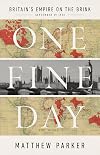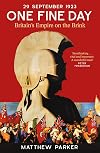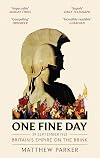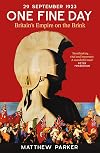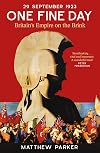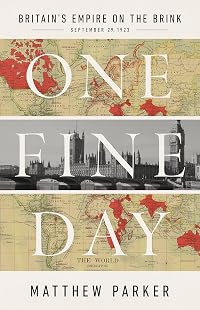
One Fine Day: Britain's Empire on the Brink
by Matthew Parker
On This Page
Description
September 29, 1923. Once the Palestine Mandate officially takes effect, the British Empire - now covering a quarter of the world's land and boasting a population of 460 million - is the largest the world has ever seen. But it is also an empire in rapid transition. Nationalist and Pan-African movements are gaining momentum throughout West Africa, thanks as much to Marcus Garvey as to the sustained efforts of local activists and politicians. On far-flung Ocean Island in the Pacific, highly show more profitable phosphate extraction threatens to render the land uninhabitable for its native population. Colonial officials are torn between their integrity and their careers. And in India, Jawaharlal Nehru and fellow nationalists wonder despairingly about the future of the independence movement as Gandhi languishes in prison. Moving from London to Kuala Lumpur, Australia to the West Indies, One Fine Day is a breathtaking and unflinching tour of the British Empire at its pinnacle. Here, the Empire is at its biggest; but it is on a precipice, beset with debts and doubts as liberation movements emerge to undo the colonial era, and see the sun set on the Empire. show lessTags
Recommendations








Member Reviews
On September 29, 1923, the League of Nations’ Mandate of Palestine became law. The Mandate formally transferred the regions of Palestine and Transjordan to the UK from the Ottoman Empire, which had ceded them at the end of World War I. On that date the British Empire reached its maximum extent. The Empire covered a quarter of the world’s landmass at 14 million square miles of land. It was home to four hundred and sixty million people - a fifth of the world’s population at the time - all subjects of His Majesty King George V.
British historian Matthew Parker has built his book One Fine Day around the state of affairs inside the Empire on that day. While the British had achieved the largest Empire ever known, there were cracks show more apparent in 1923 that would lead to its eventual dissolution.
The book is a collection of stories about British colonies. Ocean Island in the Pacific, India, Malaya, Burma, Kenya and West Africa are the main focus. As the author’s sights shift to each colony, he provides the history and context leading up to the events of September 1923. The result is a rich and in-depth picture of the Empire at its height, with an amazingly wide range of characters.
The whole point of the Empire was for the colonies to provide resources to (in other words increase the wealth of) the Mother Country. The exploitation of the colonies’ resources and people was baldly excessive. Much of the picture that Parker paints is not pretty. There are some dark, tragic stories covered in this book, like the massacre in Amritsar, India in 1919.
Ocean Island ends up uninhabitable due to the removal of the island’s phosphate stores. Hundreds and thousands of tons of the island itself - the very ground under the natives’ feet - were removed to provide fertilizer for the farm fields of Australia.
The chapters on Kenya casts a dark shadow as well, with systematic exploitation (slavery in all but name) of the local population to work the fields of the Europeans who had taken their land.
Of course, the picture varied from place to place. The Dominions were self-governing, largely white colonies - places like Canada, Australia and New Zealand. In those places in 1923 the people were mostly happy with their lot within the Empire.
In other places where the dominant races were not white, and where the hand of Empire was keeping the local populace working on behalf of their white rulers, there was much discontent. The end of World War I only exacerbated tensions. Returning veterans of the native populations were treated poorly in contrast with their white counterparts.
The social impacts of the end of the Great War were one factor weighing against Empire, but there were others. Economically Britain had not kept up. Built on railroads, steel, coal and textiles the Empire had failed to modernize and could not compete on things like oil, refrigerators, radios and automobiles. In Malaya, the Empire’s richest colony, Parker points out that in 1923 only a sixteenth of the colony’s international purchases came from Britain.
The whole model of Empire was now in question. If the Empire wasn’t going to make the UK rich, then what was it good for? This was the question hanging in the air on September 29, 1923.
RATING: Four Stars ⭐⭐⭐⭐
Rating Comment: One Fine Day circles to globe 100 years ago at the height of the British Empire. It highlights the challenges and contradictions that will ultimately lead to the Empire’s demise. A hefty, well researched and enlightening book.
NOTE: I read an advanced review copy courtesy of NetGalley and the publisher PublicAffairs. The book will be generally available next Tuesday, September 26, 2023. show less
British historian Matthew Parker has built his book One Fine Day around the state of affairs inside the Empire on that day. While the British had achieved the largest Empire ever known, there were cracks show more apparent in 1923 that would lead to its eventual dissolution.
The book is a collection of stories about British colonies. Ocean Island in the Pacific, India, Malaya, Burma, Kenya and West Africa are the main focus. As the author’s sights shift to each colony, he provides the history and context leading up to the events of September 1923. The result is a rich and in-depth picture of the Empire at its height, with an amazingly wide range of characters.
The whole point of the Empire was for the colonies to provide resources to (in other words increase the wealth of) the Mother Country. The exploitation of the colonies’ resources and people was baldly excessive. Much of the picture that Parker paints is not pretty. There are some dark, tragic stories covered in this book, like the massacre in Amritsar, India in 1919.
Ocean Island ends up uninhabitable due to the removal of the island’s phosphate stores. Hundreds and thousands of tons of the island itself - the very ground under the natives’ feet - were removed to provide fertilizer for the farm fields of Australia.
The chapters on Kenya casts a dark shadow as well, with systematic exploitation (slavery in all but name) of the local population to work the fields of the Europeans who had taken their land.
Of course, the picture varied from place to place. The Dominions were self-governing, largely white colonies - places like Canada, Australia and New Zealand. In those places in 1923 the people were mostly happy with their lot within the Empire.
In other places where the dominant races were not white, and where the hand of Empire was keeping the local populace working on behalf of their white rulers, there was much discontent. The end of World War I only exacerbated tensions. Returning veterans of the native populations were treated poorly in contrast with their white counterparts.
The social impacts of the end of the Great War were one factor weighing against Empire, but there were others. Economically Britain had not kept up. Built on railroads, steel, coal and textiles the Empire had failed to modernize and could not compete on things like oil, refrigerators, radios and automobiles. In Malaya, the Empire’s richest colony, Parker points out that in 1923 only a sixteenth of the colony’s international purchases came from Britain.
The whole model of Empire was now in question. If the Empire wasn’t going to make the UK rich, then what was it good for? This was the question hanging in the air on September 29, 1923.
RATING: Four Stars ⭐⭐⭐⭐
Rating Comment: One Fine Day circles to globe 100 years ago at the height of the British Empire. It highlights the challenges and contradictions that will ultimately lead to the Empire’s demise. A hefty, well researched and enlightening book.
NOTE: I read an advanced review copy courtesy of NetGalley and the publisher PublicAffairs. The book will be generally available next Tuesday, September 26, 2023. show less
This was chosen by Pratinav Anil, Lecturer at St Edmund Hall, Oxford and author of Another India: The Making of the World’s Largest Muslim Minority, 1947-77 (Hurst, 2023), as one of History Today’s Books of the Year 2023.
Find out why at HistoryToday.com.
Find out why at HistoryToday.com.
Kingston Library - worth rereading
Ratings
Members
- Recently Added By
Published Reviews
ThingScore 100
Part of what makes this book such a fascinating read is that we all know what’s about to come, but since Parker sticks to his premise, we remain in a sense of suspense throughout.
added by Nevov
Lists

Wishlist
99 works; 1 member
Author Information
7 Works 1,206 Members
Matthew Parker is the author of three previous non-fiction books, Monte Cassino: The Hardest-Fought Battle of World War II; the Los Angeles Times bestseller Panama Fever, and The Sugar Barons, which was an Economist Book of the Year. He lives in England.
Awards and Honors
Distinctions
Observer Book of the Week (2023-09-24)
Classifications
- Genres
- History, Nonfiction, General Nonfiction
- DDC/MDS
- 909.0971241 — History & geography History World history Other Geographic Classifications Socioeconomic Regions By Political Orientation British Empire
- LCC
- DA16 .P3174 — History of Europe, Asia, Africa and Oceania Great Britain History of Great Britain British Empire. Commonwealth of Nations. The
- BISAC
Statistics
- Members
- 93
- Popularity
- 345,764
- Reviews
- 3
- Rating
- (3.67)
- Languages
- English
- Media
- Paper, Audiobook, Ebook
- ISBNs
- 8
- ASINs
- 4