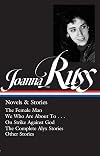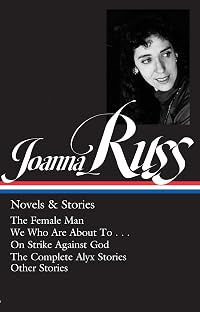
Novels & Stories: The Female Man / We Who Are About To ... / On Strike Against God / The Complete Alyx Stories / Other Stories
by Joanna Russ
On This Page
Description
"This Library of America volume gathers the essential novels and stories of Joanna Russ, an incandescent stylist, unabashedly feminist New Wave science fiction visionary, and, in Samuel R. Delany's words, 'one of the finest--and most necessary--writers of American fiction.' Here is her provocative, multidimensional classic The Female Man, in which four women's alternate worlds collide; We Who Are About To..., a dark reimagining of planetary colonization; and her joyous, long out-of-print show more coming out novel, On Strike Against God. For the first time, all of Russ's 'Alyx' stories are collected, showcasing the unforgettable, time-traveling adventures of her hero-assassin from Ourdh. Rounding out the volume are the prize-winning tales 'When It Changed' and 'Souls,' and a newly researched chronology of Russ's extraordinary life and career."--Dust jacket. show lessTags
Recommendations





























Member Reviews
[I need to preface this review by saying that it violates my rule not to review any book I haven't read from beginning to end. I've read only "The Alyx Stories" portion, which includes all of what has been published as a standalone book, plus more; but I want to review the Library of America volume, instead of one of the variant publications of the Alyx cycle, because my comments are more about Russ, especially as she is presented in this volume, than about the Alyx stories considered as stories.]
Joanna Russ was a fierce and engaging writer, a great theoretician of story telling, and of course, an important feminist artist — the last of which, although mostly incidental to my perspective in this review, was in no way incidental to her show more or any of her mature work. In reintroducing myself to her, I read the Alyx stories, all of the biographical information in this volume, and many of the notes: not only the notes to the stories, but also to the other books, which I dipped into here and there as my interest was piqued.
As a young man, I was a devotee of the work of Russ's friend and colleague Samuel R. Delany. I read Delany's Dhalgren at age 15 and read it twice more in ensuing years, while keeping up with Delany's other work until his Neverÿona series petered out in the late '80s. (The non-Neverÿona novel Stars in my Pocket Like Grains of Sand, the first half of what would have been a monumental diptych, was the last Delany I read.) I studied the way Delany wrote and it had immense influence on how I read, how technique and especially the deliberate withholding of certain information can more powerfully engage the reader. What I didn't realize until I read Russ's work was how powerfully she apparently influenced Delany. It surprises me not to be aware of anyone else who's noticed, which is one reason I'm making the point here.
There is a particular scene in Russ's Picnic on Paradise (a 1968 novella that Delany repeatedly championed, as I recall) in which a character falls into a pit, which has major emotional repercussions for the other characters following an attempted rescue. And in Dhalgren (1975), a major set piece, about 20 pages in all if I recall correctly, a character falls into an elevator shaft, and likewise has to be retrieved. For me, it's the most memorable extended scene in that book, and having read Russ, it's impossible to suppose that Delany was not directly inspired by the similar scene in Paradise.
This was interesting to notice, considering how much I've thought about Delany's elevator shaft scene in my life, but it was more interesting to read Russ's work with a couple of generations' worth of reading experience behind me. The Alyx stories (for example) work great as entertainment: they can be read quickly, even carelessly, and still be enjoyed in the same way you enjoy a more straightforwardly told tale by Isaac Asimov or George R.R. Martin. But the way they are told is actually more complex, and clever. Most obviously (to me), emotion is rarely portrayed directly. Instead, it's implied in dialog which could support multiple emotional interpretations, as in reading a play. It's also portrayed by means of action, but usually only cinematically, in broad strokes. Dashiell Hammett writes this way, but in his work emotion is secondary to the cool, foggy vibe of noir. In Russ's stories, emotion is everywhere and arguably crucial to the reader's engagement: yet the reader must supply that emotion herself. She herself must figure out who this confusing, contradictory, wry, tough, defensive, ironic, vulnerable, frightening character Alyx is, and what Alyx might be actually feeling at any point in time.
She must also do this while figuring out the physical setting, as well as the natures of the characters and their relationships, from important but almost offhandedly delivered clues, in dialog and in very spare descriptive passages. This is a very adult way of writing, and very respectful of the reader's intelligence. It's astonishing that Russ used it successfully in work that was published in pulp magazines and drugstore paperbacks. show less
Joanna Russ was a fierce and engaging writer, a great theoretician of story telling, and of course, an important feminist artist — the last of which, although mostly incidental to my perspective in this review, was in no way incidental to her show more or any of her mature work. In reintroducing myself to her, I read the Alyx stories, all of the biographical information in this volume, and many of the notes: not only the notes to the stories, but also to the other books, which I dipped into here and there as my interest was piqued.
As a young man, I was a devotee of the work of Russ's friend and colleague Samuel R. Delany. I read Delany's Dhalgren at age 15 and read it twice more in ensuing years, while keeping up with Delany's other work until his Neverÿona series petered out in the late '80s. (The non-Neverÿona novel Stars in my Pocket Like Grains of Sand, the first half of what would have been a monumental diptych, was the last Delany I read.) I studied the way Delany wrote and it had immense influence on how I read, how technique and especially the deliberate withholding of certain information can more powerfully engage the reader. What I didn't realize until I read Russ's work was how powerfully she apparently influenced Delany. It surprises me not to be aware of anyone else who's noticed, which is one reason I'm making the point here.
There is a particular scene in Russ's Picnic on Paradise (a 1968 novella that Delany repeatedly championed, as I recall) in which a character falls into a pit, which has major emotional repercussions for the other characters following an attempted rescue. And in Dhalgren (1975), a major set piece, about 20 pages in all if I recall correctly, a character falls into an elevator shaft, and likewise has to be retrieved. For me, it's the most memorable extended scene in that book, and having read Russ, it's impossible to suppose that Delany was not directly inspired by the similar scene in Paradise.
This was interesting to notice, considering how much I've thought about Delany's elevator shaft scene in my life, but it was more interesting to read Russ's work with a couple of generations' worth of reading experience behind me. The Alyx stories (for example) work great as entertainment: they can be read quickly, even carelessly, and still be enjoyed in the same way you enjoy a more straightforwardly told tale by Isaac Asimov or George R.R. Martin. But the way they are told is actually more complex, and clever. Most obviously (to me), emotion is rarely portrayed directly. Instead, it's implied in dialog which could support multiple emotional interpretations, as in reading a play. It's also portrayed by means of action, but usually only cinematically, in broad strokes. Dashiell Hammett writes this way, but in his work emotion is secondary to the cool, foggy vibe of noir. In Russ's stories, emotion is everywhere and arguably crucial to the reader's engagement: yet the reader must supply that emotion herself. She herself must figure out who this confusing, contradictory, wry, tough, defensive, ironic, vulnerable, frightening character Alyx is, and what Alyx might be actually feeling at any point in time.
She must also do this while figuring out the physical setting, as well as the natures of the characters and their relationships, from important but almost offhandedly delivered clues, in dialog and in very spare descriptive passages. This is a very adult way of writing, and very respectful of the reader's intelligence. It's astonishing that Russ used it successfully in work that was published in pulp magazines and drugstore paperbacks. show less
Joanna Russ: Novels & Stories is an excellent collection of some of Russ's best fiction. You've probably heard the name if you're a science fiction reader but you may not have read a lot of her work. This is a great place to start.
I was pleased to see that A Game of Vlet was included with the other Alyx stories, the copy of The Adventures of Alyx that I have doesn't include it. Admittedly, I don't know if later editions include it.
Russ wasn't just a great science fiction writer, she pioneered feminist science fiction criticism, and her critical works are every bit as interesting as her fiction.
I would highly recommend this to any fans of science fiction, especially speculative science fiction. Whether this serves as an introduction or show more a handy volume because you might no longer have some of her work, it will be an excellent addition to your library.
Reviewed from a copy made available by the publisher via NetGalley. show less
I was pleased to see that A Game of Vlet was included with the other Alyx stories, the copy of The Adventures of Alyx that I have doesn't include it. Admittedly, I don't know if later editions include it.
Russ wasn't just a great science fiction writer, she pioneered feminist science fiction criticism, and her critical works are every bit as interesting as her fiction.
I would highly recommend this to any fans of science fiction, especially speculative science fiction. Whether this serves as an introduction or show more a handy volume because you might no longer have some of her work, it will be an excellent addition to your library.
Reviewed from a copy made available by the publisher via NetGalley. show less
Ratings
Members
- Recently Added By
Author Information

94+ Works 7,647 Members
Joanna Russ was born in New York City on February 22, 1937. She received a degree in English from Cornell University in 1957 and a MFA in playwriting from the Yale Drama School in 1960. She taught at various colleges and universities during her lifetime including a long stint at the University of Washington in Seattle. She was a critic and science show more fiction writer best known for books of criticism such as The Female Man (1975) and How to Suppress Women's Writing (1984) as well as the novel And Chaos Died (1970). She died on April 29, 2011 at the age of 74. (Bowker Author Biography) show less
All Editions
Awards and Honors
Distinctions
Series
Belongs to Publisher Series
Library of America (373)
Work Relationships
Contains
Common Knowledge
- Canonical title
- Novels & Stories: The Female Man / We Who Are About To ... / On Strike Against God / The Complete Alyx Stories / Other Stories
Classifications
Statistics
- Members
- 90
- Popularity
- 355,414
- Reviews
- 2
- Rating
- (4.38)
- Languages
- English
- Media
- Paper, Ebook
- ISBNs
- 1